The latest on the SeaTac Prop 1 $15/hr minimum wage initiative that was passed last November (the campaign for which was run out of the top floor of the building where I work) appeared in a story, "Seattle Port commissioners listen to SeaTac wage activists," written last week for the Puget Sound Business Journal by Ana Sofia Knauf. Here are the first two paragraphs:
SeaTac wage activists attended a Port of Seattle Commission meeting on Tuesday [January 7] to appeal to commissioners to get a $15-per-hour minimum wage reinstated at Seattle-Tacoma International Airport.
On Dec. 27, King County Superior Court Judge Andrea Darvas struck down part of a city of SeaTac ordinance that would have increased the minimum wage from $9.32 per hour to $15 per hour for some employees at the airport, which is run by the port, as well as others outside the airport. Her decision limited the minimum-wage increase to some hospitality workers in the city of SeaTac. Wage activists have appealed her decision to the state Supreme Court.
Service Employees International Union distributed video of a KING 5 TV story on the port commission meeting.
But last week I also got the worker perspective on the implementation of Prop 1 from a young Latina acquaintance who rides the
bus I take from the light rail stop in SeaTac. She works at one of the hotels located next to the building where I work.
According to my friend, her
employer, in order to get out of paying
the $15/hr minimum wage passed by initiative, is laying off staff to get
below 30 employees, the trigger for the $15/hr wage. My friend will earn $15/hr this month, but next month she will go back to $9.32/hr, except that the
number of rooms she cleans will go up to 19 from 17.
"Very bad," she said.
Her English isn't very good, and my Spanish is unspeakable. So I had
difficulty understanding what she was trying to say, but I think that was
what she was getting at. I had her repeat it twice.
Now she has more work for less pay. Isn't capitalism beautiful?
A little bit behind the wave of people who immersed themselves in Breaking Bad in anticipation of the last year's final season, I am now watching the last few episodes of Season 5, Pt. 2. And what struck me is how consistently gritty, harsh, violent and dark the last season is. Is there a mass population out there for this kind of toxic, harrowing entertainment? Yes. And why is that? Because it accurately reflects the doomed world in which we live.
Last Friday's paper is a perfect illustration of the bizarre incongruities the type of which Breaking Bad dramatizes. On the one hand, you have a story by Mark Landler outlining the possible resumption of U.S. non-lethal aid to the rebels in Syria. The aid was suspended after jihadis took control of Free Syrian Army warehouses where the materiel was stored. Landler's piece is full of quotes from anonymous senior administration officials saying that with a resumption of aid there will be no way to prevent it from falling into the hands of the jihadists.
Then in the same paper on the same day you have a story by Michael Schmidt and Eric Schmitt, "Syria Militants Said to Recruit Visiting Americans to Attack U.S.," telling of efforts by Al Qaeda to use the Syrian civil war as a recruiting platform for attacks against the "Far Enemy":
“We know Al Qaeda is using Syria to identify individuals they can recruit, provide them additional indoctrination so they’re further radicalized, and leverage them into future soldiers, possibly in the U.S.,” said a senior counterterrorism official, who, like half a dozen other top intelligence, law enforcement and diplomatic officials interviewed for this article, spoke on the condition of anonymity because he did not want to be identified discussing delicate national security issues.
So there you have it. Our government is fully aware that it is providing material support to an enemy that is planning to attack us. Yet this same government is going to great lengths to protect its prerogatives to access all our emails and telephone calls. How much more bizarre can it get?
The florescence of Al Qaeda in the Levant is a problem for the United States Government on a number of levels, not the least of which is the damage it does to its image right here in the homeland. The huge outpouring of popular opposition to an attack on Syria was motivated in no small measure by the public recognition that those who would benefit were the same Wahhabi radical Islamic fundamentalists who we have been at war with since 9/11. Hence, the necessity of the canard that has been spun over the last several months that there is bad Qaeda operating in the Levant, Islamic State of Iraq and Syria (ISIS) and good Qaeda, Nusra Front. Anne Barnard explains in a piece this morning, "Syria Rebels Turn Against Most Radical Group Tied to Al Qaeda," how the canard works:
A decisive victory over ISIS could lift the Syrian opposition ahead of planned peace talks in Switzerland on Jan. 22, if disparate factions show a new unity and coordination that they could use to regain momentum against the government. The timing has prompted speculation that the coalition of rebel leaders in exile, which has steadily been losing influence, or its regional and Western backers have encouraged or supported the fighting.
The exile coalition hopes the battles will persuade the West that the insurgents, not Mr. Assad, can best stop Al Qaeda from establishing a base in the country. That security threat has made foreign powers, not to mention many Syrians, more open to accommodation with the government.
Advocates of increased Western aid to the rebels argue that the fighting shows that the Islamic Front, a collection of Islamist Syrian groups now fighting ISIS, is not a Qaeda-like threat. But many of its leaders, and even some in other groups that nominally answer to the exile coalition, say they have no quarrel with the main Qaeda affiliate, the Nusra Front.
Nusra, indeed, could be the main beneficiary of the scuffling. Taking a more pragmatic approach has helped Nusra recruit many Syrian fighters and could now enable it to cement alliances, rid itself of a rival for Qaeda-inspired donations, absorb foreign fighters fleeing ISIS and embed itself more deeply in society. In trying to mediate the dispute, it has also set itself up as peacemaker and power broker.
But Nusra has come in for its own share of criticism for clashes with rebel groups, killing civilians and branding minority Shiites and Alawites as the enemy. For the West and for secular Syrians, said Michael Hanna, an analyst at the Century Foundation, “Nusra, because they are more pragmatic, are a much more intractable problem.”
The ham-handed ruse of "Good Cop Qaeda" / "Bad Cop Qaeda" is designed to get Western aid flowing to jihadi camps in northern Syria, but more importantly, to get cruise missiles flying to Damascus.
But it is foolish and it can't work. Why? Because it is so obviously a lie.
Here in the homeland trouble is brewing. The political system, the corporate duopoly, is geared entirely toward inaction on the issues of fundamental importance to the people -- peace and prosperity. What the political system is good at is throwing up marginal issues -- guns, legalized dope, rights of the fetus, gay marriage -- to mobilize voters along two-party lines to keep showing up at the polls. An elaborate racket of money laundering, reported on yesterday by Nicholas Confessore, has been built to guarantee that the moribund corporate parties maintain a balance of power while there putative constituents go unrepresented.
We will see, but I think a shift is coming. The junior college professor -- a woman, an Indian immigrant -- who won election as socialist based on her support of a $15/hr. minimum wage is a sign of things to come. The complete unresponsiveness of the two parties to the needs of the people (Obamacare?) -- I think this unresponsiveness is structural due to the way the parties fund their operations -- will lead to change.
Dark as dusk near midday with the rain pouring down. Earlier this morning out on run, most if not all passersby geared up with Seahawks hats and jerseys, I suddenly became concerned about the emotional impact a loss this afternoon would have on the collective psyche of the city. We are attached by heart and hip to this football team -- to Marshawn Lynch and Richard Sherman and Russell Wilson and Golden Tate and Earl Thomas. Our suffering will be immense if they falter.
Speaking of suffering, I dropped a table on the top of my foot the other day setting up for a safety training at the local. It hurt so much I entertained the thought that it might be broken. The monkey mind starts chattering away, and you have to apply the higher mind. The higher mind was saying, "Look, simmer down. If the foot had a break, I wouldn't be walking. Plus, it would be swollen so much it would hurt to be wearing a shoe." But the monkey mind keeps on chattering, "You don't know that! There are a lot of bones in the foot. And it'll probably swell up tonight. Why not at least go get an X-ray?"
I stopped off at the grocery store last night to get my shopping done for the coming work week. When I got home I noticed that my computer was powered down. Unusual. I always leave my computer on; I let it go into sleep mode. When I tried to boot it up I had difficulty. After a long while it did start up, but I could not access my accounting software -- Quicken -- nor my iTunes. I ignored it. Then before going to bed I decided to restart the computer, which it would not do, staying perpetually in "Shutting down . . ." mode.
I went to bed and left the computer running like that. Around 1 AM I was awoken by a young man-young woman dispute taking place on the street below. The guy was repeating this torrent of words punctuated by the word, "Now!" I could not make out the others words in the torrent. Just the cadence ending with "Now!" Over and over again he repeated it like some kind of black-magic incantation.
I took the opportunity, being up at 1:30 AM, to try to reboot my PC, which was still stuck on the "Shutting down . . ." screen. This time it would not boot. I tried to remember how to access the BIOS screen and the process I went through a couple of months back when I have was having problems, but I was groggy and couldn't remember much.
Finally, after going to my filing cabinet and determining after a halfhearted search that I hadn't saved the instructions to boot to the BIOS screen, I decided to power down the computer one more time and just let it sit all night trying to boot.
By the time I got back to bed, I heard another voice down on the street. Apparently a resident of my apartment building, a guy my age maybe a little older from the first floor who I didn't recognize, was not so tolerant of the ongoing dark arts lovers' street quarrel. He had gone to the street in his rain gear and intervened. He was telling the guy to leave the young woman alone. I guess the young guy had grabbed the young lady. So the young guy and the rain-geared neighbored argued, with the neighbor yelling to a woman -- (his girlfriend? his wife?) who must have been at the window of their apartment -- to phone the police. I was about to get dressed and go down, debating the wisdom of adding my voice to the drama, when I saw the young woman take off down the street, and then shortly thereafter another young man came up from out of nowhere in a black t-shirt and took the aggressive young man by the arm and led him away.
And with that quiet returned. And lo and behold! In the meantime my PC had booted. I went back to bed and slept soundly.
The letter below, from more than a quarter-century ago, is addressed to my father, with whom I have a good relationship to this day. I visit him twice a year at his Solano County home, and we run a road race together.
In college I was a Kantian, but one who was seduced by Hegel's revision of Kant, that noumenal knowledge was possible. At the time my father and I shared the Hegelian seduction, this Beatnik idea, as expressed by Dean Moriarity in On the Road, that "we know time." (I was also, as you can see, heavily influenced by Paul Virilio.)
Now I am a Kantian of the type expressed by Jacobi when he said that the rationalism of Kant's critical philosophy ends in nihilism; he thereby coined the term. I do think we can know time, but I don't think that offers any liberation from the idea that the unknowable, systemically, always remains unknown.
Nihilism is the province of fathers and sons. It is no coincidence that nihilism was first popularized in an 1862 novel by Ivan Turgenev which was translated into English with the title Fathers and Sons. The great Cormac McCarthy's last two novels -- No Country for Old Men (2005) and The Road (2006) -- both enormously successful critically and commercially, explore this connection between nihilism and fathers and sons. Nothing says it better than the Sheriff's dream at the end of No Country for Old Men, delivered by Tommy Lee Jones who played Sheriff Ed Tom Bell in the 2007 movie version of the novel:
Autumn 1988
Well Dad, I tell you, I forgot the exact point of this correspondence. Did it have something to do with the car? I remember the bike(s) and the missing box information, but that's it. So anyway, I bought a Casio watch today. I was getting sick and tired of the gold dandy that uncle Boo-guy gave me; it made for a left hand (because of the wedding band) that was a little too ostentatious for my palate; and you had to wind it regularly, making life run five-minutes fast or days slow. The digits on the Casio don't leave any room for doubt, and the unostentatious black speaks to my heart. But this shift raises an important question: the shift -- my personal shift -- from circular time to linear time. The old conception of time, the circular one, was something I definitely had to live under for a spell, and it did me an unquantifiable sum of good. But I always had the itch to return to linear tine, and today I did. If I start to notice those ill effects I have come to attribute to the Casio scheme of things, I'm going to have to go back to the gold dandy, at least for a couple days a week.
[Weeks passed] Ashley is doing just fine. Midterms are i.n about a week. And thank goodness for the A's. I've almost given up on the 49ers. They don't televise the games out here very often, though I did enjoy the early season 4th-quarter conquest of the pompous Giants.
[Weeks passed] Well, needless to say, I'm back to the 49ers now. The World Series left me shattered for a while. Everyone needs their salvation. So I'm back to my old status of blood and guts for the red and gold. The squeaky stallion is gonna make at least one more gallop on the Western trail, to the land of Hegel, champion of the Occident. Hegel's schtick was that we know time, and by me that's just about the hippest, most optimistic thing a person can come to; so I don't shy away from all the bad raps he gets as a rigid Trinitarian dialectician Prussian apologist. His core, heartfelt insight was that the noumena, the unknowable element in our world, is a product of time, and is revealed through time. Hey, that's okay. Because of you and mom and whatever you two we're going through, I got a taste of the Sixties explosion and a heap of the Seventies confusion. I did the Eighties myself. But knowing time is a dangerous thing. It's what Nietzsche talked about in THE USE AND ABUSE OF HISTORY; it's the opiate of looking backwards, of resting on one's rotten laurels (what the old Christmas tree looks like on the first day of spring). Knowing time always has got to be coupled with a philosophy of speed, of shooting forward and taking on the accidental; otherwise, there isn't anything to ruminate historically about. In Hegel's scheme, the accidental (what he calls Nature) steps up, transmogrifies, evolves through the dialectic into the rational (Geist, spirit). So the accidental is essential fuel for the old thinking machine.
I send along a picture of one of my hearts, which you know well.
Standing in the queue this morning at Starbucks I was greeted by servers wearing handsome Seahawks 12th Man t-shirts. A good omen? Hard to say. My neighbor, the super of the apartment building where I have lived for the past decade, a guy my age and a fellow sports-on-TV junkie, had this to say the other day when I ran into him on the stairs to our third-floor residences: "It is hard to beat a team three times in a row."
Ah, yes. Words of wisdom. But I think it is a tall order for the Saints to come to CenturyLink Field and hand the Seahawks a loss. Granted, last week the New Orleans defense contained the premier running back in the National Football League; and, granted, the Saints own ground game was terrific; -- I am betting that Seattle has too much defense -- a well-rested defense with springy legs -- for the Saints. It will tighter than the Week 13 34-7 blowout, but it will be a Seattle victory nonetheless. Take the Seahawks.
New Orleans at Seattle is the Saturday afternoon game. The Saturday evening game has the Colts at Foxboro Stadium to take on the Patriots. Andrew Luck has been getting a lot of ink after his comeback win over the Chiefs. I don't think that T.Y. Hilton is going to run crazy in the secondary at Foxboro. Though the forecast is for warmer weather tomorrow -- temperatures in the 50s with rain -- I don't see massive breakdowns in a Belichik defense. Combine that with what I think is a potent Patriots rushing attack and the passing of Tom Brady and I say take New England.
Quickly on the Sunday games, I'm taking San Francisco. Kaep is too strong, andthe 49ers defense is too cagey. True, the Panthers have a dynamite defense. But the Cam Newton-led offense is mediocre.
I'm going out on a limb and taking San Diego. The Chargers are the hot team now, and they have proven they can win in Denver. I love the Mathews-Woodhead-Brown ground game. And for some reason I think it is Philip Rivers moment.
As a regular feature of Hippies vs. Punks we have been exploring the undercard of some prominent music festivals of the era. For the Hippies, we have dipped into the Aquarian Family Festival of May 1969 and the Cincinnati Summer Pop Festival of June 1970. For the Punks, it is harder because they eschewed anything that smacked of Hippiedom, and the multi-day or daylong music festival was a Hippie-era staple.
The one storied Punk music festival is known as the 100 Club Punk Special, which took place on two nights, September 20 and 21, 1976, at the 100 Club in London. The headliners were Sex Pistols, The Clash, The Damned, and Buzzcocks; basically, a hall of fame of first wave UK Punk. The undercard featured Subway Sect (explored in a previous Hippies vs. Punks post) as well as the first-ever appearance of Siouxsie and the Banshees (with a pre-Pistols Sid Vicious on drums).
The story goes that Siouxsie Sioux and Steven Severin, Sex Pistols groupies who belonged to the Bromley Contingent, pushed their way into a slot at the 100 Club Punk Special that was vacated at the last moment. With future Adam and the Ants lead guitarist Marco Pirroni, Siouxsie and the Banshees took the stage after Subway Sect and played a medley of the "Lord's Prayer," Twist and Shout," "Deutschland Uber Alles," and "Knocking on Heaven's Door." As Siouxsie describes it in a Soundsarticle from 1977, "That 100 Club gig/the intention was to play one number until they threw us off the stage/but they never did/we had to end it."
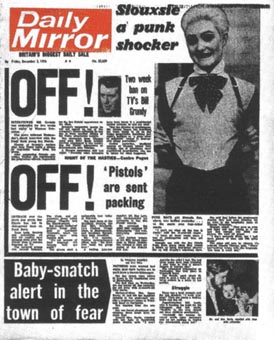
Siouxsie and Severin would next appear on a stage of a different sort. In December of 1976 the Bromley Contingent appeared on the Today evening TV program and were interviewed along with the Sex Pistols by host Bill Grundy. Siouxsie, stunning with platinum blonde hair and Hippie-ish face paint, coquettishly says she has always wanted to meet Bill Grundy, which prompts Grundy to lewdly suggest an assignation after the show. This sets Steve Jones off on a string of profanity. Words never heard on English TV. The rest, as they say, is history:
If there was one event that led to the explosion of UK Punk it was the Today interview; it filled the tabloids for a week. Siouxsie graced the front page of the Daily Mirror with the headline "Siouxsie's a punk shocker."
The Bromley Contingent would also figure in the other great Sex Pistols public relations windfall, the boat-ride-turned-police-melee on the Thames during Queen Elizabeth II's Silver Jubilee anniversary celebration, June of 1977. But by that time Siouxsie and Severin had stopped being groupies and started performing regularly and writing songs as Siouxsie and the Banshees. Peter Fenton was added as a guitarist; Kenny Morris, on drums.
To hear what the band sounded like in its Punk heydey listen to the demo recorded for EMI the same month as the Pistols police melee on the Thames.
Shortly after recording the EMI demo, Fenton is replaced on guitar by John McKay. The early Sioux-Severin-Morris-McKay can be heard in the Peel Sessions from November 1977.
We're still in the Punk period. Never Mind the Bollocks has been released at the end of October.
The next Peel Sessions appearance, from early February 1978, a half month after the Pistol's Winterland implosion, still has a Punk vibe. But something has changed. Something has shifted. One can hear that in "Hong Kong Garden," which would reach number seven on the UK Singles Chart at the end of summer.
By this time the band is in the studio with producer Stephen Lillywhite recording their debut album, The Scream (1978), which is released in November.
The Scream is a great album that was well received and peaked at number 12 on the UK Albums Chart. I would class it as one of the main pillars of Post-Punk along with Metal Box(1979), Entertainment! (1979) and Unknown Pleasures (1979). "Overground" is an incredible song:
Siouxsie and the Banshees 1979 followup album, Join Hands, is generally not as well received as The Scream.
In particular, the studio reprise of "The Lord's Prayer," the song that began it all for Sioux and Severin, is usually panned by the critics. But I think it is an exceptionally strong record.
There is tendency to downplay the excellence and the impact of The Scream and Join Hands, partly I think because of the success of Kaleidoscope (1980) and Juju (1981), albums which will be our focus next Friday. Siouxsie and the Banshees as time rolled on would be thought of mostly in relation to these two albums, as well as A Kiss in the Dreamhouse (1982). But in doing so I think we've missed out on some of the richness of Post-Punk.
Yesterday I was too optimistic in my assessment that the United States would not stand by idly and let Iraq be fractured by a Saudi-backed Al Qaeda uprising; that the recent events in Anbar had sparked a push-back by Realists in the Obama administration, evidence of which could be found on the frontpage of the New York Times in the form of rare overt attacks on the credibility of the Kingdom of Saudi Arabia.
Today's frontpage offering, "Grim Sequel to Iraq’s War," by Peter Baker provides proof of Neoconservative support in Congress for Al Qaeda's ascension in Iraq. Senator Bob Menendez (Dem-NJ), an old-fashioned corrupt machine politician from Hudson County, has been blocking the sale of Apache helicopters to the al-Maliki government. And while today there is a story, "Senator Signals Support for Sending Helicopters to Iraq," that says that Menendez has been mollified and now supports shipping the Apaches, it reads more like a "rope-a-dope" to me:
Mr. Menendez received a three-page letter last week from Prime Minister Nuri Kamal al-Maliki of Iraq responding to his concerns and received an urgent call from the State Department on Tuesday promising a further response. Although committee officials said the answers so far do not go much further than Mr. Maliki or the administration have in the past, Mr. Menendez was convinced that they are serious about dealing with the concerns given the latest strife in Anbar Province.
“The administration is now addressing concerns first raised in July that required responses before this sale could proceed,” said Adam Sharon, the senator’s spokesman. “Provided these issues are sufficiently addressed, Chairman Menendez will be ready to move forward.”
The Obama administration has proposed selling 20 to 30 of the helicopters to the Iraqi government, but, because it could take years for them to be built, it has also asked to lease up to 10 aircraft in the interim. Administration officials said the Apaches could be useful in targeting fighters affiliated with Al Qaeda like those who have taken over parts of Fallujah and Ramadi in recent days. But even if Mr. Menendez dropped his objections, it could take until April to deliver them, and officials noted that pilots would still need to be trained.
It is fashionable in Congress to blame al-Maliki for the Qaeda florescence in Anbar. It is a mantra similar to the "blame al-Assad" mantra. One can't help but notice that there is not a "blame el-Sisi" mantra after every bombing in the Sinai.
The al-Maliki blame game goes something like this: al-Maliki was not inclusive enough of Sunnis; this led to an estrangement of the population in Anbar, which gave Al Qaeda its current foothold. So, see, it's al-Maliki's fault.
But that's just a thin cover story. What is really going on is that Congress is pay-to-play territory occupied by Israel and the House of Saud. Senator Menendez, as rotten as they come, is a reliable mouthpiece and water carrier for Israel, and apparently Israel doesn't want Iraq to have Apache attack helicopters and drones with the ability to fire missiles.
The game then is Realists vs. Neocons. The Realists are winning in Syria. Syria's joining the Chemical Weapons Convention was an enormous blow to the Saudi/Israeli/Neocon axis. (ISIS has been expelled from Aleppo in internal fighting between jihadi groups; jihadi groups are attacking Syrian chemical weapons sites.) So the Neocons shifted to Anbar and have planted their black flag there.
It is all amazing. Straight out of the pages of comic books and right off the silver screen. The United States' great allies -- Saudi Arabia and Israel -- with fulsome support from politicians here at home -- are actively supporting our latest existential foe, Al Qaeda.
Keep your eyes focused on Anbar. That's where the Great Game is being played out.
The New York Times' new willingness to focus on the Saudi role in war currently convulsing the Middle East is again on display this morning. First, in a frontpage story, "Saudis Back Syrian Rebels Despite Risks," by Robert Worth where he skeptically interviews an erstwhile Saudi jihadist named Abu Khattab supplied by the Saudi Interior Ministry:
But as Abu Khattab talked about Syria, his own convictions seemed scarcely different from the jihadists he had carefully denounced (two officials from the Interior Ministry were present during the interview). He made clear that he considered Shiite Muslims and Mr. Assad’s Alawite sect to be infidels and a terrible danger to his own people.
“If the Shiites succeed in controlling Syria, it will be a threat to my country,” Abu Khattab said. “I went to Syria to protect my country.”
At times, his sectarian feelings seemed to outshine his unease about the excesses of some of his more extreme comrades. He did not deny that he had often fought alongside members of the Islamic State of Iraq and Syria, or ISIS, the brutal jihadist group affiliated with Al Qaeda.
Abu Khattab also mentioned proudly that he is no stranger to jihad. He fought as a teenager in Afghanistan (“With the government’s permission!”) and, a few years later, in Bosnia. He chose not to fight the Americans in Iraq “because there are too many Shiites there,” he said, with a look of distaste on his face.
Yet this is a man who lectures inmates at the rehabilitation center every week about ethics and war. The center, like many Saudi institutions, has been somewhat embarrassed by the contradictions of Saudi policy with regard to Syria. Although the center incarcerates some men who have been arrested for trying to travel to Syria, last summer the nephew of Abdelrahman al-Hadlaq, its director, was killed while fighting there. His mother posted statements on Twitter saying she was proud of him.
Worth makes clear that the Saudi ban on nationals traveling to Syria for jihad is a farce. A story like this could have been written and frontpaged at any time during the last year. Why now? Why the sudden focus on the explicit Saudi connection to the Qaeda florescence?
My sense is that the catalyst is Anbar. Fracturing Iraq with jihad is something that apparently is not going to fly with the United States Government. And the extent to which the Gray Lady is a stand-in -- definitely in terms of foreign policy priorities -- for the USG, the abrupt shift in coverage of the conflict in Iraq-Syria-Lebanon to highlight Saudi weakness and cravenness is noteworthy.
Next, a story by Ben Hubbard and Anne Barnard, also on the frontpage, that briefly quotes Nusra Front head Abu Mohammed al-Jolani calling for the creation of an Islamic court to resolve the conflict between ISIS and other Salafist groups. Then Yasir Ghazi and Tim Arango report in "In Iraqi City Under Siege, More Support for Militants Than Officials" a story which must be the reason the Saudis are suddenly getting frontpage attention. Sunnis in Falluja are lining up with Al Qaeda to fight against the Iraqi Army:
“We are going to fight for our city,” said Saif al-Jumaily, a resident of Falluja who said he did not want to live under Al Qaeda rule but would nevertheless fight against the Iraqi Army should it try to retake Falluja.
The government’s shelling of Falluja in recent days, and its previous heavy-handed response to Sunni protests in the province, which prompted the recent fighting, has exacerbated the animosity among Sunnis toward the central government. For many residents, the shelling has also evoked painful memories of the early years of the American occupation of Iraq, when United States forces fought two big battles for control of the city, with heavy civilian casualties.
“We are sick and tired of wars in Falluja,” said Mohamed Hameed, a 35-year-old resident of the city. “Every time, we think this is the end of the battles. We want to live a normal life. We have had enough wars in the previous years, and we saw Al Qaeda, the Americans and the Iraqi Army destroying our city.”
Mr. Hameed added: “Today when I leave my home I cry. I see the flags of Al Qaeda again; I see damaged buildings. I see masked men with guns. It’s like walking into Falluja of 2005. I remember all those bad days and ask myself, what was the fighting about then? Why did so many Iraqis and Americans die for this city? Now we are in the same situation.”
In the current fight for Falluja, many ordinary citizens would rather see their city in the hands of plain-clothed and masked militiamen — even if they do not understand their true allegiance — than under the control of soldiers loyal to the Shiite-controlled federal government.
Scenes of Shiite men, some of them waving the flag of Hezbollah, the Lebanese militant group, as they lined up at army recruiting stations in Baghdad to volunteer to fight in Anbar Province, have only heightened the sense of sectarian grievances among Sunnis here. An offer from Iran to give military aid to Mr. Maliki has also added to the sectarian tensions.
The Awakening fighters in Ramadi have cooperated with the government to oust ISIS from that city. But Falluja appears to be different. As Iraqi Army tanks circle, the city is under siege. An all-out assault with heavy civilian loss of life would likely herald an expansion of civil war that would be the end of Iraq.
The question then becomes, "How much longer before U.S. military intervention?" The United States spent trillions of dollars invading Iraq. I don't think American elites will stand by and watch a caliphate erected.