Showing posts with label Sex Pistols. Show all posts

Friday, April 17, 2015

Hippies vs. Punks: Yes vs. Black Flag, Round 1, "Mood for a Day" vs. "Wasted"

On a recent Saturday, while out for a run, a Yes song shuffled on my iPod, something off one of the three seminal studio albums of the early 1970s -- The Yes Album (1971), Fragile (1971), Close to the Edge (1972) -- and it sounded good. Lush, sweeping, soothing, harmonic -- whatever you want to call it -- "big ticket" rock 'n' roll.


Then, up next or shortly thereafter, came a Black Flag song, "Wasted," off the band's first record, the Nervous Breakdown EP (1978), and it pretty much said it all in terms of Hippies vs. Punks:


I was so wasted I was a hippie I was a burnout I was a dropout I was out of my head I was a surfer I had a skateboard I was so heavy man, I lived on the strand I was so wasted I was so fucked up I was so messed up I was so screwed up I was out of my head I was so jacked up I was so drugged up I was so knocked out, I was out of my head I was so wasted I was wasted
The contrast between these two songs, Yes's "Mood for a Day" and Black Flag's "Wasted" couldn't be greater. Yet there it is -- Hippies vs. Punks. It is almost as if there is no reason to continue on with these Hippies vs. Punks posts because aurally the matter has been settled. But who won?

One thing that leapt to my attention out of the happenstance iPod shuffle was the realization that Black Flag's first record, Nervous Breakdown, an EP that clocked in at all of 5 minutes 13 seconds, was recorded as early as January 1978, the month that Punk is supposed to have died when the Sex Pistols broke up after their show at Winterland. This qualifies Black Flag as a first-wave Punk band.

Nervous Breakdown didn't appear until the fall when foot-dragging by Bomp Records! motivated Black Flag founder and guitarist Greg Ginn to use funds from his ham radio business, Solid State Transmitters, to establish, along with Black Flag bass player Chuck Dukowski, a new record label, SST Records. Nervous Breakdown is the first SST Records disk, 001.

Black Flag was formed in 1976. Originally the band's name was Panic. But just as Joy Division had to change from Warsaw to Joy Division because there was another band going by Warsaw, Panic changed its name to Black Flag because there was another band called Panic.

In 1976 Yes was at the top of the heap along with Peter Frampton. This is what the kids were listening to when Greg Ginn put his band together. Skateboarding was very big. Skateboards with wheels of polyurethane instead of clay. Puka-shell necklaces and rugby shirts, long hair and Ocean Pacific drawstring cotton pants. Hippies, without a war to protest or a president to impeach, decided to let the good times roll. They might not necessarily have absconded to the discotheque but they had certainly found their way to AstroTurfed sports stadiums, where, along with tens of thousands of other shaggy-headed boys and girls, drunk and stoned, they, in the words of Crass, stared "up a superstar's arse."

This is the milieu that created Punk. The summer of 1976. The American Bicentennial. The summer that the boys from Joy Division see the Sex Pistols in Manchester and decide to start a band; the same summer that Mari Elliot, a.k.a., Poly Styrene, sees the Sex Pistols in Hastings and decides to start a band. The Yes-Frampton-Gary Wright sold-out stadium tour is happening simultaneously. The sonic womb that begets Punk is the no-longer-Hippie corporate sounds of Hippies like Yes, Peter Frampton and Gary Wright.

We'll have to tarry here a bit longer.

Friday, March 27, 2015

Hippies vs. Punks: X-Ray Spex's Germfree Adolescents


Germfree Adolescents (1978) was not released in the United States for more than 20 years after it first appeared in the UK. Robert Christgau lamented the fact that it was unavailable stateside four months after its UK release in November 1978:
My two favorite LPs of recent months are not available in domestic release and it pisses me off. So let me recommend once again Pere Ubu's Dub Housing on English Chrysalis, especially to admirers of Captain Beefheart who find themselves attracted by the force but put off by the simplifications of most new wave. Simplification fans should seek out the even more exciting Germ Free Adolescents, by X-Ray Spex on English EMI. Poly Styrene's cheerfully moralistic nursery rhymes sound samey at first, but their melodies soon reveal themselves and the dubiously tuned one-sax horn section provides irresistible color. From a song about suicide: "Did you do it for fame?/Did you do it in a fit?/Did you do it before read about it?"
Finally in 1991, during the heyday of Grunge, Caroline Records reissued Germfree Adolescents in the United States, an interesting synchronicity since 1991 is the year Bikini Kill's first record appears.

X-Ray Spex was definitely a Poly Styrene vehicle. She put the band together after seeing the Sex Pistols perform in Hastings the summer of 1976 (just as Bernard Summer and Peter Hook of Joy Division decided to form a band after seeing the Sex Pistols in Manchester the summer of 1976) and the band quickly fell apart after she left in 1979, burnt out from the exigencies of the popular music industry touring and promotion.

Poly Styrene née Marianne Joan Elliott-Said, who died of cancer at the age of 53 in April of 2011, was part Scotch-Irish and part Somali. She ran away from home as a teenager to live the life of a Hippie. Prior to her Sex Pistols conversion, she put out a record in 1976 as Mari Elliot that was produced by Falcon Stuart.

Falcon Stuart produced Germfree Adolescents as well, and Poly Styrene wrote all its songs. And what I took away from my immersion in the album this past week is Falcon Stuart, or whoever did the sound engineering, did a fantastic job. Despite the fact that it is garage rock Punk and therefore has that monaural, bleached quality, the high end of Styrene's vocals most of the time is in perfect balance with Rudi Thompson's saxophone which simultaneously occupies the low end vocal range. So what is created is a steady sonic wave. I find it quite unique.


Then there is the uniqueness of Styrene's anti-consumerist invective. The entire record is a sustained bombardment directed at the artificiality and alienation of capitalist society as actually lived by a human being. I can't think of another first wave Punk album that is anywhere near as focused and consistent in its message.

Germfree Adolescents is a Punk document because it doesn't hold out the possibility of a New World, a Hippie retreat to a pasture in the sun or a rock'n'roll revolution where sexual liberation will provide happiness for everyone and the kids are alright. No, it wades out into the plastic muck and says, "Take a look! This is all we are."

Studying Germfree Adolescents this past week has opened up a hidden reservoir of memory. Falcon Stuart was instrumental in getting Adam and the Ants launched. Adam and the Ants were everywhere when I first moved out on my own to attend the university.

X-Ray Spex's first saxophone player was Lora Logic, who got me thinking about Lene Lovich, who got me thinking about Nina Hagen. And then there is Lydia Lunch. Female Punk artists who were ubiquitous when I was a young man. Then there is Judy Nylon. Let's not forget Judy Nylon.

We're going to have to return to this topic soon. The idea here being that feminism made huge strides because of Punk.

Tuesday, June 24, 2014

Hippies vs. Punks: Saved by The Damned's "New Rose"

There is something that I want to mention and if I don't do it soon I'll forget it entirely. Two weeks for me is about the outer limit of keeping something in mind without writing it down.

Not last week but the week before, when I was limping along in a great deal of pain one morning trying to get through a crosswalk before the light turned red, The Damned's "New Rose" shuffled on the iPod:


What a song! Though each step sent a jolt of misery into my brain, I smiled a bruised smiled because my brain was also filled with the aural ecstasy of "New Rose."

Released in October of 1976 when Fly Like an Eagle was soaring the charts and giving the Hippies a swan song, "New Rose" is credited with being the first single by a UK Punk band; I think it might be the purest expression of Punk any Punk music not just first wave English Punk.

The Damned were always considered also-rans to The Clash and Sex Pistols. On the storied Anarchy in the UK Tour, The Damned decided to perform at a few venues that refused to allow the Pistols on stage (due to the band's super-historic incendiary appearance on the Today show). The Clash and The Heartbreakers showed solidarity and refused to perform.

I was so affected by hearing "New Rose" that I purchased the first album, Damned Damned Damned (1977), though it can be streamed for free on YouTube:


I know I have written briefly before about this album, the first full-length Punk record released in the UK, preceding The Clash (1977) by two months. I called it good. But it is time to amend that. I am ready to class Damned Damned Damned -- along with The Clash (1977), Never Mind the Bollocks (1977) and Pink Flag (1977) -- as a timeless monument to Punk.

Listen to this record. Put your player on repeat. Summer is upon us. July approaches. The planet is growing hotter.

The sound you will hear is the sound of purity. The buzz burning blur of youth and its confused clarity.

"Society is a Hole," as Sonic Youth would sing eight-years later. The Hippies felt the same way but acted as if there there was a way out of the hole. The Punks brought home the message that there is no way out.

Friday, February 7, 2014

Hippies vs. Punks: Tommy Bolin's Teaser + Private Eyes

At first for today's Hippies vs. Punks post I had planned on doing something on Phil Ochs, the political activist/folk singer who committed suicide in 1976, but then I shied away because of the scope involved. There is too much material with which I, like too many others, am not familiar. I'll have to punt on Ochs and return to him another day.

Then the plan became to resume working my way through the bands at the seminal Cincinnati Summer Pop Festival of June 1970. So far we have dealt with Fort Worth's Blood Rock, Cleveland's Damnation of Adam's Blessing, and Alice Cooper during the period the band was signed with Frank Zappa's Straight Records.

Next up is the Boulder, Colorado band Zephyr, reputed to be the equal of any band from Haight-Ashbury, but remembered mostly now because of the group's teenage lead guitarist, Tommy Bolin.

(Since I have been dealing with computer issues this week, I wasn't able to download all the Zephyr albums until yesterday. Look for the Zephyr post next Friday.)

But in the meantime I thought it would be fruitful to listen to Tommy Bolin's two solo releases, Teaser (1975) and Private Eyes (1976). Both are amazing sonic documents that chronicle the zenith of what the Hippie had become by the middle 1970s: a slick studio musician with amazing chops who could effortlessly glide between what Rolling Stone labeled as "jazz, white reggae, Latin rhythms and hard-grinding rock."


Tommy Bolin is the classic rock guitar hero, complete with the drug overdose death in a hotel room (the same year that Ochs took his own life). A Sioux City, Iowa high school dropout who refused to kowtow to school officials and cut his hair, he travels to Denver and eventually Boulder where he joins the band Zephyr. After two albums he leaves the group vowing never to perform again in a band that features a female lead singer. He starts his own group, Energy, a fusion of jazz and heavy metal which goes unsigned but he does manage to parlay the experience into a session gig for Billy Cobham and what turns out to be the enormously successful album Spectrum (1973). That is where most of us have probably encountered Tommy Bolin without knowing it:


From there Bolin joins James Gang for two albums, Bang (1973) and Miami (1974); cuts his first solo record, Teaser; does some session work on another seminal jazz fusion album, Alphonse Mouzon's Mind Transplant (1975); joins a post-Ritchie Blackmore Deep Purple long enough to record Come Taste the Band (1975); and then, signed by Columbia Records as the next Jimi Hendrix, puts together the Tommy Bolin Band and records Private Eyes.

Bolin was touring in support of Private Eyes when he OD's after warming up for Jeff Beck in Miami. Bolin's death occurs under questionable circumstances; it seems as if support staff, fearing a cancellation of the tour if they rushed Bolin to the hospital, preferred to see if he could ride out the poisoning in the privacy of his hotel room. Interestingly, Bolin dies at the same time the British tabloids are plastered with the Sex Pistols scatological appearance on Bill Grundy's Today show.

There are a lot of sources on the Internet for Tommy Bolin, foremost of which is a spectacular web site, Tommy Bolin Archives. There is also a good video biography available on YouTube:

Friday, January 10, 2014

Hippies vs. Punks: Siouxsie and the Banshees, Pt. 1, Punks Go Post


As a regular feature of Hippies vs. Punks we have been exploring the undercard of some prominent music festivals of the era. For the Hippies, we have dipped into the Aquarian Family Festival of May 1969 and the Cincinnati Summer Pop Festival of June 1970. For the Punks, it is harder because they eschewed anything that smacked of Hippiedom, and the multi-day or daylong music festival was a Hippie-era staple.

The one storied Punk music festival is known as the 100 Club Punk Special, which took place on two nights, September 20 and 21, 1976, at the 100 Club in London. The headliners were Sex Pistols, The Clash, The Damned, and Buzzcocks; basically, a hall of fame of first wave UK Punk. The undercard featured Subway Sect (explored in a previous Hippies vs. Punks post) as well as the first-ever appearance of Siouxsie and the Banshees (with a pre-Pistols Sid Vicious on drums).

The story goes that Siouxsie Sioux and Steven Severin, Sex Pistols groupies who belonged to the Bromley Contingent, pushed their way into a slot at the 100 Club Punk Special that was vacated at the last moment. With future Adam and the Ants lead guitarist Marco Pirroni, Siouxsie and the Banshees took the stage after Subway Sect and played a medley of the "Lord's Prayer," Twist and Shout," "Deutschland Uber Alles," and "Knocking on Heaven's Door." As Siouxsie describes it in a Sounds article from 1977, "That 100 Club gig/the intention was to play one number until they threw us off the stage/but they never did/we had to end it."

Siouxsie and Severin would next appear on a stage of a different sort. In December of 1976 the Bromley Contingent appeared on the Today evening TV program and were interviewed along with the Sex Pistols by host Bill Grundy. Siouxsie, stunning with platinum blonde hair and Hippie-ish face paint, coquettishly says she has always wanted to meet Bill Grundy, which prompts Grundy to lewdly suggest an assignation after the show. This sets Steve Jones off on a string of profanity. Words never heard on English TV. The rest, as they say, is history:


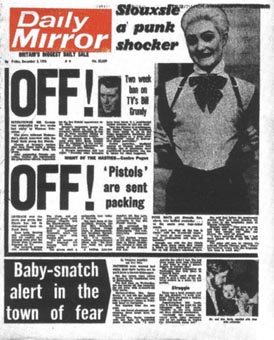
If there was one event that led to the explosion of UK Punk it was the Today interview; it filled the tabloids for a week. Siouxsie graced the front page of the Daily Mirror with the headline "Siouxsie's a punk shocker."


The Bromley Contingent would also figure in the other great Sex Pistols public relations windfall, the boat-ride-turned-police-melee on the Thames during Queen Elizabeth II's Silver Jubilee anniversary celebration, June of 1977. But by that time Siouxsie and Severin had stopped being groupies and started performing regularly and writing songs as Siouxsie and the Banshees. Peter Fenton was added as a guitarist; Kenny Morris, on drums.

To hear what the band sounded like in its Punk heydey listen to the demo recorded for EMI the same month as the Pistols police melee on the Thames.

Shortly after recording the EMI demo, Fenton is replaced on guitar by John McKay. The early Sioux-Severin-Morris-McKay can be heard in the Peel Sessions from November 1977.

We're still in the Punk period. Never Mind the Bollocks has been released at the end of October.

The next Peel Sessions appearance, from early February 1978, a half month after the Pistol's Winterland implosion, still has a Punk vibe. But something has changed. Something has shifted. One can hear that in "Hong Kong Garden," which would reach number seven on the UK Singles Chart at the end of summer.

By this time the band is in the studio with producer Stephen Lillywhite recording their debut album, The Scream (1978), which is released in November.


The Scream is a great album that was well received and peaked at number 12 on the UK Albums Chart. I would class it as one of the main pillars of Post-Punk along with Metal Box (1979), Entertainment! (1979) and Unknown Pleasures (1979). "Overground" is an incredible song:


Siouxsie and the Banshees 1979 followup album, Join Hands, is generally not as well received as The Scream.


In particular, the studio reprise of "The Lord's Prayer," the song that began it all for Sioux and Severin, is usually panned by the critics. But I think it is an exceptionally strong record.

There is tendency to downplay the excellence and the impact of The Scream and Join Hands, partly I think because of the success of Kaleidoscope (1980) and Juju (1981), albums which will be our focus next Friday. Siouxsie and the Banshees as time rolled on would be thought of mostly in relation to these two albums, as well as A Kiss in the Dreamhouse (1982). But in doing so I think we've missed out on some of the richness of Post-Punk.

Friday, September 6, 2013

Hippies vs. Punks: The Nuns


World War III, usually associated with the Cold War and its many crises -- Suez, Berlin, Cuban Missile -- and proxy military conflicts -- Korea, Vietnam, Afghanistan, Nicaragua -- is back with a vengeance. The United States is banging its war drum. China is reportedly sending a warship to the Mediterranean. Russia, with an anti-submarine ship and a missile cruiser already there, is sending additional ships. They will be monitoring -- and who knows what else -- a U.S. submarine and the five U.S. destroyers loaded with cruise missiles meant for Syria. One mistake, a faulty guidance system on one of the Tomahawks, and a regional crisis becomes a global conflagration.

For the last several weeks I've been meaning to take a stab at a Hippies vs. Punks post devoted to The Nuns, a first wave Punk group from San Francisco. Along with Crime and Avengers they dominated the San Francisco Punk scene in the early years, 1976 through 1978. 

What captivated me at first about The Nuns was the realization that they are the band that kicked off the famous last show of the Sex Pistols, the moment when Punk died and Post-Punk began. The venue was Bill Graham's Winterland Ballroom where The Last Waltz had been filmed a little over a year earlier. The line-up that January night in 1978 was The Nuns, Avengers, Sex Pistols, followed by Negative Trend.

None of The Nuns' recordings really jump out at you. The eponymous The Nuns, released in 1980, was minus guitarist, co-founder, song writer and present-day star Alejandro Escovedo. The band broke up in 1979 and reformed, except for Escovedo, for a single week in the spring of 1980 to quickly record the self-titled album. To hear the band in its prime with Escovedo on guitar you have to track down singles.

What does exist is video of The Nuns' performance at the Sex Pistols' Winterland show, January 14, 1978. (The web sites where one can find it, sadly, require membership.)


But what has stuck with me the past few weeks is not the music as much as the story of their keyboard player, Jennifer Miro, who, along with Jeff Olener and Richie Detrick, was a vocalist. (For Jennifer Miro's story check out the excellent SF Weekly piece by Jack Boulware.)

Miro died of breast and liver cancer in December of the year before last alone in hospice care at Manhattan's Bellevue Hospital Center. Up until then she had been employed as a receptionist for celebrity divorce attorney Raoul Felder. Obits can be found at the SF Weekly and the San Francisco Chronicle.

The Nuns put out five more albums after The Nuns (1980), all built around Jennifer Miro and her embrace of a cold, drum-track driven, synthesizer-based sound and a sexual fetishist persona. Not my cup of tea. But I am drawn to a woman, a fellow office worker, who, present at the creation of our current exhausted Zeitgeist, chose to die alone as quietly as possible. There is something to be learned here. 

Let's end with the last lines from Jack Boulware's appreciation:
On January 14, 1978, at the Winterland in San Francisco, what would be the final show ever for the Sex Pistols, the most talked-about punk show in history, before the mob of 5,000 roared to life and pelted the stage with spit and D-sized batteries, before anyone knew what to expect, before rock media anointed this night as the death of punk rock, before the voiceover introduction, "We're The Nuns, and we ain't from New York, and we ain't from England, we're from San Francisco!", the very first person to take the stage was Jennifer, walking out by herself in a single spotlight, scared to death and emotionally fragile from just having broken up with Crime drummer Brittley Black. She sat at her piano, began a closing-time saloon melody, leaned into the mic and sang, "I'm so lazy, so lazy...I'm too lazy to fall in love...It's such a bother, I'd much rather stay home and watch TV..." 
Jennifer remembered the moment clearly. "After that," she said, "you can't go back to a normal life."

Friday, August 23, 2013

Hippies vs. Punks: Q: Are We Not Men? A: We Are Devo!


Yesterday started out poorly. It could have been the big slice of chocolate cake eaten at 9 AM making me feel stoned. Add to that a general feeling of exhaustion that comes with the end of the work week; and then to top it off I listened to The Nuns' 4 Days in a Motel Room - Their Greatest Sins (1994) four times in a row from start to finish.

On the train home I was ready to fly the white flag of surrender. I needed something to wipe everything clean, to redeem myself, to give me the strength to carry on. On my post-work agenda I had the grocery store, a birthday gift for a coworker, dinner preparations. All minor mundane chores of a burdened bachelor made monumental by flagging spirits. Then I thumbed through my iPod and found the answer to my prayers. Q: Are We Not Men? A: We Are Devo! (1978).

By the time I listened to all 11 tracks through "Shrivel-Up," I had stormed up the hill to the grocery store and was a man reborn by dint of Nietzschean self-overcoming -- thanks to Messrs. Casale, Mothersbaugh & Myers.

I'm running a 10K tomorrow. My first one of the year. So I'm cutting Hippies vs. Punks short tonight in order to avoid an evening hunched over the keyboard. Suffice it to say that I had high expectations for tonight following multiple posts devoted to The Last Waltz (1978). At first, I was going to focus on The Dicks' seminal SST Records release Kill From the Heart (1983). Then I thought, No, I've got to do MDC's super-historical Millions of Dead Cops (1982). I saw both bands at the Rock Against Reagan concert in front of Moscone Center where the Democratic National Convention was taking place in July of 1984. That was a big event in my 19-year-old life. Dead Kennedys headlined. I participated in the march on the Hall of Justice following the concert and the running game of hide and seek with San Francisco's Finest (about which I still dream 30 years later). Better to spend some quality time on that post.

Then I looked at the undercard of the famous Winterland show in January of 1978 when the Sex Pistols blew apart. Avengers and The Nuns were the warm-up acts. I listened to the eponymous Avengers (1983) all the time in college. I downloaded the Avengers' Live at Winterland 1978 (2010) album this week. It's good; it sounds a lot like the Avengers album. But I was intrigued by The Nuns, the only knowledge of whom I had was the name. And that brings us back to the top of this post.

We'll have to explore The Nuns another time. It's a thoroughly depressing tale. Next to Crime, they were the biggest San Francisco Punk band in the heady days of 1977, a group briefly courted by San Francsico Sound impresario Bill Graham.

As for Q: Are We Not Men? A: We Are Devo!, though some will scoff, I'd class it with Never Mind the Bollocks (1977), Horses (1975), Pink Flag (1977) and Entertainment! (1979) as one of the greatest Punk/Post-Punk albums of all time.

Friday, August 2, 2013

Hippies vs. Punks: Subway Sect


Tonight, we're at halftime of the The Last Waltz posts. So it's time for a breather. Next week Hippies vs. Punks will return to The Last Waltz for part three, the main focus of which will be Music From Big Pink. Then on Friday, August 16, we will conclude with The Brown Album.

In the meantime, let's look at a band that performs at the seminal 100 Club Punk Special in London two months before The Last Waltz concert is staged in San Francisco. The 100 Club Punk Special is considered a seminal event because it marks a dividing line, according to an excellent interview with Punk promoter Ron Watts, between the close-knit London pub scene that spawns Punk -- what most people think of when they think of Punk -- and the national and then international celebrity that soon follows (and in so doing hastens the Hippies' extinction).

The Punk festival happened over two nights in September of 1976 just before the equinox. It featured big hitters like the Sex Pistols, The Clash, The Damned and Buzzcocks. But there were other lesser known bands that performed. One, Subway Sect, so named because they first played together busking in the Hammersmith subway, kicked things off. True to previous posts where I explore undercard bands at Hippie music festivals like the Aquarian Family Festival and the Cincinnati Summer Pop Festival, I thought tonight I'd do the same with the 100 Club Punk Special.


Led by singer/songwriter Vic Godard, Subway Sect formed after seeing the Sex Pistols. They were managed by the same guy, Bernie Rhodes, who managed The Clash, for whom the band warmed up on the White Riot tour in 1977. Subway Sect then recorded an album with Rhodes, after which he shit canned the entire group except for Godard. The album went unreleased and was lost except for the single "Ambition," released in 1978, and some tracks that eventually showed up on the 1999 Twenty Odd Years compilation (which sells new for $3K on Amazon!):


The original Subway Sect lineup released only two singles -- "Nobody's Scared" b/w "Don't Split It" (at the top of the post) and "Ambition" b/w "A Different Story." Thank goodness then for the Peel Session from October 1977. I have been listening to it all week -- "Chain Smoking" kicks ass! -- and it captures the punch -- the mojo -- that first iteration of the group had working in 1977:


The young Vic Godard was a skilled songwriter with the looks of Another Side of Bob Dylan Bob Dylan; he sounds at times like Richard Hell, Johnny Rotten and Pete Shelley ( -- a prism of first wave Punk, Godard sings better than all three); plus, he strikes me as a good guy. Reading a November 1976 interview with him in the punk zine Sniffin' Glue, his sincerity and earnestness shine through.

Godard reformed Subway Sect as Vic Godard & Subway Sect with a different set of players. He put out three more albums (two with Subway Sect and one solo effort) and moved through styles -- swing and jazz -- before going to work for the postal service in 1986.

There's a great interview that Godard does with 3:AM magazine from 2002 after he finished working on his Sansend album. (Three of these songs are available as Lazy So and So for MP3 download from Amazon; I've enjoyed listening to it, particularly on the morning train into work.) Godard talks about the process of trying to be creatively productive (i.e., perform and produce an album) while holding down a full-time job. As far as I'm concerned, it's a feat of heroism. Here's his description:
Sansend -- it took years to put it together. Because, really, we were only working on Sunday afternoons. A lot of the time we'd arrive at about six thirty on a Sunday afternoon, so that's why it took so long. There was the odd evening session, but with me being uninformed, and my mate in the group who does all the computer side of it, he's a carpenter, so his hours are basically about ten until six, so by the time he'd finished his carpentry and got down there it took you till about seven thirty and then I've got to be up at four or five the next morning which meant we couldn't work much beyond nine thirty. So we did start off at the beginning with the evening sessions, but we soon reverted back to Sunday afternoons. That explains why there are so many ideas running around in the album. We recorded quite a lot of songs on top of the ones we've put out. The first fourteen that came to us that gelled really well we worked on and we abandoned about six songs I suppose. We just didn't bother working on them. It was all done on a Mac and he was learning it from scratch. So at the beginning it was really slow because he was learning. I wrote all the lyrics except the reggae one which was written by Ken Wisdom. I've changed the odd bits to fit in with what he wrote. He didn't write it to that tune. He gave me a set of lyrics so I fitted them to a tune. So I had to change the odd bit here and there. But it's basically the same.
Godard maintains an active website which features an interesting blog. It's human and alive and not made opaque by commercialism. He continues to tour and make music. He is an exemplar of Punk revolutionary spirit:

Tuesday, June 18, 2013

Damned Damned Damned

At some point I went from being approximately the same age of the majority of people in my neighborhood to now I am clearly older than most. It seems like this has happened in just the last couple of years. Capitol Hill went from being a neighborhood that though weighted towards young adults nonetheless had healthy representation in all age brackets except children now appears to be populated overwhelming by young people in their 20s and 30s.

I'm not complaining. I like young people, particularly if they're not intoxicated. Young people have yet to be defeated existentially; they still harbor hope. It's young people who are taking to the street in Turkey and Brazil. As Richard Hell has said, "The truth is in the youth."

The rich maintain power by pumping the youth full of religious dogma and then setting them to fight each other. Things might be starting to shift though.

This morning at work I decided to make a study of The Damned's first album, Damned Damned Damned (1977). I didn't listen to it in college. The first wave of English Punk bands that I listened to were The Clash, Sex Pistols and Buzzcocks. Nineteen-Seventy-Seven is huge for Punk, and Damned Damned Damned, released in February of that year, is a good album.

It's much better than live performances I saw on The Old Grey Whistle Test DVD I checked out from the library the winter of 2012 and that got me thinking about Hippies vs. Punks.


But The Damned were huge back in the day. No denying it.

Friday, May 10, 2013

Hippies vs. Punks: Sex Pistols at Winterland, January 14, 1978

Post-Punk starts, in the usual telling of the tale, when Johnny Rotten walks off the stage of the Winterland Ballroom on January 14, 1978. The Sex Pistols had just performed The Stooges "No Fun." Rotten, right before tossing his mic, asks the audience, "Ever feel like you've been cheated?"

The entire Winterland show can be heard here:


The next day the Dallas Cowboys demolished the Denver Broncos in Super Bowl XII. And, yes, I did feel as if I had been cheated. My mother and I watched the game on a tiny portable Sony television that we had set on top of the kitchen table.


I had jumped ship at the end of the summer of 1977, leaving my father in California while exchanging places with my sister in Southern Oregon. My dad had not required that I attend school. So I just stopped going. My 7th-grade year was spent riding motorcycles -- a 70cc Honda trail bike and a Kawasaki 100cc street bike -- in the Santa Cruz Mountains. But by the beginning of the next school year I had seen the handwriting on the wall. My father's behavior was growing more erratic -- drinking, carrying on a romance with a much younger woman -- and I knew I couldn't blow off another year of junior high. I made the move north to Ashland, Oregon, where my mother had relocated earlier that spring. I started the 8th grade right on schedule, the day after Labor Day, with all the other kids.

We lived in a cockroach-infested, moldy two-bedroom rental house located on a dirt road on the outskirts of a tract housing development called Quiet Village. Across the dirt road from our house were acres of pasture dotted with blackberry brambles and a horse or two. My mother supported us by working as a psychic, doing astrological and tarot readings. She had long, flowing golden hair, and she wore knee-high leather moccasins. She looked like she stepped out of a John Everett Millais painting

My mother had gone to high school with Craig Morton; he was her brother's good friend. The Super Bowl was something really special for that reason; it's not often that a starting quarterback in the paramount secular ritual of the United States is kith to kin.

Monday was the Gala Benefit for the spring 2013 exhibition, "PUNK: Chaos to Couture," organized by The Costume Institute of The Metropolitan Museum of Art. "The exhibition, on view from May 9 through August 14, 2013, will examine punk’s impact on high fashion from the movement’s birth in the 1970s through its continuing influence today." The elite walked the red carpet in a display as far removed from that weekend in January over 35 years ago as one could possibly imagine. Only torrents of money and complete amnesia (which is a pretty good description of our current rush to doomsday) can label the raw power of a Punk manifesto like "Problems" -- no doubt one of the greatest, most pure examples of rock 'n' roll -- "high fashion":


A couple months back I read The New Yorker piece, "Anarchy Unleashed," written by Calvin Tompkins, about Andrew Bolton, the Met curator who put the Punk show together. One interesting thing that Bolton says, quoting Mick Jones of the Clash, is that Punk in its pure form lasted only a hundred days. Mick Jones is probably referring to a string of months in 1976. But think about it this way: Never Mind the Bollocks, Here's the Sex Pistols -- the timeless, living, breathing monument of Punk Rock -- is released at the end of October 1977 (the month of the Baader-Meinhof Group's German Autumn -- the flame-out, along with Red Brigades' kidnapping and assassination of Aldo Moro five months later, of Western Leftist armed guerrilla resistance). The band breaks up the middle of January 1978. That's about three months. And then we're supposed to be speaking about a world that's "Post-Punk." This is confusing. It's a problem. Punk is over before it ever really happens.

Wednesday, May 8, 2013

"Public Image"

In preparation for Friday evening's usual Hippies vs. Punks post, I've been immersing myself in Public Image Ltd's first two albums: Public Image: First Issue (1978) and Second Edition from 1980 (which was originally released as Metal Box -- because its three 12-inch 45s came in a film canister -- at the end of 1979). And by immersion I mean I've listened to both albums several times in a row, falling asleep with my ear buds in while on the train in the morning. I am well versed in Second Edition, having owned and played a cassette tape copy repeatedly over the years. There was one summer at the end of the 1990s where it seemed like that's all I listened to for a couple of weeks. Tremendous album with a vibe all its own, it creates a dark, deep, distant space which I find myself happy to occupy. Jah WobbleKeith Levene and John Lydon did it right in 1979.

And while Metal Box usually gets the accolades, I've enjoyed Public Image: First Issue just as much. Up until this past weekend I had never owned a copy. But most of the songs are familiar. The album must have been ambiently absorbed; it was widely played when I first arrived at the university in the early '80s. At Rasputin's on Telegraph my freshman or sophomore year I remember seeing the video for "Public Image" on one of those old big projection-screen televisions with the three lenses. Great single. It's probably the closest thing to a Sex Pistols song that PiL ever did: