On a recent Saturday, while out for a run, a Yes song shuffled on my iPod, something off one of the three seminal studio albums of the early 1970s -- TheYes Album (1971), Fragile (1971), Close to the Edge (1972) -- and it sounded good. Lush, sweeping, soothing, harmonic -- whatever you want to call it -- "big ticket" rock 'n' roll.
Then, up next or shortly thereafter, came a Black Flag song, "Wasted," off the band's first record, the Nervous Breakdown EP (1978), and it pretty much said it all in terms of Hippies vs. Punks:
I was so wasted I was a hippie I was a burnout I was a dropout I was out of my head I was a surfer I had a skateboard I was so heavy man, I lived on the strand I was so wasted I was so fucked up I was so messed up I was so screwed up I was out of my head I was so jacked up I was so drugged up I was so knocked out, I was out of my head I was so wasted I was wasted
The contrast between these two songs, Yes's "Mood for a Day" and Black Flag's "Wasted" couldn't be greater. Yet there it is -- Hippies vs. Punks. It is almost as if there is no reason to continue on with these Hippies vs. Punks posts because aurally the matter has been settled. But who won?
One thing that leapt to my attention out of the happenstance iPod shuffle was the realization that Black Flag's first record, Nervous Breakdown, an EP that clocked in at all of 5 minutes 13 seconds, was recorded as early as January 1978, the month that Punk is supposed to have died when the Sex Pistols broke up after their show at Winterland. This qualifies Black Flag as a first-wave Punk band.
Nervous Breakdown didn't appear until the fall when foot-dragging by Bomp Records! motivated Black Flag founder and guitarist Greg Ginn to use funds from his ham radio business, Solid State Transmitters, to establish, along with Black Flag bass player Chuck Dukowski, a new record label, SST Records. Nervous Breakdown is the first SST Records disk, 001.
Black Flag was formed in 1976. Originally the band's name was Panic. But just as Joy Division had to change from Warsaw to Joy Division because there was another band going by Warsaw, Panic changed its name to Black Flag because there was another band called Panic.
In 1976 Yes was at the top of the heap along with Peter Frampton. This is what the kids were listening to when Greg Ginn put his band together. Skateboarding was very big. Skateboards with wheels of polyurethane instead of clay. Puka-shell necklaces and rugby shirts, long hair and Ocean Pacific drawstring cotton pants. Hippies, without a war to protest or a president to impeach, decided to let the good times roll. They might not necessarily have absconded to the discotheque but they had certainly found their way to AstroTurfed sports stadiums, where, along with tens of thousands of other shaggy-headed boys and girls, drunk and stoned, they, in the words of Crass, stared "up a superstar's arse."
This is the milieu that created Punk. The summer of 1976. The American Bicentennial. The summer that the boys from Joy Division see the Sex Pistols in Manchester and decide to start a band; the same summer that Mari Elliot, a.k.a., Poly Styrene, sees the Sex Pistols in Hastings and decides to start a band. The Yes-Frampton-Gary Wright sold-out stadium tour is happening simultaneously. The sonic womb that begets Punk is the no-longer-Hippie corporate sounds of Hippies like Yes, Peter Frampton and Gary Wright.
Spooky Tooth was a Chris Blackwell creation. The Island Records founder combined the front man, Gary Wright, of an upstart cover band, The New York Tymes, touring the continent in 1967 with The V.I.P.'s, a band from the northwest of England that had recently been renamed Art to coincide with the release of their debut full-length album, Supernatural Fairy Tales (1967) as well as to cash in on the exploding popularity of all things psychedelic.
What made Spooky Tooth novel is that the band had two lead vocalists and keyboard players, Mike Harrison and Wright. Harrison provided a classic testosterone rock'n'roll Cockeresque voice while Wright, a former child actor who had appeared in the Broadway musical Fanny with Florence Henderson (the future Jan Brady of The Brady Bunch), sang the high parts.
Spooky Tooth's debut, It's All About You (1968), was fairly well received, as was the follow up, Spooky Two (1969), but neither sold that well. Christgau dismissed the seminal Spooky Tooth record, Spooky Two, as a not entirely successful Blind Faith knockoff, saying "At its best ('Waitin' for the Wind,' 'That Was Only Yesterday') this group is not significantly poorer than Blind Faith. At its worst ('Lost In My Dream,' 'I've Got Enough Heartaches') it is painfully overwrought. C+"
It was at this point probably that Blackwell determined that Spooky Tooth was never going to make it anywhere near the top of the charts. So why not swing for the fences? Hence, he assigned the band to work on a project with electronic music and musique concrète pioneer Pierre Henry.
Henry had recently achieved breakout success with La Messe Pour Le Temps Present (1967) and the track "Psyché Rock." Henry was persuaded by his publisher to work with an English rock band, as he explains in an interview that originally appeared in Vital magazine in 1995, for commercial reasons:
In the 60s you worked with the rock group Spooky Tooth on Ceremony. Why was that?
The reason for this was much more commercial than artistic. The great success of La Messe Pour Le Temps Present and Les Jerks Electroniques with Michel Colombier gave my editor at Philips the idea that I should work together with an English group to make a thematic album, based on the idea of the Mass. When this started, I didn't know these people at all, and I accepted for a number of reasons which would not interest me now. . . .
Spooky Tooth traveled to France to record in a cathedral the material that Wright, who was raised Catholic, had written. Wright supported the project because he thought it was going to be a working collaboration with Henry, a classically trained avant-garde composer. But it turned out to be nothing of the sort. Spooky Tooth quickly recorded Ceremony live, and that was the last that the band had anything to do with it. Henry slapped a track of his musique concrète and some low-tech electronics over the top and Blackwell rushed it to market. Wright was so pissed off he quit the band.
Before proceeding any further we should consult Reggae pioneer Lee "Scratch" Perry's assessment of Chris Blackwell in "Judgement in a Babylon":
"Chris Blackwell is a vampire . . . He killed Bob Marley, and take away his royalty." But for all Blackwell's ruthlessness, you can't argue that the guy was a visionary. He brought Bob Marley and the Wailers and Jimmy Cliff to worldwide renown (this happened after Ceremony flopped), not to mention Roxy Music and Eno, Fairport Convention and Richard and Linda Thompson. And all this after discovering Stevie Winwood.
Returning to Ceremony, I have got to say that Blackwell knew what he was up to. Marrying the musique concrète of a founding master like Henry with the prog rock ostentatiousness of B-listers like Spooky Tooth is genius. Right when the religious rock is getting too far over the top, in comes Henry hammering on a metal pipe or mumbling gibberish.
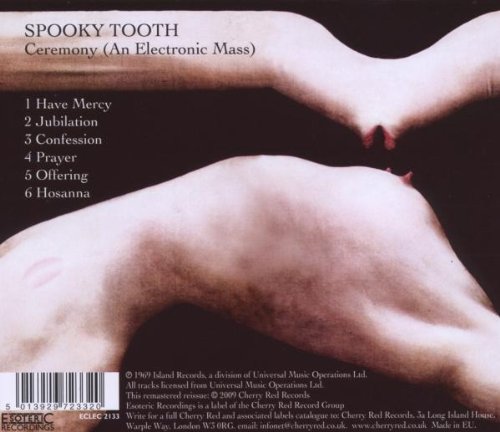
Then there is the amazing album cover by commercial artist John Holmes:
Released in December 1969, Ceremony beat Jesus Christ Superstar (1970) and Godspell (1971) to the Hippies-on-acid-play-acting-the-Gospels punch. Spooky Tooth and Henry just never got to wallow in the cash trough.
What interests me about Spooky Tooth is how the band represents the baseline sensibility of Westernized youth in the early 1970s. Prog rock, acid rock ruled the roost. Call it a default Deep Purple state of Nixonian middle-class Hippie America. Generally open minded, aspiring to be educated, anti-war, skeptical of large corporations and big government, modestly multicultural and ecumenical, this young, white America is still out there despite decades of market segmentation and being poked and prodded in a rightward, know-nothing direction; it is still the majority, I would say, which, after all is said and done, is worthy of awe.
Spooky Tooth would reform and be welcomed back to Island in 1973 after initial forays at solo stardom by Gary Wright and Mike Harrison foundered. Blackwell finally upended the gravy train in late 1974 and sacked the group. The writing on the wall was plain to see. Arena acid rock was fading. The kids were moving on. There was no longer a demand for a middle-of-the-bill act like Spooky Tooth.
Lou Reed died this past Sunday. Here is one of the items from his New York Times obituary by Ben Ratliff that caught my eye:
Beloved of Mr. Reed and not too many others, “Metal Machine Music” was four sides of electric-guitar feedback strobing between two amplifiers, with Mr. Reed altering the speed of the tape recorder; no singing, no drums, no stated key. At the time it was mostly understood, if at all, as a riddle about artistic intent. Was it his truest self? Was it a joke? Or was there no difference?
Mr. Reed wrote in the liner notes that “no one I know has listened to it all the way through, including myself,” but he also defended it as the next step after La Monte Young’s early minimalism. “There’s infinite ways of listening to it,” he told the critic Lester Bangs in 1976.
I read the obit Monday morning on the train coming into work. As an homage I listened to Metal Machine Music, which was released the summer of 1975, all the way through on Wednesday. I made another attempted go-round on Thursday, making it only halfway before I was pulled away from my desk to rearrange the conference space on the first floor. I resumed this afternoon approximately where I left off
James Wolcott in a review from August 14, 1975 in Rolling Stone calls M/M/M a masochistic indulgence:
If this album is Reed's Self Portrait, then we may have to tolerate a lot of stroboscopic sludge before he gets back on the tracks. What's most distressing is the possibility that Metal Machine Music isn't so much a knife slash at his detractors as perhaps a blade turned inward. At its very worst this album suggests masochism.
And I think there's something to it. Absorbing all that guitar feedback you can't help but feel as if you are indulging in self-punishment. The sound is the sound of radio signals bouncing through deep space; it's the sound reminiscent of the soundtrack of low-budget science fiction masterpiece Dark Star (1974); it's a sound that includes squeaking noises of small feral animals; it's the sound of the monkey-mind chattering away during that part of the race when you are done, finished, kaput but you have miles left to go -- "Stop! Give up! You're just hurting yourself." / "No. I must continue." Metal Machine Music is the sound of suffering.
But for all of that, listening to M/M/M is not unpleasant. It was appropriate that I did so at work, ear buds affixed to head, toiling away at my Bartlebyesque chores. The modern office, boneyard of Western Man, is a perfect environment to hear Metal Machine Music. No one wants to be in an office: it's a soulless, sorrowful place filled with electronic equipment and alienated people; it's not a place for pop or hard rock or really for any music other than the distorted electronic feedback sounds captured on M/M/M.
Lou Reed biographer Victor Bockris has called Metal Machine Music "the ultimate conceptual punk album and the progenitor of New York punk rock." And while this may be true, M/M/M is fundamentally an homage to drone music. Lou Reed gives a shout-out to La Monte Young's Theatre of Eternal Music, the group John Cale was a member of prior to The Velvet Underground, in the liner notes to M/M/M: "Drone cognizance and harmonic possibilities vis a vis Lamont Young's Dream Music."
A prime example of drone music is Dream House 78' 17" (1974), by its chief creator La Monte Young, with his partner Marian Zazeela and the Theatre of Eternal Music:
La Monte Young's drone music is influenced by Hindustani classical singer Pran Nath. (Lou Reed might have loathed the Hippies, but drone music is important to both.)
In the last five years Lou Reed returned to Metal Machine Music by performing as part of the Metal Machine Trio. A recording of their first live show is excellent and available for download on Lou Reed's website.
To draw an illuminating contrast, a brief inspection of an album released a month prior to M/M/M is called for. Gary Wright's The Dream Weaver (1975) is touted as the first-ever all-synthesizer pop album (if you don't count the many Wendy Carlos albums like the soundtrack to A Clockwork Orange (1971), or session superstar Jim Keltner's drumming or some Ronnie Montrose guitar on one track).
Released in June 1975 The Dream Weaver peaked in the spring of 1976 at #7 on Billboard's pop album chart. I listened to it twice in a row at work today. And believe it or not, while much shorter in length than Metal Machine Music, I found it more painful to listen to. There are some decent tracks. I like "Can't Find the Judge" and "Much Higher" where Wright is doing his best to channel his inner Stevie Wonder. (The Dream Weaver features the ARP synthesizer and the Fender Rhodes electric piano, Stevie's instruments of choice from the albums of his classic period.) I'm less enamored with all the Moog Wright employs; it frequently rises from the back of the mix like a stoned zombie teenager stumbling out of a Friday night 1970s planetarium laser light show.
Gary Wright was definitely a Hippie. A buddy of George Harrison -- he played piano and organ on All Things Must Pass(1970) -- and previously the organ player and a vocalist for Spooky Tooth, Gary Wright wrote the song "Dream Weaver," which, along with "Love is Alive," reached #2 on the Billboard singles chart, after reading the Hippie manifesto Autobiography of a Yogi, a gift from George Harrison. (I grew up in the 1970s frequently glancing at the picture of Paramahansa Yogananda that adorned the front cover of his autobiography; for a couple of years there my father always seemed to be caring around a copy.)
One thing you can say about Gary Wright's The Dream Weaver, it successfully forecast the synthesizer-based, slow-dance schlock that dominated the 1980s.
The moral of the story? In 1975 the Hippie cashed in while the Punk took a courageous stand.
When you wake up in the morning with the worst hangover of your life, Metal Machine Music is the best medicine. Because when you first arise you're probably so fucked (i.e., still drunk) that is doesn't even really hurt yet (not like it's going to), so you should put this album on immediately, not only to clear all the crap out of your head, but to prepare you for what's in store the rest of the day.
Speaking of clearing out crap, I once had this friend who would say, "I take acid at least every two months & JUST BLOW ALL THE BAD SHIT OUTA MY BRAIN!" So I say the same thing about MMM. Except I take it about once a day, like vitamins.