Showing posts with label Chris Blackwell. Show all posts

Friday, June 19, 2015

Hippies vs. Punks: Tom Tom Club


Back in February I posted on The Clash's "Overpowered by Funk."

Punks do hip hop. That was the message. I cited Tom Tom Club's "Wordy Rappinghood" as a probable influence. I put a request in at the public library for the 2009 deluxe edition 2-CD import of the 1981 eponymous Tom Tom Club debut album and the band's follow up, Close to the Bone (1983). Last week it finally arrived, and I've been listening to it since.

Tom Tom Club (1981) is another product of the genius of Chris Blackwell. He saw explosive creative potential in the Talking Heads rhythm section of Tina Weymouth and Chris Frantz that others did not (or possibly he could have just been following the market, since both David Byrne and Jerry Harrison also released solo debuts in 1981). Blackwell's plan was to pair Frantz and Weymouth with superstar producer Lee "Scratch" Perry in a Bahamas recording studio. But Perry was a no show. So Steve Stanley stepped in and produced a miracle.

The album charted in both the UK and the United States on the strength of the first two tracks, "Wordy Rappinghood" and "Genius of Love," which became dance hall favorites.


I owned the album in cassette form back in the day, purchasing it when I first arrived at the university as a freshman. This would have been the end of summer 1982. At the time, Tom Tom Club seemed incredibly fresh and novel even if it was part of an old tradition of white artists "borrowing" from black ones. It seemed spontaneous, exuberant, playful, multicultural, with both black urban and French Caribbean influences.

For me Tom Tom Club and those first two cuts represent the sunshine of the early 1980s, an interesting time. Reaganism and Thatcherism were new and not really accepted as legitimate. Most thought of these new conservative governments as aberrational one-offs. We had no way of knowing the extent of the regression that Reagan and Thatcher represented. There were dark hints in the Reagan recession (something I have explored in a previous Hippies vs, Punks devoted to Generic Flipper) but for the most part the early 1980s were a time of hope, ska, new horizons and multiracial possibilities (something I scratched the surface of in a previous post on 2 Tone Ska).


In listening to the 2009 deluxe edition re-issue of Tom Tom Club what is striking is that once you get past the opening cuts and into the second side of the album a more ominous and brooding sound surfaces. I think the tendency in the early '80s was to not think too much about songs like "As Above, So Below"; "Lorelei"; "On, On, On, On . . ."; "Booming and Zooming" but the dystopian future was all there to hear.

One remarkable track from the 2009 deluxe edition re-issue that was not included on the LP, cassette or CD versions of Tom Tom Club is "Spooks (Single Version)." It is a menacing ambient harbinger of the "total awareness" national security state aborning. Even if it had been included on the original album, we wouldn't have noticed it. We were too busy dancing in the sunshine to new rhythms and beats. It is very noticeable now though:

Friday, April 10, 2015

Hippies vs. Punks: Ceremony: An Electronic Mass (1969) by Spooky Tooth and Pierre Henry


Spooky Tooth was a Chris Blackwell creation. The Island Records founder combined the front man, Gary Wright, of an upstart cover band, The New York Tymes, touring the continent in 1967 with The V.I.P.'s, a band from the northwest of England that had recently been renamed Art to coincide with the release of their debut full-length album, Supernatural Fairy Tales (1967) as well as to cash in on the exploding popularity of all things psychedelic.

What made Spooky Tooth novel is that the band had two lead vocalists and keyboard players, Mike Harrison and Wright. Harrison provided a classic testosterone rock'n'roll Cockeresque voice while Wright, a former child actor who had appeared in the Broadway musical Fanny with Florence Henderson (the future Jan Brady of The Brady Bunch), sang the high parts.

Spooky Tooth's debut, It's All About You (1968), was fairly well received, as was the follow up, Spooky Two (1969), but neither sold that well. Christgau dismissed the seminal Spooky Tooth record, Spooky Two, as a not entirely successful Blind Faith knockoff, saying "At its best ('Waitin' for the Wind,' 'That Was Only Yesterday') this group is not significantly poorer than Blind Faith. At its worst ('Lost In My Dream,' 'I've Got Enough Heartaches') it is painfully overwrought. C+"

It was at this point probably that Blackwell determined that Spooky Tooth was never going to make it anywhere near the top of the charts. So why not swing for the fences? Hence, he assigned the band to work on a project with electronic music and musique concrète pioneer Pierre Henry.


Henry had recently achieved breakout success with La Messe Pour Le Temps Present (1967) and the track "Psyché Rock." Henry was persuaded by his publisher to work with an English rock band, as he explains in an interview that originally appeared in Vital magazine in 1995, for commercial reasons:
In the 60s you worked with the rock group Spooky Tooth on Ceremony. Why was that? 
The reason for this was much more commercial than artistic. The great success of La Messe Pour Le Temps Present and Les Jerks Electroniques with Michel Colombier gave my editor at Philips the idea that I should work together with an English group to make a thematic album, based on the idea of the Mass. When this started, I didn't know these people at all, and I accepted for a number of reasons which would not interest me now. . . .
Spooky Tooth traveled to France to record in a cathedral the material that Wright, who was raised Catholic, had written. Wright supported the project because he thought it was going to be a working collaboration with Henry, a classically trained avant-garde composer. But it turned out to be nothing of the sort. Spooky Tooth quickly recorded Ceremony live, and that was the last that the band had anything to do with it. Henry slapped a track of his musique concrète and some low-tech electronics over the top and Blackwell rushed it to market. Wright was so pissed off he quit the band.

Before proceeding any further we should consult Reggae pioneer Lee "Scratch" Perry's assessment of Chris Blackwell in "Judgement in a Babylon":


"Chris Blackwell is a vampire . . . He killed Bob Marley, and take away his royalty." But for all Blackwell's ruthlessness, you can't argue that the guy was a visionary. He brought Bob Marley and the Wailers and Jimmy Cliff to worldwide renown (this happened after Ceremony flopped), not to mention Roxy Music and Eno, Fairport Convention and Richard and Linda Thompson. And all this after discovering Stevie Winwood.

Returning to Ceremony, I have got to say that Blackwell knew what he was up to. Marrying the musique concrète of a founding master like Henry with the prog rock ostentatiousness of B-listers like Spooky Tooth is genius. Right when the religious rock is getting too far over the top, in comes Henry hammering on a metal pipe or mumbling gibberish.

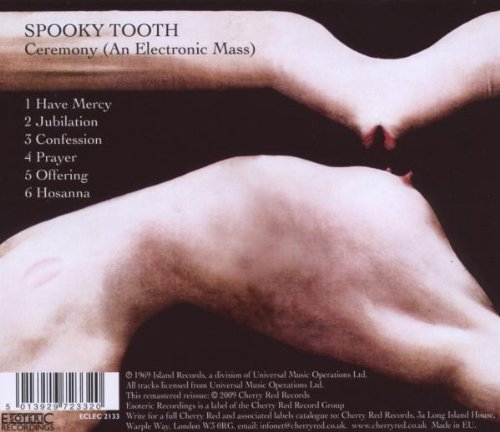
Then there is the amazing album cover by commercial artist John Holmes:


Released in December 1969, Ceremony beat Jesus Christ Superstar (1970) and Godspell (1971) to the Hippies-on-acid-play-acting-the-Gospels punch. Spooky Tooth and Henry just never got to wallow in the cash trough.

What interests me about Spooky Tooth is how the band represents the baseline sensibility of Westernized youth in the early 1970s. Prog rock, acid rock ruled the roost. Call it a default Deep Purple state of Nixonian middle-class Hippie America. Generally open minded, aspiring to be educated, anti-war, skeptical of large corporations and big government, modestly multicultural and ecumenical, this young, white America is still out there despite decades of market segmentation and being poked and prodded in a rightward, know-nothing direction; it is still the majority, I would say, which, after all is said and done, is worthy of awe.

Spooky Tooth would reform and be welcomed back to Island in 1973 after initial forays at solo stardom by Gary Wright and Mike Harrison foundered. Blackwell finally upended the gravy train in late 1974 and sacked the group. The writing on the wall was plain to see. Arena acid rock was fading. The kids were moving on. There was no longer a demand for a middle-of-the-bill act like Spooky Tooth.