Showing posts with label Siouxsie and the Banshees. Show all posts

Friday, January 17, 2014

Hippies vs. Punks: Siouxsie and the Banshees, Pt. 2, the McGeoch Albums


Following Siouxsie and the BansheesJoin Hands (1979) album, guitarist John McKay and drummer Kenny Morris are replaced by Magazine co-founder and guitarist John McGeoch and Budgie, the drummer on the Slits' debut album, Cut (1979). With this lineup -- Sioux, Severin, McGeoch, and Budgie -- Siouxsie and the Banshees would record their most influential albums by far -- Kaleidoscope (1980); their masterpiece, Juju (1981); and the proto-House music, A Kiss in the Dreamhouse (1981) -- before McGeoch is purged following what is termed a "nervous breakdown" due to alcohol and exhaustion.

McGeoch is called "the Jimmy Page of New Wave." His work with Howard Devoto on Magazine's Real Life (1978) defines Post-Punk and, as I proffered in a previous Hippies vs. Punks, presciently captures the sound of the 1980s. McGeoch's 2004 obituary in The Independent describes his joining the Banshees:
In 1980, the "guitarist for hire" came to the attention of Siouxsie and the Banshees, then a trio of the singer Siouxsie Sioux, the bassist Steve Severin and the drummer Budgie, with occasional help from the Cure's Robert Smith. "I was surprised to get the call," said McGeoch. "Steve Strange told me to wear black and we met up in a pub in Notting Hill. They invited me along to their rehearsal studio in Camden and, within two days, we'd routined 'Happy House.' They really liked that guitar line, that was the clincher. I was going through a picky phase, as opposed to strumming. 'Happy House' was lighter and had more musicality in it. They invited me to join. I was sad leaving Magazine but the Banshees were so interesting and it felt like a good move."

I had both Kaleidoscope and Juju back in the day in the early 1980s. I remember being home, skipping class in order to finish papers that were due at the end of the week. I remember sitting in the kitchen at the kitchen table in front of the television which also doubled as a computer monitor. My live-in girlfriend had a Texas Instruments TI-99, one of the first personal computers; it hooked up to the TV. We used it mostly as a word processor on which we composed our college papers. It was balky, and if you jostled the software cartridges that fit into the keyboard you could lose everything you were working on.


Like I say, I have memories of being home alone on dark overcast afternoons, probably in 1984, and sitting in the kitchen in front of the television / Texas Instruments TI-99 monitor and listening to Siouxsie and the Banshees records I had playing on the stereo in the living room. "Spellbound" was my favorite track. It seemed at the time to have more testosterone than anything else around.


Immersing myself this week in the three McGeoch Siouxsie and the Banshees albums, it is clear that these are great records. Kaleidoscope is fantastic. I particularly like "Trophy" and "Clockface."

Kaleidoscope is more like Join Hands in that the individual cuts cohere to form a whole whose sum is far greater and more different than its parts. But with Juju you have an album that is loaded with songs that rock and rock hard repeatedly throughout the album. "Sin in My Heart" and "Monitor" are two fine examples, but really every track has ass-kicking quality. McGeoch's guitar playing and Budgie's drumming drive the album.


I never owned A Kiss in the Dreamhouse, McGeoch's last album with the band. At first I was put off by the Flashdance (1983) vibe of the first track, "Cascade":


The drums have that flat, bottom-heavy, slightly echoey sound that becomes prevalent in the 1980s. This is not noticeable in the video clip above. Budgie's drums sound warm here. (But look at the size of the audience, and the size of Budgie's kit; he's a veritable Post-Punk Carl Palmer!)

In any event, after listening to A Kiss in the Dreamhouse several times, I got over my aversion to its Flashdance aspects. It is a complex, rich album that was ahead of its time; it forecasts the urban dance hall revival of the 1980s. But at the same time it also is the end of the line for Post-Punk.

Friday, January 10, 2014

Hippies vs. Punks: Siouxsie and the Banshees, Pt. 1, Punks Go Post


As a regular feature of Hippies vs. Punks we have been exploring the undercard of some prominent music festivals of the era. For the Hippies, we have dipped into the Aquarian Family Festival of May 1969 and the Cincinnati Summer Pop Festival of June 1970. For the Punks, it is harder because they eschewed anything that smacked of Hippiedom, and the multi-day or daylong music festival was a Hippie-era staple.

The one storied Punk music festival is known as the 100 Club Punk Special, which took place on two nights, September 20 and 21, 1976, at the 100 Club in London. The headliners were Sex Pistols, The Clash, The Damned, and Buzzcocks; basically, a hall of fame of first wave UK Punk. The undercard featured Subway Sect (explored in a previous Hippies vs. Punks post) as well as the first-ever appearance of Siouxsie and the Banshees (with a pre-Pistols Sid Vicious on drums).

The story goes that Siouxsie Sioux and Steven Severin, Sex Pistols groupies who belonged to the Bromley Contingent, pushed their way into a slot at the 100 Club Punk Special that was vacated at the last moment. With future Adam and the Ants lead guitarist Marco Pirroni, Siouxsie and the Banshees took the stage after Subway Sect and played a medley of the "Lord's Prayer," Twist and Shout," "Deutschland Uber Alles," and "Knocking on Heaven's Door." As Siouxsie describes it in a Sounds article from 1977, "That 100 Club gig/the intention was to play one number until they threw us off the stage/but they never did/we had to end it."

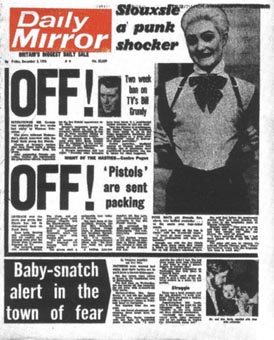
Siouxsie and Severin would next appear on a stage of a different sort. In December of 1976 the Bromley Contingent appeared on the Today evening TV program and were interviewed along with the Sex Pistols by host Bill Grundy. Siouxsie, stunning with platinum blonde hair and Hippie-ish face paint, coquettishly says she has always wanted to meet Bill Grundy, which prompts Grundy to lewdly suggest an assignation after the show. This sets Steve Jones off on a string of profanity. Words never heard on English TV. The rest, as they say, is history:


If there was one event that led to the explosion of UK Punk it was the Today interview; it filled the tabloids for a week. Siouxsie graced the front page of the Daily Mirror with the headline "Siouxsie's a punk shocker."


The Bromley Contingent would also figure in the other great Sex Pistols public relations windfall, the boat-ride-turned-police-melee on the Thames during Queen Elizabeth II's Silver Jubilee anniversary celebration, June of 1977. But by that time Siouxsie and Severin had stopped being groupies and started performing regularly and writing songs as Siouxsie and the Banshees. Peter Fenton was added as a guitarist; Kenny Morris, on drums.

To hear what the band sounded like in its Punk heydey listen to the demo recorded for EMI the same month as the Pistols police melee on the Thames.

Shortly after recording the EMI demo, Fenton is replaced on guitar by John McKay. The early Sioux-Severin-Morris-McKay can be heard in the Peel Sessions from November 1977.

We're still in the Punk period. Never Mind the Bollocks has been released at the end of October.

The next Peel Sessions appearance, from early February 1978, a half month after the Pistol's Winterland implosion, still has a Punk vibe. But something has changed. Something has shifted. One can hear that in "Hong Kong Garden," which would reach number seven on the UK Singles Chart at the end of summer.

By this time the band is in the studio with producer Stephen Lillywhite recording their debut album, The Scream (1978), which is released in November.


The Scream is a great album that was well received and peaked at number 12 on the UK Albums Chart. I would class it as one of the main pillars of Post-Punk along with Metal Box (1979), Entertainment! (1979) and Unknown Pleasures (1979). "Overground" is an incredible song:


Siouxsie and the Banshees 1979 followup album, Join Hands, is generally not as well received as The Scream.


In particular, the studio reprise of "The Lord's Prayer," the song that began it all for Sioux and Severin, is usually panned by the critics. But I think it is an exceptionally strong record.

There is tendency to downplay the excellence and the impact of The Scream and Join Hands, partly I think because of the success of Kaleidoscope (1980) and Juju (1981), albums which will be our focus next Friday. Siouxsie and the Banshees as time rolled on would be thought of mostly in relation to these two albums, as well as A Kiss in the Dreamhouse (1982). But in doing so I think we've missed out on some of the richness of Post-Punk.