Showing posts with label 100 Club Punk Special. Show all posts

Friday, January 10, 2014

Hippies vs. Punks: Siouxsie and the Banshees, Pt. 1, Punks Go Post


As a regular feature of Hippies vs. Punks we have been exploring the undercard of some prominent music festivals of the era. For the Hippies, we have dipped into the Aquarian Family Festival of May 1969 and the Cincinnati Summer Pop Festival of June 1970. For the Punks, it is harder because they eschewed anything that smacked of Hippiedom, and the multi-day or daylong music festival was a Hippie-era staple.

The one storied Punk music festival is known as the 100 Club Punk Special, which took place on two nights, September 20 and 21, 1976, at the 100 Club in London. The headliners were Sex Pistols, The Clash, The Damned, and Buzzcocks; basically, a hall of fame of first wave UK Punk. The undercard featured Subway Sect (explored in a previous Hippies vs. Punks post) as well as the first-ever appearance of Siouxsie and the Banshees (with a pre-Pistols Sid Vicious on drums).

The story goes that Siouxsie Sioux and Steven Severin, Sex Pistols groupies who belonged to the Bromley Contingent, pushed their way into a slot at the 100 Club Punk Special that was vacated at the last moment. With future Adam and the Ants lead guitarist Marco Pirroni, Siouxsie and the Banshees took the stage after Subway Sect and played a medley of the "Lord's Prayer," Twist and Shout," "Deutschland Uber Alles," and "Knocking on Heaven's Door." As Siouxsie describes it in a Sounds article from 1977, "That 100 Club gig/the intention was to play one number until they threw us off the stage/but they never did/we had to end it."

Siouxsie and Severin would next appear on a stage of a different sort. In December of 1976 the Bromley Contingent appeared on the Today evening TV program and were interviewed along with the Sex Pistols by host Bill Grundy. Siouxsie, stunning with platinum blonde hair and Hippie-ish face paint, coquettishly says she has always wanted to meet Bill Grundy, which prompts Grundy to lewdly suggest an assignation after the show. This sets Steve Jones off on a string of profanity. Words never heard on English TV. The rest, as they say, is history:


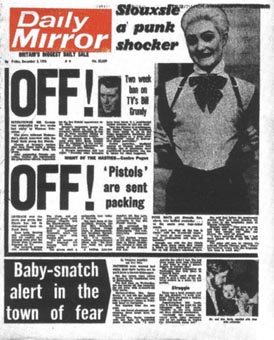
If there was one event that led to the explosion of UK Punk it was the Today interview; it filled the tabloids for a week. Siouxsie graced the front page of the Daily Mirror with the headline "Siouxsie's a punk shocker."

The Bromley Contingent would also figure in the other great Sex Pistols public relations windfall, the boat-ride-turned-police-melee on the Thames during Queen Elizabeth II's Silver Jubilee anniversary celebration, June of 1977. But by that time Siouxsie and Severin had stopped being groupies and started performing regularly and writing songs as Siouxsie and the Banshees. Peter Fenton was added as a guitarist; Kenny Morris, on drums.

To hear what the band sounded like in its Punk heydey listen to the demo recorded for EMI the same month as the Pistols police melee on the Thames.

Shortly after recording the EMI demo, Fenton is replaced on guitar by John McKay. The early Sioux-Severin-Morris-McKay can be heard in the Peel Sessions from November 1977.

We're still in the Punk period. Never Mind the Bollocks has been released at the end of October.

The next Peel Sessions appearance, from early February 1978, a half month after the Pistol's Winterland implosion, still has a Punk vibe. But something has changed. Something has shifted. One can hear that in "Hong Kong Garden," which would reach number seven on the UK Singles Chart at the end of summer.

By this time the band is in the studio with producer Stephen Lillywhite recording their debut album, The Scream (1978), which is released in November.


The Scream is a great album that was well received and peaked at number 12 on the UK Albums Chart. I would class it as one of the main pillars of Post-Punk along with Metal Box (1979), Entertainment! (1979) and Unknown Pleasures (1979). "Overground" is an incredible song:


Siouxsie and the Banshees 1979 followup album, Join Hands, is generally not as well received as The Scream.


In particular, the studio reprise of "The Lord's Prayer," the song that began it all for Sioux and Severin, is usually panned by the critics. But I think it is an exceptionally strong record.

There is tendency to downplay the excellence and the impact of The Scream and Join Hands, partly I think because of the success of Kaleidoscope (1980) and Juju (1981), albums which will be our focus next Friday. Siouxsie and the Banshees as time rolled on would be thought of mostly in relation to these two albums, as well as A Kiss in the Dreamhouse (1982). But in doing so I think we've missed out on some of the richness of Post-Punk.

Friday, August 2, 2013

Hippies vs. Punks: Subway Sect


Tonight, we're at halftime of the The Last Waltz posts. So it's time for a breather. Next week Hippies vs. Punks will return to The Last Waltz for part three, the main focus of which will be Music From Big Pink. Then on Friday, August 16, we will conclude with The Brown Album.

In the meantime, let's look at a band that performs at the seminal 100 Club Punk Special in London two months before The Last Waltz concert is staged in San Francisco. The 100 Club Punk Special is considered a seminal event because it marks a dividing line, according to an excellent interview with Punk promoter Ron Watts, between the close-knit London pub scene that spawns Punk -- what most people think of when they think of Punk -- and the national and then international celebrity that soon follows (and in so doing hastens the Hippies' extinction).

The Punk festival happened over two nights in September of 1976 just before the equinox. It featured big hitters like the Sex Pistols, The Clash, The Damned and Buzzcocks. But there were other lesser known bands that performed. One, Subway Sect, so named because they first played together busking in the Hammersmith subway, kicked things off. True to previous posts where I explore undercard bands at Hippie music festivals like the Aquarian Family Festival and the Cincinnati Summer Pop Festival, I thought tonight I'd do the same with the 100 Club Punk Special.


Led by singer/songwriter Vic Godard, Subway Sect formed after seeing the Sex Pistols. They were managed by the same guy, Bernie Rhodes, who managed The Clash, for whom the band warmed up on the White Riot tour in 1977. Subway Sect then recorded an album with Rhodes, after which he shit canned the entire group except for Godard. The album went unreleased and was lost except for the single "Ambition," released in 1978, and some tracks that eventually showed up on the 1999 Twenty Odd Years compilation (which sells new for $3K on Amazon!):


The original Subway Sect lineup released only two singles -- "Nobody's Scared" b/w "Don't Split It" (at the top of the post) and "Ambition" b/w "A Different Story." Thank goodness then for the Peel Session from October 1977. I have been listening to it all week -- "Chain Smoking" kicks ass! -- and it captures the punch -- the mojo -- that first iteration of the group had working in 1977:


The young Vic Godard was a skilled songwriter with the looks of Another Side of Bob Dylan Bob Dylan; he sounds at times like Richard Hell, Johnny Rotten and Pete Shelley ( -- a prism of first wave Punk, Godard sings better than all three); plus, he strikes me as a good guy. Reading a November 1976 interview with him in the punk zine Sniffin' Glue, his sincerity and earnestness shine through.

Godard reformed Subway Sect as Vic Godard & Subway Sect with a different set of players. He put out three more albums (two with Subway Sect and one solo effort) and moved through styles -- swing and jazz -- before going to work for the postal service in 1986.

There's a great interview that Godard does with 3:AM magazine from 2002 after he finished working on his Sansend album. (Three of these songs are available as Lazy So and So for MP3 download from Amazon; I've enjoyed listening to it, particularly on the morning train into work.) Godard talks about the process of trying to be creatively productive (i.e., perform and produce an album) while holding down a full-time job. As far as I'm concerned, it's a feat of heroism. Here's his description:
Sansend -- it took years to put it together. Because, really, we were only working on Sunday afternoons. A lot of the time we'd arrive at about six thirty on a Sunday afternoon, so that's why it took so long. There was the odd evening session, but with me being uninformed, and my mate in the group who does all the computer side of it, he's a carpenter, so his hours are basically about ten until six, so by the time he'd finished his carpentry and got down there it took you till about seven thirty and then I've got to be up at four or five the next morning which meant we couldn't work much beyond nine thirty. So we did start off at the beginning with the evening sessions, but we soon reverted back to Sunday afternoons. That explains why there are so many ideas running around in the album. We recorded quite a lot of songs on top of the ones we've put out. The first fourteen that came to us that gelled really well we worked on and we abandoned about six songs I suppose. We just didn't bother working on them. It was all done on a Mac and he was learning it from scratch. So at the beginning it was really slow because he was learning. I wrote all the lyrics except the reggae one which was written by Ken Wisdom. I've changed the odd bits to fit in with what he wrote. He didn't write it to that tune. He gave me a set of lyrics so I fitted them to a tune. So I had to change the odd bit here and there. But it's basically the same.
Godard maintains an active website which features an interesting blog. It's human and alive and not made opaque by commercialism. He continues to tour and make music. He is an exemplar of Punk revolutionary spirit: