As a regular feature of Hippies vs. Punks we have been exploring the undercard of some prominent music festivals of the era. For the Hippies, we have dipped into the Aquarian Family Festival of May 1969 and the Cincinnati Summer Pop Festival of June 1970. For the Punks, it is harder because they eschewed anything that smacked of Hippiedom, and the multi-day or daylong music festival was a Hippie-era staple.
The one storied Punk music festival is known as the 100 Club Punk Special, which took place on two nights, September 20 and 21, 1976, at the 100 Club in London. The headliners were Sex Pistols, The Clash, The Damned, and Buzzcocks; basically, a hall of fame of first wave UK Punk. The undercard featured Subway Sect (explored in a previous Hippies vs. Punks post) as well as the first-ever appearance of Siouxsie and the Banshees (with a pre-Pistols Sid Vicious on drums).
The story goes that Siouxsie Sioux and Steven Severin, Sex Pistols groupies who belonged to the Bromley Contingent, pushed their way into a slot at the 100 Club Punk Special that was vacated at the last moment. With future Adam and the Ants lead guitarist Marco Pirroni, Siouxsie and the Banshees took the stage after Subway Sect and played a medley of the "Lord's Prayer," Twist and Shout," "Deutschland Uber Alles," and "Knocking on Heaven's Door." As Siouxsie describes it in a Soundsarticle from 1977, "That 100 Club gig/the intention was to play one number until they threw us off the stage/but they never did/we had to end it."
Siouxsie and Severin would next appear on a stage of a different sort. In December of 1976 the Bromley Contingent appeared on the Today evening TV program and were interviewed along with the Sex Pistols by host Bill Grundy. Siouxsie, stunning with platinum blonde hair and Hippie-ish face paint, coquettishly says she has always wanted to meet Bill Grundy, which prompts Grundy to lewdly suggest an assignation after the show. This sets Steve Jones off on a string of profanity. Words never heard on English TV. The rest, as they say, is history:
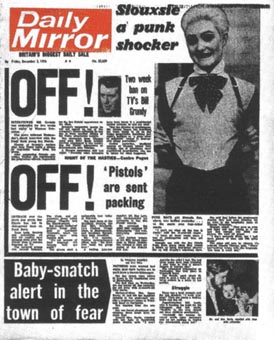
If there was one event that led to the explosion of UK Punk it was the Today interview; it filled the tabloids for a week. Siouxsie graced the front page of the Daily Mirror with the headline "Siouxsie's a punk shocker."
The Bromley Contingent would also figure in the other great Sex Pistols public relations windfall, the boat-ride-turned-police-melee on the Thames during Queen Elizabeth II's Silver Jubilee anniversary celebration, June of 1977. But by that time Siouxsie and Severin had stopped being groupies and started performing regularly and writing songs as Siouxsie and the Banshees. Peter Fenton was added as a guitarist; Kenny Morris, on drums.
To hear what the band sounded like in its Punk heydey listen to the demo recorded for EMI the same month as the Pistols police melee on the Thames.
Shortly after recording the EMI demo, Fenton is replaced on guitar by John McKay. The early Sioux-Severin-Morris-McKay can be heard in the Peel Sessions from November 1977.
We're still in the Punk period. Never Mind the Bollocks has been released at the end of October.
The next Peel Sessions appearance, from early February 1978, a half month after the Pistol's Winterland implosion, still has a Punk vibe. But something has changed. Something has shifted. One can hear that in "Hong Kong Garden," which would reach number seven on the UK Singles Chart at the end of summer.
By this time the band is in the studio with producer Stephen Lillywhite recording their debut album, The Scream (1978), which is released in November.
The Scream is a great album that was well received and peaked at number 12 on the UK Albums Chart. I would class it as one of the main pillars of Post-Punk along with Metal Box(1979), Entertainment! (1979) and Unknown Pleasures (1979). "Overground" is an incredible song:
Siouxsie and the Banshees 1979 followup album, Join Hands, is generally not as well received as The Scream.
In particular, the studio reprise of "The Lord's Prayer," the song that began it all for Sioux and Severin, is usually panned by the critics. But I think it is an exceptionally strong record.
There is tendency to downplay the excellence and the impact of The Scream and Join Hands, partly I think because of the success of Kaleidoscope (1980) and Juju (1981), albums which will be our focus next Friday. Siouxsie and the Banshees as time rolled on would be thought of mostly in relation to these two albums, as well as A Kiss in the Dreamhouse (1982). But in doing so I think we've missed out on some of the richness of Post-Punk.
To bring to a close a series of posts on the famous Winterland concert of January 14, 1978 -- the last show of the Sex Pistols, the event designated as the moment that Punk ended, the first wave at least, and Post-Punk began -- today's Hippies vs. Punks will look at the Avengers, the San Francisco band fronted by archetypal Punk lead singer Penelope Houston. All bands that performed that night, and even the one that didn't, will have thus been dealt with: Sex Pistols, The Nuns and Negative Trend. However meager the final product, there is something to be said for completion.
It is fitting that today, the 50th anniversary of the assassination of John F. Kennedy, is the day that we finish off the Sex Pistols' final show at Winterland. Previously, we argued that the Age of Aquarius begins the summer of 1964 with the cross country psychedelic bus trip of Ken Kesey and the Merry Pranksters to the New York World's Fair, the same time the Gulf of Tonkin Resolution is passed in Congress paving the way for the expansion of American involvement in the Vietnam War.
For several decades debate has raged in Kennedy assassination circles, largely I think due to Oliver Stone's JFK Hollywood blockbuster, whether the main motive of the conspirators who killed Kennedy was to prevent him from pulling U.S. troops out of Vietnam. John Newman wrote an influential book, JFK and Vietnam: Deception, Intrigue, and the Struggle for Power (1992), that placed special significance on one of LBJ's first official acts as president: to sign a National Security Action Memorandum (NSAM 273) committing the United States to militarily prop up the rotten government of South Vietnam. Noam Chomsky entered the fray with Rethinking Camelot: JFK, the Vietnam War, and U.S. Political Culture (1993) arguing that Kennedy was the ultimate Cold Warrior and that he had no intention of withdrawing from Vietnam.
The Hippies begin with the Vietnam War and end with the Vietnam War. First wave Punk occupies that important place where the Hippies die off and the tentacles of neoliberalism and neoconservatism are attached to the body politic. That's why it is so important in these End Times of the death throes of neoliberalism and neoconservatism that we go back and evaluate the period of first wave Punk, 1975 to 1979, in order to look for answers and see what mistakes were made and what was gotten right.
The Avengers have a nice take on the Kennedy assassination in "The Amerikan in Me," riffing on Kennedy's inaugural "Ask not what your country can do for you":
It's the American in me that makes me watch the blood
running out of the bullethole in his head.
It's the American in me that makes me watch TV
see on the news, listen what the man said.
He said
"Ask not what you can do for your country
what's your country been doing to you
Ask not what you can do for your country
what's your country been doing to your mind?"
It's the American in me says it an honor to die
in a war that's just a politicians lie
It's the American in me that makes me watch TV
see how they burn the SLA
They say
"Ask not what you can do for your country
what's your country been doing to you
Ask not what you can do for your country
what's your country been doing to your mind?"
In the USA!
In the USA!
In the USA!
It's the American in me that makes me watch the blood
running out of the bullethole in his head.
It's the American in me that never wonders why
Kennedy was murdered by the FBI (said)
Thanks to the recommendation of my buddy Oliver, I purchased a copy of the eponymous Avengers (1983), also known as the Pink Album, not too long, probably one year, after its release. I picked it up new at Rasputin Records, which tells me that at that point, late 1984, the record was still easily found and not the rarity it would become.
I played the LP a lot. I remember I copied it onto cassette tape for a high school buddy at Stanford whose musical tastes tended toward the commercial mainstream. I had a decent stereo; not connoisseur-level great, but a cut above your average undergraduate's sound system. It was a Marantz receiver, turntable and cassette tape player with a pair of fairly large big-woofer'd speakers made by a local company in Sunnyvale. I ran a patch jack from the receiver to a Toshiba boom box, allowing me to use the boom box's speakers as auxiliaries; this provided me a rich mid-range sound; it also provided the bonus, through use of the boom box's condenser mic, to add my singing voice to whatever album I was copying to cassette tape.
I only took advantage of this technical feature once. It was on a night I was making a tape of Avengers for my Stanford buddy Kevin. I was drunk and I moaned along with Penelope Houston on "Car Crash."
Later Kevin would say that whenever he had friends over to his dorm room sitting around drinking beer and they were listening to the cassette of Avengers I had made he would have to spring quickly to his stereo and fast forward past that part of the tape to save him and me from embarrassment.
In any event, the Pink Album was put together by drummer Danny Furious a few years after the band broke up in 1979. Penelope Houston describes the process in an excellent interview with rock 'n' roll historian Richie Unterberger:
I moved to England, and before I left the country--this was in '81, '82--Danny [Furious], who was the drummer, was living in San Francisco trying to ask me for any tapes I had or photos. Because he wanted to get an album together. I think I sent him some stuff. The album originally came out on Go! Records, which were partners with David Ferguson [of CD Presents]. They had some falling out. He ended up suing them, and preventing them from releasing that record when they had already printed up 1000 record covers. Every now and then you can see those in collections. But I was in Europe, and basically he was dealing with Danny. So he had Danny's permission to put it out on his label.
At some point, I think that the other guys said hey, what about us? Because Danny was getting these producer advances. So then Jimmy came on board, Jimmy Wilsey, and he was doing something with it. Because he felt that Danny was not handling it. When I came back to San Francisco, I called up Ferguson's. I said, "You've put all this stuff [out], you haven't even asked me. And you haven't given me money, you haven't sent me any contract." He said, "Oh, yeah, come on in." I was visiting, actually, I hadn't moved back. I called and called and called. I tried to contact him from the U.K., where I was living. I went to his house, and as soon as I was there on his door, somebody said, "Oh, I have some contracts for you to sign now!" So he gave me a small advance. That was the last money that I ever saw from him. It came out as a CD after that. Of all the CDs that have sold of that record, I've seen zero royalties.
It would have been great if somebody might take it upon themselves to wrest the rights from CD Presents, because they really don't exist as a label anymore. They can sell the rights. Since he hasn't paid the band their royalties or their publishing...at one point I got together with Jimmy and Greg [Westermark], and we went and saw a lawyer. Danny was living in Sweden. To see what we could do to get back the publishing. The contract that was signed was so horribly written that not only did we get nothing, not only that we didn't get the pittance that was accorded to us on the contract, but you couldn't take it to court, it had to be settled in arbitration or something like that. The lawyers just looked at it and said, "This is fucked." We didn't have the money to throw at it. I keep hoping that someday some label will decide to write them a letter and see what they're willing to do. In the meantime, we haven't gotten anything. The last time we saw any money from them was over ten years ago. I don't know what it really sold.
It is a great album. I think it is the closest that an American band came to the sound and vibe of Never Mind the Bollocks, Here's the Sex Pistols (1977). For that reason alone it is an amazing record.
Steve Jones produced one of the band's two EPs, Avengers (1979), which appeared shortly after the band split up. Two of the songs -- "White Nigger" and "Corpus Christi" -- end up on the Pink Album. You can hear the signature Steve Jones Sex Pistols guitar sound on "White Nigger"; it is one of my favorite cuts:
Penelope Houston is the perfect counterpart to Johnny Rotten. She is a pure manifestation of West Coast egalitarian femininity and strength. When you listened to the Avengers there was never any questioning Penelope Houston's sexual identity. Yet she never vamps. It is a feminine persona that is tough -- you would never dare imagine fucking with Penelope Houston -- but also waifish and vulnerable. There is no other first wave Punk lead except for Johnny Rotten who taps into that untouchable, unassailable white light of youth, the ultimately rare type of soul who you would follow over the ramparts to a certain death because she is so pure, so true.
The 2012 digital-download version of the two-disk Pink Album, available on Penelope Houston's web site, is a must-have. I imagine as the years wind on Avengers will continue to grow in importance and it will come to be seen -- if it isn't already -- as one of the seminal recordings of first wave Punk..
Though "Second to None" and "Corpus Christi" appear on side two of the 1983 vinyl LP, the songs I mostly remember from my college days are "The Amerikan in Me," "White Nigger," "Car Crash," the cover of "Paint it Black," and of course "We Are the One." Hearing these two tracks today they both sound really good. Below are recent performances of "Second to None" and "Corpus Christi":