Showing posts with label $15/hr minimum wage. Show all posts

Thursday, November 19, 2015

Black Lives Matter: The Only Game in Town

There is a good story, sort of a roundup, on Black Lives Matter by John Eligon ("One Slogan, Many Methods: Black Lives Matter Enters Politics"). At this point, as I see it, Black Lives Matter is pretty much "the only game in town," if you exclude efforts to struggle in the Augean Stables of the duopoly. The $15 Now movement has largely been adopted by the mainstream. Efforts continue to raise the minimum wage at the city level and for large university systems, but by and large $15 Now has carried the day.

Ferguson, where Black Lives Matter took off, is now almost a year-and-a-half gone, but Black Lives Matter, as Eligon's piece makes clear, is still going strong. It has plenty of grass-roots mojo, as well as insider chops. In a potentially troubling sign, a Black Lives Matter super PAC is being set up, as Eligon reports, to raise money from wealthy Democrat funders:
“At this point, marching and protesting, it’s not going anywhere,” said Tarik Mohamed, treasurer and a founder of the super PAC. “So we’re trying to find new avenues of engaging people for change.” 
And, in a sign of its growing influence, the movement is attracting the attention of deep-pocketed Democratic donors, who met with activists in Washington this week to discuss how they can support the budding movement.
*** 
The Black Lives Matter Super PAC, in addition to contributing to campaigns next year, hopes to capitalize on new technology, such as virtual reality software, to help people understand experiences like solitary confinement, Mr. Mohamed said.
Members of the Democracy Alliance, an influential club of liberal donors, met on Tuesday with groups allied under the Black Lives Matters banner — including ColorOfChange.org, Black Youth Project 100 and the Black Civic Engagement Fund — to discuss possibly directing funds to the movement, said Leah Hunt-Hendrix, an alliance member. The organizations represented only a sample of the groups that donors wanted to shed light on, she said.
“It was just a really real conversation about the complexities of funding movements and the need for more infrastructure, especially black-led infrastructure,” said Ms. Hunt-Hendrix, who has inherited wealth from an oil company her grandfather started. 
Specific funding commitments were not made, she said, and it would be up to individual donors to follow up with organizations they want to support.
“We don’t want to raise expectations that this is a secretive group of donors hoping to raise tons of money,” she said.
As soon as "gee whiz" whiz-bang technology is trotted out as a growth strategy for a social movement run for the hills, preferably the Sierra Maestra.

Nonetheless, Black Lives Matter has been around now and is organizing, growing and influencing perception and governance longer than Occupy Wall Street, an organization I thought would be able to successfully redefine itself with its Occupy Sandy volunteerism after its main encampment was demolished. No such luck,

There needs to be an egalitarian mass movement that is not appropriated by one of the two devilish hands of the duopoly. Obama's legacy will be that he proved adept at suckering people back into belief and participation in a corrupt and failed political system. There are no avatars of the mainstream who will better our lot because the mainstream is choked with lies and is sped along by warfare and concentrated wealth.

There is a powerful, expanding understanding that the system has failed. Black Lives Matter so far has walked the talk.

Wednesday, May 20, 2015

Los Angeles $15/Hr. Minimum Wage Huge Win


Leadership of mainstream political parties, zombies of a bankrupt and corrupt neoliberal consensus, got a jolt yesterday as the megalopolis of Los Angeles adopted a $15/hr. minimum wage. Jennifer Medina and Noam Scheiber have the story, "Los Angeles Lifts Its Minimum Wage to $15 Per Hour":
LOS ANGELES — The nation’s second-largest city voted Tuesday to increase its minimum wage from $9 an hour to $15 an hour by 2020, in what is perhaps the most significant victory so far for labor groups and their allies who are engaged in a national push to raise the minimum wage.
The increase, which the City Council passed in a 14-to-1 vote, comes as workers across the country are rallying for higher wages and several large companies, including Facebook and Walmart, have moved to raise their lowest wages. Several other cities, including San Francisco, Chicago, Seattle and Oakland, Calif., have already approved increases, and dozens more are considering doing the same. In 2014, a number of Republican-leaning states like Alaska and South Dakota also raised their state-level minimum wages by ballot initiative.
The effect is likely to be particularly strong in Los Angeles, where, according to some estimates, almost 50 percent of the city’s work force earns less than $15 an hour. Under the plan approved Tuesday, the minimum wage will rise over five years.
“The effects here will be the biggest by far,” said Michael Reich, an economist at the University of California, Berkeley, who was commissioned by city leaders to conduct several studies on the potential effects of a minimum-wage increase. “The proposal will bring wages up in a way we haven’t seen since the 1960s. There’s a sense spreading that this is the new norm, especially in areas that have high costs of housing.” 
The groups pressing for higher minimum wages said that the Los Angeles vote could set off a wave of increases across Southern California, and that higher pay scales would improve the way of life for the region’s vast low-wage work force. 
Supporters of higher wages say they hope the move will reverberate nationally. Gov. Andrew M. Cuomo of New York announced this month that he was convening a state board to consider a wage increase in the local fast-food industry, which could be enacted without a vote in the State Legislature. Immediately after the Los Angeles vote, pressure began to build on Mr. Cuomo to reject an increase that falls short of $15 an hour.
Opponents of the $15/hr. minimum wage hide behind small business owners, arguing that it will force them to close their doors. This is a red herring akin to trotting out the family farm when it comes time to call for a repeal of the estate tax or similar to USG claims that Shiite militias have to be sidelined in order to prevent the spread of sectarianism as Islamic State rampages.

If you have been to any urban core lately, you will have noticed, as I did recently on a trip to the Bay Area, that there are very few independent, small business retailers left standing. The overwhelming number of the storefronts I saw were corporate chains. The Bay Area I grew up in always had a large number of vibrant, independent small businesses, part of the legacy of being a Hippie Mecca. No longer.

As the Medina and Scheiber story makes plain, neoliberal Democrats like Andrew Cuomo are now on the hot seat. It is "shit or get off the pot" time for captive politicians. This minimum-wage wave is robust in red states too, as victories in Alaska and South Dakota during the GOP landslide of the 2014 midterms prove.

Over the weekend I finished Tariq Ali's The Extreme Centre: A Warning (2015). Ali takes us on a tour of Western democracies, focusing principally on the UK, since the collapse of communism in the late 1980s/early 1990s. The mainstream parties have morphed into de facto permanent neoliberal government cannibalizing the remnants of the post-WWII social order.

I mentioned in a post last month that Ali thinks that there is plenty of juice left in U.S. global hegemony. All talk of a "decline of the U.S.-led West" is wishful thinking. The one wild card Ali does hold out is popular reaction. As the mainstreams parties have cohered into an extreme center, they have become almost totally divorced from the 99% they nominally represent. This creates an opportunity for new parties to form, at least in parliamentary systems where party formation isn't impossible. So you have Syriza, which has been locked in a death struggle with enforcers of neoliberal austerity, the troika, since it came out on top in Greece's January elections. And you have Podemos in Spain, which will get a chance this Sunday in municipal and regional elections.

In the U.S., the only game in town is $15 Now. Well, that's not true. There's the #Black Lives Matter movement, which has, in less than a year, re-framed centuries of policing and racial stereotypes. Whites are moving toward minority status in the U.S. Obama, in Camden, NJ on Monday, announced that he was curtailing the Pentagon pipeline of surplus hardware to local police.

The LA $15 minimum wage and the shift underway in racial perceptions are huge gains and bode ill for business-as-usual neoliberalism. A mainstream party will win the election next year, but the ground is shifting. Change is coming.

Thursday, April 16, 2015

$15 Now Last Gasp for Organized Labor

Yesterday was another nationwide mobilization to demand a $15-an-hour minimum wage for low-wage workers. The fast-food industry has been the principal target. Service Employees International Union (SEIU) is the key labor organization spearheading the push. For instance, SEIU ran the successful 2013 initiative campaign for a $15/hr. minimum wage in SeaTac, the city that is home to Seattle's airport, at the same time it provided valuable support in socialist Kshama Sawant's victory over an entrenched corporate liberal Seattle City Council incumbent. Sawant's win paved the way for Seattle's breakthrough $15/hr. minimum wage, which was copied, in one form or another (usually a lower rate of pay), in other cities and states.

"In Test for Unions and Politicians, a Nationwide Protest on Pay," by Noam Scheiber, provides background and an overview to yesterday's 200-city-plus protest. It is a good story.
“America, period, is unequal,” said Chasten Florence, 26, a construction worker from Jamaica, Queens. “Once we accept that, we can change that." 
McDonald’s said in a statement: “We respect people’s right to peacefully protest, and our restaurants remain open every day with the focus on providing an exceptional experience for our customers.” 
The campaign, staffed in part by organizers from the Service Employees International Union, orchestrated the country’s first-ever fast-food industry strike in November 2012, when 200 New York City workers walked off their jobs. The periodic protests expanded to six other cities in the spring of 2013, 60 cities in August of that year, 150 cities in May 2014, and 190 last December. 
The protests have coincided with an extraordinary shift in the political consensus on the minimum wage. In the last two years, Seattle has moved to gradually increase its minimum wage to $15 an hour, from $9.32. Oakland, Calif., established a new minimum wage of $12.25, while Chicago approved an increase to $13, from $8.25, over the next four years. Alaska and Arkansas passed minimum wage increases by referendum in 2014. 
In 2013, President Obama endorsed raising the federal minimum wage to $9, from $7.25 an hour, then increased that to $10.10 by the fall of that year. Democrats in the Senate are now working on a proposal to raise the national minimum wage to $12 by 2020.
But there was not a peep about the event yesterday in my place of employment, and I work for a union. And that is the problem. There is a yearning on the part of the broad public for a change in working conditions, which Scheiber makes clear, but, besides SEIU, the other big international unions have shown no ability to capitalize on the unrest.
“The labor movement has been stuck,” said Janice R. Fine, an associate professor of Labor Studies at Rutgers University. “They deserve a lot of credit in deciding that, in a situation this bleak, you needed ‘climate change’ ”— that is, a change in how the public views low-wage work — “before you’d actually get an opportunity to organize again.”
Partly in response to the political shift as well as competitive pressure from tighter labor markets, several major employers of low-wage workers have moved to raised their base pay in recent months. Walmart, Target and McDonald’s have all announced plans to increase their minimum wage to or near $10, though for McDonald’s it would apply only to the roughly 10 percent of its workers employed directly by the company, not by its franchisees.
But business groups argue that a substantially higher increase would force employers to reduce hiring, accelerate automation and even threaten the basic economic model of some industries.
For Mary Kay Henry, the president of S.E.I.U., the investment in the Fight for $15 campaign was initially controversial among her colleagues, many of whom wondered why the union should spend millions of dollars on a campaign that did not immediately net it dues-paying members. 
But it was the result of a calculation that the 20th-century model of organizing workers was rapidly becoming obsolete for those in a growing sector where employers considered it essentially costless to replace them. “We can no longer change our lives, and our kids’ lives, without the support of a broader movement of workers,” Ms. Henry said.
The origins of the Fight for $15 campaign date back to early 2012, when organizers from New York Communities for Change, which had built support for Occupy Wall Street activists among more established progressive activists and labor organizers, began canvassing low-income New Yorkers, many of them employed in the fast-food industry.
At the same time, public opinion was shifting. According to the General Social Survey, regarded by researchers as the gold standard in public opinion data, the share of Americans who agreed that “inequality continues to exist because it benefits the rich and powerful” spiked by more than 10 points from 2010 to 2012, to over 60 percent.
“People know Walmart and McDonald’s are doing pretty well, people at top,” said Leslie McCall, a professor of sociology at Northwestern University, who has closely analyzed the opinion data on inequality. “It was like: ‘Wait a minute. We’re into the recovery, the unemployment rate is going down. But most people aren’t doing well.’”
Even politically moderate voters appear to believe that it is the responsibility of corporations to mitigate the problem. In her own preliminary surveys, Professor McCall found that, when asked to choose who should be most responsible for reducing inequality — the poor, the rich, the government, major companies, or that it did not need to be reduced — a plurality of Republican respondents, about 37 percent, chose “major companies.”
The Fight for $15 campaign hopes to harness these sentiments in ways that Occupy Wall Street never quite succeeded in doing. In Seattle, Steve Gelb, who makes above minimum wage at a work force training outfit, said he supported the protests because “the disparity of wealth has reached alarming proportions and the salaries of business owners and executives are way out of proportion.”
There is some evidence that the big internationals headquartered in D.C. are beginning to get the message. But it is not about income inequality and economic justice and the need for a broad mobilization of low-wage workers. What the big, wealthy internationals are afraid of is the rapid spread of right-to-work laws, some of which are being passed at the local and county level. The right senses weakness and fear and it is lunging for the jugular. Right to work has become a new litmus test for Republican governors. Wisconsin's Scott Walker is the matinee idol of the movement. His chances of winning the GOP presidential nomination are as good as anyone's.

The math on right to work is unforgiving. Once passed it quickly leads to a loss of 20 percent in union dues-paying membership. So the message that is coming from on high is not "We need to mobilize our membership and develop a radical consciousness," it is, "We need to get our budgets in line with a possible 20-percent loss in operating revenue. We need to think about a dues increase."

Unions are gray at the top and completely captive to business-as-usual, conventional thinking. There is zero ability to transform into a radical organization capable of spearheading progressive social change. The guys at the top are all about dollars and cents and the size of their pension funds and the amount of bonus miles they have on their credit cards. They have their eyes on retirement. They'll willingly file aboard the Titanic of Hillary's presidential campaign and argue that it is a vessel for working people.

Even SEIU, a local of which I have worked for, is a conventional, top-down, tyrannical hierarchy that produces a culture of mendacity. Our problem is that it is the only game in town. There needs to be a new leftist political formation. At least SEIU has shown a willingness to work with a socialist like Kshama Sawant.

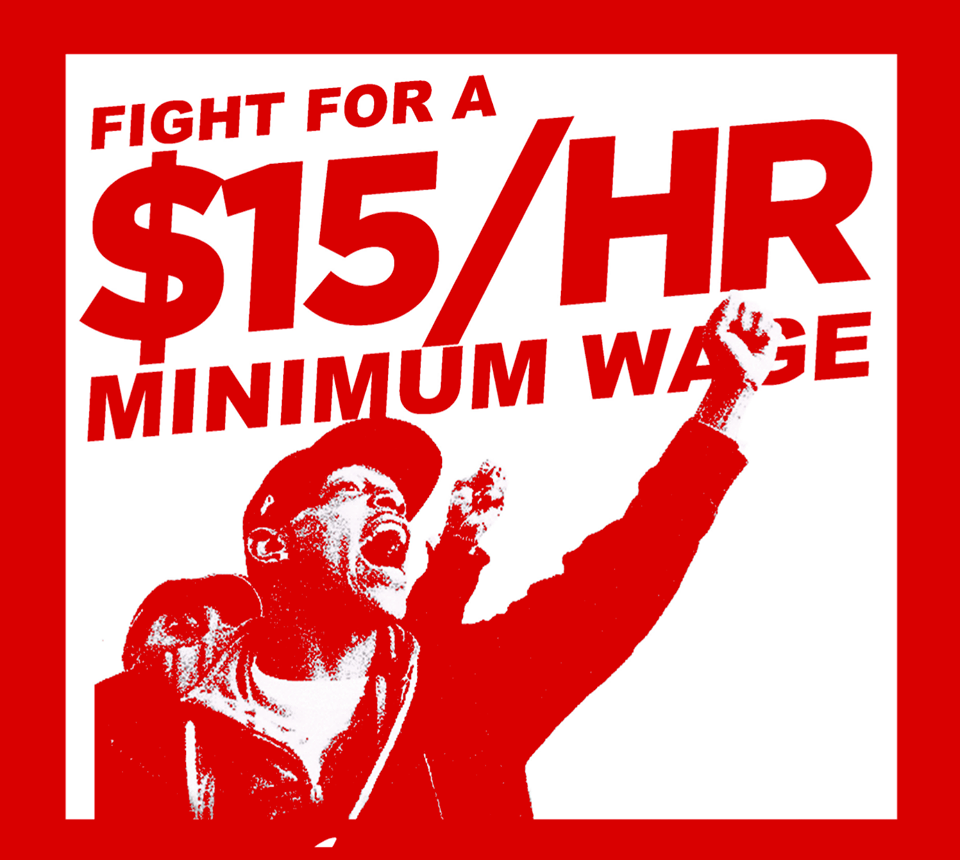
Wednesday, April 8, 2015

Fast Food and the Political Mainstream

Two interesting items this morning that point in the same direction while dealing with different subjects -- political parties and fast food.

Support for mainstream, established political parties is collapsing in Europe (the same could be said of the United States) at the same time fast-food behemoth McDonald's is losing market share and engaging in a panicked makeover as a “modern, progressive burger company.”

Steven Erlanger addresses the former in the story "As Europe’s Political Landscape Shifts, Two-Party System Fades." A longtime Gray Lady foreign correspondent, Erlanger is presently based in London. His story looks at the May 7 general election in Britain, where Labour and the Conservatives are expected to win less than two-thirds of the vote, requiring the formation of another coalition to govern; but he ranges over the continent as well, providing helpful sketches of the rise of splinter parties in Germany, France, Italy and Spain:
The fragmentation of traditional party voting is increasing all over Europe. Fueled by the last recession and enabled by social media, issue-oriented or protest parties have cropped up everywhere in response to the failure of governments to deliver economic growth and security. The days of a “broad church” party and governments formed by a single party are fading. 
And turnout in national elections has been falling since the 1970s in most Western countries, raising new questions about the health of democracy as multinational corporations and institutions like the European Union, the European Central Bank and the International Monetary Fund influence national decisions.
A.k.a., the triumph of neoliberalism:
Charles Grant, director of the Center for European Reform, emphasizes the failure of the European center-left to keep its promise “to create growth and redistribute it to make a fairer society.” With the decline of the manufacturing sector and weaker unions, the left has been forced to buy into the orthodoxy of market economics, which “means their core support has been hollowed out here,” he said, as in France, Germany and Sweden.
“The center-left seems intellectually dead,” Mr. Grant said, little different from the center-right. “So you see alternatives on the far left like Die Linke, Podemos and Syriza,” he said, referring to the Left by its German name.
Meanwhile on the right, he said, politicians and elites are increasingly unpopular, blamed for the 2008 economic crash, the euro crisis, stagnant growth, austerity and the bailing out of bankers.
The combination of low economic growth, high debt, surging migration and increasing anti-Muslim sentiment provoked by terrorism has put the European Union itself under great strain, he said. There is a strong anti-austerity feeling on the left and a strong anti-immigration feeling on the right — and neither issue can be easily managed by national governments or coalitions.
The problem for those of us who are citizens of the United States is that we don't have a parliamentary system of government; instead we have one of the most corrupt, anti-democratic democracies in the world. The mainstream, established parties, the Democrats and Republicans, absent a mass uprising bordering on the revolutionary, cannot be broken. The barriers to third parties and independents are practically insurmountable. This means that the U.S. will not be able to communicate the general will of the people with the growth of a Syriza or a Podemos or a Sinn Féin.

Faced with this type of political stasis, perfectly captured by yet another Bush v. Clinton match-up, people will choose to stay home and not vote. My sense is that there is a little more juice in the GOP right now since they recently had to undergo an emergency Tea Party re-branding when all appeared lost with Obama 2008. So there is a decent chance that Scott Walker will beat Jeb, improving the party's hope to win the White House next fall. As for the Democrats, since they are truly "intellectually dead" and captive to big money, I don't see Hillary being beaten in the primary at this point.

Given the lack of meaningful outlets for people to express themselves politically in the U.S., change is being registered in patterns of consumption. There is a pervasive feeling that something is terribly wrong. We as a species are picking up warning signs, and in response we are choosing to alter what we eat, which is where Mark Bittman's morning column on troubles ("15 percent drop in its United States operating income in the last quarter of 2014") for Ronald McDonald comes in, "McDonald’s Turns ‘Progressive’":
McDonald’s can’t get a break. In the last two months, the company has made several well-publicized big announcements that were widely greeted with yawns or jeers. 
The first was a decision to phase out chickens raised using antibiotics meant to treat humans. The second was to unilaterally raise the salaries of those minimum-wage workers the company directly employs by at least a dollar an hour, granting a small amount of paid vacation time to company employees and financial assistance for education to all workers in its system. And the third was to begin referring to itself as a “modern, progressive burger company.”
***
 What McDonald’s should do is go all in and really transform itself, because the effect of positive change would be immeasurable. Instead it tries to play it both ways, controlling what franchisees buy and sell but insisting that it cannot dictate how they treat employees. Thus the wage increase touches only around 11 percent of the chain’s workers, and workers immediately decried it as inadequate. (Even Walmart did better.) No one turns down a raise, but this one virtually guarantees that most of the company’s workers will remain eligible for food stamps, thus perpetuating the public subsidy for McDonald’s labor force.
That the nonantibiotic move has taken this long (Chipotle has tried to be antibiotic-free for more than a decade, as has Panera) and is so incomplete — that is, there’s no word about pork or beef, and the move is being phased in — also seems pathetic. (Even more pathetic is the refusal of the Food and Drug Administration to mandate the removal of nonmedicinal antibiotics from animal production, but that’s another story.)
These moves demonstrate that McDonald’s is hardly a “progressive” company but one that is merely trying in a halfhearted way to catch up with changing market norms and to anticipate inevitable regulation.
If McDonald’s were truly progressive, what would it do? It might revamp the menu in favor of sustainably sourced and fresher food (it’s worth noting that in Britain, McDonald’s uses free-range eggs and organic milk), and might increase its workers’ wages (and hours) to something approaching a living wage.
It may be that the biggest beneficiary of McDonald’s recent moves is the food movement, which, smelling blood, continues to apply pressure. (In response to the raise, some demonstrating workers chanted: “Hey McDonald’s, let’s be blunt/This is just a P.R. stunt.”) And that movement continues to gain credibility as it attends more to the rights of humans than those of animals — not that animals don’t matter, but it’s all relative.
It’s great that McDonald’s blinked. I’d love to see it become a truly progressive company — I’d even help them if I could — but if that’s not in the cards, it would be fine to see a continuing decline in its business. Either would be a satisfactory ending to the McDonald’s story.
The chances that McDonald's will become a truly progressive company are about as likely as the Democrats becoming a truly progressive party. It is not going to happen.

Sunday, March 23, 2014

The Colt 45 Chronicle #60

Last Saturday I participated in a march and rally for the $15/hr. minimum wage in Seattle. It was a pleasure, probably the most fun I have had a political event in a decade. There is energy in this movement, thanks to Kshama Sawant's leadership. Her victory against an odious placeholder on the city council was the springboard. But to her credit, Sawant didn't hunker down and try to find her place within the council structure; she immediately set to work keeping her supporters mobilized and growing the movement to achieve a $15/hr. minimum wage in Seattle.

One of the things that was such a pleasure about last weekend's march was seeing the faces of union activists with whom I was friendly and familiar over a decade ago. Some appeared not to have aged at all. They were in the minority. Most had grayed and carried crimson in their countenances. I imagine aging has a lot to do with diet. A meat-based diet combined with alcohol will zap a person, and good. Best to cut down on meat intake and eliminate alcohol altogether once we get into our 40s. Couple these dietary changes with an exercise regimen of some sort -- movement! -- and one should be able to age with a degree of dignity.

The letter below, like #50 (which, based on the number of hits, is for some reason the all-time most popular post of this blog), is addressed to my father-in-law. I wrote it after about six months in the Big Apple. It is a fairly accurate description of Manhattan from the perspective of young man forced to work in its skyscraper canyons -- "Sequestered away in a fluorescently lit office twenty-five stories up with no windows, you begin to feel your masculinity drip away. But not just masculinity, life."

There is of course the backward-glancing reverie about life at the university, which, if you have read any of these "Colt 45 Chronicles," you know that beer-induced nostalgia for campus life is to be expected. I do get off a decent riff about respect being the true foundation of a happy relationship.
Spring 1989
How's the ballgame going Pete? It's been a year since we've seen you. Seems more like two or three. At night you can see the Yankee Stadium lights from our living room window. They reflect off the windows of this big ass concrete government building sitting over there to the east of Harlem. The stadium is just across the river in the Bronx. We walked there last summer; took St. Nicholas Avenue down. Harlem looked good, people had nice faces; it had a comfortableness to it, like a sofa on the porch. I haven't made that walk since then. I was gonna go today (I wasn't working), but the weather was bad and the game was supposed to be televised. So I took a rain check.
I got a new job today. The bad part about it being that it's down in the Wall Street area, which is a very long subway ride from where we live, about thirty minutes longer than the ride I made to my other job. The good part about it is that the work is much steadier, a solid 40 hours a week, with an opportunity to earn some overtime. My other job was only a couple days a week, and sometimes not at all; it depended on the amount of proofreading that had to be done. Yep, that's right.  I'm a proofreader. And I'll tell you, it's hard to accept at times. Sequestered away in a fluorescently lit office twenty-five stories up with no windows, you begin to feel your masculinity drip away. But not just masculinity, life. The women who make these high-rise offices run are the deadest-looking people you have ever seen -- sullen, gray, tortured, tired. Hell, I used to be a teaching assistant, with strawberry blonds in every class; I used to walk the sunny campus greens and stop and chat with friends and drink coffee as the birds whistled songs overhead in trees; I used to haul sheetrock, sucking in the bay fog at 8 AM, skipping lunch and working straight through to the can of beer at the end of the day. Well, that's all over with now. But it's all part of the picture, and it's good because you got give something up sometime. You just have to keep telling yourself that everything is okay and that God is Love and all the rest of that hogwash that only makes sense after you've put your nose to the grindstone.
New York City, like everything else that is truly great, is a well-crafted illusion. The people who make the big money and run the city don't even live here; they're out in Long Island or Connecticut or New Jersey. Greenwich Village can be okay. The West Village is mostly commercial and expensive; the East Village is solid, good places to eat for cheap but not that many good bars. Nothing jumps out and grabs you and says, "We're here!"
I've worked pretty much all over the city, except for post-Uptown, which is where we live. Uptown stops, or people stop talking about Manhattan, around the 90s; and, to give you some indication, we live between 169th and 170th. After the 90s the neighborhoods start to get poor. From 100th to Columbia University (not the medical school, which is where we live, but the actual campus -- 116th) the neighborhoods are black and Hispanic, with a student population tossed in for good measure. After Columbia, Harlem starts. After Harlem, around 150th, Washington Heights starts. That's where we live, or that's what it's called. It has a reputation for being the best place to buy crack in Manhattan; all the big boys sell there. We live a little ways up, smack dab against the Hudson. We have nice safe university housing in a family-oriented Hispanic community. It starts getting exciting about five blocks down. I've been down there a few times very late at night to get some fried chicken, down around 161st, and sure enough you get some royal treatment. People can't imagine what you're doing there at that hour except to buy what they have to sell. The only thing I took exception to was how aggressive they were. I had to fix 'em square in the eye and brush chests just to assure then that I all I wanted to do was get something to eat down the road. But once they perceived my drunken sincerity, they were decent and good-natured and nodded me a goodbye and I was off on my way towards, like I said, the best fried chicken and french fries I've had, and I think Ashley might agree.
I'm still drinking the Coors, but more and more I find myself moving to Colt 45. Ashley and I have a few friends, though nothing like Berkeley -- they're not that close. Ashley and I spend a lot of time together, probably more than since we were first living together, back then in the dark golden ages of the early 80s. We still respect each other, which, if you ask me, is the only thing in any relationship -- the only thing to keep a relationship a relationship and not a servilityship or tortureship.
So what I want to say is that you should come visit us. Anytime you want. We'll be here for the next three-and-a-half years. Another year from now I'll have this city down pat, even better than I do now, of course, because time is time. But I'm doing my research; I'm learning this beast. So when you have the money to pay for a ticket and say $100 spending money, you should make the trip; I'll pay for beers we drink at home. But then again, you wouldn't be missing much; you'd only be shifting your frame of reference, which, I guess, isn't so bad; in fact, it's probably the only thing that's noble, truly selfless, in this life.

Monday, February 10, 2014

Democrats Vulnerable on the Left

Eric Lipton has a decent frontpage story this morning on how the infernal machine that is Washington D.C. works. "Fight Over Minimum Wage Illustrates Web of Industry Ties" details the work of pro-corporate Employment Policies Institute in generating research saying that increasing the minimum wage kills jobs and raises prices.

Employment Policies Institute is funded by right-wing foundations as well as the restaurant and retail industry; it is run by a guy named Howard Berman out the office of his public relations firm:
The sign at the entrance is for Berman and Company, as the Employment Policies Institute has no employees of its own. Mr. Berman’s for-profit advertising firm, instead, “bills” the nonprofit institute for the services his employees provide to the institute. This arrangement effectively means that the nonprofit is a moneymaking venture for Mr. Berman, whose advertising firm was paid $1.1 million by the institute in 2012, according to its tax returns, or 44 percent of its total budget, with most of the rest of the money used to buy advertisements.
The Employment Policies Institute's commissioned research has come under fire:
But some questions have been raised about the institute-funded work. Saul D. Hoffman, a professor of economics at University of Delaware, examined the employment data Mr. Sabia used for a 2012 paper funded in part by the institute. Mr. Hoffman concluded that the narrow cut of data Mr. Sabia picked was perhaps unintentionally skewed, and once corrected, it would have showed that the 2004 increase in New York State’s minimum wage had no negative impact on employment — the opposite of the conclusion the institute had proclaimed in its news releases.
Raising the minimum wage is a vital issue for the Democrats. It is basically the only thing they have to offer voters. Obama's approval rating has taken a nosedive, as Mike Whitney points out in an excellent piece, "The American Dream is Dead," that appeared over the weekend on the Counterpunch web site:
Obama has done nothing to help working people. He hasn’t lifted a damn finger, which is why “58 percent of Americans disapprove of his stewardship of the economy” (Wall Street Journal/NBC News and Quinnipiac University) It’s also why 78 percent said of respondents in a recent Wall Street Journal/NBC News poll said they think the country is “on the wrong track.” And it’s also why Obama’s personal performance ratings have slipped below those of George Bush in the fifth year of his presidency. Obama has been a disaster and everyone knows it. The impact of his misrule with be felt for years to come. Just take a look at this comment by University of Michigan economist Richard Curtain who explains the dramatic change he’s seen in consumer behavior due to the policies that were put in place following the Great Financial Crisis (GFC). The quote is from an analytic piece titled “Consumer Behavior Adapts to Fundamental Changes in Expectations” Economic Outlook Conference November 21, 2013:
“I have been reporting on the economic implications of the latest twists and turns in consumer expectations at this conference for nearly four decades. From the heights of expansions to the depths of recessions, consumers had never deserted their bedrock belief that the economy would produce ever increasing levels of affluence. The Great Recession, unlike any other downturn in the past half century, has not only tarnished the American Dream, but has prompted some fundamental changes in consumer expectations and behavior.” (“Consumer Behavior Adapts to Fundamental Changes in Expectations” Economic Outlook Conference November 21, 2013, University of Michigan)
How do you like that? After 40 years of watching this stuff, Curtin says he’s noticed a “fundamental change” in the “bedrock belief that the economy would produce ever increasing levels of affluence.” 
This is quite profound, I think, with far-reaching implications for the economy. The pessimism that Obama (and Congress) have generated through their policies have dampened expectations and changed people’s views about the future. Most people no longer expect their wages to increase or their financial situation to improve. For a growing number of people, the American dream is dead. This is already having an effect on personal consumption, household spending and economic growth. It’s also effecting the way people view the government, and what we think of ourselves as a nation. As Curtin notes:
(The) “deeply rooted uncertainty about future economic conditions…has been sustained by the growing recognition that no federal policy has yet emerged that will restore long term economic prosperity anytime soon for the majority of consumers. Optimism about long term job and income prospects are essential for maintaining high levels of economic motivation. Too few consumers have regained that optimism.”
Exactly. “No federal policy” has been put in place to “restore long term economic prosperity.”
That’s the whole ball o’ wax, right there. The pols have done nothing. 
The pessimism we now see everywhere, can be traced back to government policy. All the blame goes to Obama and Congress. They’re the ones who ended the American Dream. They killed it.
Not only is the loss of faith in Obama, an electoral avatar, potentially ruinous for Dems in the near term, but so too are the rumblings of socialism. Here is how Robert McChesney describes it in "Sharp Turn Left for Media Reform" (a must-read) in the latest issue of Monthly Review:
U.S. capitalism is in the midst of what Paul Krugman refers to as another great depression. Unemployment remains very high, corporations are sitting on some $1.7 trillion they are not investing in new plants and equipment, and downward pressures on wages are extreme, particularly for the young and the working class. This is part of a long-term problem of secular stagnation for monopoly-finance capitalism, as John Bellamy Foster and I write about in The Endless Crisis. Stagnation, combined with political corruption, means that poverty rates have returned to levels not seen for nearly a century in the United States, and inequality is trending towards that found in Malaysia or the Philippines, with Western Europe and Japan in its rearview mirror. Nothing in the range of current debates on economic policy proposes anything that will change this dynamic. For the bulk of the population, the future is grim. 
The political-economic situation in the United States is therefore unstable and ultimately untenable. When one factors in the environmental crisis, this becomes an even more calamitous and desperate period. What is striking is that all the paeans to the genius of the market, which remain commonplace in policy or academic debates on communication from the respectable left to the right, now increasingly smell like month-old fish left out on a table. While the news has yet to hit the corrupt elites in Washington, academia, or the mainstream news media, it is increasingly understood by a beleaguered citizenry. It is also understood by Pope Francis, who delivered a condemnation of capitalism, and capitalist media, in November 2013 that was unsparing and radical. “No one else,” the journalist Robert Scheer wrote, “has put it as powerfully and succinctly.” 
What is taking place is little short of a sea change. As John Nichols notes, “Thirty-nine percent of Americans surveyed for a November 2012 Gallup poll said they had a positive image of socialism. In a 2011 Pew survey, 49 percent of Americans under 30 said they felt positive about socialism, while just 46 percent felt positive about capitalism. Among African-Americans, 55 percent had a positive reaction to socialism, versus 41 percent to capitalism. Among Latinos, it was 44 percent for socialism, 32 percent for capitalism.” This is especially notable since few Americans have ever heard anything positive about socialism; it would be like a survey in the Soviet Union in 1955 asking people to compare the merits of capitalism versus communism. What Americans do know today from firsthand experience is that really existing capitalism, to employ the vernacular, sucks. In 2013 the “socialist alternative” candidate Kshama Sawant won a citywide election for the Seattle City Council, over a liberal Democrat opponent in a two-person race. A decade ago a radical like Sawant—who called for using eminent domain to take over abandoned factories and have workers “take over the factories”—would have been unlikely to nudge 1 or 2 percent of the vote.
I supported Sawant, with my vote and by making campaign contributions. Post-election she is doing the right thing. Sawant is keeping her supporters mobilized. The goal is to realize her campaign goal of a $15/hr. minimum wage in Seattle. She has set up 15now.org. Saturday a big organizing rally is to be held.

If Sawant is successful, watch out.

My read is that Democrats are far more vulnerable than they will acknowledge. With liberal/progressive voters finally experiencing their "morning after" moment with Obama and more bad news likely on the way -- Keystone XL, continuing Congressional gridlock, war in the Middle East and a collapse of Israeli-Palestinian negotiations, a new Cold War with Russia, more embarrassing revelations from Snowden and details about what is on the Trans-Pacific Partnership bargaining table -- the Democratic Party could be looking at something far worse than Nader 2000 in the next couple of years.

Tuesday, January 14, 2014

How Employers are Subverting the SeaTac $15/hr Minimum Wage Law

The latest on the SeaTac Prop 1 $15/hr minimum wage initiative that was passed last November (the campaign for which was run out of the top floor of the building where I work) appeared in a story, "Seattle Port commissioners listen to SeaTac wage activists," written last week for the Puget Sound Business Journal by Ana Sofia Knauf. Here are the first two paragraphs:
SeaTac wage activists attended a Port of Seattle Commission meeting on Tuesday [January 7] to appeal to commissioners to get a $15-per-hour minimum wage reinstated at Seattle-Tacoma International Airport. 
On Dec. 27, King County Superior Court Judge Andrea Darvas struck down part of a city of SeaTac ordinance that would have increased the minimum wage from $9.32 per hour to $15 per hour for some employees at the airport, which is run by the port, as well as others outside the airport. Her decision limited the minimum-wage increase to some hospitality workers in the city of SeaTac. Wage activists have appealed her decision to the state Supreme Court.
Service Employees International Union distributed video of a KING 5 TV story on the port commission meeting.

But last week I also got the worker perspective on the implementation of Prop 1 from a young Latina acquaintance who rides the bus I take from the light rail stop in SeaTac. She works at one of the hotels located next to the building where I work.

According to my friend, her employer, in order to get out of paying the $15/hr minimum wage passed by initiative, is laying off staff to get below 30 employees, the trigger for the $15/hr wage. My friend will earn $15/hr this month, but next month she will go back to $9.32/hr, except that the number of rooms she cleans will go up to 19 from 17.

"Very bad," she said.

Her English isn't very good, and my Spanish is unspeakable. So I had difficulty understanding what she was trying to say, but I think that was what she was getting at. I had her repeat it twice.

Now she has more work for less pay. Isn't capitalism beautiful?