Showing posts with label Jennifer Medina. Show all posts

Tuesday, August 11, 2015

The Watts Rebellion: Has Trump Figured Out a Reboot of White Backlash Fifty Years On?

Today is the fiftieth anniversary of the Watts rebellion. Usually referred to as the "Watts riots," in terms of importance the uprising in Watts over six days in August of 1965 is on a level with the Whiskey Insurrection or the Haymarket affair, if not more so.

Watts is where the civil rights movement ran aground in the 1960s, black nationalism became au courant and white backlash as the main political force in the country took hold. The politics of Negrophobia, as articulated in Kevin Phillips' seminal The Emerging Republican Majority (1969), recreated the Republic Party, helped elect Ronald Reagan and enshrined neoliberalism as the decades-long paradigm governing the Western world.

There is a decent opinion piece by Jeanne Theoharis, "50 Years Later, We Still Haven’t Learned From Watts," in today's paper which reminds us that racism is not confined to the criminal justice system; rather, it pervades the entire society, thereby maintaining the persistent underdevelopment of black communities that make uprisings in Baltimore and Ferguson inevitable.
The refusal to recognize the black freedom struggle pre-Watts became a way to avoid responsibility for an unjust, unequal city, long highlighted by black Angelenos, and an excuse to demonize them for the outpouring of anger during the uprising.
A similar framing exists today. While recent uprisings in Ferguson, Cleveland and Baltimore have prompted extensive reporting on injustice in law enforcement, municipal policy and the courts, few stories have focused on the groups and people in these cities that have been highlighting these problems for years. 
Such silences are comfortable. It is easier to cast people as “thugs” than to grapple with the ways we as a society haven’t listened and wouldn’t change. It is easier to frame the situation as regrettable but outside our control (the actions of certain bad cops) than to grapple with our responsibility in maintaining an unjust criminal justice system. In doing so, we cast these tragedies as discrete incidents — and escape our larger social responsibility.
This conclusion while not explicitly stated is perfunctorily limned in Jennifer Medina's frontpager, "Watts, 50 Years On, Stands in Contrast to Today’s Conflicts." The jaw-dropper that Medina delivers is that Watts in now 70% Latino:
This is not the same Watts their parents grew up in. While the area remains persistently poor, demographics have transformed it from an African-American enclave to a neighborhood that is more than 70 percent Latino. Many blacks have moved to the suburbs in the Inland Empire and the desert north of Los Angeles. Those changes have brought their own tensions; many black residents talk of feeling pushed out while Latinos have struggled to rise to political leadership.
One glaring blind spot in Kevin Phillips' otherwise downright oracular The Emerging Republican Majority is his failure to foresee the rise of the Latino voter. Latinos now dictate presidential elections in the United States. No Republican can win the White House polling 30% of the Hispanic vote (Mitt Romney won 27%). That is why there was a collective gasp of horror in the corporate suites of the Republican National Committee when Trump kicked off his presidential campaign by tagging Mexican immigrants rapists.

Say what you will about Trump, it should be apparent by now to everyone who follows politics that he has got game. Republicans even with Marco Rubio as the nominee are unlikely to win more than 35% of Latino voters. So Trump immediately attacked them in a bid to coalesce the white working class, ever jealous of its rapidly disappearing prerogatives, around his candidacy, not to mention a number of blacks as well. (Blacks, to risk an overly broad generalization, tend not to be huge fans of Mexican immigrants.) Laura Ingraham promptly declared Trump's anti-immigrant rhetoric the coup de main of the GOP contest to date.

What this means in a general election campaign if Trump is the eventual nominee is difficult to suss out. Hillary says she is relying on a strategy of returning the Obama coalition to the polls. The Obama coalition path to victory is juiced turnout among blacks, Latinos, women and youth. Hillary cannot do this. Even if she is paired up against The Donald, I don't see her arousing much enthusiasm among Hispanics; on the other hand, I do see Trump cutting into black support for the Democratic ticket.

Maybe Trump has figured a way to reboot white backlash fifty years after the Watts rebellion.

Wednesday, May 20, 2015

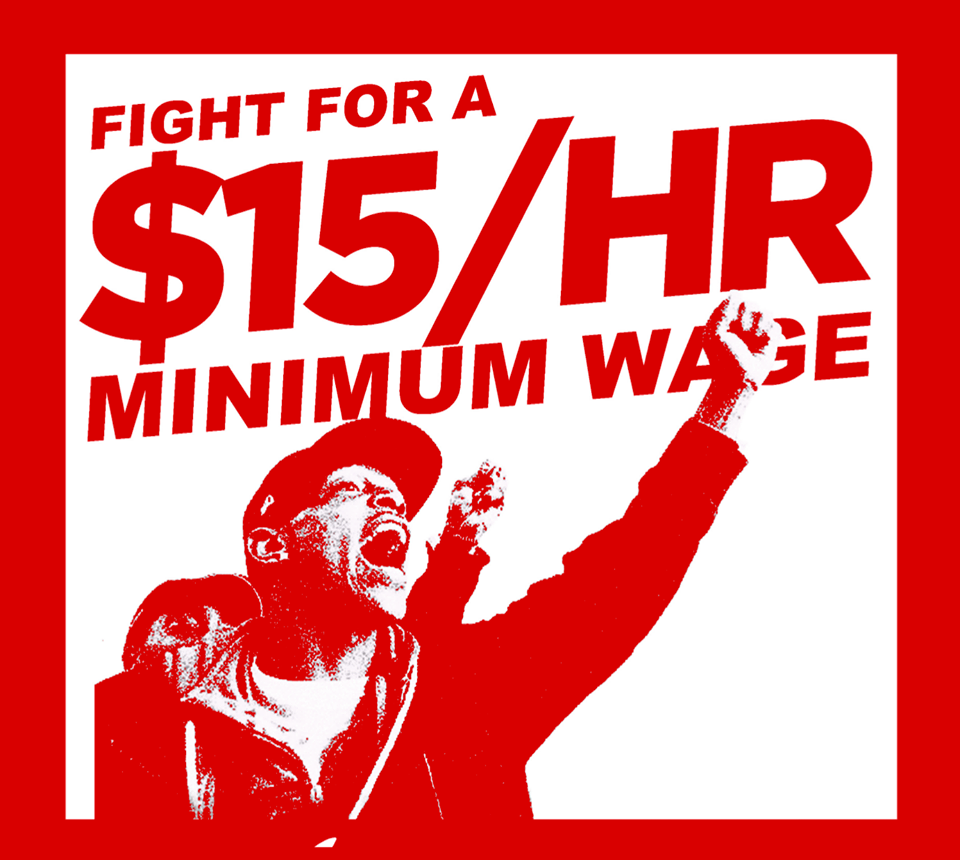
Los Angeles $15/Hr. Minimum Wage Huge Win


Leadership of mainstream political parties, zombies of a bankrupt and corrupt neoliberal consensus, got a jolt yesterday as the megalopolis of Los Angeles adopted a $15/hr. minimum wage. Jennifer Medina and Noam Scheiber have the story, "Los Angeles Lifts Its Minimum Wage to $15 Per Hour":
LOS ANGELES — The nation’s second-largest city voted Tuesday to increase its minimum wage from $9 an hour to $15 an hour by 2020, in what is perhaps the most significant victory so far for labor groups and their allies who are engaged in a national push to raise the minimum wage.
The increase, which the City Council passed in a 14-to-1 vote, comes as workers across the country are rallying for higher wages and several large companies, including Facebook and Walmart, have moved to raise their lowest wages. Several other cities, including San Francisco, Chicago, Seattle and Oakland, Calif., have already approved increases, and dozens more are considering doing the same. In 2014, a number of Republican-leaning states like Alaska and South Dakota also raised their state-level minimum wages by ballot initiative.
The effect is likely to be particularly strong in Los Angeles, where, according to some estimates, almost 50 percent of the city’s work force earns less than $15 an hour. Under the plan approved Tuesday, the minimum wage will rise over five years.
“The effects here will be the biggest by far,” said Michael Reich, an economist at the University of California, Berkeley, who was commissioned by city leaders to conduct several studies on the potential effects of a minimum-wage increase. “The proposal will bring wages up in a way we haven’t seen since the 1960s. There’s a sense spreading that this is the new norm, especially in areas that have high costs of housing.” 
The groups pressing for higher minimum wages said that the Los Angeles vote could set off a wave of increases across Southern California, and that higher pay scales would improve the way of life for the region’s vast low-wage work force. 
Supporters of higher wages say they hope the move will reverberate nationally. Gov. Andrew M. Cuomo of New York announced this month that he was convening a state board to consider a wage increase in the local fast-food industry, which could be enacted without a vote in the State Legislature. Immediately after the Los Angeles vote, pressure began to build on Mr. Cuomo to reject an increase that falls short of $15 an hour.
Opponents of the $15/hr. minimum wage hide behind small business owners, arguing that it will force them to close their doors. This is a red herring akin to trotting out the family farm when it comes time to call for a repeal of the estate tax or similar to USG claims that Shiite militias have to be sidelined in order to prevent the spread of sectarianism as Islamic State rampages.

If you have been to any urban core lately, you will have noticed, as I did recently on a trip to the Bay Area, that there are very few independent, small business retailers left standing. The overwhelming number of the storefronts I saw were corporate chains. The Bay Area I grew up in always had a large number of vibrant, independent small businesses, part of the legacy of being a Hippie Mecca. No longer.

As the Medina and Scheiber story makes plain, neoliberal Democrats like Andrew Cuomo are now on the hot seat. It is "shit or get off the pot" time for captive politicians. This minimum-wage wave is robust in red states too, as victories in Alaska and South Dakota during the GOP landslide of the 2014 midterms prove.

Over the weekend I finished Tariq Ali's The Extreme Centre: A Warning (2015). Ali takes us on a tour of Western democracies, focusing principally on the UK, since the collapse of communism in the late 1980s/early 1990s. The mainstream parties have morphed into de facto permanent neoliberal government cannibalizing the remnants of the post-WWII social order.

I mentioned in a post last month that Ali thinks that there is plenty of juice left in U.S. global hegemony. All talk of a "decline of the U.S.-led West" is wishful thinking. The one wild card Ali does hold out is popular reaction. As the mainstreams parties have cohered into an extreme center, they have become almost totally divorced from the 99% they nominally represent. This creates an opportunity for new parties to form, at least in parliamentary systems where party formation isn't impossible. So you have Syriza, which has been locked in a death struggle with enforcers of neoliberal austerity, the troika, since it came out on top in Greece's January elections. And you have Podemos in Spain, which will get a chance this Sunday in municipal and regional elections.

In the U.S., the only game in town is $15 Now. Well, that's not true. There's the #Black Lives Matter movement, which has, in less than a year, re-framed centuries of policing and racial stereotypes. Whites are moving toward minority status in the U.S. Obama, in Camden, NJ on Monday, announced that he was curtailing the Pentagon pipeline of surplus hardware to local police.

The LA $15 minimum wage and the shift underway in racial perceptions are huge gains and bode ill for business-as-usual neoliberalism. A mainstream party will win the election next year, but the ground is shifting. Change is coming.