Showing posts with label Podemos. Show all posts

Wednesday, July 24, 2019

"Podemos Still Doesn't Understand the World is Heading Towards Chaos"

One can scramble about online in vain trying to find an explanation as to why Podemos so far refuses to form a coalition government in Spain with the Socialists. Most of the reporting boils down to a personality struggle between Socialist Party leader Pedro Sanchez and Podemos' Pablo Iglesias. Al Jazeera explains that
In a parliamentary debate on Monday, Podemos leader Pablo Iglesias accused the socialists of refusing to offer his party significant positions and wanting them to be "mere decor" in the government.
"We have to talk about content, we have to talk about programmes, and not so much about who will occupy the blue seats," Sanchez retorted on Tuesday, regarding the places reserved for the cabinet in parliament.
Sanchez's effort to form a government is important because the Socialists' performance in Spain's April general election was heralded as a stunning comeback for a mainstream party in the age of Brexit and Trump. As Raphael Minder notes in "Sánchez Struggles to Assemble New Government in Spain":
Mr. Sánchez’s surprisingly strong result in April was seen as a victory for Socialism in Europe. It also came as a relief to backers of the European Union, which he and his party support, at a time when the bloc is embattled by challenges from nationalists and populists, especially in Italy and Eastern Europe.
The political uncertainty in Spain will be watched closely by European partners, particularly President Emmanuel Macron of France. He has been hoping that Mr. Sánchez could prove a strong ally in his project to fortify the European Union as it prepares for Britain’s departure.
At the time I interpreted that the Socialists' big win was due to Sanchez campaigning against austerity and for more social spending. Macron's embrace of Sanchez refutes any idea that the Spanish Socialist Party is going to scrap neoliberalism.

For a better understanding of the issues at stake it is worth reading an interview with Manolo Monereo, "Podemos Must Become an Anti-Establishment Force Again," which appeared last month.

Monereo goes into the rise of Podemos out the Indignados/Occupy movement and how that post-meltdown political moment seems to have lapsed.

Monereo is clear. There is nothing for Podemos in a coalition with the Socialists, other than greater irrelevance. Podemos not only lost over a third of its MPs in the April elections, but it performed even worse in regional elections held in May.

Given this, one would think Iglesias will resist and Sanchez will lose again tomorrow when a second vote is held to form a government.

Monereo ends the interview with a wonderful statement on the neoliberal/neoconservatism fin de siècle in the midst of which we are presently planted:
In Spain, the establishment might be stabilizing itself once more, but the world is heading towards an almost permanent state of chaos. That’s the key thing for me. Pablo taught geopolitics but he doesn’t seem to understand it, what’s happening in the world. The world is heading towards chaos, towards a great new transition that has already begun. We’re about to enter a period similar to the one Europe witnessed between 1875 and 1914 — which saw the failure of the first wave of globalization. Now we’re about to enter the period of failure for the second wave of globalization. This is something Podemos still doesn’t understand.

Wednesday, June 29, 2016

Brexit Post-Mortem

The reason the neoliberal status quo has been around for as long as it has -- 40 years and counting, ten years longer than the social democratic consensus following World War Two -- is that it has proven agile at quickly adapting to threats.

Two recent examples. First, the Arab Spring, which, after stunning victories in Tunisia and Egypt, was completely rolled back thanks in large part to the export of jihad by the U.S. client states of the Gulf Cooperation Council. Next, the Occupy Wall Street movement, which was easily co-opted by Obama's 2012 presidential campaign, with a hefty assist from New York City's Finest.

What is happening in the case of Brexit is more of the same. The neoliberal status quo lost the vote last Thursday but has been winning ever since. The first significant casualty might have been Podemos in Spain's parliamentary elections on Sunday. Going into the vote, many predicted that Podemos would replace the Socialists as the number two party behind the ruling conservatives. It didn't happen. While Podemos didn't lose ground, neither did it gain any. The Popular Party actually picked up seats. The reason for Podemos' lackluster showing is being explained as voter risk-aversion following the currency and equity markets turmoil on Friday following the Brexit vote.

The markets have calmed since. Brexit will not be another Lehman Brothers. The narrative that is cohering to the point that it is close to being chiseled in stone is that the successful Leave campaigners, leaders like UKIP's Nigel Farage and Tories Boris Johnson (BoJo) and Michael Gove, have not a clue what Britain is to do now that its people have actually voted to separate from the European Union. This confusion is crystallized in a much-cited column written by BoJo for The Telegraph, "I cannot stress too much that Britain is part of Europe – and always will be," where he basically dismisses the reasons for a Leave vote by both the right and the left: Immigration will continue and so too will free trade. Britain will negotiate for itself a Norwegian membership in the common market.

Cameron must have been mindful of this dearth of leadership atop the Leave campaign. His 90-day exit is looking like the smart move at this point. Given another week like the last one, the Leave Tories will be so discredited they will not be able to govern. Cameron's Remainers will keep control of the Conservative Party, better able to join Labour's parliamentary putschists -- assuming they are somehow able to rid themselves of the troublesome Jeremy Corbyn as party leader (which I don't think they will be able to do) -- to finagle avoidance of Article 50, whether through a re-vote or artful negotiation.

The problem in all of this are those hard-shell anti-neoliberal voters, both left and right, who have grown deaf to the mellifluous hymns sung in praise of unfettered markets. Bigger is not better. And I would argue that a solid majority of voters in countries throughout the West have come to believe this, which is a real problem for the governing elite. This majority can be tamped down here and there by means of fear and focusing on division within its ranks, but it will not go away.

I would guess that over the next few years the major parties in the capitalist core will continue to splinter.

Monday, December 21, 2015

Podemos Performs Well in Spanish Elections + 50th Anniversary of U.S.-Backed Genocide in Indonesia Goes Unmentioned in Democrat Debate

Good news out of Spain this morning. Both the ruling conservative Popular Party and their mainstream opposition, the Socialists, lost seats in yesterday's parliamentary elections, setting up a situation like the one in Portugal in October where the governing conservative party won the most seats but in a diminished number and ended up being unable to piece together a majority.

As Raphael Minder reports in "Spain’s Governing Party Loses Majority in Parliamentary Election," the big loser is the mainstream duopoly -- a paradigm where there is a conservative Tweedledum and a liberal Tweedledee that both suckle from the same corrupt corporate neoliberal tit -- while the big winners are Podemos and Citizens, new party formations:
Mr. Rajoy’s Popular Party won 123 of the 350 parliamentary seats, down from 186 seats in the last elections, in 2011, according to the results with nearly all of the votes counted. The Socialists won 90 seats, compared with 110 four years ago, when they were ousted from office after an economic crisis hit Spain. The emerging parties Podemos and Citizens will enter Parliament for the first time after winning 69 and 40 seats. 
Before Sunday’s vote, the leaders of Spain’s main parties had hinted at possible coalition partnerships, without firmly committing to any.
Mr. Rajoy celebrated the results on Sunday, but gave a cautious message to his supporters, saying, “I will try to form a government, and I believe Spain needs a stable government.” 
Podemos and Citizens wanted the elections to mark the end of Spain’s bipartisan system, and they came close to achieving that goal, despite a Spanish system of proportional representation that did not favor them. 
Mr. Rajoy’s conservatives and the main opposition Socialists together won 50.7 percent of the votes, their lowest combined total and down from 73.4 percent in 2011. 
The elections showed an erosion of support for Mr. Rajoy and his party, but also for the Socialists. Even with their worst election results, they maintained their status as the largest left-leaning party in Parliament thanks to votes in their longstanding regional stronghold of Andalusia in the south. 
Podemos was formed early last year as a far-left, anti-austerity party, modeled in part on the success of Syriza, the governing party in Greece. Citizens transformed itself last year from a regional Catalan party, fiercely opposed to the Catalan secessionist movement, into a national party with a liberal economic agenda.
***
One of the main challenges facing Spain’s next government is Catalonia, where separatist parties are struggling to form their own regional coalition government. According to Sunday’s results, Podemos made the clearest gains in Catalonia, apparently benefiting from a promise by Mr. Iglesias to hold a referendum on Catalan independence if he became Spain’s prime minister. Mr. Rajoy’s government, with the support of Spanish courts, has repeatedly blocked any Catalan attempt to hold such a referendum. 
“Spain has voted for a change of system,” Mr. Iglesias told supporters on Sunday night. We’re very happy that the two-party system has ended.”
Mr. Rivera, the leader of Citizens, told his supporters, “Spain is starting a new political era and is doing so because millions have decided that Spain will change.”
In the United States it is much harder to change the duopoly because the barriers to third parties and independent candidacies are so enormous. But Bernie Sanders' robust challenge to the anointing of Hillary as the Democratic nominee is a sign that there is just as much voter dissatisfaction with the neoliberal two-party system in America as there is in Spain.

Watching the Democratic debate Saturday, when I wasn't remoting over to the UFC on Fox, I was struck by the left-progressive dominance of the candidates' messaging. Both Sanders and O'Malley demand the break up of the big banks and the return of Glass-Steagall. All Hillary can try to do is obscure the issue by saying that her financial prescriptions, which don't include breaking up the big banks, are actually more extensive than her rivals.

Part of this left-progressive dominance are the withering attacks Hillary absorbed because of her defense of the longstanding U.S. policy of regime change. We have come to a place in this country where the sordid, criminal nature of U.S. interventions can be discussed on national television during a presidential debate. Here is a sample of from Saturday night:
SANDERS: Look, the secretary is right. This is a terribly complicated issue. There are no simple solutions. But where we have a disagreement is that I think if you look at the history of regime changes, you go back to Mossaddegh (ph) in Iran, you go back to Salvador Allende who we overthrew in Chile, you go back to overthrowing Saddam Hussein in Iraq, you go back to where we are today in Syria with a dictator named Assad. 
The truth is it is relatively easy for a powerful nation like America to overthrow a dictator but it is very hard to predict the unintended consequences and the turmoil and the instability that follows after you overthrow that dictator. 
So I think secretary Clinton and I have a fundamental disagreement. I'm not quite the fan of regime change that I believe she is.
Sanders has said this before. The former Sixties radical that he is, he'll mention CIA-engineered coups in Iran, Guatemala and Chile. But what about Indonesia?

It is 50th anniversary of the rise of Suharto, the fall of Sukarno, and the genocide of communists in Indonesia, something, as Sanders' coup list makes plain, that we don't really track in the United States, despite the fact that the bloodbath was carried out with extensive U.S. involvement.

The current issue of the Monthly Review is devoted to the Indonesian genocide of 1965-1966. As explained in Notes from the Editors:
In this issue we feature two articles on the 1965–1966 mass killings and imprisonments in Indonesia. The army-led bloodbath was aimed at the near-total extermination of members of the Indonesian Communist Party (PKI), then a highly successful electoral party with a membership in the millions.… In all, an estimated 500,000 to a million (or more) people were murdered. Another 750,000 to a million-and-a-half people were imprisoned, many of whom were tortured. Untold thousands died in prison. Only around 800 people were given a trial—most brought before military tribunals that summarily condemned them to death.… The United States…was involved clandestinely in nearly every part of this mass extermination: compiling lists of individuals to be killed; dispatching military equipment specifically designated to aid the known perpetrators of the bloodletting; offering organizational and logistical help; sending covert operatives to aid in the “cleansing”; and providing political backing to the killers.… [T]he mass killings…[were carried out with the active] complicity of the U.S. media.
The duopoly is wobbling. But there is no exit, no place for citizens to turn. New party formation is basically banned in the United States. We live in an irrational, closed society based on consumption. Eventually something is going to burst.

Tuesday, May 26, 2015

Neoliberal Consensus Faces Difficulty at the Polls

Plenty of news over the weekend points to an electorate ready to make changes. First, in Spain, where municipal and regional elections were held on Sunday, two leftists, Ada Colau in Barcelona and Manuela Carmena in Madrid, came out on top in the mayor's race. Carmena was not the top vote-getter, but she is expected to govern in coalition with the Socialists.

The election is being interpreted as a triumph for upstart Podemos, led by the youthful Pablo Iglesias. As Raphael Minder reports in "Spain’s Local Election Results Reshape Political Landscape":
The success of anti-establishment candidates, who ran for small local parties, in the two largest Spanish cities underlined the fragmentation of Spain’s politics, as well as the precipitous slide of the governing Popular Party of Prime Minister Mariano Rajoy, ahead of general elections this year.
The elections also confirmed the erosion of Spain’s bipartisan system. The Popular Party and the main opposition Socialist Party together won just over half of the vote on Sunday, compared with two-thirds in the last election in 2011. Instead, Podemos (We Can), a far-left party, and — to a lesser extent — Ciudadanos (Citizens), a center-right party, emerged as the new kingmakers of Spanish politics. Now come complicated negotiations to form new regional governments and city administrations across the country.
In 2011, the Popular Party swept to power as voters punished the Socialists for sinking Spain into economic crisis. Four years later, Mr. Rajoy has been urging voters not to risk derailing Spain’s recent return to growth by entrusting economic management to left-leaning or untested political parties. The government is forecasting growth of 2.9 percent this year, which Mr. Rajoy expects to be the strongest among major European nations.
However, “there is a broader change in the political mood in Spain that the Popular Party doesn’t seem to be able to grasp,” said Manuel Arias-Maldonado, a politics professor at the University of Málaga. Sunday’s results, he added, show that the Popular Party had “false confidence that economic recovery would suffice” to win elections.
Pablo Iglesias, the national leader of Podemos, told supporters on Sunday night that the results in Spain’s largest cities showed the end of the bipartisan system. In Valencia, Spain’s third-largest city, Rita Barberá, the conservative mayor, is also expected to resign after 24 years. Ms. Barberá’s Popular Party won, but with an insufficient margin to stop left-leaning parties from forming a coalition and removing her from office.
“The big cities are the big engine of change in Spain,” Mr. Iglesias said on Sunday. He went on to predict that the change in the country’s political landscape would be confirmed in general elections to be held at the end of the year. 
Such a forecast seems premature. But Sunday’s outcome suggests that the days of clear-cut results in Spanish elections are numbered, replaced instead by four-way races that will force parties to enter into the largely uncharted waters of coalition negotiations.
Iglesias is correct. Big cities are the engine for change. And that is why Hillary should be very concerned. There is an anti-incumbent, no more "business as usual" virus that has infected the electorate. Whether it is in Poland, where an anti-establishment campaign by rocker Pawel Kukiz threw the election into a runoff that led to the defeat of incumbent president Bronislaw Komorowski by challenger Andrzej Duda, or in Alberta, the "Texas of  Canada," home base of conservative prime minister Stephen Harper, where Rachel Notley of the New Democratic Party was sworn in as premier, voters are casting about for a way to get rid of the mainstream ruling parties.

It isn't going to be an easy path forward to meaningful change. As Minder notes in his piece on the Spanish elections, coalition governments are difficult creations. And in Alberta, the 51 members of the New Democratic Party recently elected to the provincial legislature, are being labeled novices. If true, the odds are long that there will be any grand transformation in Calgary. My experience with the Green Party, a political organization that attracted mostly idealistic newcomers, is that novices make poor political workers. Look at the Five Star Movement in Italy, another novice-filled political organization; it has not been the transforming force as advertised.

Nonetheless transformation is knocking at the door. Though the corporate mainstream has increasingly embraced LGBT rights in the last five years, Ireland's approval of a same-sex marriage referendum by a super-majority last Friday is noteworthy. Long considered a colony of the Roman Catholic Church, the same-sex marriage vote proves the Irish are shedding their religious shackles. Many of the referendum photos I saw featured a smiling Gerry Adams of Sinn Féin holding a rainbow flag. Add Sinn Féin to the growing list of parties rising to challenge the neoliberal orthodoxy.

While it is true the U.S. political system is the most sclerotic in the Western world, and therefore resistant to the kind of change percolating in Europe and Canada, I am not convinced at this point that Hillary is unbeatable. While Bernie Sanders is no staunch opponent of the American perpetual war machine, his take on inequality and economic justice is going to be a big problem for the Clintons, as this passage from the First Draft reveals:
Senator Bernie Sanders of Vermont won’t condemn Hillary Rodham Clinton for raking in millions in speech fees and campaign donations. But he warns it could curb her effectiveness in challenging corporate interests on behalf of working Americans. 
“When you hustle money like that, you don’t sit in restaurants like this,” Mr. Sanders said during an interview in a small Italian bistro on Capitol Hill. “You’re sitting in restaurants where you’re spending — I don’t know what they spend, hundreds of dollars for dinner.” 
He added: “That’s the world that you’re accustomed to, and that’s the worldview that you adopt. You’re not worrying about a kid three blocks away from here whose mom can’t afford to feed him.” 
Mr. Sanders spoke on the eve of the first big rally for his 2016 presidential bid, in Burlington, Vt. One question looming over his effort is how aggressively he will draw contrasts with Mrs. Clinton, his former Senate colleague. The Vermont independent concedes that Mrs. Clinton is heavily favored. 
Mr. Sanders advocates a “revolution” to reverse a “massive transfer of wealth” from the middle class to the affluent over the last generation. 
He exuded contempt for the “sick” and “disgusting” views of some titans of business who have likened such efforts to Hitler and his persecution of Jews. 
“These people are so greedy, they’re so out of touch with reality,” Mr. Sanders said. “You know what? Sorry, you’re all going to have to pay your fair share of taxes.” 
He doesn’t flinch over returning to the 90 percent personal income tax rates of the 1950s for top earners. And if reducing income inequality reduces economic growth, he says, that’s fine. “You don’t necessarily need a choice of 23 underarm spray deodorants,” he said, “when children are hungry in this country.”

Wednesday, May 20, 2015

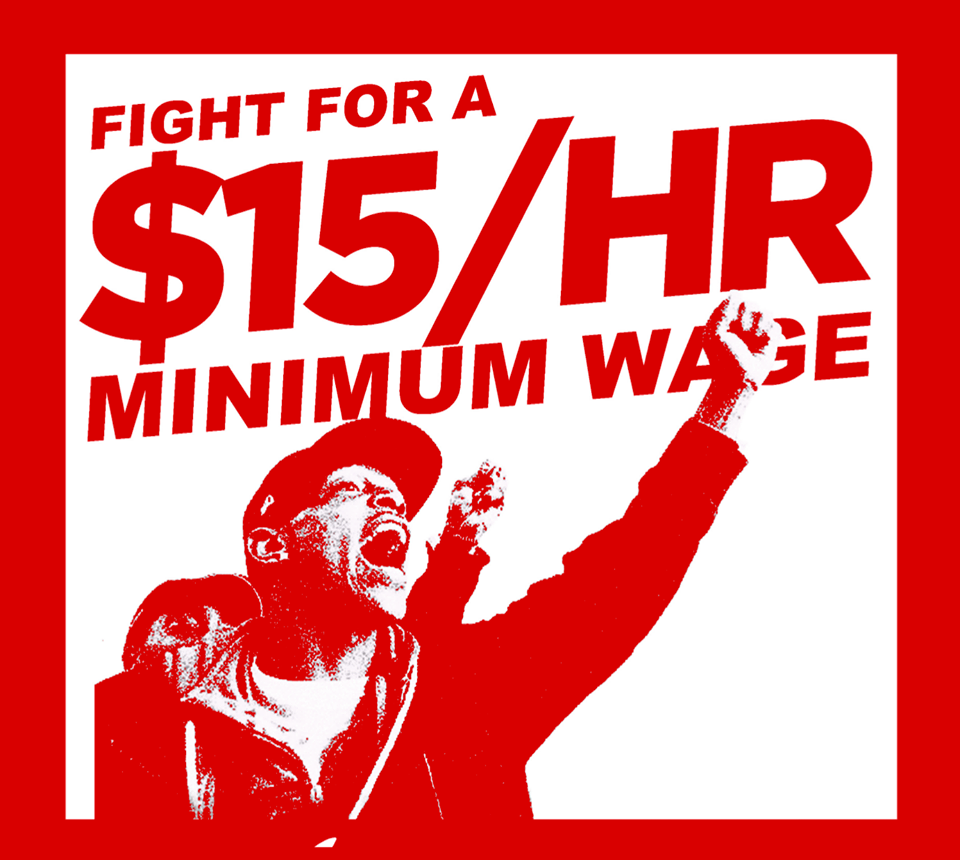
Los Angeles $15/Hr. Minimum Wage Huge Win


Leadership of mainstream political parties, zombies of a bankrupt and corrupt neoliberal consensus, got a jolt yesterday as the megalopolis of Los Angeles adopted a $15/hr. minimum wage. Jennifer Medina and Noam Scheiber have the story, "Los Angeles Lifts Its Minimum Wage to $15 Per Hour":
LOS ANGELES — The nation’s second-largest city voted Tuesday to increase its minimum wage from $9 an hour to $15 an hour by 2020, in what is perhaps the most significant victory so far for labor groups and their allies who are engaged in a national push to raise the minimum wage.
The increase, which the City Council passed in a 14-to-1 vote, comes as workers across the country are rallying for higher wages and several large companies, including Facebook and Walmart, have moved to raise their lowest wages. Several other cities, including San Francisco, Chicago, Seattle and Oakland, Calif., have already approved increases, and dozens more are considering doing the same. In 2014, a number of Republican-leaning states like Alaska and South Dakota also raised their state-level minimum wages by ballot initiative.
The effect is likely to be particularly strong in Los Angeles, where, according to some estimates, almost 50 percent of the city’s work force earns less than $15 an hour. Under the plan approved Tuesday, the minimum wage will rise over five years.
“The effects here will be the biggest by far,” said Michael Reich, an economist at the University of California, Berkeley, who was commissioned by city leaders to conduct several studies on the potential effects of a minimum-wage increase. “The proposal will bring wages up in a way we haven’t seen since the 1960s. There’s a sense spreading that this is the new norm, especially in areas that have high costs of housing.” 
The groups pressing for higher minimum wages said that the Los Angeles vote could set off a wave of increases across Southern California, and that higher pay scales would improve the way of life for the region’s vast low-wage work force. 
Supporters of higher wages say they hope the move will reverberate nationally. Gov. Andrew M. Cuomo of New York announced this month that he was convening a state board to consider a wage increase in the local fast-food industry, which could be enacted without a vote in the State Legislature. Immediately after the Los Angeles vote, pressure began to build on Mr. Cuomo to reject an increase that falls short of $15 an hour.
Opponents of the $15/hr. minimum wage hide behind small business owners, arguing that it will force them to close their doors. This is a red herring akin to trotting out the family farm when it comes time to call for a repeal of the estate tax or similar to USG claims that Shiite militias have to be sidelined in order to prevent the spread of sectarianism as Islamic State rampages.

If you have been to any urban core lately, you will have noticed, as I did recently on a trip to the Bay Area, that there are very few independent, small business retailers left standing. The overwhelming number of the storefronts I saw were corporate chains. The Bay Area I grew up in always had a large number of vibrant, independent small businesses, part of the legacy of being a Hippie Mecca. No longer.

As the Medina and Scheiber story makes plain, neoliberal Democrats like Andrew Cuomo are now on the hot seat. It is "shit or get off the pot" time for captive politicians. This minimum-wage wave is robust in red states too, as victories in Alaska and South Dakota during the GOP landslide of the 2014 midterms prove.

Over the weekend I finished Tariq Ali's The Extreme Centre: A Warning (2015). Ali takes us on a tour of Western democracies, focusing principally on the UK, since the collapse of communism in the late 1980s/early 1990s. The mainstream parties have morphed into de facto permanent neoliberal government cannibalizing the remnants of the post-WWII social order.

I mentioned in a post last month that Ali thinks that there is plenty of juice left in U.S. global hegemony. All talk of a "decline of the U.S.-led West" is wishful thinking. The one wild card Ali does hold out is popular reaction. As the mainstreams parties have cohered into an extreme center, they have become almost totally divorced from the 99% they nominally represent. This creates an opportunity for new parties to form, at least in parliamentary systems where party formation isn't impossible. So you have Syriza, which has been locked in a death struggle with enforcers of neoliberal austerity, the troika, since it came out on top in Greece's January elections. And you have Podemos in Spain, which will get a chance this Sunday in municipal and regional elections.

In the U.S., the only game in town is $15 Now. Well, that's not true. There's the #Black Lives Matter movement, which has, in less than a year, re-framed centuries of policing and racial stereotypes. Whites are moving toward minority status in the U.S. Obama, in Camden, NJ on Monday, announced that he was curtailing the Pentagon pipeline of surplus hardware to local police.

The LA $15 minimum wage and the shift underway in racial perceptions are huge gains and bode ill for business-as-usual neoliberalism. A mainstream party will win the election next year, but the ground is shifting. Change is coming.

Wednesday, April 8, 2015

Fast Food and the Political Mainstream

Two interesting items this morning that point in the same direction while dealing with different subjects -- political parties and fast food.

Support for mainstream, established political parties is collapsing in Europe (the same could be said of the United States) at the same time fast-food behemoth McDonald's is losing market share and engaging in a panicked makeover as a “modern, progressive burger company.”

Steven Erlanger addresses the former in the story "As Europe’s Political Landscape Shifts, Two-Party System Fades." A longtime Gray Lady foreign correspondent, Erlanger is presently based in London. His story looks at the May 7 general election in Britain, where Labour and the Conservatives are expected to win less than two-thirds of the vote, requiring the formation of another coalition to govern; but he ranges over the continent as well, providing helpful sketches of the rise of splinter parties in Germany, France, Italy and Spain:
The fragmentation of traditional party voting is increasing all over Europe. Fueled by the last recession and enabled by social media, issue-oriented or protest parties have cropped up everywhere in response to the failure of governments to deliver economic growth and security. The days of a “broad church” party and governments formed by a single party are fading. 
And turnout in national elections has been falling since the 1970s in most Western countries, raising new questions about the health of democracy as multinational corporations and institutions like the European Union, the European Central Bank and the International Monetary Fund influence national decisions.
A.k.a., the triumph of neoliberalism:
Charles Grant, director of the Center for European Reform, emphasizes the failure of the European center-left to keep its promise “to create growth and redistribute it to make a fairer society.” With the decline of the manufacturing sector and weaker unions, the left has been forced to buy into the orthodoxy of market economics, which “means their core support has been hollowed out here,” he said, as in France, Germany and Sweden.
“The center-left seems intellectually dead,” Mr. Grant said, little different from the center-right. “So you see alternatives on the far left like Die Linke, Podemos and Syriza,” he said, referring to the Left by its German name.
Meanwhile on the right, he said, politicians and elites are increasingly unpopular, blamed for the 2008 economic crash, the euro crisis, stagnant growth, austerity and the bailing out of bankers.
The combination of low economic growth, high debt, surging migration and increasing anti-Muslim sentiment provoked by terrorism has put the European Union itself under great strain, he said. There is a strong anti-austerity feeling on the left and a strong anti-immigration feeling on the right — and neither issue can be easily managed by national governments or coalitions.
The problem for those of us who are citizens of the United States is that we don't have a parliamentary system of government; instead we have one of the most corrupt, anti-democratic democracies in the world. The mainstream, established parties, the Democrats and Republicans, absent a mass uprising bordering on the revolutionary, cannot be broken. The barriers to third parties and independents are practically insurmountable. This means that the U.S. will not be able to communicate the general will of the people with the growth of a Syriza or a Podemos or a Sinn Féin.

Faced with this type of political stasis, perfectly captured by yet another Bush v. Clinton match-up, people will choose to stay home and not vote. My sense is that there is a little more juice in the GOP right now since they recently had to undergo an emergency Tea Party re-branding when all appeared lost with Obama 2008. So there is a decent chance that Scott Walker will beat Jeb, improving the party's hope to win the White House next fall. As for the Democrats, since they are truly "intellectually dead" and captive to big money, I don't see Hillary being beaten in the primary at this point.

Given the lack of meaningful outlets for people to express themselves politically in the U.S., change is being registered in patterns of consumption. There is a pervasive feeling that something is terribly wrong. We as a species are picking up warning signs, and in response we are choosing to alter what we eat, which is where Mark Bittman's morning column on troubles ("15 percent drop in its United States operating income in the last quarter of 2014") for Ronald McDonald comes in, "McDonald’s Turns ‘Progressive’":
McDonald’s can’t get a break. In the last two months, the company has made several well-publicized big announcements that were widely greeted with yawns or jeers. 
The first was a decision to phase out chickens raised using antibiotics meant to treat humans. The second was to unilaterally raise the salaries of those minimum-wage workers the company directly employs by at least a dollar an hour, granting a small amount of paid vacation time to company employees and financial assistance for education to all workers in its system. And the third was to begin referring to itself as a “modern, progressive burger company.”
***
 What McDonald’s should do is go all in and really transform itself, because the effect of positive change would be immeasurable. Instead it tries to play it both ways, controlling what franchisees buy and sell but insisting that it cannot dictate how they treat employees. Thus the wage increase touches only around 11 percent of the chain’s workers, and workers immediately decried it as inadequate. (Even Walmart did better.) No one turns down a raise, but this one virtually guarantees that most of the company’s workers will remain eligible for food stamps, thus perpetuating the public subsidy for McDonald’s labor force.
That the nonantibiotic move has taken this long (Chipotle has tried to be antibiotic-free for more than a decade, as has Panera) and is so incomplete — that is, there’s no word about pork or beef, and the move is being phased in — also seems pathetic. (Even more pathetic is the refusal of the Food and Drug Administration to mandate the removal of nonmedicinal antibiotics from animal production, but that’s another story.)
These moves demonstrate that McDonald’s is hardly a “progressive” company but one that is merely trying in a halfhearted way to catch up with changing market norms and to anticipate inevitable regulation.
If McDonald’s were truly progressive, what would it do? It might revamp the menu in favor of sustainably sourced and fresher food (it’s worth noting that in Britain, McDonald’s uses free-range eggs and organic milk), and might increase its workers’ wages (and hours) to something approaching a living wage.
It may be that the biggest beneficiary of McDonald’s recent moves is the food movement, which, smelling blood, continues to apply pressure. (In response to the raise, some demonstrating workers chanted: “Hey McDonald’s, let’s be blunt/This is just a P.R. stunt.”) And that movement continues to gain credibility as it attends more to the rights of humans than those of animals — not that animals don’t matter, but it’s all relative.
It’s great that McDonald’s blinked. I’d love to see it become a truly progressive company — I’d even help them if I could — but if that’s not in the cards, it would be fine to see a continuing decline in its business. Either would be a satisfactory ending to the McDonald’s story.
The chances that McDonald's will become a truly progressive company are about as likely as the Democrats becoming a truly progressive party. It is not going to happen.

Thursday, February 5, 2015

Maybe Not a Grexit but a Default: Naked Capitalism's Yves Smith on Greece's Efforts to Free Itself From Bloodsucking Austerity

With recent moves by the European Central Bank to force Greece's Syriza government to accept the same neoliberal austerity program that it was elected to reject, the one that has led to 25% unemployment and a 25% reduction in the size of the Greek economy, and to accept it quickly it seems to me that the only option available to Varoufakis and Tsipras is to default.

Naked Capitalism's Yves Smith's writing on Syriza's efforts to beat back austerity, though pessimistic, has been superb. Her "Will the Cavalry Ride Over the Hill in Time for Greece?" is a must read:
We’ve cautioned readers that Greece is in a very weak bargaining position relative to its financial overlords in the Troika. As much as Finance Minister Yanis Varoufakis is making sound, logical arguments and presenting proposals that if anything are too accommodating, despite initial cool reactions, many of Greece’s soi disantpartners are diehard neoliberals and/or are politically constrained. Varoufakis is approaching them as if they can deal in good faith, when their idea of “good faith” comes from a punitive parallel universe.
While Varoufakis and presumably Tsipras are unwilling to deploy the one realpolitik tool at their disposal, a threat of Grexit, other parties who have influence on the recalcitrant actors are more sensitive to the fact that much more is at issue than just the fate of Greece. The ongoing game of extend and pretend has managed to forestall what amounts to an existential crisis for the Eurozone. Its founders knew its structure was incomplete and imperfect, but they believed the logic of preventing future wars was so compelling that the inevitable future crises would be resolved by further integration. 
Unfortunately, as we’ve been chronicling off and on since 2010, the northern bloc, and most important, Germany, have not wanted to give up its catbird seat. It has influence in excess of its population, continues to run trade surpluses with the rest of the Eurozone, which is tantamount to stealing demand, yet it is unwilling to accept the inevitable consequence of running sustained trade surpluses, which is that you must finance your trade partners (or to put it in the terms of petrostates, recycle your surpluses). Moving toward integration, particularly more powerful governance at the Eurozone level, and having more fiscal transfers to allow countries like Greece to have enough demand to have manageable levels of production and employment, means that Germany will have to cede power. And Europe still has strong nationalistic impulses, another obstacle to cementing the alliance. 
But it has also been clear, with the rise of ultra-right, anti-Eurozone parties, and to a lesser degree, anti-austerity parties like Syriza and Spain’s Podemos, that this unsustainable status quo is if anything past its sell-by date. Thus for the more forward-thinking technocrats and politicians, Greece’s efforts to free itself from failed austerity policies serve as a focus point for their own agendas to move away from anti-growth, anti-democratic policies. 
The problem for Varoufakis and Syriza generally is that the magnitude of the task before them, of negotiating what they hope is a deal with significant new components, is already difficult to accomplish by June, the longest time frame they are likely to have, even if their interlocutors were more receptive. With limited knowledge of the power structures in the key governments with which they are dealing, it’s well nigh impossible for them to find, let alone work with, mid level and senior level figures who are their natural allies. 
Thus Varoufakis (at least for now) is forced to broadcast his messages when narrowcasting would be better. Broadcasting means he will almost inevitably offend some key audience, given if nothing else how far apart Syriza’s voters and German officials are in their expectations for the negotiations. But the broadcasting is critical to communicating and rallying both insider allies as well as voters in periphery countries, since shifts in poll results increase pressure on the Eurozone reactionaries. Perversely, the best thing for Syriza’s chances were the Hebdo murders, since the boost it gave to anti-Eurozone Front National leader Marine Le Pen is a big wake-up call for the Eurozone elites.
Today, after ECB announced that it will not accept Greek government debt as collateral for new loans, Smith writes in "ECB to Greece: Drop Dead":
Even by the standards of bank thuggishness, the move by the ECB against Greece last night was a stunner. Americans have become used to banks taking houses under dubious pretexts when both the investors and borrowers would do better with a writedown. But to see the ECB try take a country is another matter entirely. As one seasoned pro said, “If anyone had tried something like this against a country with a decent sized military, the tanks would be rolling.” 
The ECB’s bombshell was to put Greece at risk of an intensification of its ongoing bank run in order to pressure it to agree to a deal with the Troika under an impossibly tight timetable, even shorter than the February 28 pre-existing deadline that Greece Finance Minister Yanis Varoufakis had planned to extend until June. As we’ve discussed at length previously, a longer negotiation timetable would be necessary to meet Greece’s objective of restructuring of the relationship with the Troika. Greece wanted that to be based on the recognition that Greece could never pay off its debts and that it was in both side’s interest to let Greece implement more growth-oriented policies. But the message from the enforcers at the ECB was unambiguous: Greece has no rights and needs to accept its debtcropper status. 
The ECB has thus also effectively said that it would rather have fascists like Golden Dawn running Greece, which is what will eventually occur if it succeeds in breaking Syriza. It also just handed France’s Marine Le Pen, head of the nationalistic, anti-Eurozone Front National fantastic fodder for her campaign. 
The February 28 date was the result of Greece presumably needing access to so-called bailout funds to pay off an IMF obligation coming due. Varoufakis said he would refuse those funds, and could get by until June, when more loans came due, by relying on existing tax receipts and getting what he regarded as minor waivers from the central bank. He also had some creative ideas for restructuring Greece’s debts and said that he wanted the OECD rather than the Troika to provide auditors on behalf of the lenders. 
Even though we warned that the ECB was likely to use its control over liquidity facilities to stymie Syriza’s plans and force Greece to the negotiating table sooner rather than later, the smackdown was even more brutal than we imagined possible.
***
As we have said before, Greece is in a weak bargaining position. It may be able to go beyond February 28, but probably not very long. Some readers have suggested appealing to Russia, but not only would that unleash even more brutal treatment from the Troika, but the German press has also reported that Russia is not interested. 
Varoufakis has ruled out a Grexit as ultimately hugely detrimental to Greece. Even if the Tsipras government were to decide to reverse course (likely leading Varoufakis to resign), he would probably want a referendum to make sure it had popular support. Most governments have procedures that don’t allow for them to be launched on short order. So even with this averse development, a Grexit seems unlikely. 
The Greek government can implement emergency measures, like capital controls and restrictions on daily bank withdrawals, to reduce the bank run. Measures like nationalizing all domestic banks and implementing a plan to allow foreign banks to leave the country in an orderly manner works only if the Greek central bank can backstop the domestic banks, and that in turn works only in the event of a Grexit, since the central bank needs to be a currency issuer. 
And of course, Greece can default. 
In response to an e-mail tonight, Varoufakis wrote, “One thing we will not do is capitulate.” I hope readers will wish him and his fellow citizens good luck. But the Troika seems determined to destroy Greece if that is what it takes to show that their authority remains unchallenged. But the cost of discipling Greece is likely to be far greater than they imagine, not just in financial terms, but to the Eurozone project itself. 

Thursday, January 15, 2015

ECB's QE: Too Little, Too Late

Proof that Mario Draghi has the votes he needs to launch a European Central Bank (ECB) version of the U.S Federal Reserve's quantitative easing (bond buying) program when bank governors next meet on January 22 is David Jolly's "Swiss National Bank Abandons Minimum Exchange Rate Against Euro":
The Swiss National Bank said in a statement that it was giving up the minimum exchange rate of 1.20 Swiss francs per euro, less than a month after it had reiterated a pledge to continue to support that floor by buying the euro in “unlimited quantities” if needed.
***
The euro, used by 19 nations, has been a one-way bet since last May, falling about 15 percent against the dollar to a nine-year low, partly because of expectations that the European Central Bank would announce its intention next week to combat economic weakness and deflationary pressures by buying eurozone government bonds on a large scale. 
In that policy, known as quantitative easing, the central bank would effectively be printing money, increasing the supply of euros relative to other currencies and driving down its market price. 
Phyllis Papadavid, foreign exchange strategist at BNP Paribas in London, said after the Swiss central bank action that monetary authorities were “still sensitive” to the overvaluation of the franc, but that they had adapted to changed conditions — particularly the dollar’s recent rise — by changing course.
With prices dropping 0.2 percent in December, deflation has come to Europe. This, along with a favorable appeals court opinion yesterday supporting the ECB's earlier 2012 announcement that it would purchase government bonds of eurozone member states on the open market, has strengthened Draghi against the German naysayers. For an excellent summary of the ECB's planned foray into quantitative easing (QE) see Jack Ewing's "Devil May Be in the Details on European Central Bank Bond-Buying":
A solid majority on the central bank’s 25-member Governing Council appears, based on recent public statements, to favor broad bond-buying. Their position was strengthened by the opinion submitted to the highest European appeals court on Wednesday in response to a lawsuit by German citizens seeking to block a previously planned bond-buying program that Mr. Draghi announced in 2012 but never deployed.
The ECB's QE is already being criticized as too little, too late. Analysts doubt that purchasing €1-trillion worth of government bonds will cure deflation which has to do with withered demand. Plus, the Governing Council will most likely not act until March; it will only make a commitment to a QE program at its January meeting, but details won't be available until it reconvenes in March.

From now until then the ECB will have to figure out a formula for which bonds to buy. There are no "eurozone" bonds, only bonds issued by member nations. As Ewing clearly summarizes:
Because of the large number of unanswered questions, the European Central Bank may not be ready to announce details of a bond-buying program next week.
“It’s almost impossible for the E.C.B. in this environment not to act,” said Mujtaba Rahman, an analyst at Eurasia Group. But, he said, “We think it’s a two-step move — announcement in January, further details in March.”
Some elements of such a program are a given. The central bank would buy bonds on the open market — not directly from governments, which would be a violation of its charter.
But the bank will have to figure out how to deal with the lack of Pan-European assets comparable to the United States Treasury bonds that the Fed purchased in its quantitative easing program.
The simplest and most likely option would be to buy bonds in proportion to each eurozone country’s share of the central bank’s capital, which is calculated according to each member state’s population and gross domestic product.
The drawback to this method is that it would mean buying large quantities of German government bonds, which are already in heavy demand — so much so that on Wednesday the yield on the 10-year German bond reached a new low. 
Germany accounts for 18 percent of the European Central Bank’s capital, more than any other country. (Malta, with 0.65 percent of the central bank’s capital, has the smallest share.) Market interest rates on some other German government bonds are already below zero. So it is not clear what purpose, if any, would be served by pushing the rates even lower, as would happen if the European Central Bank started buying.
A second option would be to buy only highly rated government bonds — those of France, Finland and Germany, say, while avoiding the bonds of governments with riskier finances, like Portugal or Greece. That approach would answer German concerns that taxpayers could be stuck with the bill if some eurozone governments were to default on their debt.
In theory, if the European Central Bank drove up the prices of highly rated bonds, private investors would turn to the bonds of weaker countries instead. But it is not certain that would happen. If not, the E.C.B. would not achieve its goal of providing relief in heavily indebted countries like Italy.
A third option would be to buy bonds in proportion to the outstanding debt of each eurozone country — the higher the debt level, the more bonds the central bank would buy. This alternative would favor countries that are the most deeply in debt and need the most help, like Italy. But conservative critics in Germany would probably complain that these countries were being rewarded for irresponsibly running up huge debts.
It is hard to imagine a situation where Germany would green-light option three, the only option that Ewing brutes that might have a meaningful impact. So Draghi's QE will not be enough to arrest eurozone deflation.

Draghi has made clear that he wants no part in any candidacy for the Italian presidency (Elisabetta Povoledo, "Resignation of President Will Test Italy’s Premier"). Hopefully this augurs ill for the fresh-faced neoliberal PM Matteo Renzi.

Neoliberalism has to be torn down. Syriza is maintaining its narrow lead going into Greece's January 25 parliamentary elections. If elections were held today in Spain, Podemos would gain a majority (see Vicente Navarro's excellent "What is Going On in Spain? The End of an Era and the Beginning of Podemos").

The mainstream parties of the big three -- Germany, France and the UK -- are under assault from the Right. That is not going to change. The left-hand of the mainstream political duopolies will rush to defend the right, which will have the effect of further disillusioning voters in each nation. Maybe out of this disillusionment real Leftist parties will arise in the big three.

If Hillary is nominated, a similar hopeful possibility will confront voters in the U.S.

The answer to European deflation is obvious. Why not a continent-wide building program similar to China's massive investment in infrastructure?