Showing posts with label militarized police. Show all posts

Wednesday, May 20, 2015

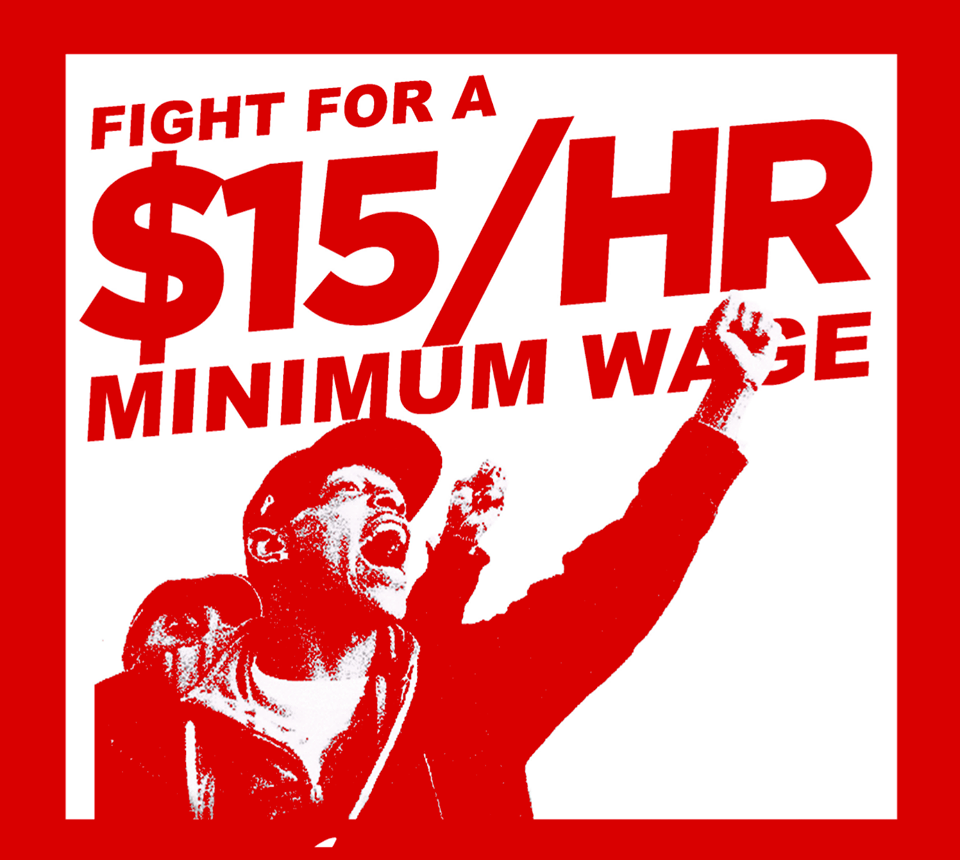
Los Angeles $15/Hr. Minimum Wage Huge Win


Leadership of mainstream political parties, zombies of a bankrupt and corrupt neoliberal consensus, got a jolt yesterday as the megalopolis of Los Angeles adopted a $15/hr. minimum wage. Jennifer Medina and Noam Scheiber have the story, "Los Angeles Lifts Its Minimum Wage to $15 Per Hour":
LOS ANGELES — The nation’s second-largest city voted Tuesday to increase its minimum wage from $9 an hour to $15 an hour by 2020, in what is perhaps the most significant victory so far for labor groups and their allies who are engaged in a national push to raise the minimum wage.
The increase, which the City Council passed in a 14-to-1 vote, comes as workers across the country are rallying for higher wages and several large companies, including Facebook and Walmart, have moved to raise their lowest wages. Several other cities, including San Francisco, Chicago, Seattle and Oakland, Calif., have already approved increases, and dozens more are considering doing the same. In 2014, a number of Republican-leaning states like Alaska and South Dakota also raised their state-level minimum wages by ballot initiative.
The effect is likely to be particularly strong in Los Angeles, where, according to some estimates, almost 50 percent of the city’s work force earns less than $15 an hour. Under the plan approved Tuesday, the minimum wage will rise over five years.
“The effects here will be the biggest by far,” said Michael Reich, an economist at the University of California, Berkeley, who was commissioned by city leaders to conduct several studies on the potential effects of a minimum-wage increase. “The proposal will bring wages up in a way we haven’t seen since the 1960s. There’s a sense spreading that this is the new norm, especially in areas that have high costs of housing.” 
The groups pressing for higher minimum wages said that the Los Angeles vote could set off a wave of increases across Southern California, and that higher pay scales would improve the way of life for the region’s vast low-wage work force. 
Supporters of higher wages say they hope the move will reverberate nationally. Gov. Andrew M. Cuomo of New York announced this month that he was convening a state board to consider a wage increase in the local fast-food industry, which could be enacted without a vote in the State Legislature. Immediately after the Los Angeles vote, pressure began to build on Mr. Cuomo to reject an increase that falls short of $15 an hour.
Opponents of the $15/hr. minimum wage hide behind small business owners, arguing that it will force them to close their doors. This is a red herring akin to trotting out the family farm when it comes time to call for a repeal of the estate tax or similar to USG claims that Shiite militias have to be sidelined in order to prevent the spread of sectarianism as Islamic State rampages.

If you have been to any urban core lately, you will have noticed, as I did recently on a trip to the Bay Area, that there are very few independent, small business retailers left standing. The overwhelming number of the storefronts I saw were corporate chains. The Bay Area I grew up in always had a large number of vibrant, independent small businesses, part of the legacy of being a Hippie Mecca. No longer.

As the Medina and Scheiber story makes plain, neoliberal Democrats like Andrew Cuomo are now on the hot seat. It is "shit or get off the pot" time for captive politicians. This minimum-wage wave is robust in red states too, as victories in Alaska and South Dakota during the GOP landslide of the 2014 midterms prove.

Over the weekend I finished Tariq Ali's The Extreme Centre: A Warning (2015). Ali takes us on a tour of Western democracies, focusing principally on the UK, since the collapse of communism in the late 1980s/early 1990s. The mainstream parties have morphed into de facto permanent neoliberal government cannibalizing the remnants of the post-WWII social order.

I mentioned in a post last month that Ali thinks that there is plenty of juice left in U.S. global hegemony. All talk of a "decline of the U.S.-led West" is wishful thinking. The one wild card Ali does hold out is popular reaction. As the mainstreams parties have cohered into an extreme center, they have become almost totally divorced from the 99% they nominally represent. This creates an opportunity for new parties to form, at least in parliamentary systems where party formation isn't impossible. So you have Syriza, which has been locked in a death struggle with enforcers of neoliberal austerity, the troika, since it came out on top in Greece's January elections. And you have Podemos in Spain, which will get a chance this Sunday in municipal and regional elections.

In the U.S., the only game in town is $15 Now. Well, that's not true. There's the #Black Lives Matter movement, which has, in less than a year, re-framed centuries of policing and racial stereotypes. Whites are moving toward minority status in the U.S. Obama, in Camden, NJ on Monday, announced that he was curtailing the Pentagon pipeline of surplus hardware to local police.

The LA $15 minimum wage and the shift underway in racial perceptions are huge gains and bode ill for business-as-usual neoliberalism. A mainstream party will win the election next year, but the ground is shifting. Change is coming.

Tuesday, December 2, 2014

From Cairo to Ferguson a Shift in Consciousness is Creating Fear in the Power Elite

We need a change in consciousness, and there is plenty of evidence that such a change is underway. When I got out of the train station last night I stepped into one of the many Ferguson protests that occurred nationwide yesterday. I didn't see or hear any protesters, but there were lots of police, and they were guarding the entrances to the big downtown shopping malls. My feeling is that these protests are not going softly into the night; they are a continuation of the Occupy Wall Street movement for economic justice but with the added powerful message of racial equality, not to mention a critique of excessive state force.

Why it is a safe bet to say that these protests are not going away one merely has to think back three years. Occupy was zapped because there were still enough people who believed that Obama represented a progressive trend in politics that had to be defended; hence, when the main Zuccotti Park encampment was rolled up by Gotham's finest in November of 2011, energy shifted to the 2012 presidential campaign and defending Obama from GOP attacks. Obama marshaled some of the Occupy rhetoric and ended up trouncing a weak Republican standard-bearer, Mitt Romney.

Now, besides some Democratic Party apparatchiks, there is no wellspring of support for Obama's presidency. He has alienated the peace wing of the party; I don't believe his "too little, too late" immigration overhaul is anything more than a chess move to checkmate Republicans, and I think that Latinos sense this; finally, his dissembling, feckless treatment of the Ferguson protests have finally splintered his bedrock constituency, blacks.

This was clearly on display yesterday at Obama's White House summit on Ferguson. Mark Landler has an excellent summary of the event in "Obama Offers New Standards on Police Gear":
Among those in the White House meetings on Monday were Mayor Bill de Blasio of New York and Mayor Michael A. Nutter of Philadelphia; the president of the National Urban League, Marc Morial; the Rev. Al Sharpton; and two civil rights leaders from Ferguson, Rasheen Aldridge and Brittany Packnett.
Besides the photo op, there were three items of substance that Obama announced yesterday: 1) a change in federal programs dispensing military hardware to local police departments; 2) federal funding for police body cameras; and 3) a creation of a task force to provide answers on how to improve policing.

But as it turns out the first item of substance is really not substantial at all. All Obama proposed was a change in reporting and an undefined training requirement:
WASHINGTON — President Obama, grappling with how to respond to the racial unrest in Ferguson, Mo., and a wave of anger at law enforcement officials across the country, said Monday that he would tighten standards on the provision of military-style equipment to local police departments and provide funds for police officers to wear cameras. 
But Mr. Obama stopped short of curtailing the transfer of military-grade gear to local law enforcement authorities and continued to put off a visit to Ferguson. Instead, the White House tried to channel the rage over the fatal police shooting of a black teenager there into a national debate about how to restore trust between the police and the public.

Administration officials said they concluded after a review that the vast majority of transfers of military-style equipment strengthened local policing, even after the police in Ferguson were criticized for heavy-handed use of such gear to quell protests last summer. But the officials said local authorities needed common standards in the types of hardware they requested and better training in how to use it.
All told, the changes were modest, and Mr. Obama himself was circumspect in remarks about Ferguson after an orchestrated day of meetings at the White House with civil rights and religious leaders, big-city mayors, and law enforcement officials. The president seemed eager to keep the focus not on what happened in Ferguson but on its broader lessons for the country.
***
Curtailing those transfers, experts said, would be a reversal of years of policy and would have scant support in Congress. The militarization of police has been part of a broader counterterrorism strategy of fortifying American cities, which took root after the terrorist attacks of Sept. 11, 2001, and has become a reliable source of federal largess for local authorities.
With no legislation likely, Mr. Obama has instead focused on standardizing regulations across the multiple federal agencies — primarily the Department of Homeland Security — that supply this equipment to cities and towns. He would also seek to improve training and require “after-action” reports for incidents involving federal equipment. 
The report, the White House said, found “a lack of consistency in how federal programs are structured, implemented and audited.” Criticism of the practices swelled after the police in full body armor, on heavily armed vehicles, confronted protesters in Ferguson with assault rifles.
*** 
To bolster local policing, the government also announced a $263 million program that will provide up to 50,000 body cameras for police. The video footage from these cameras could clarify disputed incidents like the deadly encounter between the teenager in Ferguson, Michael Brown, and the police officer, Darren Wilson.
***
The president also announced on Monday the formation of a task force to improve local policing. Leading the panel will be Charles H. Ramsey, the commissioner of the Philadelphia Police Department, and Laurie Robinson of George Mason University, a leading criminal law scholar.
Don't get your hopes up that the task force is anything other than a cosmetic effort by Obama because as Landler reports at the end of his story,
The White House also faced skepticism in its choice of Commissioner Ramsey as a co-chairman of the task force. During his tenure as police chief in the District of Columbia from 1998 to 2007, he was criticized for the mass arrest of people protesting International Monetary Fund and World Bank meetings. 
“We were just dumbfounded when we heard they had chosen Chief Ramsey,” said Mara Verheyden-Hilliard, executive director of the Partnership for Civil Justice Fund, which brought suits against Mr. Ramsey in Washington. “You’d be hard pressed to find a more inappropriate choice.”
Obama is spent. He can't keep the indians on the rez anymore. We are at the beginning of a great conflict. The established political parties are absent legitimacy. There will be a tendency to reassert the legitimacy of the state by means of a display of force -- like the pools of police officers I saw guarding department stores last night. This will have the opposite effect, diminishing the government's legitimacy even more.

In the United States we are heading in the direction of what I have been calling the "Sisi option" -- a sunlighting of the Deep State, a public embrace by the power elite of a massive police state. Thailand is already there.

Apropos of this it is worthwhile to read the Gray Lady's unsigned editorial on Mubarak's release from prison, "In Egypt, a Verdict Turns Back the Clock":
The Egyptian court that threw out the murder charges against former President Hosni Mubarak may have closed the final chapter on the Arab Spring. After the country’s brief, flawed attempt at democracy, the army and its supporters put in place an even more authoritarian system than the Mubarak regime. 
Now, in a final insult to the hundreds of protesters who were killed in the 2011 uprising, Mr. Mubarak apparently will go free, and there will be no justice for those who died or accountability for the decades of human rights abuses by his government.
***

The public prosecutor could appeal the murder case to the Court of Cassation, Egypt’s highest criminal court. But, on Sunday, President Abdel Fattah el-Sisi, the former army general who overthrew the country’s first democratically elected president, Mohamed Morsi, in 2013, seemed to rule that out. Meanwhile, Mr. Morsi and thousands of his Muslim Brotherhood supporters still languish in prison. 
Mr. Sisi said Egypt must “look to the future” and “cannot ever go back.” It appears that the Obama administration feels the same way. In a bizarre response, a State Department spokeswoman offered diplomatic pablum when asked to comment on the verdict and referred queries to the Egyptian government.
*** 
Since Saturday, protests against the ruling have drawn hundreds of participants and involved numerous clashes with security forces. Two demonstrators were killed. While the demonstrations have been smaller than those in 2011, the venues — university campuses across the country — suggest that it may be harder for Mr. Sisi to erase the past than he thinks. Among other challenges, Egypt is struggling with a depressed economy, an insurgency in Sinai, and an Islamic State affiliate that late Sunday took responsibility for killing an American oil worker in Egypt’s Western Desert in August. 
Half of Egypt’s population is under the age of 25, and many of those young people were at the heart of the Arab Spring movement and its demands for jobs, education, housing and greater freedoms. 
Those aspirations won’t go away. And while Egyptians may want stability, repression and a lack of accountability will produce only more discontent. The Mubarak verdict is another shift away from long delayed hopes for a productive and just society.
The same goes for the United States.

**** 

Update on Missouri Governor Jay Nixon's call for a special session of the legislature to find ways to pay for the lengthy deployment of the national guard and state highway patrol. Turns out he doesn't need a special session -- which would have allowed for a spirited public debate on the wisdom and effectiveness of martial law; he can fund by fiat. According to Monica Davey, John Eligon, Jess Bidgood in "A Week Later, Protesters Remain Vocal on Ferguson, Partly With Silence":
Gov. Jay Nixon of Missouri said on Monday that there was no longer a need for a special legislative session, which he had called to authorize more money for Ferguson-related expenses by the National Guard and the State Highway Patrol. He and senior legislative leaders agreed that he could use his budget authority to cover the payments.

Thursday, August 28, 2014

Michael Brown: Race-Based Peonage Exposed

The shooting death of unarmed black teenager Michael Brown at the beginning of the month has revealed much that is shameful about how we live our lives here within the United States of America. All were witness to the St. Louis County peace officers' militarized, attack-oriented response to the spontaneous protests that erupted following the shooting. And all have had to come to terms with the inherent racism of a system that allows for a black-majority city like Ferguson to be policed by a nearly all-white law enforcement agency.

What I have found encouraging is that there has been very little defense in the mainstream media of our rotten, racist, militarized status quo. The evidence is too overwhelming to refute. People can be bamboozled about what goes on overseas, but it becomes more difficult to convince people of something that goes against their direct daily experience: in this case, that the police are angels of light and good order and there is no racial bias to found in our public places. Fox News, the few times I caught a glimpse of it, made some passes at playing "blame the victim," but it rang hollow. You could feel the skittishness emanating from the executive suites. You don't want to be perceived as lily white in a global marketplace that is multiracial; it is bad for business. If a television network goes too far in fomenting race hatred, an advertising boycott campaign can't be far behind.

A particularly illuminating story by Campbell Robertson and Joseph Goldstein, "In Aftermath of Missouri Protests, Skepticism About the Prospects for Change," appeared in the newspaper yesterday; it provides an accessible nuts and bolts explanation about how institutional racism works:
MAPLEWOOD, Mo. — On Monday night, just a few hours after Michael Brown was laid to rest, an amiable judge sat in the City Council chambers here and weighed in on the traffic violations and petty crimes, one by one, of more than a hundred people. At least two-thirds of those waiting were black, roughly a reverse racial image of the demographics of Maplewood itself. 
The scene was banal compared to the tear gas and outrage over the last two weeks in Ferguson, 13 miles away. But it is in courts like this that the daily frustrations that led in 
Young black men, who in many towns in St. Louis County are pulled over at a rate greater than whites, routinely find themselves in the patchwork of municipal courts here, without lawyers and unable to pay the fines levied for their traffic violations. Many end up being passed from jail to jail around the county until they can pay their fines and in some cases other administrative fees, a revenue source on which some towns are growing increasingly reliant.
“It angers people, because it seems like they’re just messing with you,” said Cameron Lester, a 22-year-old college student who knew Mr. Brown, and days earlier was protesting his death. He described how an unpaid $75 ticket once turned into days behind bars in two different police stations and hundreds of dollars in fees. He was skeptical about change. 
“Will it make a difference?” he asked. “Same thing as Trayvon Martin. Where’s that now?”part to the turmoil in Ferguson begin to fester.  
What Roberston and Goldstein describe is our present-day system of peonage, the way in which white supremacy was enforced in the South after the Civil War. Newly freed blacks were rounded up as "vagrants" and forced into involuntary servitude or contract labor. Southern states enshrined this in laws known as the "Black Codes."

As Robertson and Goldenstein explain the current version of the Black Codes begins with "driving while black." After a traffic citation is written, a no-show at court turns into an arrest warrant and additional penalties and fees:
That there is racial disparity in police stops is borne out by official numbers. 
In Maplewood, according to a 2013 report by the state attorney general, black motorists were searched or arrested during stops at more than twice the rate of whites. Yet searches of whites and blacks were almost equally likely to turn up contraband. Messages for the police chief in Maplewood were not returned. 
In the city of Hazelwood, blacks were twice as likely as whites to be searched during a police stop, and nearly three times as likely to be arrested, while searches of whites were about one and a half times as likely to yield contraband. 
City officials, pointing out that there is extensive training to avoid racial profiling, said these numbers cannot be interpreted without context.
“If our stops may reflect a higher percentage of people, perhaps that reflects the percentage of people who are coming through Hazelwood,” said Gregg Hall, the city’s police chief. 
Many of the towns have come to rely on court fines; in St. Ann, which has a population of around 13,000 and a 27-person jail, court fines and fees make up well over a third of the general fund revenues.
Matt Conley, the St. Ann city administrator, said that a rise in the number of tickets there came from a crackdown on speeding because of frequent accidents. 
“Nobody is forcing people to go out there and speed and commit traffic issues,” he said, adding that radar cameras cannot detect race. 
When a person fails to appear and pay, here as in many other places, a warrant is issued and that person’s license is suspended. In the hodgepodge of cities that make up St. Louis County, some drivers may have multiple warrants. In Ferguson, more than one and a half warrants have been issued for every resident. And as the warrants stack up, so do the fines: Not showing up to pay a $90 taillight violation means a failure-to-appear warrant with its own fee of $100 or more; each successive failure-to-appear warrant adds to that; and if there is a stop, there are incarceration fees and towing fees.
In the end, said Brendan Roediger, an assistant professor at St. Louis University Law School, a person who had trouble coming up with $90 might owe a jurisdiction well over a thousand dollars.
“The police aren’t actually pulling people over to find contraband,” he said. “They’re pulling people over to see if they have warrants. And they always do. If you run a system that ultimately makes every black person in your town have a warrant, then racial profiling does work.”

State Senator Jamilah Nasheed, who represents part of the city of St. Louis, said the racial disparity in traffic stops, the unwillingness of cities to consider ability to pay and the fact that small city budgets are increasingly reliant on court fines show how officials have learned to “sustain their municipalities by pulling young black men over.”
This is race-based peonage plain and simple, a system where involuntary servitude is used to maintain the local power structure:
Making the rounds,” the “muni-shuffle,” the “jail hop”: Talk to a young black man in northern St. Louis County and he knows what this is. When someone is stopped on a warrant in any of the municipalities in north St. Louis County, he knows he is going to jail everywhere he has a warrant for an unpaid traffic ticket. Whether the full amount of the fine — often in addition to hundreds of dollars in fees — is still due after a few days in jail is up to the judge. 
“You sit in jail for a week and you get out and you still owe it,” said Brandon Ghoston, 33, who works at a car dealership and has done the rounds himself. 
His brother, Nikos Chatman, who paints airplanes at the St. Louis Downtown Airport, has a ritual: “If I know I have warrants in five or six different places, and I get pulled over, the first thing I do is light a cigarette because I know I’m gone, I’m going to do the rounds.” 
“I’m 30 years old and I’ve never been locked up for anything but a traffic ticket,” Mr. Chatman added. “I’ve been locked up a lot of times.”
How to change a system that has been around basically for 150 years -- since the end of the Civil War? The prevalent line is always "Get out and vote." But winning elections, hard as that is, is not even half the struggle. Once the right people have been elected to office, you have to keep the voting public engaged in the change process; you have to keep the elected official(s) engaged; and you have to combat the push-back from the entrenched status quo, the abiding "deep state" of things.

As long as we have this simplistic, Cracker Jack cartoon vision of civic engagement -- "Vote the bums out! -- nothing will change.