Showing posts with label Tariq Ali. Show all posts

Wednesday, June 8, 2016

Five Star Movement + How Much Time Left for the Dominant Paradigm, Six Years or Six Decades?

With Hillary being feted this morning as the likely Democratic nominee for president, it might help to cast a glance elsewhere for hope. Good news comes from Italy.  The Five Star Movement's mayoral candidate in Rome, 37-year-old lawyer Virginia Raggi, is polling ahead after the first round of voting.

At about the same time Syriza was rising in Greece, the Five Star Movement (M5S) was on the ascent in Italy. Led by comedian and blogger Beppe Grillo, the new party seemed like the best hope in 2013 for exploding the Brussels hive mind.

Then Syriza captivated the media and the political left; this, combined with M5S's underwhelming showing in 2014 elections for the European Parliament, moved the party off the front burner.

Now -- after the spectacular failure of Syriza, the diffident performance of Spain's Podemos, the rise of right-wing populism in Europe (Austria's Freedom Party is challenging May's election loss), the triumph of the corporate media behemoth over Bernie Sanders' millennials, and many other disappointments -- besides the Scottish National Party, there seems little to celebrate in terms of elections in the West, other than the Five Star Movement. The Brexit vote coming up is a big deal. But the left is split on whether to stay in the EU or go. (I say go.)

I ask people I know who pay attention to the news the following question -- "How much longer can the dominant neoliberal paradigm last?" Everyone so far has replied, "A lot longer." Tariq Ali agrees.

The basic question as I frame it is "Six or 60?" Does the corporate-dominated predatory capitalist system which is vacuuming up all the wealth to the top of the pyramid and destroying the planet survive for six years, say early to middle 2020s, or six decades, at which time many agree that the effects of climate change -- sea-level rise and acidifying oceans -- will demand a huge, paradigm-shifting coordinated response?

The reason I favor the near-term shift is I can't see how the present system lasts beyond four years. First off, the party system throughout the West is collapsing. Granted, charismatic, rejuvenating leadership championing popular policies could rise from within the discredited mainstream Christian Democrats, Labourites, Tories, Socialists and Tea Party Republicans, but there is zero evidence for this. So sooner rather than later a minor party will rise to the top and lead, successfully or not, in such a way that it will create a fissure in the dominant paradigm. If not a Brexit on June 23, then Marine Le Pen in 2017 or Alternative for Germany. An EU subservient to U.S. global hegemony becomes much harder to imagine.

Secondly, the U.S.-led warfare state cannot keep multiplying and maintaining its many theaters of conflict. The fall of Saigon led to an adjustment and correction in the way that the U.S. conducted war. There was a decade-plus pause and reset. Does the fall of Kabul lead to the same type of timeout? Unlikely. But there is a limit to what the U.S. can manage in the way of mayhem. Already the blow black from its wars in the Middle East  and North Africa is diminishing support for the major parties of Europe.

Below is a helpful primer on the Five Star Movement that appeared a couple days ago on the Europe Online web site. Having kept an eye out for M5S over the last several years, I find it accurate:
No laughing matter: Italy's comedian-led Five Star Movement
Rome (dpa) - Italy‘s Five Star Movement (M5S) is one of the most successful anti-establishment parties in Europe, whose main rallying cries are clean politics, direct democracy, euroscepticism and basic income support for all.
"We are normal citizens like you, and this normality is scary" for the establishment, Virginia Raggi, who topped a first round of elections for the Rome mayoralty on Sunday, said at her closing campaign rally last week.
Founded in 2009 by Beppe Grillo, a stand-up comedian, and Gianroberto Casaleggio, a shadowy internet consultant who died in April, the M5S shot to national prominence after taking a surprise 25 per cent of the votes in the 2013 general elections.
The movement defies left-right categorizations, and shuns alliances with other parties, which it sees as fundamentally corrupt. It is also critical of banks, big corporations, free trade agreements and wants a referendum on Italy‘s exit from the eurozone.
The movement‘s defining characteristic is its reliance on internet consultations among its supporters to select its candidates and political priorities, which are communicated online via Grillo‘s blog.
But critics have accused Grillo and Casaleggio of using the system arbitrarily and quashing internal dissent. Out of the 163 M5S lawmakers elected in 2013, some 37 have either been expelled or have walked out of the party.
In 2014, the M5S hoped for an electoral breakthrough in elections for the European Parliament, which did not come. It won 21 per cent of the vote, against a record 41 per cent for the ruling Democratic Party (PD).
In this month‘s local elections, the M5S led polls in Rome and came a strong second in Turin, but fared poorly in other big cities like Milan and Naples, suggesting that it still has some way to go before building a strong national base.
In the EU assembly, M5S lawmakers have formed the Europe of Freedom and Direct Democracy group with the British eurosceptic UK Independence Party (UKIP) and the German anti-immigration Alternative for Germany (AfD) party.
The death of Casaleggio, who acted as a behind-the-scenes strategist, has raised questions about the future of M5S, but plans to prepare a younger cadre of party members to take over the leadership have been under way for some time.
After saying in 2014 that he was "a bit tired," Grillo has cut down on campaigning, giving more space to the M5S‘ rising stars, such as lawmakers Alessandro Di Battista and Luigi Di Maio. Tellingly, the 67-year-old comic stayed out of Raggi‘s campaign finale in Rome.

Di Maio, a 29-year-old deputy speaker of the lower house of parliament, is seen as the most likely M5S prime ministerial candidate for the next general elections, due within the next two years. Grillo has always refused to run for office.

Monday, December 28, 2015

It Can Happen Here

One thing I noticed over the holiday, because I found myself in front of a television with cable, is that the latest CNN poll shows Donald Trump with a stable and commanding lead -- more than double -- over his nearest challenger. Yet why is it that most mainstream commentators persistently deny that Trump will win? Yesterday conservative columnist Ross Douthat, in an otherwise interesting op-ed, "Cracks in the Liberal Order," flat out says "Trump will not be the Republican nominee (yes, really)."

Do these commentators see something that we are missing or are they just singing for their supper? The easy answer is the latter. Clearly a circling of the wagons is going on. Trump is perceived as a threat by the elites who sit atop a crumbling order. No analyst or commentator wants to catch the baleful eye of his boss for trumpeting the Donald.

But maybe conservatives like Douthat and liberals like Nate Silver have the sagacity to look past the obvious. If the neoliberal order survived not only intact but with an even greater distribution of pie for the 1% after the Lehman Brothers meltdown and Obama's two progressive landslides, what real threat does a populist challenge from the right pose or really any of the myriad threats from whatever quarter? To pick up Douthat where he left off with Trump:
Bernie Sanders won’t beat Hillary. Far-left antics at Amherst and Oberlin and Claremont McKenna and Yale are not as significant as elite college graduates like to think.
In Europe, Jeremy Corbyn probably won’t be Britain’s next prime minister, Marine Le Pen probably won’t be France’s next president, Sweden probably isn’t about to turn fascist, the E.U. probably isn’t about to break apart. Houellebecq’s vision of an Islamified Europe, like ISIS’s vision of a new Islamic empire or Putin’s Stalinist nostalgia, is more a resonant fantasy than a plausible atlas of the future. 
It’s still wise to bet on the current order, in other words, and against its enemies and rivals and would-be saboteurs. 
But after liberalism’s year of living dangerously, for the first time in a long time it might make sense to hedge that bet.
Conservative Douthat is making much the same argument as Marxist Tariq Ali made in his book The Extreme Centre: A Warning (2015) -- neoliberalism still has a lot of juice left. At least Douthat allows that it might be wise to start looking for a hedge.

Next year should be very interesting. Depending on how the GOP primary unfolds, Republican power brokers will likely try to block Trump at the convention. Barring that, there will be moves made in the background to make sure a wounded Hillary wins the general election.

Either way, Trump unbowed or Trump beaten into the dust, the political system after Obama is stressed, its legitimacy in doubt.

Given that the Joint Chiefs worked against the Commander in Chief in order to prevent the Middle East from descending into even greater chaos, and recognizing the fact that the armed forces are the recipient of an enormous, ongoing public relations campaign, one can imagine a situation like that which unfolded in Egypt or Thailand happening here in the not-too-distant future.

Tuesday, September 15, 2015

Corbyn's Triumph Another Ill Omen for Hillary


Hillary's grave has been dug.

Back at the beginning of May, after Ed Miliband led Labour to a historic defeat in Britain's parliamentary elections, I opined that it augured ill for corporate Democrats in the U.S. At the time, analysts in the mainstream media were trying to spin Cameron's big win as a cautionary tale for Labour moving to the left. Somehow these analysts (I'm thinking here of Steven Erlanger's "Appeal to Dwindling Core Proves Costly for Labour Party in Britain") interpreted Miliband's meekly mouthed promises to roll back some of the egregious aspects of Tory austerity, and Labour's subsequent collapse at the polls, as proof that a leftist attack on neoliberalism was a surefire loser. These analysts failed to account for the incredible showing of the Scottish National Party, a party far to the left of Labour.

Now, this past weekend, Labour has corrected course by shifting hard to the left. Longtime socialist, anti-war firebrand and Labour MP Jeremy Corbyn has been elected leader of the Labour Party. (See top of the post the informative interview with Tariq Ali from yesterday's Democracy Now! for a good intro to Corbyn.) He won thanks in part to a change in rules that broadened the base of who could vote for party leader. Young people overwhelming supported Corbyn and his message of equality, fraternity and an end to foreign wars; he won with 60 percent of the vote over a mishmash of Blairites.

So Labour is starting its journey back to relevance. Rocky will be the road because zombies occupy most positions of power in neoliberal Western society. (Erlanger pitifully reprises his tune from May by arguing that Corbyn's election means a big Tory win in 2020.)

But the canon has sounded and the blast has been heard across the pond. The U.S. and UK are cousins. When neoliberalism drove it piles into the soil 40 years ago it did so with Thatcherism and Reaganism. Markets are always right and unions are insidious special-interest groups and blacks are lazy scofflaws and military might must be exercised frequently (preferably against a powerless opponent). These are some of the tenets of Thatcherism/Reaganism. And I would say that they have largely lost their purchase on the general public.

Hillary as the Democratic banner-waver of the neoliberal consensus has said that her plan to win the White House is based on returning the Obama coalition to the polls. One crucial bloc of the Obama coalition is the youth vote. Youth went overwhelming with Corbyn in the Labour leadership vote. Youth is not going to go for Hillary in any significant number.

Richard Hell said that the truth is in the youth. The youth has rejected neoliberalism and its perpetual wars and inequality. Even if Hillary manages to cart her carcass across the finish line and defeat Sanders in the Democratic primary, Trump's traveling fascist road show will prove far too formidable for a conventional champion of neoliberalism like Rodham Clinton.

Wednesday, May 20, 2015

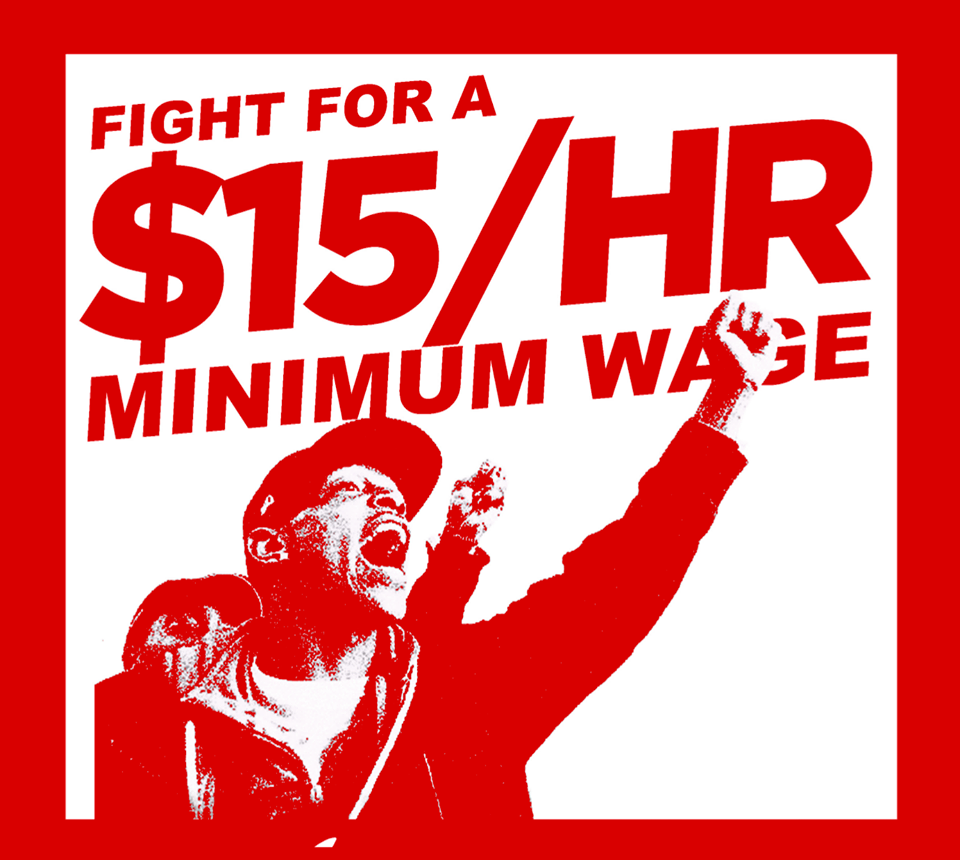
Los Angeles $15/Hr. Minimum Wage Huge Win


Leadership of mainstream political parties, zombies of a bankrupt and corrupt neoliberal consensus, got a jolt yesterday as the megalopolis of Los Angeles adopted a $15/hr. minimum wage. Jennifer Medina and Noam Scheiber have the story, "Los Angeles Lifts Its Minimum Wage to $15 Per Hour":
LOS ANGELES — The nation’s second-largest city voted Tuesday to increase its minimum wage from $9 an hour to $15 an hour by 2020, in what is perhaps the most significant victory so far for labor groups and their allies who are engaged in a national push to raise the minimum wage.
The increase, which the City Council passed in a 14-to-1 vote, comes as workers across the country are rallying for higher wages and several large companies, including Facebook and Walmart, have moved to raise their lowest wages. Several other cities, including San Francisco, Chicago, Seattle and Oakland, Calif., have already approved increases, and dozens more are considering doing the same. In 2014, a number of Republican-leaning states like Alaska and South Dakota also raised their state-level minimum wages by ballot initiative.
The effect is likely to be particularly strong in Los Angeles, where, according to some estimates, almost 50 percent of the city’s work force earns less than $15 an hour. Under the plan approved Tuesday, the minimum wage will rise over five years.
“The effects here will be the biggest by far,” said Michael Reich, an economist at the University of California, Berkeley, who was commissioned by city leaders to conduct several studies on the potential effects of a minimum-wage increase. “The proposal will bring wages up in a way we haven’t seen since the 1960s. There’s a sense spreading that this is the new norm, especially in areas that have high costs of housing.” 
The groups pressing for higher minimum wages said that the Los Angeles vote could set off a wave of increases across Southern California, and that higher pay scales would improve the way of life for the region’s vast low-wage work force. 
Supporters of higher wages say they hope the move will reverberate nationally. Gov. Andrew M. Cuomo of New York announced this month that he was convening a state board to consider a wage increase in the local fast-food industry, which could be enacted without a vote in the State Legislature. Immediately after the Los Angeles vote, pressure began to build on Mr. Cuomo to reject an increase that falls short of $15 an hour.
Opponents of the $15/hr. minimum wage hide behind small business owners, arguing that it will force them to close their doors. This is a red herring akin to trotting out the family farm when it comes time to call for a repeal of the estate tax or similar to USG claims that Shiite militias have to be sidelined in order to prevent the spread of sectarianism as Islamic State rampages.

If you have been to any urban core lately, you will have noticed, as I did recently on a trip to the Bay Area, that there are very few independent, small business retailers left standing. The overwhelming number of the storefronts I saw were corporate chains. The Bay Area I grew up in always had a large number of vibrant, independent small businesses, part of the legacy of being a Hippie Mecca. No longer.

As the Medina and Scheiber story makes plain, neoliberal Democrats like Andrew Cuomo are now on the hot seat. It is "shit or get off the pot" time for captive politicians. This minimum-wage wave is robust in red states too, as victories in Alaska and South Dakota during the GOP landslide of the 2014 midterms prove.

Over the weekend I finished Tariq Ali's The Extreme Centre: A Warning (2015). Ali takes us on a tour of Western democracies, focusing principally on the UK, since the collapse of communism in the late 1980s/early 1990s. The mainstream parties have morphed into de facto permanent neoliberal government cannibalizing the remnants of the post-WWII social order.

I mentioned in a post last month that Ali thinks that there is plenty of juice left in U.S. global hegemony. All talk of a "decline of the U.S.-led West" is wishful thinking. The one wild card Ali does hold out is popular reaction. As the mainstreams parties have cohered into an extreme center, they have become almost totally divorced from the 99% they nominally represent. This creates an opportunity for new parties to form, at least in parliamentary systems where party formation isn't impossible. So you have Syriza, which has been locked in a death struggle with enforcers of neoliberal austerity, the troika, since it came out on top in Greece's January elections. And you have Podemos in Spain, which will get a chance this Sunday in municipal and regional elections.

In the U.S., the only game in town is $15 Now. Well, that's not true. There's the #Black Lives Matter movement, which has, in less than a year, re-framed centuries of policing and racial stereotypes. Whites are moving toward minority status in the U.S. Obama, in Camden, NJ on Monday, announced that he was curtailing the Pentagon pipeline of surplus hardware to local police.

The LA $15 minimum wage and the shift underway in racial perceptions are huge gains and bode ill for business-as-usual neoliberalism. A mainstream party will win the election next year, but the ground is shifting. Change is coming.

Monday, April 20, 2015

The Staying Power of Neoliberalism and U.S. Unipolarity

Krugman was in Athens recently to survey the damage the troika has wrought and to offer his idea for a solution.

No keen insight will be found in reading "Greece on the Brink." Krugman, one of the preferred thinkers of the Democrats, begins his column tut-tutting the perception held by Greeks that a bloodsucking neoliberal establishment is out to get them:
"Don’t you think they want us to fail?” That’s the question I kept hearing during a brief but intense visit to Athens. My answer was that there is no “they” — that Greece does not, in fact, face a solid bloc of implacable creditors who would rather see default and exit from the euro than let a leftist government succeed, that there’s more good will on the other side of the table than many Greeks suppose.
Krugman then basically performs a somersault and acknowledges that Greeks have a point: a way forward is clearly visible; Greece recently achieved a budget surplus; all that needs to be done is to freeze the implementation of further austerity measures -- cuts to pensions and labor rights -- and let the country stabilize; but the troika appears to be in no mood to bargain in good faith:
The shape of a deal is therefore clear: basically, a standstill on further austerity, with Greece agreeing to make significant but not ever-growing payments to its creditors. Such a deal would set the stage for economic recovery, perhaps slow at the start, but finally offering some hope.
But right now that deal doesn’t seem to be coming together. Maybe it’s true, as the creditors say, that the new Greek government is hard to deal with. But what do you expect when parties that have no previous experience in governing take over from a discredited establishment? More important, the creditors are demanding things — big cuts in pensions and public employment — that a newly elected government of the left simply can’t agree to, as opposed to reforms like an improvement in tax enforcement that it can. And the Greeks, as I suggested, are all too ready to see these demands as part of an effort either to bring down their government or to make their country into an example of what will happen to other debtor countries if they balk at harsh austerity. 
To make things even worse, political uncertainty is hurting tax receipts, probably causing that hard-earned primary surplus to evaporate. The sensible thing, surely, is to show some patience on that front: if and when a deal is reached, uncertainty will subside and the budget should improve again. But in the pervasive atmosphere of distrust, patience is in short supply. 
It doesn’t have to be this way. True, avoiding a full-blown crisis would require that creditors advance a significant amount of cash, albeit cash that would immediately be recycled into debt payments. But consider the alternative. The last thing Europe needs is for fraying tempers to bring on yet another catastrophe, this one completely gratuitous.
So in the end Krugman obliquely endorses the Greek belief that their country is being sacrificed on the altar of neoliberal orthodoxy.

A particularly good read from this past weekend but one sure to depress those who like myself see a fast-approaching collapse to the U.S. neoliberal global hegemony is Tariq Ali's "The New World Disorder: They Knew Exactly What They Were Doing."

Ali argues that U.S. unipolarity has more staying power than is commonly acknowledged and "declinism" as a school of thought is superficial and overrated; he then takes the reader on a brief  yet magisterial global tour to emphasize that U.S. leadership while maybe not waxing is certainly not waning.

Towards the end of his essay he comes to Europe:
What is the situation in Europe? The first point to be made is that there isn’t a single country in the European Union that enjoys proper sovereignty. After the end of the Cold War and reunification, Germany has become the strongest and strategically the most important state in Europe but even it doesn’t have total sovereignty: the United States is still dominant on many levels, especially as far as the military is concerned. Britain became a semi-vassal state after the Second World War. The last British prime ministers to act as if Britain was a sovereign state were Harold Wilson, who refused to send British troops to Vietnam, and Edward Heath, who refused to allow British bases to be used to bomb the Middle East. Since then Britain has invariably done the Americans’ bidding even though large parts of the British establishment are against it. There was a great deal of anger in the Foreign Office during the Iraq War because it felt there was no need for Britain to be involved. In 2003, when the war was underway, I was invited to give a lecture in Damascus; I got a phone call from the British embassy there asking me to come to lunch. I thought this was odd. When I arrived I was greeted by the ambassador, who said: ‘Just to reassure you, we won’t just be eating, we’ll be talking politics.’ At the lunch, he said: ‘Now it’s time for questions – I’ll start off. Tariq Ali, I read the piece you wrote in the Guardian arguing that Tony Blair should be charged for war crimes in the International Criminal Court. Do you mind explaining why?’ I spent about ten minutes explaining, to the bemusement of the Syrian guests. At the end the ambassador said: ‘Well, I agree totally with that – I don’t know about the rest of you.’ After the guests had left, I said: ‘That was very courageous of you.’ And the MI6 man who was at the lunch said: ‘Yeah, he can do that, because he’s retiring in December.’ But a similar thing happened at the embassy in Vienna, where I gave a press conference attacking the Iraq war in the British ambassador’s living room. These people aren’t fools – they knew exactly what they were doing. And they acted as they did as a result of the humiliation they felt at having a government which, even though the Americans had said they could manage without the UK, insisted on joining in anyway.
The Germans know they don’t have sovereignty, but when you raise it with them they shrug. Many of them don’t want it, because they are over-concerned with their past, with the notion that Germans are almost genetically predisposed to like fighting wars – a ludicrous view, which some people who should know better have expressed again in marking the anniversaries of the First World War. The fact is that – politically and ideologically and militarily, even economically – the European Union is under the thumb of the global imperial power. When the Euro elite was offering a pitiful sum of money to the Greeks, Timothy Geithner, then US secretary of the treasury, had to intervene, and tell the EU to increase its rescue fund to €500 billion. They hummed and hawed, but finally did what the Americans wanted. All the hopes that had been raised, from the time the European idea was first mooted, of a continent independent of the other major powers charting its own way in the world, disappeared once the Cold War ended. Just when you felt it might be able to achieve that goal, Europe instead became a continent devoted to the interests of bankers – a Europe of money, a place without a social vision, leaving the neoliberal order unchallenged.
The Greeks are being punished not so much for the debt as for their failure to make the reforms demanded by the EU. The right-wing government Syriza defeated only managed to push through three of the 14 reforms the EU insisted on. They couldn’t do more because what they did push through helped create a situation in Greece which has some similarities with Iraq: demodernisation; totally unnecessary privatisations, linked to political corruption; the immiseration of ordinary people. So the Greeks elected a government that offered to change things, and then they were told that it couldn’t. The EU is frightened of a domino effect: if the Greeks are rewarded for electing Syriza other countries might elect similar governments, so Greece must be crushed. The Greeks can’t be kicked out of the European Union – that isn’t permitted by the constitution – or out of the Eurozone, but life can be made so difficult for them that they have to leave the euro and set up a Greek euro, or a euro drachma, so that the country keeps going. But were that to happen conditions would, at least temporarily, get even worse – which is why the Greeks have no choice but to resist it. The danger now is that, in this volatile atmosphere, people could shift very rapidly to the right, to the Golden Dawn, an explicitly fascist party. That is the scale of the problem, and for the Euro elite to behave as it’s doing – as the extreme centre, in other words – is short-sighted and foolish.
And then there’s the rise of China. There’s no doubt that enormous gains have been made by capitalism in China; the Chinese and American economies are remarkably interdependent. When a veteran of the labour movement in the States recently asked me what had happened to the American working class the answer was plain: the American working class is in China now. But it’s also the case that China isn’t even remotely close to replacing the US. All the figures now produced by economists show that, where it counts, the Chinese are still way behind. If you look at national shares of world millionaire households in 2012: the United States, 42.5 per cent; Japan, 10.6 per cent; China, 9.4 per cent; Britain, 3.7 per cent; Switzerland, 2.9 per cent; Germany, 2.7 per cent; Taiwan, 2.3 per cent; Italy, 2 per cent; France, 1.9 per cent. So in terms of economic strength the United States is still doing well. In many crucial markets – pharmaceuticals, aerospace, computer software, medical equipment – the US is dominant; the Chinese are nowhere. The figures in 2010 showed that three-quarters of China’s top two hundred exporting companies – and these are Chinese statistics – are foreign-owned. There is a great deal of foreign investment in China, often from neighbouring countries like Taiwan. Foxconn, which produces computers for Apple in China, is a Taiwanese company.
The notion that the Chinese are suddenly going to rise to power and replace the United States is baloney. It’s implausible militarily; it’s implausible economically; and politically, ideologically, it’s obvious that it’s not the case. When the British Empire began its decline, decades before it collapsed, people knew what was happening. Both Lenin and Trotsky realised that the British were going down. There’s a wonderful speech of Trotsky’s, delivered in 1924 at the Communist International, where, in inimitable fashion, he made the following pronouncement about the English bourgeoisie:
Their character has been moulded in the course of centuries. Class self-esteem has entered into their blood and marrow, their nerves and bones. It will be much harder to knock the self-confidence of world rulers out of them. But the American will knock it out just the same, when he gets seriously down to business. In vain does the British bourgeois console himself that he will serve as a guide for the inexperienced American. Yes, there will be a transitional period. But the crux of the matter does not lie in the habits of diplomatic leadership but in actual power, existing capital and industry. And the United States, if we take its economy, from oats to big battleships of the latest type, occupies the first place. They produce all the living necessities to the extent of one-half to two-thirds of what is produced by all mankind.
If we were to change the text, and instead of the ‘English bourgeois character’ say the ‘American bourgeois character has been moulded in the course of centuries … but the Chinese will knock it out just the same,’ it wouldn’t make sense.
Ali does not provide much in the way of hope other than the assertion that when people get truly fed up with neoliberalism there will be change. But how many lives will be lost in the process? All we need do is look to Yemen to see that the U.S. and its client states are more than willing to embrace genocide to maintain full-spectrum dominance.

Ali concludes his piece with some fine words from third century BC Sparta:
It’s a mixed and confused world. But its problems don’t change – they just take new forms. In Sparta in the third century BCE, a fissure developed between the ruling elite and ordinary people following the Peloponnesian Wars, and those who were ruled demanded change because the gap between rich and poor had become so huge it couldn’t be tolerated. A succession of radical monarchs, Agis IV, Cleomenes III and Nabis, created a structure to help revive the state. Nobles were sent into exile; the magistrates’ dictatorship was abolished; slaves were given their freedom; all citizens were allowed to vote; and land confiscated from the rich was distributed to the poor (something the ECB wouldn’t tolerate today). The early Roman Republic, threatened by this example, sent its legions under Titus Quinctius Flamininus to crush Sparta. According to Livy, this was the response from Nabis, the king of Sparta, and when you read these words you feel the cold anger and the dignity:
"Do not demand that Sparta conform to your own laws and institutions … You select your cavalry and infantry by their property qualifications and desire that a few should excel in wealth and the common people be subject to them. Our law-giver did not want the state to be in the hands of a few, whom you call the Senate, nor that any one class should have supremacy in the state. He believed that by equality of fortune and dignity there would be many to bear arms for their country."

Thursday, October 2, 2014

Coups and Assassinations Coming Shortly to Kabul

I'm sure the Gray Lady ran a biographical perspective piece on Ashraf Ghani at some point when he emerged out of the pack of presidential contenders to replace the increasingly recalcitrant U.S. quisling Hamid Karzai. I must have missed it. But I didn't miss the ringing endorsement of the newly -- one doesn't want to say "elected" because that doesn't really capture the process that led to Ghani assuming the title of president -- seated leader of Afghanistan by Ralph Nader.

I am familiar with Ralph Nader. I changed my life because of his Green Party candidacy for president in 2000. He doesn't give out pro forma recommendations; he does't play the usual kind of quid pro quo, "I'll scratch your back if you scratch mine"-type of politics. He's an iconoclast with a lot of pride who does things his own way.

I remember being at a campaign event early on in the 2000 election, a fundraiser. Nader was speaking at a coffee house; he was talking about the legacy of legislature-backed stadium giveaways to professional sports teams. He mentioned the amount of money Seahawks owner Paul Allen had spent to win the initiative campaign to build what is currently named CenturyLink Field. I called from out of the small crowd surrounding him the correct figure, "Five million dollars in five weeks." Nader shot me the steely look -- even though I wrote a check (I can't remember how much) to be in attendance -- of a man who didn't like to be interrupted but one who appreciated another armed with the facts willing to raise his voice.

So Nader's recommendation of Ghani means something. And that is supported in a story today by Azam Ahmed and Declan Walsh, "New Afghan Leader, Putting Focus on Graft, Revives Bank Fraud Inquiry":
KABUL, Afghanistan — Signaling his intent to improve the Afghan government’s poor reputation on corruption, President Ashraf Ghani on Wednesday ordered a new examination of the stagnant Kabul Bank fraud prosecutions. 
The bank, likened to a roughly $800 million Ponzi scheme after powerful insiders pillaged it through fraudulent loans, has come to symbolize the legal impunity enjoyed by Afghanistan’s elite. And the case has become a major sticking point for donor nations and the International Monetary Fund, which at one point made prosecution of those responsible for the bank’s collapse a condition of any new loans to the government.
Just three days into Mr. Ghani’s presidency, his decree about the bank was clearly meant to reassure Western partners that aid to the country would not be a bad investment. The day before, as Afghanistan signed long-term security deals with the United States and NATO, Mr. Ghani had emphasized the importance of international aid in tackling “shared challenges.”
The Gray Lady, at times able to comport herself in stunning fashion, has an excellent unsigned editorial today, "Paying Afghanistan’s Bills," that I will quote in its entirety because it does such a fine job defining those "shared challenges":
By the end of the year, Congress will have appropriated more money for Afghanistan’s reconstruction, when adjusted for inflation, than the United States spent rebuilding 16 European nations after World War II under the Marshall Plan. 
A staggering portion of that money — $104 billion — has been mismanaged and stolen. Much of what was built is crumbling or will be unsustainable. Well-connected Afghans smuggled millions of stolen aid money in suitcases that were checked onto Dubai-bound flights. The Afghan government largely turned a blind eye to widespread malfeasance. Even as revelations of fraud and abuse stacked up, the United States continued shoveling money year after year because cutting off the financial spigot was seen as a sure way to doom the war effort. 
As the Pentagon winds down its combat mission there at the end of the year, it’s tempting to think of the Afghan war as a chapter that is coming to an end — at least for American taxpayers. But, as things stand, the United States and its allies will continue paying Afghanistan’s bills for the foreseeable future. That commitment was solidified Tuesday as the American ambassador in Kabul and Afghanistan’s security adviser signed a bilateral security agreement that will keep a small contingent of NATO troops there for at least two years. 
The United States and NATO partners recently agreed to spend $5.1 billion a year to pay for the army and police, until at least 2017. Western donors are expected to continue to give billions more for reconstruction and other initiatives, recognizing that Afghanistan won’t be weaned off international aid anytime soon. In fact, the government appears to be broke.
A few weeks ago, Afghanistan’s Finance Ministry made an urgent plea to the United States for a $537 million bailout, warning that it would otherwise not be able to make payroll. That’s part of a broader, worrisome trend. The International Monetary Fund estimates that Afghanistan will face a financial gap of roughly $7.7 billion annually between now and 2018. 
If the flow of money is to keep going, the Afghan government has to prove that it can be trusted. And, for its part, Congress should not hesitate to cut off the aid if corruption remains unabated. 
Afghanistan’s new president, Ashraf Ghani, who took office on Monday, has pledged to stamp out graft. “I am not corrupt, and I am not going to encourage corruption, tolerate it or become the instrument,” the president, a former World Bank executive, told the BBC in an interview. 
That will be easier said than done in a country where back-room deals are the norm. Mr. Ghani can show he is serious by appointing and empowering a new attorney general willing to take on unscrupulous officials. His proposal to lead a new procurement board is commendable because it would make him personally accountable. 
Of the $104 billion that American lawmakers have appropriated for Afghan reconstruction, nearly $16 billion remains unspent, according to John Sopko, the inspector general who is overseeing the reconstruction effort. As one of the poorest nations on earth, Afghanistan clearly has plenty of needs. But the American agencies tasked with spending the money must do a better job identifying priorities, setting realistic goals and adopting stronger safeguards. 
Delivering a speech at Georgetown University recently, Mr. Sopko marveled at the Marshall Plan comparison. “What have we gotten for the investment?” he asked.
My only problem with the editorial is the impression it casts that USG has somehow been a duped victim of all this fiscal mismanagement rather than its chief architect. The American way of doing things is just as corrupt as the Afghan way of doing things. What went on with the fleecing of Kabul Bank had a precedent in the American savings and loan scandals of the 1980s.

With the Taliban ascendant -- this year was the deadliest for the Afghan police since the U.S.-led occupation began 13-years ago -- the U.S. experience in Iraq is noteworthy. Once the U.S. military exited, the Iraqi Army became little more than an elaborate system of graft, a Ponzi scheme, where officers purchase their commissions to receive kickbacks from recruits, who may or may not actually be reporting for duty. This is not to say that this doesn't occur when the U.S. is in country maintaining a supervisory role; it is just that the corruption doesn't run so rampant the the entire system implodes as it did in Iraq. The ability of American military supervisors to call in airstrikes probably has something to do with it too.

A singular description of the corruption-fueled collapse of the Iraqi military can be found in an interview of Patrick Cockburn by Tariq Ali, "The Rise of ISIS and the Origins of the New Middle East War," that appeared earlier in the week on the Counterpunch web site:
Tariq Ali: And so, if we come down to the speed with which this particular organisation swept through parts of Iraq, which you yourself talk about in the book, how do you explain the total collapse of the Iraqi army, Patrick? Is it in that sense not too much different from the army created by the West in Afghanistan, the fact that they are not prepared to fight and die for the United States? At that time it was, al-Qaeda and Iraq was only one of a number of serious resistance movements to the occupation but it was very evident in Baghdad at the time when I went to American briefings that anything that happened was attributed by the spokesman, the military spokesman, to al-Qaeda. Of course this played well back in the US, but in Iraq it had quite the contrary effect which people who were against the occupation think, oh it’s al-Qaeda who’s doing all this resisting, let’s go an get a black flag and join them…

Patrick Cockburn: Yeah, and even more so. I mean I think this is, it’s difficult to think of another example in history, where there are 300 or 350 thousand men in the Iraqi army, they’d spent 41.6 billion dollars on this army over the last three years. But it disintegrated because of an attack by maybe a couple of thousand people in Mosul. Why did it happen? Well, the army was rather extraordinary. I mean one Iraqi general I was talking to who’d been forcibly retired said at the beginning of the disaster was the Americans, [who] when they set it up, insisted that supplies and things like that should be outsourced, privatised. 
So immediately a colonel of a battalion nominally of 600 men would get money for 600 men, [but] in fact there were only 200 men in it, and would pocket the difference, which was spread out among the officers. And this applied to fuel, it applied to ammunition… At the time of the fall of Mosul there are meant to be 30,000 troops there. In fact, it’s estimated that only one in three was there. Because what you did was: you joined the army, you got your full salary and then you kicked back half that salary to your officer, who spread it among the officers. So I remember about a year ago talking to a senior Iraqi politician, and who said look: the army’s going to collapse if it’s attacked. I said surely some will fight, he said: no no no, you don’t understand. These officers are not soldiers, they’re investors! 
They have no interest in fighting anybody; they have interest in making money out of their investment. Of course you had to buy your position. So in 2009, you want to be a colonel in the Iraqi army, it’ll cost you about 20,000 dollars, more recently it cost you about $200,000. You want to be divisional commander, and there are 15 divisions, it will cost you about 2 million. Of course, there are other ways of making money. Checkpoints on the roads act as sort of customs barriers and a tariff on each truck going through would be paid. So that’s why they ran away, led by their commanding officer, the three commanding generals got into a helicopter in civilian clothes and fled to Erbil, the Kurdish capital. And that led to the final dissolution of the army. 
Tariq Ali: It is one of the most astonishing events in recent history, Patrick. I mean can you think of any other equivalent, even in the last century?
Patrick Cockburn: I can’t think of any of such a large well-equipped army disintegrating. You could say that Saddam’s army disintegrated in ’91 when attacked by the Americans, and again in 2003. But then it was attacked by the largest military force in the world and was being bombed. So it’s not a parallel. It of course shows that ISIS was quite effective in spreading terror through social media, by films of it decapitating Shia captives. So the soldiers were terrified of ISIS.
Nader's ringing endorsement of Ghani makes me thinks that he is different. If he is, we'll know soon enough. The Organization for Economic Cooperation and Development’s Working Group on Bribery "will release its report, 'Unfinished Business,' which names every beneficiary of the Kabul Bank scandal" today according to Ahmed and Walsh. If Ghani goes after those named, even if they are the elite, the palace intrigue will grow thick. Coups and assassinations can't be far off.

Friday, March 29, 2013

Political Ferment in Karachi

Declan Walsh and Zia ur-Rehman have an interesting story today, "Taliban Spread Terror in Karachi as the New Gang in Town." The Pakistani Taliban is targeting two rival Karachi political parties -- the ethnic Pashtun Awami National Party and the ethnic Mohajir Muttahida Qaumi Movement -- and taking their turf.
Police officials, militant sources and Pashtun residents say that three major Taliban factions operate in Karachi — the most powerful one, which is rooted in South Waziristan and dominated by the Mehsud tribe, and two others from the Swat and Mohmand areas.

A senior city police officer, speaking on the condition of anonymity, said that militant commanders with those factions send operational orders to Karachi from the tribal belt; while some captured militants have tried to justify their activities by citing the authorization of religious clerics in the northwest. 
In cases, he added, regular criminal groups have posed as Taliban fighters in a bid to increase their power of intimidation. 
Just why the Taliban are adopting such an aggressive profile in Karachi right now is unclear. Some cite the greater number of militants fleeing Pakistani military operations in the northwest; others say it may be the product of dwindling funds, as jihadi donors in the Persian Gulf states turn to the Middle East.
Imagine a city like Karachi -- 20 million souls (compared to New York City's 8.3 million) with real political parties (not the completely moribund ones, both ruled by the 1%, that are featured in our dysfunctional duopoly). We bomb countries in the name of democracy, but those countries, at least in the case of Pakistan, often times have more democracy than we do.

For a brief period I attempted a study of Pakistan's politics. I read several books by Tariq Ali; on my web browser I bookmarked Dawn and Foreign Policy's AfPak Daily Brief. But it proved too much to keep up with.

Walsh and ur-Rehman conclude their story by saying that a brake on the Taliban's spread in Karachi could be Mullah Omar himself:
Other factors limit the Pakistani Taliban’s ingress into Karachi. One of the more provocative ones is that allied militants — particularly the Afghan Taliban — might not like the added publicity. The Afghan wing has long used the city as place to rest and resupply. There are longstanding rumors that the movement’s leader, Mullah Muhammad Omar, is taking shelter here, and that his leadership council, known as the Quetta Shura, has met in Karachi.