Showing posts with label New York Times. Show all posts

Monday, October 23, 2017

New York Times Editorializes on Perpetual War

A New York Times editorial does a drive-by on the U.S. perpetual warfare state in "America’s Forever Wars." The U.S. has troops in almost every country. Military commitments wax but seemingly never wane.

The Times offers up a few critical ingredients for the post-9/11 perpetual warfare state: no draft, a professional military that makes up less than 1% of the general population, abdication of Congressional authority, etc.

The editorial is written with the question -- "How many new military adventures, if any, is the American public prepared to tolerate?" -- forefront. But it is an obvious rhetorical sleight of hand meant to obscure the commitment of the political system -- Republicans and Democrats -- to perpetual war.

Americans voted for the peace candidate in 2008 and 2012 by a landslide, only to see the war machine grow. One, at least last fall, could argue that Trump was the peace candidate in the "Trump vs. Hillary" main event.

But no matter how voters vote, the war machine rumbles on. For The Times to place perpetual war in the lap of the American voter begs the question -- How can we to vote to end this? Who can we vote for who will stop it? Is it time to grab the pitchfork and musket?
So far, Americans seem to accept that these missions and the deployments they require will continue indefinitely. Still, it’s a very real question whether, in addition to endorsing these commitments, which have cost trillions of dollars and many lives over 16 years, they will embrace new entanglements of the sort President Trump has seemed to portend with his rash threats and questionable decisions on North Korea and Iran.
For that reason alone, it’s time to take stock of how broadly American forces are already committed to far-flung regions and to begin thinking hard about how much of that investment is necessary, how long it should continue and whether there is a strategy beyond just killing terrorists. Which Congress, lamentably, has not done. If the public is quiet, that is partly because so few families bear so much of this military burden, and partly because America is not involved in anything comparable to the Vietnam War, when huge American casualties produced sustained public protest. It is also because Congress has spent little time considering such issues in a comprehensive way or debating why all these deployments are needed.
Congress has repeatedly ducked efforts by Senator Tim Kaine, Democrat of Virginia, and others to put the war against the Islamic State, which has broad popular support but no specific congressional authorization, on a firm legal footing. President Trump, like his predecessor, insists that legislation passed in 2001 to authorize the war against Al Qaeda is sufficient. It isn’t. After the Niger tragedy, the chairman of the Senate Foreign Relations Committee, Bob Corker of Tennessee, has agreed to at least hold a hearing on the authorization issue. It is scheduled for Oct. 30.
Andrew Bacevich, a retired Army colonel who lost a son in Iraq and is a critic of military operations, says that “a collective indifference to war has become an emblem of contemporary America.” The idea that Americans could be inured to war and all its horrors is chilling, and it’s a recipe for dangerous decisions with far-reaching ramifications. There are many factors contributing to this trend:
During earlier wars, including Vietnam, the draft put most families at risk of having a loved one go to war, but now America has all-volunteer armed forces. Less than 1 percent of the population now serves in the military, compared with more than 12 percent in World War II. Most people simply do not have a family member in harm’s way.
American casualty rates have been relatively low, especially in more recent years after the bulk of American troops were withdrawn from Afghanistan and Iraq. Also, the United States has shifted to a strategy in which Americans provide air power and intelligence, and train and assist local troops who then do most of the fighting and most of the dying. This year, for instance, 11 American service members died in Afghanistan and 14 in Iraq. By comparison, 6,785 Afghan security force members died in 2016 and 2,531 died in the first five months this year, according to the United States and Afghan governments. Tens of thousands of civilians also perished at the hands of various combatants, including in 2017, but the figures get little publicity. Most Americans tend not to think about them.

Thursday, January 19, 2017

The Death of the Daily Newspaper

Yesterday, bottom of the fold on the front of the business page, was a story more illuminating than most of what was found on the front page. In "New York Times Study Calls for Rapid Change in Newsroom" Sydney Ember discusses “Journalism That Stands Apart," the Gray Lady's assessment, known internally as the 2020 report, of how it can survive in a digital age when it continues to hemorrhage print ad revenue:
The report comes at a particularly sobering time for the legacy media industry. The steep and continuous decline of high-margin print advertising has led to significant financial challenges for most newspapers, which in turn are cutting costs and trying to find new revenue sources.
News organizations, including The Wall Street Journal and Gannett, have made significant cuts in staffing; The Journal is currently conducting a newsroom review similar to that of The Times, called WSJ2020.
Among the other recommendations in The Times’s report were reducing duplicative layers of article editing, and having visual experts play “the primary role covering some stories” — part of an urgent call for more visual journalism. The report also calls for a renewed focus on diversity within The Times as a way of ensuring that the paper’s journalists “reflect the audience we seek.”
“The world is changing really rapidly,” David Leonhardt, a columnist who led the group’s work, said in an interview. “We have to keep up, and even get ahead of it.”
The key to survival for The Times appears to be more of the same -- layoffs and greater Snapchatesque digitalization.

A great deal of Ember's article was taken up with the coming cull of editors at the paper, with a hint of the funereal gloom of front-line staff:
Within The Times’s newsroom, where the impending staff cuts have some employees on edge, the report did not satisfy those looking for specific guidance on their future.
Several employees said much of the report merely confirmed many of the initiatives that were already underway. Some expressed frustration that the report did not provide details about layoffs and that there was little information about how individual departments might be altered or how specific jobs might change.
Instead, the report emphasizes The Times’s strengths and lays out a series of broad recommendations intended to ensure the company’s survival for years to come. Mr. Baquet [executive editor] said the goal was to put in place as many recommendations as possible this year. Several of them have been introduced, including the creation of subject-focused newsroom teams and a restructuring of the copy desks.
Most important, the report affirms The Times’s commitment to its subscriber-based revenue model, a departure from many other publications, both traditional and online, whose businesses are built on page-views, visitors and clicks.
“We are, in the simplest terms, a subscription-first business,” the report says. “We are not trying to maximize clicks and sell low-margin advertising against them. We are not trying to win a page-views arms race.”
Herein lies the contradiction for The Times. Without seeing a profit & loss statement, my guess is that the Gray Lady is excessively dependent on the revenue from her print subscribers; that the revenue from digital subscriptions pales in comparison. Yet the 2020 changes outlined will diminish the printed product while pushing more resources online, meaning the foundation of the company's business model will continue to erode.

If I am to take my apartment building as an example, I would have to say that there are as many subscribers to the print national edition of The New York Times as there ever have been, at least since I have been here (spring 2002). There are two -- me and a transgender person my age -- on my side of the building, and I think two on the other side. (What I don't see are nearly as many copies of the local daily.)

The death knell for The Times is that young people don't read newsprint. They read their phones. When my neighbor Carla and I age out there will be no one to take up our subscriptions.

I give the daily newspaper in its present form 20 more years. In the next two decades digital corporate ad placement will become increasingly inseparable from regular newspaper columns and features, the content of which will be almost entirely of government origin.

Tuesday, December 27, 2016

Deep State Worried About Al Saud

Another installment in The New York Times' irregular "Secrets of the Kingdom" series appears on the front page this morning.

"Saudi Royal Family Is Still Spending in an Age of Austerity," by Nicholas Kulish and Mark Mazzetti, focuses on "Al Saud Inc.," an "insider" name given to the Kingdom of Saudi Arabia (KSA) that attempts to capture the toxic mixture of Wahhabism, big oil (Saudi Aramco) and an extended, profligate royal family.

Al Saud is obviously in the cross hairs of "the newspaper of record," along with Russia, Fake News and Donald Trump. But in this case, by going after KSA, the Gray Lady is on the side of the angels.

Even within the Deep State, on behalf of which The New York Times speaks, there is a realization that the Kingdom, if left to its own devices, will destroy the neoliberal New World Order.

I think it is too late. The damage has been done. Europe, because of the refugee crisis unleashed by the House of Saud's adventures in Syria and Iraq, is going to find its own way. We'll see that this March.

Tuesday, December 6, 2016

Pussy Riot Reappraised

Pussy Riot, the punk-rock/guerilla-protest collective, was in the business page yesterday, interviewed by the soft-spoken Jim Rutenberg for a piece titled "A Warning for Americans From a Member of Pussy Riot." The member, Nadya Tolokonnikova, was in Miami for Art Basel, the annual jet set international art fair.

Based on her new video, “Make America Great Again,” Tolokonnikova has left her ski mask and her faux-punk behind and is now angling in a Madonna/Lady Gaga direction. She is trying to hit the jackpot in the United States.

It is easy to make fun of Pussy Riot, at least the solemn expressions of concern for the group's artistic freedom belched out by the USG/NGO nexus, but Tolokonnikova and Masha Alyokhina did support Occupy Wall Street, visiting imprisoned Cecily McMillan on Rikers Island. Plus, Tolokonnikova publicly backed Bernie Sanders. So it is doubtful that Pussy Riot is a creation of the National Endowment for Democracy (NED).

Rutenberg, a champion of internet censorship in the form of policing Fake News, steered the conversation towards the dangers of authoritarianism and the crisis of belief in objective truth.
But truth cannot break through if people never find it or believe it when they do. And the problem in Russia is the same one we’re seeing here, Ms. Tolokonnikova told me. “A lot of people are living really unwealthy lives so they have to work not one but two jobs, so they don’t have time to analyze and check facts, and you cannot blame them,” she said.
And, after so many years in which the “lift-all-boats” promises of globalization didn’t come to pass, she said, “they don’t trust bureaucrats, they don’t trust politicians, and they don’t really trust media.”
That’s why the top Russian propagandist Dmitry K. Kiselyov can assert that “objectivity is a myth” and, here in the United States, the paid CNN Trump-supporting contributor Scottie Nell Hughes can declare: “There’s no such thing, unfortunately, anymore, of facts.”
When there is no truth, invasions are “liberations” and internment camps are “relocation centers.”
But, as Ms. Tolokonnikova said, “There is always a way if you really want to tell the truth.”
Doing so, for her, has come at a cost, even after prison. Informal Cossack security forces beat her and other Pussy Riot members as they prepared to perform in Sochi during the 2014 Olympics. That same year, a youth gang attacked her with trash and a green antiseptic chemical in Nizhny Novgorod, where she was protesting prison conditions. The men were clearly identifiable but, she said, police made no arrests.
Ms. Tolokonnikova has also co-founded a news site called Media Zona. She said it avoided opinion so that readers would accept it as a just-the-facts counter to disinformation.
“You are always in danger of being shut down,” she said. “But it’s not the end of the story because we are prepared to fight.”
Her counsel for United States journalists: You better be, too.
I am not so sure about Media Zone. There appears to be a lot of stuff on Navalny's ongoing legal battles, but there is also a feature on the recent prison strike in the U.S.

What struck me was Tolokonnikova's critique of globalization to a newspaper, The New York Times, whose entire mission is to spread the gospel of globalization.

Wednesday, June 15, 2016

Liberals on the Precipice: Knowing that Neoliberalism has Failed while Pretending that Politics can Fix It

Eduardo Porter has a column every Wednesday on the business page of The New York Times. It is interesting because it records how a liberal is comings to grips with a bankrupt neoliberal economic paradigm. Lately Porter has been jousting with proponents of a universal basic income (UBI).

Today, "For Hillary Clinton, a Risk of Excess Caution in Economic Policy," Porter implores Hillary to go big in addressing the problems of today's economy, which he correctly identifies as the shrinking of the working class:
A big part of the problem is the erosion of America’s working class. It has been hollowed out as trade and technology have done away with most of the well-paid jobs once available to Americans without a college degree, tipping many of them into a service economy of low wages, uncertain hours and little job security.
He likes Clinton's emphasis on rebuilding the nation's infrastructure, but he thinks her proposal to do so is too stingy:
For instance, she is proposing $275 billion in federal infrastructure investment over five years. That is less than 10 percent of what the American Society of Civil Engineers estimates will be needed. 
Mrs. Clinton’s entire tax plan would raise only $1.1 trillion over the next decade, according to the Tax Policy Center, half a percentage point of the nation’s gross domestic product.
Porter then goes on to list some helpful liberal ideas on how to create a more equitable economy:
What about dismissing the deficit scolds who shape the outdated Washington Beltway consensus and borrowing $1 trillion or so to sharply increase the spending on infrastructure, letting states and municipalities select the investments and manage the job?
How about taking advantage of the cheapest oil prices in a very long time to propose a carbon tax? Or how about imposing a progressive wealth tax to tap into the good fortune of 160,000 American families at the very tip of the wealth pyramid, who are on their way to pass $12 trillion to the next generation, much of it untaxed.
The money could be spent on high quality and universal early education, providing the next generation a better shot at a level playing field. It could be spent on training, to provide workers with needed skills, or job search services to help match workers and jobs. These strategies have been successfully employed by other advanced nations but remain a rarity in the United States.
Mrs. Clinton, of course, is not the only candidate indulging in nostalgia. Witness Donald Trump’s bombastic appeal to white working class men uncomfortable in an America where one must dial “1” for English.
Still, she has a rare opportunity. If she wins, she may well come into office with the political wind at her back: a Senate returned to Democratic control and a divided Republican Party with only a tenuous hold on the House. [Some robust magical thinking here.]
Americans have just lived through perhaps the most progressive presidency [!] since the 1960s. President Obama raised tax rates on the rich and expanded health insurance for millions of Americans. Facing stubborn resistance in Congress, he leaned on his executive powers to improve working conditions.
Yet the nation’s enormous inequities just got bigger. The income of the richest 1 percent grew 27 percent from 2009 to 2014. The average gain for everybody else barely exceeded 4 percent. A future projected along these lines does not look promising.
Bernie Sanders talks about a revolution. Mrs. Clinton might want to try to deliver one.
Most liberals (they don't call themselves liberals anymore; if pushed, they call themselves progressives) are where Porter is at. They realize the economic paradigm is malfunctioning for the vast majority of people, but they are still attached to the delusion that the political system can address and solve the problem. It can't.

The idea that Clinton is going to have long coattails in November and sweep the GOP from control of the Senate, or even substantially reduce the Republican majority in the House, is fanciful. No fix is in store. And what will be interesting is the level of allegiance Hillary will enjoy from liberals who remained loyal to Obama even after it became apparent post-2012 election that he was not "the one we were waiting for." I suspect liberal loyalty will be at a minimum.

At least liberals like Porter are able to frame the question, as he did in last week's column on technology-induced unemployment, "Jobs Threatened by Machines: A Once ‘Stupid’ Concern Gains Respect":
Jeffrey D. Sachs of Columbia University has been working with a series of colleagues on an economic model of a world in which robotization both raises economic output and immiserates workers, pushing them out of their jobs. It is not a theoretical impossibility.
“The point for me is that these two scenarios — robots lead to nirvana and hell — can happen side by side,” Professor Sachs told me. “Generally capital wins and all labor can lose. It shows up as a fall in the labor share of national income.”
In that event, preventing a dynastic society of relentlessly growing inequality would require large-scale redistribution. It could even take the form of a universal income paid for with a hefty estate tax — using some of the vast profits accruing to the owners of robots to finance a living for everybody else.
Since most paid human labor would be pointless, the disincentive to work produced by a monthly check would be unimportant. People could devote themselves to unpaid creative affairs.
“Don’t destroy the robots,” Professor Sachs said. But recognize that “not everybody would be better off as a result of market forces. With redistribution everybody could be made better off.”
Many experts are not convinced. For every analysis like this one — forecasting that half of all jobs in the United States will be replaced by new technology — others point out that there is no evidence of humanity’s impending redundancy.
A research paper published last month by the Organization for Economic Cooperation and Development argued that even the occupations most at risk of being replaced by machines contained lots of tasks that were hard to automate, like face-to-face interaction with customers.
My sense is that given a choice between interacting with another human or a computerized machine, consumers will overwhelming opt for the machine. Look at the fate of the corner video store. Streaming home video had a lot to do with the demise of the mom-&-pop neighborhood video rental store, but not so much as the appearance of the Redbox movie kiosks in grocery stores and in front of 7/11s.

We have to give more weight to predictions of 50% job loss due to automation than a pie-in-the-sky-by-and-by faith that robotic efficiencies in the job market will trickle down and create other types of employment.

To this end, Porter concluded his column last week with a Larry Summers anecdote. And who doesn't love a story about the pompous economics guru ex-Harvard president?
Last November, Lawrence H. Summers — a former Treasury secretary under President Bill Clinton, a top economic adviser in President Obama’s first term and one of the youngest people to earn tenure on the Harvard faculty — strode up to the podium at the Peterson Institute for International Economics in Washington and made an unlikely admission: Perhaps economists were not always the smartest people in the room.
He reminisced about his undergraduate days at M.I.T. in the 1970s, when the debate over the idea of technological unemployment pitted “smart people,” exemplified by the great economist Robert Solow, and “stupid people,” “exemplified by a bunch of sociologists.”
It was stupid to think technological progress would reduce employment. If technology increased productivity — allowing companies and their workers to make more stuff in less time — people would have more money to spend on more things that would have to be made, creating jobs for other people.
But at some point Mr. Summers experienced an epiphany. “It sort of occurred to me,” he said. “Suppose the stupid people were right. What would it look like?” And what it looked like fits pretty well with what the world looks like today.
For large categories of workers, wages are inadequate. Many are withdrawing from the labor force altogether. In the 1960s, one in 20 men between 25 and 54 were not working. Today it’s three in 20. The population is generally healthier than it was in the 1960s; work is almost uniformly less demanding. Still, more workers are on disability.
“Maybe the stupid people weren’t quite as stupid as I thought they were,” Mr. Summers conceded. “This was at least a serious concern that had to be thought about.”
In a world in which many Americans do not work during large chunks of their lives, we might have to conceive of Social Security and disability much more broadly than we do today.
That, Mr. Summers said, “could start to look like a universal income.”
So this is where smart-set type liberals are now. They are the on the precipice. The economic system is clearly not working for the masses, and it promises to only get worse. Talk about solutions is headed in the right direction, but there is very little acknowledgement that the political system will address the problem in any significant way.

A political revolution is called for, but in the United States a political revolution is not on the horizon. So things are going to continue to get worse.

Thursday, June 9, 2016

Arango on the Outskirts of Falluja: NYT's Reporting on Conflict in Iraq and Turkey

Tim Arango is one of The New York Times' better reporters. He is stationed in Turkey but he has been reporting out of Baghdad for some time. Reporting on Iraq NYT staff have to follow certain guidelines that are identical to USG talking points. First, Iraq is a sectarian mess mostly due to the corruption of Shiite leadership and the malign, Snidley Whiplashesque influence of Iran. The recrudescence of Al Qaeda in Iraq in the form of ISIS is blamed on former prime minister Nouri al-Maliki (onetime U.S. favorite). Almost no mention is made of the Wahhabi jihadis of Islamic State and their sectarianism and where it comes from. Next, as Iraqi forces, both Iranian-led militias and U.S.-led regular army and special forces, take back territory from ISIS there is a great deal of attention paid to the plight of civilians (compared with, say, Yemen).

Tim Arango in his story the other day, "Iraqis Who Flee Fighting in Falluja Find Hardship and Hunger," adheres to the guidelines in the first two-thirds of his dispatch from the outskirts of Falluja. But the able reporters find a way to subvert the standard narrative, and Arango delivers: the Iranian-led Shiite militias are conducting themselves professionally with no targeting of the civilian Sunni population fleeing the war zone, and any sectarianism appears to be fomented by Saudi Arabia and the other Gulf monarchies:
Shiite militias have played a prominent role in the offensive to retake Falluja after nearly three years of Islamic State rule. But because of that, the battle is playing out amid persistent worries that the campaign could intensify the sectarian tensions that are tearing the country apart. [A good distillation of the official U.S. position.]
The Sunni extremist fighters for the Islamic State have warned civilians that the Shiite militias would slaughter them in revenge attacks whenever possible. The news media in Saudi Arabia and other Persian Gulf countries have framed the battle in crass sectarian terms, warning that Iran’s militias were intent on killing Sunnis. [Not at all dissimilar from NYT's reporting.]
But for the most part, civilians who have fled the areas around Falluja have said they had tired of the grim life under the Islamic State and had been treated well by the militias and Iraqi soldiers.
“We were surprised that they treated us so well,” said a man at a camp who was in his 50s and gave his name as Abu Muhammad, standing on Sunday outside his tent. “Daesh had told us the Shiites wanted revenge and would kill us.” 
Instead, he said, he was given cookies and orange juice.
For evidence of ruthless state-sponsored terrorism which news consumers hear almost nothing about, Arango needs to travel back to his old turf, Turkey, where president Recep Tayyip Erdoğan is waging a scorched-earth campaign against the Kurdish population of the country's southeast.

Erdoğan's Kurdish war fulfills all the guidelines of NYT's Iraq reporting, but the Gray Lady gives the Turkish government a pass for the most part. I say for the most part because Ceylan Yeginsu did have an informative piece yesterday, "Bomb in Istanbul Kills 11 Near Tourist District":
Violence has surged in the country’s predominately Kurdish southeast in recent months, after Turkey undertook a major military operation to eradicate militants from their strongholds in the region.
The Turkish authorities have imposed round-the-clock curfews across several southeastern cities and pounded Kurdish militant targets with tanks and artillery, and they claim to have killed almost 5,000 militants. In the process, they have reduced many Kurdish cities to rubble.
Critics of President Recep Tayyip Erdogan say he deliberately short-circuited the peace process with the Kurds last year to stir nationalist sentiments after his ruling Justice and Development Party fared poorly in a first round of parliamentary elections. Premeditated or not, the tactic worked, as the party went on to win in a landslide in November, prompting the president to say the country had voted for stability.
Despite that victory, violence sharply escalated and the P.K.K.’s youth branches, fighting for self-rule, began carrying out increasingly sophisticated attacks in urban areas.
Last month, lawmakers from Mr. Erdogan’s governing party pushed through a contentious amendment to the Turkish Constitution that would strip lawmakers’ immunity. Analysts say the move will lead to the ouster of Kurdish politicians, many of whom could face terrorism charges. Kurdish politicians have warned that their exclusion from Parliament could aggravate tensions in the southeast.
Erdoğan's Turkey has been rewarded by the E.U., under Merkel's leadership, for its help in keeping refugees away from European shores.

Thursday, May 19, 2016

The New York Times

The New York Times has become almost unreadable. Always slanted, now, I believe, because of the obsolescence of newspapers, it has decided to stake its commercial future on becoming entirely a government organ.

It used to be just recently that a reader of the Gray Lady could at least follow developments overseas, for instance the unfolding battlefield of Syria or the coup in Kiev. No longer. Now the paper hopscotches from country to country -- a story about the collapse of the Ghani government in Afghanistan one day, a tiny report on the nightly street protests in Paris the next -- without following one country day after day. The only exception that comes to mind, and this because of the USG's revanchist agenda in South America, is NYT's coverage of Brazil's impeachment circus.

Pakistan is hardly ever reported on. The quality of coverage on the upcoming Brexit vote has been poor, as has the political upheaval underway in Germany. A reader has no idea what is happening in Yemen or Ethiopia or Libya, and very little about what is going in other hot spots, whether Syria, Iraq, the Donbass or southern Turkey; and when it comes to "official enemies" Russia, China, Iran and Venezuela, the news is cartoonishly vile.

The sense I have is that the world's political structure is shaking as if experiencing an enormous earthquake, and the response of The Times is to occlude this occurrence as much as possible -- and this goes without even mentioning the paper's shameless boosterism of Hillary Clinton.

Monday, March 21, 2016

Russian Military Power, Syrian Federalization and Merkel's Refugee Deal with Turkey

Recently I've been wrong about two of the biggest issues facing the West: war in Syria and the European refugee crisis that it has helped to create. I didn't think that the February 27 U.S.-Russia negotiated ceasefire in Syria (minus territory controlled by Nusra and Islamic State) would work. It has for the most part. There have been violations from the outset, but the agreement has held; so much so that last week Putin announced the withdrawal of the bulk of Russian forces from the war-torn country. (The S-400 missile defense system will stay of course.) Then in Brussels on Friday Turkey and the Europe Union actually settled on a Rube Goldbergesque plan to stem the flow of refugees to Europe.

What is going on? It looks as if the warpig Western leaders are -- finally -- turning the battleship around. We should be incredulous since the neoliberal coin of the realm is stamped with the motto "In war we trust." But something is definitely happening here.

Whenever the reporting largely goes blank in The New York Times you know that it is not for lack of action on the ground but because a political decision has been made to put out the lights. It happened in Ukraine after the junta got its clock cleaned in Debaltseve. The paper, which had three reporters -- Andrew Kramer, David Herszenhorn and Neil MacFarquhar -- regularly filing dispatches, basically stopped reporting on the Donbass conflict. Debaltseve impressed upon the Obama administration the ease with which Russia could take Kiev. So I suspect the word went out to ratchet down coverage of the New Cold War in Ukraine, and editors of "the newspaper of record" complied. The free press at work.

I think what happened in Debaltseve at the beginning of last year in Ukraine is something similar to what the Russians accomplished in Syria with the recent victories in Aleppo Province. A game changer. The West and the Gulf sheikhs were forced to the table; we got the ceasefire and now the gradual press blackout.

There has been little coverage of the ongoing peace talks in Geneva. One thing seems clear though, federalization of Syria is the country's future. It is hard to believe that Turkey will accept any form of Kurdish statehood. I think this is where the refugee deal with Europe comes in. Beginning this summer, provided certain unnamed conditions are met, Turkish citizens will be able to enjoy passport-free travel to Europe. If Turkey and the EU manage to accomplish this, then Turkey's membership in the European Union is closer to becoming a reality than ever before; such a historic achievement for Erdogan would likely grease Turkish support for a federalized Syria.

As for Merkel's Rube Goldberg scheme to block refugees in Greece for rapid return to Turkey at the same time admitting to Europe a refugee warehoused in Anatolia, I think it is bound to fail. Just supplying the administrative manpower needed to process migrants in Greece for return to Turkey is an enormous logistical feat. What about corruption? What prevents smugglers from pursuing an Italian route? The agreement only covers Greece. How long can the heinous canard of listing Afghans as "economic migrants" be maintained? At least there is a partial ceasefire in Syria; in Afghanistan there is nothing of the sort. What about international humanitarian law? Merkel's EU plan is in violation. Refugees will not be allowed to seek asylum. They will be registered in Greece and then whisked back to Turkey.

Wednesday, February 10, 2016

New Hampshire Post-Mortem: Hillary, a Corpse on Life Support + Trump's Apotheosis

While the United States might not be a closed society in the classic George Orwell 1984 police state sense, it is one where its inhabitants are subject to a great deal of centrally managed thought control. Every country propagandizes its own population. But the U.S. has long prided itself on its free press, enshrined as it is in the First Amendment to the Constitution.

This morning drove home to me the extent to which we do not have a free press. Waking up I went online to see what the vote totals were in New Hampshire. On the home page to the nation's newspaper, The New York Times, there was a modest headline "Donald Trump and Bernie Sanders Win in New Hampshire," with most of its related coverage devoted to Trump's victory. Nowhere can the reader easily find the normally ubiquitous color chart graphic of the vote total.

I cooked a pot of whole wheat pasta at 3:45 AM to kill time until I could amble downstairs to the front stoop where the national edition of The New York Times usually arrives by 4:15 AM. I wanted to see if the lack of statistical information about the New Hampshire results was replicated in the home edition of the paper. Sure enough it was.

Out of curiosity I took a brief spin around the World Wide Web. I couldn't find my way past the Wall Street Journal's paywall, but the Washington Post has the vote totals on its home page. Also, if you Google "New Hampshire results," you'll find them. You just wont find them readily available in "the newspaper of record."

Here they are: Bernie Sanders 60.0%, Hillary Clinton 38.3%. Trump won by 20 points too:
Donald Trump 35.2%, John Kasich 15.8, Ted Cruz 11.6%, Jeb Bush 11.1%, Marco Rubio 10.5%.

The Times, having recently endorsed Hillary, is of course doing everything it can to keep Sanders from enjoying a deserved bounce for his commanding victory in a state that has always been kind to the Clintons. As Patrick Healy summarizes online this morning in "New Hampshire Takeaways: Trust, Experience and Message Count":
New Hampshire Abandoned the Clintons
It is hard to overstate the magnitude of the New Hampshire loss for Mrs. Clinton and former President Bill Clinton. The state was a political bellwether for Mr. Clinton, putting him on the path toward the Democratic nomination in 1992 and backing him in the general elections that year and in 1996.
Voters again came through in a big way in 2008, when Mrs. Clinton won here and revived her candidacy after losing the Iowa caucuses to Barack Obama and John Edwards. But on Tuesday night, Mrs. Clinton lost New Hampshire’s big cities: Concord, Manchester and Nashua. She lost most of the small towns. She lost in the north country and the seacoast, along the western border and through the White Mountains.

She lost many major demographic groups, performing best among the older and wealthier, and among people who care about experience and electability in November. But these voters were small in number compared with Mr. Sanders’s legions. Mrs. Clinton won 112,404 votes in New Hampshire in 2008 in a tough race against Mr. Obama and Mr. Edwards; on Tuesday, she won about 89,000 to Mr. Sanders’s 139,000.
It should be apparent now that Hillary is a corpse animated by the millions in corporate donations and filthy lucre from the sheikhs of al-Saud. If she somehow manages to win the primary she will do so by tapping deep pools of public ignorance. And while normally it is never wise to underestimate the limited vision of the average voter, 2016 represents something different. Hillary is losing not only among the white working class, but women as well. So she can't even buttress her campaign with the the two pillars of her failed 2008 run. Let's go back to Healy:
Working-Class White Voters Are Up for Grabs
In the 2008 Democratic primaries, Mrs. Clinton beat Mr. Obama in Ohio, Pennsylvania, West Virginia and other states partly because of solid support from working-class white voters. But Mr. Sanders prevailed with these voters in New Hampshire on Tuesday. Sixty-eight percent of white noncollege graduates supported him, as did 65 percent of people from families earning less than $50,000. On the Republican side, the same groups of voters broke strongly for Mr. Trump. 
Mrs. Clinton says she thinks she can still win back these voters with her policy proposals for paid family leave and for capping prescription drug costs for some Americans, but so far she has not performed well with less affluent voters in New Hampshire or Iowa.
Democratic Women Aren’t Rallying Behind Clinton
Something went wrong between Mrs. Clinton and the women of New Hampshire. Mr. Sanders won 55 percent of their votes compared with Mrs. Clinton’s 44 percent, with married women and especially unmarried women breaking his way, according to exit polls. 
Those results rocked the Clinton campaign, given that Mrs. Clinton is running to become the first female president and enjoyed the support of many of the most powerful women in the state, including its governor and its Democratic senator. Moreover, women provided the margin of victory for Mrs. Clinton in her 2008 primary victory here. 
Clinton advisers are confident that her support will rebound with women in Nevada, South Carolina and the Super Tuesday states that vote on March 1. But some of Mrs. Clinton’s friends are nervous: They did not expect her to lose New Hampshire so badly, and for women to be such a big factor in her defeat.
Clinton is in real trouble. Hence the morning after blackout of her 20-point loss in the newspaper of record.

Another warning sign for Hillary is found in John Broder's "Primary Exit Polls Show Terror Fears Aided Trump and Young Voters Helped Sanders":
Mrs. Clinton topped Mr. Sanders by a wide margin among voters who said the next president should generally continue President Obama’s policies. But they accounted for only about four in 10 Democratic primary voters in New Hampshire — far fewer than in Iowa. Instead, just as many voters said the next president should change to more liberal policies — and eight in 10 of these voters backed Mr. Sanders. Almost two-thirds of Democratic voters said they support replacing the current health care system with a single taxpayer-funded plan for all Americans.
My way of thinking is that Obama is not all that popular among the Democratic base. Since Hillary has hitched her campaign wagon to him, it appears to be a losing strategy.

Needless to say Hillary's backers are starting to freak out. Team Clinton very well might lose Nevada, having beat Obama there in 2008. But Team Clinton is assuring its supporters that all will be right come Super Tuesday, possibly a sacrifice of campaign staff will be performed to appease the distraught.

As for Trump, Healy says:
Trump Voters Are Real
Mr. Trump led in many Iowa polls before the Feb. 1 caucuses, but he came in second place when it came time for the actual voting. That result raised questions about whether all the people crowding into Trump rallies were true-blue supporters or celebrity worshipers. 
But on Tuesday night, Mr. Trump’s supporters proved that they were committed and enthusiastic enough to turn out for their candidate. He won among first-time voters in a Republican primary, as expected. But he also won among Republicans, independents and people who have voted in past party primaries. 
He did especially well with voters who preferred candidates who “tell it like it is.” But he lost to Mr. Kasich, Senator Ted Cruz of Texas and Mr. Bush among voters who wanted a candidate who “shares my values.” In the end, Mr. Trump won 30 to 40 percent of the vote among many demographic groups, showing that he can win primaries and caucuses when a large Republican field splits the vote.
Trump is popular in the South. Cruz has a lot of PAC money supporting him. Unless Establishment donors give up their "hot chick" obsession with Marco Rubio and coalesce behind Kasich, Trump and Cruz are going to continue to lead the field.

As for the Democratics, let's look and see what happens at the Nevada caucuses come February 20. Rank'n'file labor activists are overwhelming behind Bernie.

Friday, November 20, 2015

Kamel Daoud's "Saudi Arabia, an ISIS That Has Made It"

The best, most to-the-point statement I've read about the West's Global War on Terror; it is all built on a lie, or as Kamel Daoud says in "Saudi Arabia, an ISIS That Has Made It," the denial that Saudi Arabia is exporting jihad en masse. To its credit The New York Times is publishing Daoud's essay.

If you read the newspapers every day, it is a marvel to behold, this mainstream conspiracy to occlude the obvious. Yet, as Tag Team reminded us, "Whoomp! There It Is." I ask people all the time -- people at work, people at the grocery store -- what they think about the mess we have wrought in the Middle East, and no one singles out al-Saud for blame. Usually, it is, "Oh, they've been killing each other over there for thousands of years," or "That Assad is a brute." Propaganda works. But what you will read below is the unvarnished truth.
Saudi Arabia, an ISIS That Has Made It
By Kamel Daoud
Black Daesh, white Daesh. The former slits throats, kills, stones, cuts off hands, destroys humanity’s common heritage and despises archaeology, women and non-Muslims. The latter is better dressed and neater but does the same things. The Islamic State; Saudi Arabia. In its struggle against terrorism, the West wages war on one, but shakes hands with the other. This is a mechanism of denial, and denial has a price: preserving the famous strategic alliance with Saudi Arabia at the risk of forgetting that the kingdom also relies on an alliance with a religious clergy that produces, legitimizes, spreads, preaches and defends Wahhabism, the ultra-puritanical form of Islam that Daesh feeds on.

Wahhabism, a messianic radicalism that arose in the 18th century, hopes to restore a fantasized caliphate centered on a desert, a sacred book, and two holy sites, Mecca and Medina. Born in massacre and blood, it manifests itself in a surreal relationship with women, a prohibition against non-Muslims treading on sacred territory, and ferocious religious laws. That translates into an obsessive hatred of imagery and representation and therefore art, but also of the body, nakedness and freedom. Saudi Arabia is a Daesh that has made it. 
The West’s denial regarding Saudi Arabia is striking: It salutes the theocracy as its ally but pretends not to notice that it is the world’s chief ideological sponsor of Islamist culture. The younger generations of radicals in the so-called Arab world were not born jihadists. They were suckled in the bosom of Fatwa Valley, a kind of Islamist Vatican with a vast industry that produces theologians, religious laws, books, and aggressive editorial policies and media campaigns. 
One might counter: Isn’t Saudi Arabia itself a possible target of Daesh? Yes, but to focus on that would be to overlook the strength of the ties between the reigning family and the clergy that accounts for its stability — and also, increasingly, for its precariousness. The Saudi royals are caught in a perfect trap: Weakened by succession laws that encourage turnover, they cling to ancestral ties between king and preacher. The Saudi clergy produces Islamism, which both threatens the country and gives legitimacy to the regime. 
One has to live in the Muslim world to understand the immense transformative influence of religious television channels on society by accessing its weak links: households, women, rural areas. Islamist culture is widespread in many countries — Algeria, Morocco, Tunisia, Libya, Egypt, Mali, Mauritania. There are thousands of Islamist newspapers and clergies that impose a unitary vision of the world, tradition and clothing on the public space, on the wording of the government’s laws and on the rituals of a society they deem to be contaminated. 
It is worth reading certain Islamist newspapers to see their reactions to the attacks in Paris. The West is cast as a land of “infidels.” The attacks were the result of the onslaught against Islam. Muslims and Arabs have become the enemies of the secular and the Jews. The Palestinian question is invoked along with the rape of Iraq and the memory of colonial trauma, and packaged into a messianic discourse meant to seduce the masses. Such talk spreads in the social spaces below, while up above, political leaders send their condolences to France and denounce a crime against humanity. This totally schizophrenic situation parallels the West’s denial regarding Saudi Arabia.

All of which leaves one skeptical of Western democracies’ thunderous declarations regarding the necessity of fighting terrorism. Their war can only be myopic, for it targets the effect rather than the cause. Since ISIS is first and foremost a culture, not a militia, how do you prevent future generations from turning to jihadism when the influence of Fatwa Valley and its clerics and its culture and its immense editorial industry remains intact?
Is curing the disease therefore a simple matter? Hardly. Saudi Arabia remains an ally of the West in the many chess games playing out in the Middle East. It is preferred to Iran, that gray Daesh. And there’s the trap. Denial creates the illusion of equilibrium. Jihadism is denounced as the scourge of the century but no consideration is given to what created it or supports it. This may allow saving face, but not saving lives. 
Daesh has a mother: the invasion of Iraq. But it also has a father: Saudi Arabia and its religious-industrial complex. Until that point is understood, battles may be won, but the war will be lost. Jihadists will be killed, only to be reborn again in future generations and raised on the same books. 
The attacks in Paris have exposed this contradiction again, but as happened after 9/11, it risks being erased from our analyses and our consciences.

Tuesday, September 22, 2015

Castrated Tsipras Triumphs in Greek Elections: Big Win for Neoliberalism

Elections in Greece this past Sunday, despite polls which showed a neck-and-neck race between New Democracy and Syriza, returned Alexis Tsipras as prime minister with basically the same numbers his party posted last January, a time when Syriza was the idol of most of the left in the West.

There are a number of takeaways here. Foremost, certainly neoliberals, who, back in January and February when Tsipras and Varoufakis were strutting their stuff tieless in Brussels and Berlin, counseled that the best possible outcome for all -- creditors and debtors alike -- would be for a young popular new leader like Tsipras to guide his flock into acceptance of austerity and acquiescence to the diktats of the troika, are feeling vindicated.

A sample of this feeling of vindication as registered on high is expressed in a Gray Lady editorial this morning, "Greek Voters Give Alexis Tsipras Another Go as Prime Minister." I quote it in its entirety because we have to give the neoliberal power brokers their due. They ended being spot on about Tsipras. Furthermore, while it is tempting to consign neoliberalism to the dust bin of history as an exhausted paradigm thoroughly discredited as the "dung of the devil" by no less a august personality than Pope Francis, it still has marrow left in its bones.
Eight months after electing a left-wing political outlier, Alexis Tsipras, to reject more austerity, Greek voters have resoundingly re-elected the selfsame Alexis Tsipras, only this time with a mandate to manage austerity. That could prove to be a sage choice. 
Everything depends on how Mr. Tsipras, 41, plays his newly strengthened hand. After fighting fiercely against the harsh measures sought by Greece’s creditors in exchange for another bailout, he finally caved in August. The alternative, basically to abandon the euro currency, was too frightening. That led the hard-liners in Mr. Tsipras’s Syriza party to defect, and persuaded him to call a quick election. 
That he succeeded in getting roughly the same vote he had in January even after his surrender showed that Greeks believed in him, believed that he had given the negotiations his best shot, and still preferred his Syriza to the old-guard parties that got Greece into the mess it’s in. New Democracy, the party that according to the polls was neck and neck with Syriza, ended up a full seven percentage points behind, while the Syriza defectors, who formed their own party, failed to clear the 3 percent barrier for a single seat in Parliament. 
The good news — a relative concept in a country with very few good options in its future — is that Mr. Tsipras has the mandate and the popular trust to impose the economic measures he agreed to and to pursue the reforms Greece so sorely needs if it is to start reviving its battered economy. New Democracy would support Mr. Tsipras on austerity and reforms, giving him an insurmountable majority in Parliament. 
Mr. Tsipras himself declared that his mandate was “crystal clear” to get rid of the “wickedness and the regime of corruption and intertwined interests” embedded in Greek politics. That’s fine, but Greece also needs deregulation, privatization and further slimming of the bloated public sector, all of which runs counter to Mr. Tsipras’s left-wing ideology. 
The somewhat sardonic view among some of Greece’s creditors is that having Mr. Tsipras in the driver’s seat is still better than having the right-of-center New Democracy there, if only because he would be a far greater obstacle to reform as leader of the opposition. There is some truth to that; it was after he took charge that he realized that the realities of Greece’s [p]light trumped his ideology. 
The creditors — the European Commission, the European Central Bank and the International Monetary Fund — should now recognize that Mr. Tsipras is not a passing phenomenon, but the leader Greeks have seriously put their faith in. It would be in their best interest to set aside all the antipathy of the past eight months and to encourage him toward the difficult decisions he needs to make by seriously reducing the mountain of debt that is choking Greece. 
Many more trials, and many unknowns, lie ahead for the Greeks. But at least they’ve finally put some faith in a leader. It would be a shame if he and Greece’s creditors failed to take advantage of this trust.
For the left there is both good and bad in the Sunday vote. The good is that Tsipras' win was greatly diminished by it taking place during the lowest turnout election in Greek history. According to Suzanne Daley in "Alexis Tsipras Given a Second Chance by Greek Voters":
Many voters wondered whether, with the bailout deal in place giving huge oversight powers to the creditors, it really made any difference who would govern Greece. In the end, voter turnout was the lowest in Greece’s history, with only 56 percent compared with 63.6 in January.
The bad is that the Left Platform faction of Syriza, the group of lawmakers that split off from Syriza to form their own party, Popular Unity, which advocated for a return to the drachma, so underwhelmed at the polls that they will not even be represented in parliament. Turning to Suzanne Daley's latest dispatch, "Greece’s Leader Starts Big Economic Overhaul":
Perhaps the biggest losers in the election were the breakaway Syriza leftists, who formed their own party, Popular Unity, and campaigned urging a return to the drachma rather than an acceptance of new austerity measures. 
The party got so few votes that it will not even get into Parliament, leaving the former speaker of Parliament, Zoi Konstantopoulou, who is one of the country’s most ardent corruption fighters, on the sidelines.
Tsipras has recast Syriza's mission as one of fighting entrenched oligarchy and its corruption. This will prove to be more a campaign pitch than a reality. For a leader who buckled in negotiations with Brussels, there is little hope that he will be able to transform Greek society. Tsipras parliamentary majority is slimmer this go-round, and while Left Platform is gone, that does not mean that implementing the pension cuts, state asset fire sales and tax increases will be any easier for Syriza MPs to cast "Yea" votes. Daley again from "Greece’s Leader Starts Big Economic Overhaul":
[Tsipras] will need to move quickly, however, to keep the country’s creditors happy and aid flowing. In the next few months, Parliament will have to pass a mountain of legislation, in many cases measures that previous governments found too politically difficult to tackle, including higher taxes on farmers, further cuts to pensions and a stepped-up program to sell government assets. 
This alone will test anew Mr. Tsipras’s now slightly smaller majority in Parliament. But he also has to produce a budget in the next two weeks before Greece’s creditors — the other nations that use the euro, theEuropean Central Bank and the International Monetary Fund — will even consider the long-term debt relief that many experts say Greece needs to get on the road to recovery. 
There is also the need to recapitalize the banks and oversee the unwinding of capital controls.
And if Greece’s financial troubles were not enough, thousands of migrants and refugees are landing here on their way to other parts of Europe. 
Greek voters gave Mr. Tsipras a solid victory, handing him 35.5 percent of the vote and 145 seats in the 300-member Parliament. He quickly announced that he would again form a partnership with the right-wing Independent Greeks party, which won 10 seats. 
Some experts, including Mr. Bastian, said they worried about the sustainability of Syriza’s very slim majority. Past governments watched their majorities shrink over time as unpopular measures came up for votes. In the previous government, Mr. Tsipras’s coalition with the Independent Greeks controlled 162 seats, though more than two dozen of those were rebellious Syriza members on the far left who broke with Mr. Tsipras over the new bailout package. 
“There are still a lot of factions in his party,” Mr. Bastian said, “and it will be hard to keep them all in line.”
Syriza under Tsipras is a cautionary tale. Much like Occupy Wall Street, many of us projected grandiose expectations for the new Greek government. Transformation of the planet-killing neoliberal paradigm seemed to be aborning (before that, a vehicle for many fantasies of rebirth was Obama 2008). But the old, rancid, destructive paradigm keeps rolling on with barely a check on its speed, something to keep in mind as we celebrate Jeremy Corbyn's new leadership of Labour or Bernie Sanders' robust assault on the S.S. Clinton.

Monday, September 21, 2015

Blow Back from Syria Mounting, U.S. Begins About-Face while Insisting on the Righteousness of Its Big Lie

Last Monday I began the week with a few thoughts devoted to what a profound failure Obama has been -- a feckless, brittle nincompoop whose legacy is shaping up to be a new Cold War with Russia.

Today there is proof that perhaps these thoughts are not so alien in the hallways of U.S. hegemony. The New York Times publishes this morning an unsigned editorial, "Mr. Putin’s Mixed Messages on Syria," that amounts to a qualified about-face; qualified because the principal canard, that Assad -- and because Assad has been steadfastly supported by Russia, Putin -- is to blame for the disintegration of Middle East. Nary a word is mentioned about the role of U.S. allies Turkey and nations of the GCC in shuttling foreign jihadis to Syria and Iraq. But the gist of the Gray Lady's message is that an agreement between Russia and the U.S. is necessary to address the crisis in Syria:
The truth is, both men are in a bind. America’s fight against ISIS is failing; a stark indicator was the Pentagon’s admission that its $500 million program to train moderate Syrian opposition forces to fight ISIS has only four or five fighters who are actually on the battlefield. Meanwhile, Mr. Putin’s ally, Mr. Assad, is in danger of falling, which would destroy the last threads holding the state together, open the door to a takeover by the Islamic State and jeopardize Russia’s last foothold in the Middle East. Mr. Obama and Mr. Putin should be able to find common cause in battling the Islamic State, which is destabilizing the region and training a generation of foreign fighters, some of whom have already returned home to Europe, Russia and Central Asia.
The Islamic State cannot be confronted effectively unless there is a political settlement in Syria between Mr. Assad’s regime and opposition forces. The main impediment has been Mr. Putin’s insistence that Mr. Assad remain in power. But Russia previously agreed on the need for a transition in Syria and a compromise seems obvious.
It is interesting how the troubadours of U.S. full-spectrum dominance will insist on the righteous of their propaganda even when it contradicts itself, as the two paragraphs above obviously do. The U.S. position is that the havoc, the refugees flocking to Europe and overrunning Lebanon and Jordan, are Assad's creation, and that if he would only absent himself all would right itself.

But if Assad were to leave, with whom would the remaining Baathists of the Syrian Arab Republic share power? The Pentagon has just spent half-a-billion dollars to train moderates, only four or five of whom are actually on the battlefield. The answer then is that the only meaningful possible partners in a power-sharing deal with the Syrian government would be foreign-backed jihadists, and they don't even believe in secular government.

In other words, the U.S. position, as we have seen time and again, is nonsense; it is an obscene lie.

Another way to approach this issue is by looking at the composition of the refugees flocking to Europe. The majority identify themselves as being Syrian, but there are also Afghans, Libyans, Iraqis, and Albanians from the failed U.S. experiment in Kosovo -- all countries that have been ministered to by the American war machine. What does Putin have to do with Albanians fleeing Kosovo for the northern climes of Germany and Norway? Give the Gray Lady a day or two and she will fabricate some poppycock.

Monday, June 22, 2015

In Wake of Emanuel AME Massacre Gray Lady Silent on Ukraine's Love of Dixie Battle Flag

On the Gray Lady's Opinion page today there is an interesting juxtaposition. On the left hand there is the lede unsigned editorial, "The Fantasy Mr. Putin Is Selling," which is a recapitulation of the main USG talking points regarding Russia and Ukraine (Putin's aggression; Western sanctions will cripple Russia); while on the right hand is a Morris Dees and J. Richard Cohen Op-Ed column, "White Supremacists Without Borders," about the global popularity of neo-Nazi, neo-fascist, neo-Confederate ideology that motivated mass murderer Dylann Roof.

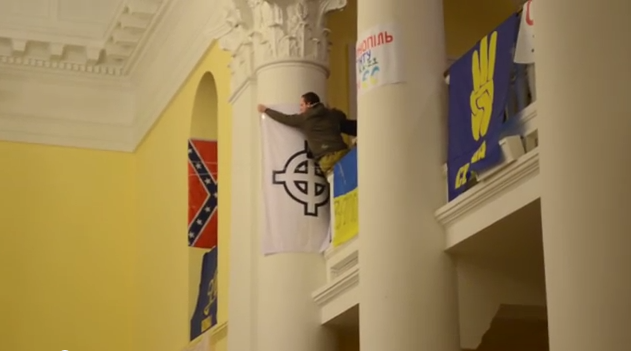
What goes unmentioned in both is that the Ukrainian government that the United States stalwartly backs is rife with neo-Nazis, and that following the coup of president Viktor Yanukovych in February of last year the battle flag of the Confederacy was displayed in Kiev's city hall.


If you Google "Ukrainian Confederate Flag" stories pop up about the pro-Russian rebels' use of a standard that bares a resemblance to the Army of Northern Virginia. All the stories appear to trace back to a single report, "Ukrainian Rebels Channel U.S. Confederates," published last year at this time in the pro-Western, English-language, tiny-circulation Moscow Times. This was picked up by Slate which ran a story with images of the Novorrosiyan flag flying in Donetsk and the Dixie battle flag flying in front of the statehouse in South Carolina.

The Moscow Times story is obviously part of a counterintelligence campaign. No one questions that the putschists openly paraded the Confederate flag -- not a flag that bears a resemblance to a Confederate army standard -- in Kiev, and that the Confederate flag, as Dees and Cohen make clear in today's column, is part of the paraphernalia and iconography of white supremacy.

Since it is fruitless to ask that The New York Times balance its demonization of Putin and its Russophobia with a condemnation of the Ukrainian use of Nazi and Confederate symbols, we should take the time to note the "newspaper of record" supports white supremacy abroad at the same time it pleads for tolerance and an end to race hatred at home.

Tuesday, June 9, 2015

Gray Lady Bangs the Drum on Institutional Racism/Police Accountability


On the one hand, we have The New York Times daily laying the foundation of the New Cold War; while on the other, the "newspaper of record" nearly as often shines a light on institutional racism, the criminal justice system and the lack of police accountability. It is a strange age we live in. A Cold War is being resuscitated sans the specter of international communism at the the same time one of the main tenets of the 1960s New Left -- black liberation -- is making a comeback.

Make no mistake, the Gray Lady is advocating for black justice. She didn't need to run a story (Carol Cole-Frowe and Richard Fausset, "Jarring Image of Police’s Use of Force at Texas Pool Party") about the police storming a pool party in a Dallas suburb, but she did. And it is decent story to boot, drawing attention to the racial divide in the city where the incident took place:
McKinney, with around 150,000 people, is a fast-growing, mostly middle-class suburb with deep racial and economic divisions. In 2009, according to an article in The Atlantic, the city settled a lawsuit in which it was accused of hindering the construction of affordable housing in the western part of the city, which is more white and more affluent.
The pool party took place on the west side, in a neighborhood that residents said is usually marked by friendly relations among black, white, Hispanic and Asian residents.
Of course the video speaks for itself. You would be hard pressed to find a better depiction of domination: an armed cracker in a dark uniform manhandling a black girl in a colorful bathing suit. It as if white fascistic America's pornographic daydream was caught on a cell-phone camera.

And the McKinney pool party story is not even the best black justice report featured in today's paper. Michael Schmidt and Matt Apuzzo have an excellent piece, "Cleveland Leaders Bypass Prosecutors to Seek Charge in Tamir Rice Case," on how an obscure Ohio law is being used to attempt a bypass of the grand-jury system so that the murder of Tamir Rice might receive a public trial:
Ohio is one of a handful of states that allow residents to request an arrest without approval from the police or prosecutors. It is difficult to know how the case will play out because there is little precedent for a citizen to request an arrest in such a contentious, high-profile case. 
Mr. Madison [lawyer for the Tamir Rice family] said that he knew of no instance in which an Ohio judge had ordered the arrest of a police officer based on a citizen complaint, but that most previous complaints had been frivolous. 
Shooting deaths by officers over the past year have prompted the most significant national discussion on policing since the 1991 beating of Rodney King in Los Angeles. The debate has highlighted, among other things, the differences in how prosecutors handle cases involving investigations of police officers. 
In a typical murder case, prosecutors often present only their best evidence to a grand jury in order to get an indictment. Arguments that a shooting was justified are typically not made until much later, at trial. 
In cases involving police officers, prosecutors are more likely to let grand jurors hear conflicting testimony or see evidence favorable to the officer. Critics say that has established two standards for bringing charges: a high one for police officers, and a much lower one for everyone else. 
A task force appointed by President Obama recommended in March that all cases involving the use of force by police officers be handled by independent prosecutors to “demonstrate the transparency to the public that can lead to mutual trust between community and law enforcement.” In the Cleveland case, however, Cuyahoga County prosecutors will decide whether to bring charges. Those prosecutors work regularly with Cleveland police officers, a closeness that activists have said is a conflict of interest.

By going directly to a judge, community leaders are trying to circumvent that process. Ohio law allows anyone with “knowledge of the facts” to file a court affidavit and ask a judge to issue an arrest warrant. If approved, the arrest would be followed by a public hearing, and community members said that was preferable to allowing prosecutors to make the decision in secret.

“Here we are taking some control of the process as citizens,” Mr. Madison said. “We are going to participate without even changing the law.”
Tamir was fatally shot in November while he played in a park. A 911 caller had reported that the boy was waving a gun that was “probably fake.” When officers arrived, they pulled their car into the park, next to the boy. Within two seconds, an officer, Timothy Loehmann, shot Tamir in the abdomen. The boy’s gun, it turned out, was a toy replica of a Colt pistol and fired plastic pellets.
The shooting raised questions about whether the officers followed procedures and whether they had time to warn Tamir three times to put down the gun, as they said they had done. Lawyers for the city have defended the shooting, saying the officers mistook the toy for a real gun. 
The Rev. Jawanza K. Colvin, who signed affidavits seeking charges of murder and manslaughter, said: “We have the video, and having witnessed it, you can see that it took two seconds for the officers to shoot a 12-year-old boy who showed no malicious intent or aggressive behavior. There is certainly reasonable suspicion that a crime was committed.” 
The planned filing comes as Cleveland tries to move past what the Justice Department recently said was a pattern of police abuse and unconstitutional behavior. The city agreed to put in place new training and civilian oversight to head off a civil rights lawsuit.
It is hard for me to imagine a Cleveland judge issuing an arrest warrant for Timothy Loehmann. The judicial system exists to protect the status quo, and the status quo allows law enforcement to operate with impunity. This impunity embraces the regular murder of black people.

For some reason, the NYT has taken up the cause of the #Black Lives Matter movement, an amazingly progressive thing to do and something that doesn't square with the paper's crude, backward parroting of USG propaganda when it comes to foreign affairs. But why?

Are the editors privy to some secret government study that foretells of a crackdown by the police state and they're, in the finest tradition of public service, trying to get out front and build a movement of civic resistance? Doubtful to impossible. Something is happening here, some form of mass awakening that is broader and simultaneously more cynical than what happened in the 1960s/early 1970s and the Gray Lady is just trying to keep up.

Tuesday, April 21, 2015

U.S. Institutional Racism: a Genocide of 1.5 Million Black Men, or the Maintenance of the Three-Fifths Compromise

No one will be tried at The Hague. The crimes against humanity, the disappearance of 1.5 million black men in the prime of life, 25 years of age to 54, have been going on for a long time in the United States. One would have to go back to the founding of the nation and the "Three-Fifths Compromise" at the 1787 Constitutional Conventional to appreciate the genocidal nature that lies at the core of the country.

That is why the work The New York Times has done exposing American institutional racism in wake of the Mike Brown shooting last summer is appreciated. The Gray Lady might be a willing accomplice in the ongoing destruction of the Middle East and the New Cold War because of slanted reporting that bolsters the false narrative peddled by USG, but in the homeland she advocates relatively progressive positions.

This morning's "1.5 Million Missing Black Men" by Justin Wolfers, David Leonhardt and Kevin Quealy puts a statistical face on institutional racism:
In New York, almost 120,000 black men between the ages of 25 and 54 are missing from everyday life. In Chicago, 45,000 are, and more than 30,000 are missing in Philadelphia. Across the South — from North Charleston, S.C., through Georgia, Alabama and Mississippi and up into Ferguson, Mo. — hundreds of thousands more are missing.
They are missing, largely because of early deaths or because they are behind bars. Remarkably, black women who are 25 to 54 and not in jail outnumber black men in that category by 1.5 million, according to an Upshot analysis. For every 100 black women in this age group living outside of jail, there are only 83 black men. Among whites, the equivalent number is 99, nearly parity.
African-American men have long been more likely to be locked up and more likely to die young, but the scale of the combined toll is nonetheless jarring. It is a measure of the deep disparities that continue to afflict black men — disparities being debated after a recent spate of killings by the police — and the gender gap is itself a further cause of social ills, leaving many communities without enough men to be fathers and husbands.
Perhaps the starkest description of the situation is this: More than one out of every six black men who today should be between 25 and 54 years old have disappeared from daily life.
“The numbers are staggering,” said Becky Pettit, a professor of sociology at the University of Texas.
And what is the city with at least 10,000 black residents that has the single largest proportion of missing black men? Ferguson, Mo., where a fatal police shooting last year led to nationwide protests and a Justice Department investigation that found widespread discrimination against black residents. Ferguson has 60 men for every 100 black women in the age group, Stephen Bronars, an economist, has noted.
Ferguson is literally trying to be true to the "Three-Fifths Compromise":
Since the 1990s, death rates for young black men have dropped more than rates for other groups, notes Robert N. Anderson, the chief of mortality statistics at the Centers for Disease Control and Prevention. Both homicides and H.I.V.-related deaths, which disproportionately afflict black men, have dropped. Yet the prison population has soared since 1980. In many communities, rising numbers of black men spared an early death have been offset by rising numbers behind bars. 
It does appear as if the number of missing black men is on the cusp of declining, albeit slowly. Death rates are continuing to fall, while the number of people in prisons — although still vastly higher than in other countries — has also fallen slightly over the last five years.

But the missing-men phenomenon will not disappear anytime soon. There are more missing African-American men nationwide than there are African-American men residing in all of New York City — or more than in Los Angeles, Philadelphia, Detroit, Houston, Washington and Boston, combined.

Tuesday, March 24, 2015

Grexit -- There Is No Alternative

Yesterday ("Deadlines Near as Greece and Germany Seek a Consensus on Debt" by Alison Smale) leftist Greek prime minister Alexis Tsipras was in Berlin meeting with rightist German chancellor Angela Merkel trying to find a path forward out of the funding impasse between Greece and the troika.

Naked Capitalism's Yves Smith ably adumbrated ("Leaked Tsipras Letter to Merkel Shows Increased Desperation, Warns of Imminent Default") the impasse as follows:
If the plan of the Troika was to starve the Tsipras government and produce either capitulation or a loss of domestic credibility, their effort appears to be on track.
FAZ reported that the Greek government is set to run out of funds by April 8. Tonight, the Financial Times reports that Greek prime minister Alexis Tsipras sent a desperate-sounding letter to Angela Merkel on March 15. That appears to have led Merkel to meet with him at an EU conference last week and arrange for a one-on-one session tomorrow.
From the Financial Times account:
Alexis Tsipras, the Greek prime minister, has warned Angela Merkel that it will be “impossible” for Athens to service debt obligations due in the coming weeks if the EU fails to distribute any short-term financial assistance to the country…
In the letter, Mr Tsipras warns that his government will be forced to choose between paying off loans, owed primarily to the International Monetary Fund, or continue social spending. He blames European Central Bank limits on Greece’s ability to issue short-term debt as well as eurozone bailout authorities’ refusal to disburse any aid before Athens adopts a new round of economic reforms.
The troika refuses to release any new bailout money until Tsipras' Syriza-led government can provide a list of revenue-generators to replace the pension cuts and privatizations agreed to by the previous government of Antonis Samaras, as Jim Yardley explains in "In Greece, Syriza Struggles to Deliver Promises as Money Runs Out":
Greece’s finances have deteriorated as postelection anxiety over uncertainty about the bailout spurred a spike in bank withdrawals. Tax collections also plunged, raising questions about whether the government would be able to pay state workers and meet other obligations.
On Feb. 20, Greek leaders signed a four-month bailout extension with its three main creditors — the International Monetary Fund, the European Central Bank and the European Commission. Yet creditors have refused to release a critical 7.2-billion-euro, or about $7.8 billion, loan payment (money that Syriza had once vowed not to accept but that is now badly needed) until the government provides a list of acceptable structural reforms to replace pension cuts and other austerity measures that had been under consideration by the previous government.
To counterattack, Tsipras voiced support for the idea of German reparations. This from a story, "Syriza’s Call for German Reparations: A Bolivaran Tsipras?," by Joshua Tartakowsky which appeared on CounterPunch over the weekend:
In his speech to the Hellenic Parliament, Prime Minister Tsipras touched on the issue which both some Anglo-Saxon socialists and Conservative Germans would wish would have avoided. Tsipras brought to public view the issue of reparations of World War II, and the fact Germany did not pay back the interest-free forced loan made on the Greek bank by the German occupation forces until today. While some reparations were paid in the 1950s, these were quite small considering the damage and did not include the forced loan. Tsipras demanded reparations from Germany for the immense damage and killing caused during the brutal German occupation as a necessary act to restore historical justice. The parliament decided on the establishment of a committee led by economists and historians who will pursue the issue of reparations. The Greek Justice Minister said that if necessary, he would consider seizing German assets in Greece, including, for example, the Goethe Institutes in Athens and Thessaloniki and even homes of German citizens.
In the Merkel-Tsipras story that appears in today's paper Smale summarizes the sniping between Greece and Germany as follows:
Verbal hostilities between Greece and Germany mounted in recent weeks, with particular bitterness lacing the remarks of each country’s finance ministers. Last week, a controversy swirled over whether the Greek minister, Yanis Varoufakis, had made a provocative one-fingered gesture at Germany at a conference in Croatia two years ago.
More gravely, the question of whether Germany should pay more reparations to Greece for Nazi war crimes and forced loans has flared, with some leading figures on the German left ready to consider such payments.
The magazine Der Spiegel summed it all up with a cover this week superimposing a picture of Ms. Merkel on an old photograph of Nazi commanders at the Parthenon in Athens under the headline, “The German Übermacht.” In an accompanying article, it argued that fellow Europeans increasingly see Germany, which is Europe’s biggest economy, and its leaders as dominant. “Yet they are rather a weak than a strong hegemon,” Der Spiegel said of the Germans.
In bad news for Greece, Smale reports that Mario Draghi, head of the European Central Bank, refuses to allow Greek banks to issue new loans based on short-term Greek government debt: "In a blow to hard-pressed Greek banks, Mario Draghi, the president of the European Central Bank, said on Monday that Greece had not yet met conditions that would allow its debt to again be used to secure central bank loans."

Patience with Syriza-troika impasse, both from the right and the left, appears to be near its end. An unsigned Gray Lady editorial over the weekend, "The Greece Issue Breeds Brinkmanship in the Eurozone," marked this growing testiness among the few tepid Syriza advocates in the mainstream:
There is no doubt that Mr. Tsipras needs to move quickly to reform the Greek economy, which is running low on cash. Tax collections have fallen since his left-wing party, Syriza, took power in January; Greek businesses are complaining that they are not being paid for work they’ve done for the government; and some bigger companies have started moving cash to London. But pushing Greece into default by withholding the short-term financing it needs to pay its bills would be courting disaster.
The rumor is that Tsipras is in Berlin to secure better terms for the privatization of state assets, a red line he promised not to cross.

The fact is that the right is in ascent. The U.S. 2014 midterms, the recent elections in Israel and France, a decent but nonetheless modest showing for Podemos in Spain's Andalusia, all point to an estranged public tacking to the right. Syriza is carrying the weight of not only Greece but the entire global electoral left. A misstep by Tsipras will continue the complete hollowing out of social democracy.

Such high stakes mean that there is little chance of Germany or the troika loosening its chokehold. Syriza will be crushed at all costs in order to leave the field free for the neoliberals to continue a decades-long orgy of looting and pillaging.

Given that, Tsipras must soon realize there is no alternative to a Grexit.