Showing posts with label Kiev. Show all posts

Thursday, June 25, 2015

With All the Talk of "Putin's Aggression," Why No Mention of King Salman's Aggression?

Sometimes the lie is so big it is best to remain silent. This is the case of late with reporting in the West about the breakaway Donbass region in Ukraine, an area that has been in revolt since the U.S.-backed coup in Kiev sent Ukrainian president Viktor Yanukovich fleeing to Russia.

The last non-Reuters story filed in the "newspaper of record" that mentioned the rebel People's Republic of Donetsk was last Friday's report by Moscow-based Russophobe Neil MacFarquhar, "Russia and Greece Flaunt Solidarity at Business Forum, but Deals Are Scarce"; in it MacFarquhar notes the disappearance of Ukrainian civil war coverage as well:
“There was an obsession about Ukraine, headlines all the time — Ukraine, Ukraine, Ukraine,” said Charles Robertson, managing director and global chief economist at Renaissance Capital. 
“Now, how many people died in the Donetsk region yesterday? How much shelling was there? Does anyone know?” he asked. “Greece has become the European story, rather than Ukraine and Russia.”
While it is true that interminable Greek debt negotiations are finally coming to a head, with a sudden show of alarm that Merkel might not make any concessions that would prevent a default by Greece and the possible tumultuous Gexident, I think what is going on here is less a crowding out of Ukrainian news and more a premeditated taciturnity. The marauders in Kiev are violating Minsk 2.0, paving the way for a broad resumption of fighting, and there is no way to obscure this other than by spiking coverage.

Whenever NATO starts keening about Russia positioning troops on Ukraine's border, as AP is reporting this morning, that is a strong tell that the Kiev junta is about to strike at DPR/LPR. As Reuters reported yesterday, "Russian Former Leader of Ukraine Rebels Warns of 'Big War' ":
MOSCOW — A ceasefire is likely to collapse in east Ukraine and Russia could be drawn into a "big war" to cleanse the "sore on its borders", the former leader of the region's pro-Russian separatists said. 
Violence has eased but not halted in east Ukraine under what are known as the Minsk 2 agreements, reached in the Belarussian capital on Feb. 12 after an earlier ceasefire collapsed. 
Alexander Borodai, a Russian citizen and former journalist for nationalist newspapers who emerged last year as prime minister of the self-proclaimed Donetsk People's Republic (DNR), said he expects the Ukrainian army to launch a new offensive. 
"To be honest, I expect that the Minsk 2 agreements will not be observed, in the same manner as the Minsk 1 agreements were not," Borodai said in an interview this week in a Moscow restaurant surrounded by former rebel commanders. 
"And at the end of the day the Ukrainian army will launch an offensive. This is a very probable development ... I am not sure that it will end without a big war, as Russia cannot tolerate this sore on its borders forever."
There has also been a great deal of silence about the Saudi terror bombing and naval blockade of Yemen, which began in March. But that changed this morning when no less than three substantive stories appeared in today's Gray Lady. In one, the UN mediator assigned to Yemen, Ismail Ould Cheikh Ahmed, reported to the Security Council yesterday morning that a humanitarian catastrophe is unfolding (Somini Sengupta, "U.N.’s Yemen Mediator Depicts Grim Scene of Deprivation"):
Painting a dire picture to world powers on Wednesday about life in Yemen, a United Nations envoy warned that polio could soon make a comeback and that a dengue outbreak had struck an estimated 3,000 people. 
Clean drinking water is out of reach for 20 million — most of Yemen’s population — and a large portion of country is, in the words of the envoy, “one step away from famine.” 
The envoy, Ismail Ould Cheikh Ahmed, the special mediator for resolving the Yemen conflict, spoke to Security Council diplomats in a closed meeting on Wednesday morning. Later in an interview, Mr. Ould Cheikh Ahmed said he was continuing to push for a humanitarian truce during the holy month of Ramadan between the Saudi-led coalition carrying out airstrikes and the Houthi rebels who have ousted the Saudi-backed government.
I assume the sporadic coverage up until now of the Saudi terror campaign directed against Yemen has something to do with the fact that the United States is administering the air war and supporting the naval blockade. What makes this cognitively so difficult to swallow is that it is an almost perfect inversion of the situation in Ukraine. There the U.S. backed Ukrainian fascists and neo-Nazi shock troops, Right Sector, based in the country's west sent the president fleeing for his life to adjoining Russia. In Yemen, the Houthis, based in the country's north, sent president Abdu Rabbu Mansour Hadi fleeing from the capital Sana to the port city of Aden before absconding by boat to Saudi Arabia. Salman of Saudi Arabia has been bombing and blockading his neighbor ever since.

Imagine if Putin had done the same thing to Ukraine, reducing to rubble the Maidan as Saudi bombs have leveled a UNESCO world heritage site in Sana's Old City. The Western press has adopted a shorthand for the Ukrainian civil war, calling it "Putin's aggression," absent any acknowledgement of the interests or aspirations of Russian-speaking citizens of the Ukraine. Yet there is no equivalent label for what is happening in Yemen. There is no discussion of "Salman's aggression."

It must be kept firmly in mind that not only is this aggression by Saudi Arabia clearly illegal under international law, it is now on the verge of becoming genocidal with widespread famine a likely outcome -- and it is all being facilitated by the United States.

Yes, the mind reels. Goebbels would beam with pride.

But today's frontpage story by Shuaib Almosawa and Ben Hubbard, "Saudi Bombing Only Fans Yemen’s Flames," with an adjoining sidebar by Hanna Ingber, "The Many Miseries of Yemeni Families," is proof that there is at least some sense within the corridors of Great Satan's beltway that the situation in Yemen is spiraling out of control, that the U.S. is complicit in genocide and soon it will not be able to control the narrative of the big lie.

Almosawa and Hubbard don't pull any punches, other than omitting the centrality of the U.S. to the Saudi/GCC military campaign:
SANA, Yemen — For nearly three months, Saudi Arabia, along with its allies, has been bombing Yemen, its southern neighbor, hoping to force the retreat of Shiite rebels who have seized major cities and to return the country’s president from the Saudi guest mansion where he lives to the presidential palace. 
So far, it has not worked. The rebels, known as the Houthis, have gained ground, more than 2,600 people have been killed, and aid groups have blamed the Saudi-led bombing and limits on maritime traffic for exacerbating a humanitarian crisis in Yemen, the Arab world’s poorest country. 
With the failure of talks last week in Geneva to establish even a short-term cease-fire, it increasingly appears that Saudi Arabia lacks a realistic strategy to end the war, according to analysts and Yemenis interviewed in different parts of the country. In fact, many of them said Saudi intervention had made matters worse, expanding the violence while making resolution even harder to achieve.
“It is very clear that the Saudis did not do their homework before they went into Yemen,” said Farea al-Muslimi, a Yemeni visiting scholar at the Carnegie Middle East Center in Beirut, Lebanon. “They thought it would be really easy, but it has not turned out that way.”
Instead, Saudi Arabia and the coalition it is leading have added an international dimension to what analysts said had essentially been a domestic conflict, while also prompting frequent attacks on Saudi Arabia’s southern border and creating space for extremists to expand.

There is much riding on the outcome for the United States, which has provided the Saudis with advice on targets and has watched with dismay as the number of civilian casualties has risen. Yemen is home to the branch of Al Qaeda long considered the most dangerous to the West, and the jihadists of the Islamic State, new to the country, claimed a number of deadly attacks last week in Sana, the capital. 
But the stakes are higher for Saudi Arabia, which must defend a long and rugged border with Yemen and could find itself embroiled in a protracted, costly war at a time when falling oil prices have strained the country’s finances.
The New York Times does not stake out a bold position on foreign affairs that is at odds with the USG. So I would imagine this has been vetted ahead of time. While the nations of Europe essentially have no sovereignty when it comes to dealing with the United States, Israel and Saudi Arabia have shown a greater degree of independence and autonomy. Hence, the Kingdom of Saudi Arabia's ability to include an Al Qaeda bigwig, ‘Abd al Wahhab al Humayqani, in the Yemeni-government-in-exile delegation sent to the failed Geneva peace talks.

Tuesday, June 23, 2015

New Cold War Another Sign of Neoliberalism's Collapse

In a post I do on Fridays called Hippies vs. Punks I explore the spiritual platform (in Schopenhauer's sense that music is pure spirit) of the industrialized Western world when our current listing, foundering political-economic paradigm was inaugurated. That paradigm, neoliberalism, has been dominant for 40 years; but for the last 15, it has lurched from crisis to crisis, from economic meltdown to war back to economic crisis. During this 15-year period it has been well known by both the ruling elite and a significant segment of those who are ruled that the planet is experiencing a man-made ecological crisis, what is being called "The Sixth Extinction."

The paradigm, neoliberalism -- defined by a worship of markets and mammon, a concentration of wealth in the 1%, the immiseration of the 99%, brutal wars of choice and record numbers of displaced persons -- is obviously bankrupt. Not only is it bankrupt and destructive to life on the planet, it is anachronistic. The United States has in little over a year reestablished a Cold War with Russia, the thawing of which 25 years ago was probably the greatest triumph of the neoliberal paradigm.

David Herszenhorn reports in "Russia Assails Extension of E.U. Sanctions in Ukraine Crisis":
MOSCOW — Kremlin officials reacted furiously Monday to the European Union’s extension of sanctions on Russia through January, calling the measure self-defeating and accusing the West of crass anti-Russian bias by timing the decision to the nation’s commemoration of the Soviet victims of World War II. 
The Russian government said it would retaliate with an extension of countersanctions in response to the decision by European Unionforeign ministers, at a meeting in Luxembourg, which had been widely expected after European ambassadors reached a tentative agreement last week in Brussels. Russia had lobbied against the renewal of sanctions, which were first imposed in July 2014 in response to the Kremlin’sinvasion and annexation of Crimea.
***
“We are deeply disappointed that once again the opinion of the Russophobic lobby, which pushed through the decision to extend illegal restrictions, dominated in the E.U.,” the Foreign Ministry’s spokesman, Aleksandr K. Lukashevich, said in the statement. “At the same time, in Brussels they are deliberately tight-lipped about the fact that this is guaranteed to be followed by hundreds of thousands of Europeans, or millions, according to some estimates, losing their jobs.”
Mr. Lukashevich also complained that the West was placing unfair responsibility on Russia for carrying out the Ukraine cease-fire agreement, which was signed in February in Minsk, Belarus. Russia has long insisted that the Ukrainian government bears the largest responsibility for the failure so far to put the accord in effect.
“The E.U. keeps laying all the responsibility over the implementation of the Minsk agreements on the Russian side,” Mr. Lukashevich said. “The absurdity of this approach has been long clear to everyone. The key to the internal Ukrainian crisis was and still remains in the hands of Kiev, which is not hurrying to implement its responsibilities.” 
As for the timing of the announcement, Mr. Lukashevich added: “It looks especially cynical that the decision to extend the anti-Russian sanctions was taken by the E.U. states on June 22, the day when fascist Germany attacked the U.S.S.R. We would like to believe that this is a coincidence, and not an intentionally planned step.”
Couple this with a story from Eric Schmitt and Steven Lee Myers, "NATO Returns Its Attention to an Old Foe, Russia," and you get the picture that the New Cold War is here to stay:
It has involved a marked increase in training rotations on territory of the newer NATO allies in the east, and stepped up patrols of the air and seas from the Baltic to the Black Sea intended to counter an increase of patrols by Russian forces around NATO’s periphery. 
Most of those are temporary deployments. But in February, NATO announced that it would set up six new command units within the Eastern allies and create a 5,000-strong rapid reaction “spearhead” force. 
And the Pentagon now plans to preposition heavy American tanks and other weaponry in Eastern Europe for the first time, prompting unease in some quarters ahead of the NATO defense ministers’ meetings, and strong protests from Moscow that coincided with an announcement by President Vladimir V. Putin that he was bolstering Russia’s arsenal of strategic nuclear weapons
With the leaders of NATO’s 28 members scheduled to gather in Warsaw for an important summit meeting next year, the alliance is now considering what other measures are needed to adjust its forces, to increase spending that had plummeted as part of a “peace dividend,” and to revisit NATO’s military strategy and planning.
Soon "megadeath" will return to regular usage in our vocabulary as both the U.S. and Russia upgrade their nuclear arsenals.

Obama, the Nobel Peace Prize POTUS, will see his legacy defined as the leader who recreated the Cold War; hopefully when he is remembered he will be thought of with a feeling of nausea. Neoliberal leaders will go to any length to maintain their failed system.

Monday, June 22, 2015

In Wake of Emanuel AME Massacre Gray Lady Silent on Ukraine's Love of Dixie Battle Flag

On the Gray Lady's Opinion page today there is an interesting juxtaposition. On the left hand there is the lede unsigned editorial, "The Fantasy Mr. Putin Is Selling," which is a recapitulation of the main USG talking points regarding Russia and Ukraine (Putin's aggression; Western sanctions will cripple Russia); while on the right hand is a Morris Dees and J. Richard Cohen Op-Ed column, "White Supremacists Without Borders," about the global popularity of neo-Nazi, neo-fascist, neo-Confederate ideology that motivated mass murderer Dylann Roof.

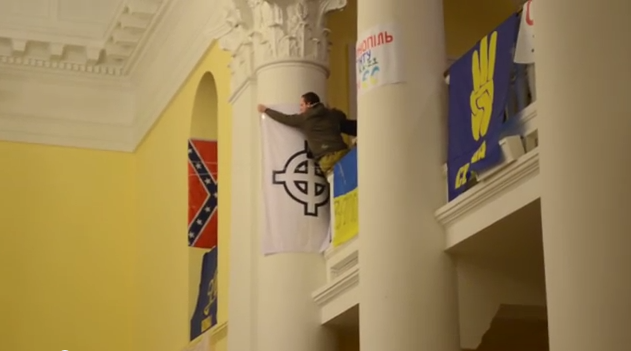
What goes unmentioned in both is that the Ukrainian government that the United States stalwartly backs is rife with neo-Nazis, and that following the coup of president Viktor Yanukovych in February of last year the battle flag of the Confederacy was displayed in Kiev's city hall.


If you Google "Ukrainian Confederate Flag" stories pop up about the pro-Russian rebels' use of a standard that bares a resemblance to the Army of Northern Virginia. All the stories appear to trace back to a single report, "Ukrainian Rebels Channel U.S. Confederates," published last year at this time in the pro-Western, English-language, tiny-circulation Moscow Times. This was picked up by Slate which ran a story with images of the Novorrosiyan flag flying in Donetsk and the Dixie battle flag flying in front of the statehouse in South Carolina.

The Moscow Times story is obviously part of a counterintelligence campaign. No one questions that the putschists openly paraded the Confederate flag -- not a flag that bears a resemblance to a Confederate army standard -- in Kiev, and that the Confederate flag, as Dees and Cohen make clear in today's column, is part of the paraphernalia and iconography of white supremacy.

Since it is fruitless to ask that The New York Times balance its demonization of Putin and its Russophobia with a condemnation of the Ukrainian use of Nazi and Confederate symbols, we should take the time to note the "newspaper of record" supports white supremacy abroad at the same time it pleads for tolerance and an end to race hatred at home.

Wednesday, February 11, 2015

Zero Hour of European Union's Demise Has Arrived

Yesterday I opined that today would be a momentous one for the future of Europe. Two sets of negotiations begin: one in Brussels between Greece and the eurogroup on bailout terms; the other, in Minsk between Russia, Ukraine, LPR/DPR, Germany and France on a new ceasefire.

I haven't seen anything since yesterday that changes my opinion: in neither case is an agreement forthcoming.

Yves Smith's post this morning says it all -- "Eurogroup Ministers to Syriza: Drop Dead":
I have heard today from a source with knowledge of the US discussions with Germany that they see signs of movement, and that Greece has supporters in other Eurozone bureaucracies. This is not inconsistent with what we’ve said, that there is a contingent that recognizes that austerity has failed and might use the Greek negotiation to advance their cause, and they could ride in and help rescue Greece. But that was before so many parties staked out hard line positions against Syriza’s proposals. The sympathizers don’t appear to be close enough to the negotiations to push for a climbdown, even if the principals could find a way to finesse what would otherwise look like a big loss of face.
It would be better if I were wrong, but what I am hearing of the US reading sounds like a classic American projection of our worldview. First, the Administration contingent seems to believe if it can get Germany to agree to a deal, the rest of the Eurozone will follow. But that isn’t how its structure works. If Greece continues to reject the bailout framework, Germany would need to lead some sort of funds extension outside the Eurozone structure. That has far more moving parts that just trying to settle differences over, say, how much of a break if any Greece gets on its fiscal surplus requirement. The White House/Treasury assumption seems to be that the two sides will negotiate within the current bailout framework, when Varoufakis keeps insisting that that is not on. If he does not budge tomorrow, the basic premise of the US view that the two sides can be pushed to come to a deal would seem to be far from the mark.
Watch the equity markets today. I'm sure they will be quite roiled.

As for the Minsk talks, unless Poroshenko can transform himself Popeye-like with a can spinach, there is no way he will accept the bottom line of Novorossiya, acceptance of the territorial gains it has made since the last ceasefire.

Kiev, backed by the United States, is a pestilential fiction; it cannot exist without war; it has no steady state other than terror; it masquerades, thanks to the support of the West, as a democratic movement striving for a closer union with Europe, but it is really more akin to Islamic State, a terrorist predator that must feed on a civilian population to survive.

Since the Novorossiyan offensive that nearly took Mariupol last summer is what forced Poroshenko's hand in signing the original Minsk ceasefire, my guess is that the junta will be routed there once the current Minsk talks end in impasse. Rick Lyman writing in "Battered Ukrainian City of Mariupol Braces for Worst as Rebels Close In" outlines what is at stake:
Mariupol is a bustling port in a strategic location on the Sea of Azov, near the Russian border. The rebels control the territory to the north and east, and Russia controls the Crimean Peninsula to the southwest. Mariupol is the only major obstacle to their realizing a long-held goal of opening a land route between Russia and Crimea and taking complete control of the Sea of Azov and its rich industrial infrastructure. Russia, which denies playing any role in the conflict here, says it has no such intention.
Even so, Mariupol has been a target almost since the fighting began early last year. The rebels briefly took control of it in the spring, and it was the scene of fierce fighting in the late summer, when the rebels drove to within 10 miles of the city limits.
“In September, Mariupol was very weak and poorly defended,” said Andrey Dzyndzya, who was a prominent activist during the protests that toppled Ukraine’s previous, pro-Russia government and is now a fighter with the Azov Battalion. “There was a kind of panic in the city,” he recalled. “In September, we managed to stop them only by luck.”
But he and other local military and government leaders said the situation was different now, with a complete ring of defensive lines, rather than just positions on the main roads.
“I feel confident that we have enough troops and enough weaponry in place to successfully protect the city now,” Mr. Dzyndzya said.
If the junta is relying on the Azov Battalion to defend Mariupol it is good indication that Kiev is in dire straits. The Ukrainian Army can't fight. So neo-Nazi battalions are pieced together to do the dirty work, like shelling city centers.

Once Mariupol falls things are going to look very different.

Friday, February 6, 2015

Ukrainian Junta Near Collapse: Merkel & Hollande on Bended Knee in Moscow, Begging for a Ceasefire

Since Novorossia forces regained control of the Donetsk airport at the end of last month the quality of reporting in "the newspaper of record" has been atrocious.

For example, take the captioning of the photos. Invariably a picture of the damage wrought by the shelling of Donetsk will appear in the Gray Lady's pages accompanying a one-sided story that largely parrots U.S. State Department statements. The photograph below from today's story ("U.S. and Europe Working to End Ukraine Fighting," Michael Gordon and David Herszenhorn) is case in point:


"A city official in Donetsk, Ukraine, inspected a building that local residents said was damaged by shelling on Wednesday." CreditMaxim Shemetov/Reuters

Note that the origin of the shelling goes unidentified. The most fundamental aspect of reportage, in this case that the Ukrainian Army is shelling civilians in Donetsk, is being purposely obscured by "the newspaper of record." 

This kind of crude, cynical thought control, which most Westerners would dismiss as atavistic, totalitarian, Stalinist, has been a regular feature of The New York Times coverage of the Ukrainian junta's Anti-Terrorist Operation (ATO) against the people of the Donbass. 

Most people don't read complete stories. Most people will glance at a headline, look at the pictures and then turn the page. Since the Western media has been overwhelming in its condemnation of "Putin's aggression" against Ukraine, most people will incorrectly assume that Russia is responsible for the destruction.

Of course people who follow the news know better. Any glance at the comments section that accompanies a story on the fighting in Ukraine reveals people by huge margins opposed to the U.S. role -- such as the decision being debated by the Obama administration whether to supply sophisticated lethal weaponry to the junta -- in exacerbating the conflict. More than anything, the U.S. role in last February's coup in Kiev, followed by the herding of Europe into sanctioning Russian for its defense of Crimea. and the Ukrainian junta's ongoing assault on the civilians in the Donbass, proves that neither was Obama worthy of the Nobel Peace Prize nor is there substantive democracy in the United States, where there is next to no support for Obama's New Cold War.

But now the New Cold War is rapidly getting very hot. Mike Whitney has a must-read story today on CounterPunch, "The Fallujah Option for East Ukraine: The Real Reason Washington Feels Threatened by Moscow." Whitney concludes his piece on a pessimistic note :
NOTE:  The Novorussia Armed Forces (NAF) currently have 8,000 Ukrainian regulars surrounded in Debaltsevo, East Ukraine.  This is a very big deal although the media has been (predictably) keeping the story out of the headlines.
Evacuation corridors have been opened to allow civilians to leave the area.  Fighting could break out at anytime.  At present, it looks like a good part of the Kiev’s Nazi army could be destroyed in one fell swoop.  This is why Merkel and Hollande have taken an emergency flight to Moscow to talk with Putin.  They are not interested in peace. They merely want to save their proxy army from annihilation.
I expect Putin may intervene on behalf of the Ukrainian soldiers, but I think commander Zakharchenko will resist.   If he lets these troops go now, what assurance does he have that they won’t be back in a month or so with high-powered weaponry provided by our war-mongering congress and White House?
Tell me; what choice does Zakharchenko really have? If his comrades are killed in future combat because he let Kiev’s army escape, who can he blame but himself?
There are no good choices.
I believe Whitney is right. Merkel and Hollande, the German chancellor and French president, respectively, are in Moscow basically begging for a ceasefire because the Ukrainian Army is about to sustain a seriouspotentially crippling loss. Things are so bad that the idea is even being floated of creating a whole new separate Ukrainian military.  This is broached in the Gordon and Herszenhorn report mentioned above in terms of revelations regarding a Russian intelligence penetration of the Ukrainian military:
The head of the Ukrainian security service, Valentyn Nalyvaichenko, said at a news conference on Wednesday that the accused spy, Lt. Col. Mykhailo Chornobai, had been at the center of an espionage ring in the capital and had passed military secrets directly to an agent of the separatist Donetsk People’s Republic, including the locations of volunteer regiments that were then used to pinpoint artillery attacks.
Dmytro Tymchuk, a military officer and member of Parliament, said that Colonel Chornobai was among about 300 people working in the military sphere who had been arrested since the start of the conflict.
The arrest further deepened mistrust of the leadership in Kiev that is already pervasive among the poorly equipped rank-and-file soldiers and midlevel commanders fighting on the front line. And it reinforced a view prevalent on the battlefield that the military leadership cannot be trusted to manage any weapons delivered by Western allies because of their ties to the Russian military and security service, the F.S.B.
“It’s really a huge question: Should we completely change our armed forces structure,” Mr. Koziy said, noting that one proposal was to build a second, new military structure. “Of course this idea seems very much crazy to create a whole new, parallel general staff,” he said. “But on the other hand when you look at what’s going on today inside this building, you think maybe it’s the right decision.”
I'm sure the U.S. will be happy to reprise its performance of creating another nation's armed forces (see Iraq and Afghanistan; in Iraq, the U.S. is on its second go-round -- the ISIS capture of Mosul last summer led to the collapse of the Iraqi Army).

Whitney opens his article with a rundown of what is at stake in Ukraine:
Washington needs a war in Ukraine to achieve its strategic objectives. This point cannot be overstated.
The US wants to push NATO to Russia’s western border. It wants a land-bridge to Asia to spread US military bases across the continent.  It wants to control the pipeline corridors from Russia to Europe to monitor Moscow’s revenues and to  ensure that gas continues to be denominated in dollars. And it wants a weaker, unstable Russia that is more prone to regime change, fragmentation and, ultimately, foreign control. These objectives cannot be achieved peacefully, indeed, if the fighting stopped tomorrow,  the sanctions would be lifted shortly after, and the Russian economy would begin to recover. How would that benefit Washington?
It wouldn’t. It would undermine Washington’s broader plan to integrate China and Russia into the prevailing economic system, the dollar system. Powerbrokers in the US realize that the present system must either expand or collapse. Either China and Russia are brought to heel and persuaded to accept a subordinate role in the US-led global order or Washington’s tenure as global hegemon will come to an end.
This is why hostilities in East Ukraine have escalated and will continue to escalate. This is why the U.S. Congress  approved a bill for tougher sanctions on Russia’s energy sector and lethal aid for Ukraine’s military. This is why Washington has sent military trainers to Ukraine and is preparing to provide $3 billion in  “anti-armor missiles, reconnaissance drones, armored Humvees, and radars that can determine the location of enemy rocket and artillery fire.” All of Washington’s actions are designed with one purpose in mind, to intensify the fighting and escalate the conflict. The heavy losses sustained by Ukraine’s inexperienced army and the terrible suffering of the civilians in Lugansk and Donetsk are of no interest to US war-planners. Their job is to make sure that peace is avoided at all cost because peace would derail US plans to pivot to Asia and remain the world’s only superpower.
One other aspect of the conflict in Ukraine that notably absent from the reporting of The New York Times is the dangerous unstable condition of the Ukrainian economy. This is another reason for Merkel and Hollande begging for a ceasefire. Oren Dorell, writing for USA Today has the story, "Collapsing economy is second front in Ukraine's war":
As U.S. Secretary of State John Kerry lands in Kiev on Thursday to discuss Ukraine's economy and the ongoing conflict, the military and financial impact of the war is being felt deeply across the nation. 
The country's national government is reeling from a spike in defense spending and the loss of production and trade, particularly after separatists seized Ukraine's main industrial and coal-mining regions of Donetsk and Luhansk in eastern Ukraine. 
The fighting is also creating a distraction for Ukrainian leaders under pressure by international investors to restructure a collapsing economy. Ukraine's economic output dropped by 6.5% in 2014, according to the International Monetary Fund, which has sent a team to the capital of Kiev to assess the nation's economic needs. 
In order to meet a large foreign debt due in the coming months, Ukraine needs $15 billion in assistance. IMF chief Christine Lagarde has said she would support an expanded funding plan for Ukraine in return for unspecified fiscal reforms. 
Ukraine's war effort costs $7 million a day, a $2.5 billion yearly expense that is cutting into a budget decimated by reduced revenues related to the fighting, Ukraine's Deputy Foreign Minister Volodymyr Prystaiko told USA TODAY during a recent visit to Washington. 
Defense spending, which includes items not directly associated with the day-to-day costs of the fighting, now eats up 5.2% of the national budget, compared with just 1% in 2013.
Clearly Ukraine cannot sustain this absent a massive infusion of aid from the West, something which is going to be difficult rationalize.

Monday, January 5, 2015

Kiev Coup Revisited by The New York Times: Who is Viktor Dubovik?

All of yesterday the story that occupied the choice spot on the Gray Lady's homepage was a piece by veteran reporters of last year's coup in Kiev -- Andrew Higgins and Andrew Kramer, "Ukraine Leader Was Defeated Even Before He Was Ousted" -- revisiting the fateful events of February 20 through February 22 that led to the downfall of Ukrainian President Viktor Yanukovych.

There is much that is unusual about this story. For one, it is infrequent that a story occupies the upper-left column -- the premiere slot -- on The New York Times homepage for the entire day. Usually there is some sort of rotation. So that it is a "tell" right there. Readers are being told to pay attention.

Then there is that headline: "Ukraine Leader Was Defeated Even Before He Was Ousted." What is this supposed to mean?

In line with the U.S. State Department, the Gray Lady insists that what happened in Kiev last year was not a coup; rather, it was a mass uprising by young, tech-savvy urban professionals and babushka ladies, a democratic convergence, a spontaneous plebiscite, wholly legitimate, that the venal Yanukovych abdicated to when he fled Ukraine. In this fantastical retelling, the Right Sector neo-Nazi shock troops that did the street fighting and sent Yanukovych scurrying for his life are merely fringe figures. Higgins and Kramer are reprising this narrative slightly to include the collaboration of people within Yanukovych's own government:
Russia has attributed Mr. Yanukovych’s ouster to what it portrays as a violent, “neo-fascist” coup supported and even choreographed by the West and dressed up as a popular uprising. The Kremlin has cited this assertion, along with historical ties, as the main justification for its annexation of Crimea in March and its subsequent support for an armed revolt by pro-Russian separatists in Ukraine’s industrial heartland in the east.
Few outside the Russian propaganda bubble ever seriously entertained the Kremlin’s line. But almost a year after the fall of Mr. Yanukovych’s government, questions remain about how and why it collapsed so quickly and completely. 
An investigation by The New York Times into the final hours of Mr. Yanukovych’s rule — based on interviews with prominent players, including former commanders of the Berkut riot police and other security units, telephone records and other documents — shows that the president was not so much overthrown as cast adrift by his own allies, and that Western officials were just as surprised by the meltdown as anyone else.
Higgins and Kramer, reporting last year from Kiev during the coup, placed heavy emphasis on the looting of an armory in Lviv in hastening the demise of Yanukovych. In that story from last February, "As His Fortunes Fell in Ukraine, a President Clung to Illusions," Higgins and Kramer note the role of a mysterious deputy interior minister in ordering the Yanukovych security forces to stand down and vacate the city:
Using a member of Parliament as an intermediary, Mr. Levus [deputy head of the Maidan “self-defense” forces] opened a line of communication with a deputy interior minister, whom he declined to name. It appeared that Mr. Yanukovych, perhaps sensing that his security forces were reluctant to press the crackdown, was inclined to turn to the army for help. He had fired the armed forces chief of staff, Col. Gen. Volodymyr Zamana, on Monday. 
“We understood they had a few hundred fanatical riot police, but the rest of the police would not fight,” Mr. Levus said. 
Several street fighters who were on the barricades early Thursday morning said that they saw police officers walking away from their positions, and that this emboldened them. Some protesters fired hunting rifles and shotguns. Police lines crumpled. 
“Our people are ideologically motivated, and on the contrary, they were demoralized,” Mr. Levus said. “They did not want this fight. And he understood that our people were ready to run against gunfire.” 
Mr. Levus said he received a call on his cellphone around noon on Thursday from the deputy interior minister. “I told him, ‘We will guarantee the safety of the police if they leave the city,’ ” he said.
The deputy minister agreed first to a cease-fire until 3 p.m., when Parliament was set to meet. With support from some members of Mr. Yanukovych’s quickly disintegrating Party of Regions, Parliament voted to support the protesters’ demand that the police demobilize.
In their report yesterday, Higgins and Kramer name the deputy interior minister, Viktor Dubovik, who played the critical role in the coup, ordering security forces to leave Kiev
Security forces were also thrown into a panic by rumors, fanned by the protesters themselves, about the whereabouts of hundreds of guns seized on the night of Feb. 18 in Lviv, a bastion of pro-European fervor 300 miles west of Kiev near the Polish border. The weapons were said to be on their way to Kiev to add to an already growing arsenal of hunting rifles, pistols, Molotov cocktails and metal clubs.
According to the chief of police in Lviv, Dmytro D. Zagariya, around 1,200 weapons, mostly pistols and Kalashnikov rifles, were seized in raids on five district police stations and the headquarters of the Interior Ministry’s western command. Only 300 of these, he said, were recovered by the authorities. He said there was no evidence that any of the missing guns had been used in or even reached Kiev.
Western diplomats in Kiev, including the American ambassador Geoffrey R. Pyatt, also heard about the guns grabbed in Lviv and worried that, if brought to Kiev, they would turn what had begun as a peaceful protest movement that enjoyed wide sympathy in the West into an armed insurrection that would quickly lose this good will.
As the foreign ministers of Germany and Poland and a senior French diplomat met Mr. Yanukovych to negotiate a truce on the evening of Thursday, Feb. 20, at the presidential offices, Mr. Pyatt and several European envoys met at the German Embassy with Andriy Parubiy, the chief of the protesters’ security forces, and told him to keep the Lviv guns away from Kiev.
“We told him: ‘Don’t let these guns come to Kiev. If they come, that will change the whole situation,’ ” Mr. Pyatt recalled telling Mr. Parubiy, who turned up for the meeting wearing a black balaclava.
In a recent interview in Kiev, Mr. Parubiy denied that the guns taken in Lviv ever got to Kiev, but added that the prospect that they might have provided a powerful lever to pressure both Mr. Yanukovych’s camp and Western governments.
“I warned them that if Western governments did not take firmer action against Yanukovych, the whole process could gain a very threatening dimension,” he said.
Andriy Tereschenko, a Berkut commander from Donetsk who was holed up with his men in the Cabinet Ministry, the government headquarters in Kiev, said that 16 of his men had already been shot on Feb. 18 and that he was terrified by the rumors of an armory of automatic weapons on its way from Lviv.
“It was already an armed uprising, and it was going to get worse,” he said. “We understood why the weapons were taken, to bring them to Kiev.”
Around 2 p.m. that Friday, just as European diplomats were gathering for the signing ceremony at the nearby presidential administration building, Mr. Tereschenko received a call from a deputy interior minister, Viktor Dubovik, with an order to leave the city. Mr. Dubovik, he said, put him in touch with the opposition lawmaker Mr. Pashinsky, who escorted the Berkut commander and his 60 or so men to the edge of town, from where they drove overnight by bus to Donetsk.
Mr. Dubovik, who the authorities say has since fled Ukraine, could not be located for comment.
Mr. Pashinsky estimated that in all, he arranged escorts out of the city for more than 5,000 officers from the riot police, Interior Ministry forces and other security units, like the special operations unit, Alfa. He said Mr. Dubovik was just one of the officials he worked with on the mass evacuation, but added that he did not know where the order to retreat had originated.
Giving Up on a Leader
Inna Bogolovskaya, a longtime ally of Mr. Yanukovych who broke with him over his November decision not to sign the trade deal with the European Union, said the retreat was merely a response to a resolution adopted late Thursday that week by the Ukrainian Parliament that ordered all Interior Ministry troops and police officers to return to their barracks.
Ms. Bogolovskaya said that the Thursday night vote sent an emphatic message to Mr. Yanukovych and his last backers that Parliament, dominated by the governing Party of Regions and previously a bastion of loyal support, had given up on him.
“This was the moment that Yanukovych realized that he no longer had even Parliament on his side,” she said, adding that the president had no choice after this but to respect its resolution and order security forces off the streets. 
But Mykhalo V. Dobkin, a Party of Regions baron who had for years worked closely with Mr. Yanukovych, said the president did not give the order and had no knowledge of it until security forces suddenly vanished.
Mr. Dobkin, who met with Mr. Yanukovych late Friday night after he fled Kiev for the eastern city of Kharkiv, said he spoke with a senior presidential official whom he declined to name and was told that the sudden departure of security forces on Friday afternoon had taken the president and his entourage entirely by surprise.
The official, Mr. Dobkin said, had looked out of his window in the presidential administration building on Friday afternoon and, shocked to see the police “laying down their shields and getting on buses,” rushed to see the president to ask what was going on. Told by Mr. Yanukovych that he had issued no order for a withdrawal, the official, according to Mr. Dobkin, then left the building, never to return.
So there you have it. All clearly laid out. Not a mass democratic uprising, but a coup, or putsch, plain and simple. U.S. Ambassador Geoffrey Pyatt powwowing with neo-Nazi leader Andriy Parubiy on coup strategy, and, when it looked like things were going to get really hot in Kiev, an order is issued by deputy interior minister Viktor Dubovik, without Yanukovych's knowledge, for the security forces to leave the city.

Dubovik was certainly bought off. Why can't he be located by the Higgins and Kramer?

This begs the question, "Why does The New York Times insist in denying the Russian explanation of Yanukovych's ouster when its own reporting basically confirms there was a coup in Kiev last February?"

My guess is that the Gray Lady wants to get out front because things are soon to grow even worse for the junta in Kiev; The New York Times doesn't want to find itself with another Judith Miller "weapons of mas destruction" canard on its hands . Oliver Stone, someone with chops (his 1991 movie JFK led to the creation of the 1992 Assassination Records Act), is working on a documentary that will delve into last year's Kiev coup. Here is Stone's Facebook entry from December 30:
Excuse my absence these past weeks. A combination of overwork, prepping the Snowden movie in Germany & England, a side trip to Moscow, and a devastating head cold have laid me low. Recovering over Christmas in California; winter sun helps.
Interviewed Viktor Yanukovych 4 hours in Moscow for new English language documentary produced by Ukrainians. He was the legitimate President of Ukraine until he suddenly wasn’t on February 22 of this year. Details to follow in the documentary, but it seems clear that the so-called ‘shooters’ who killed 14 police men, wounded some 85, and killed 45 protesting civilians, were outside third party agitators. Many witnesses, including Yanukovych and police officials, believe these foreign elements were introduced by pro-Western factions-- with CIA fingerprints on it.
Remember the Chavez ‘regime change’/coup of 2002 when he was temporarily ousted after pro and anti-Chavez demonstrators were fired upon by mysterious shooters in office buildings. Also resembles similar technique early this year in Venezuela when Maduro’s legally elected Government was almost toppled by violence aimed at anti-Maduro protestors. Create enough chaos, as the CIA did in Iran ‘53, Chile ‘73, and countless other coups, and the legitimate Government can be toppled. It’s America’s soft power technique called ‘Regime Change 101.’
In this case the “Maidan Massacre” was featured in Western media as the result of an unstable, brutal pro-Russian Yanukovych Government. You may recall Yanukovych went along with the February 21 deal with opposition parties and 3 EU foreign minsters to get rid of him by calling for early elections. The next day that deal was meaningless when well-armed, neo-Nazi radicals forced Yanukovych to flee the country with repeated assassination attempts. By the next day, a new pro-Western government was established and immediately recognized by the US (as in the Chavez 2002 coup).
A dirty story through and through, but in the tragic aftermath of this coup, the West has maintained the dominant narrative of “Russia in Crimea” whereas the true narrative is “USA in Ukraine.” The truth is not being aired in the West. It’s a surreal perversion of history that’s going on once again, as in Bush pre-Iraq ‘WMD’ campaign. But I believe the truth will finally come out in the West, I hope, in time to stop further insanity.
For a broader understanding, see Pepe Escobar’s analysis “The new European ‘arc of instability,’” which indicates growing turbulence in 2015, as the US cannot tolerate the idea of any rival economic entity http://bit.ly/1yBmpHa. You might also see “Untold History” Chapter 10 where we discuss the dangers of past Empires which did not allow for the emergence of competing economic countries.
The current situation in Kiev is growing more unstable. Sabrina Tavernise, a Gray Lady reporter who was in the Donbass last year, wrote in the Sunday Review section of the paper yesterday ("The Next Battle for Ukraine") that
One immediate problem is cash. The country is running on fumes in terms of hard currency reserves, in part a result of a large payment recently to Russia for its gas debt. Without a substantial cash infusion from the International Monetary Fund, the country is likely to suffer an economic meltdown, with far-reaching consequences for its currency, banking system and its new government’s reputation. Russia’s wobbly finances do not help — about a quarter of Ukraine’s exports go to Russia.
One big test for the new government will be Igor Kolomoisky, a Ukrainian oligarch whose PrivatBank, one of the largest commercial banks in the country, is at the center of a murky web of financial transactions, symbolizing much of what is wrong with the Ukrainian banking industry. Taking him on will be complicated: He is a friend of the new government and the revolution that put it there. He is governor of the eastern region of Dnepropetrovsk. He also has his own militia.
The odds are overwhelmingly against the reformers. Change is hard, war is distracting and history is difficult to overcome.

Tuesday, September 9, 2014

Europe on Brink of Trade War with Russia

I think we're headed for another significant shift in Ukraine. The present ceasefire was agreed to by the junta because of the success of the Novorrosiya Armed Forces (NAF) in creating a southern front and threatening the large industrial seaside city of Mariupol, where Ukrainian president Petro Poroshenko was yesterday proclaiming solidarity with residents and vowing that the city would never be yielded to the NAF.

The preliminary report on the crash of flight MH17 was released this morning, and it cautiously reaffirms conventional wisdom, namely, that shrapnel coming from NAF-controlled territory or western Russia was responsible for the midair breakup of the Malaysia Airlines Boeing 777. While the report doesn't say a BUK missile was the source of that shrapnel, a.k.a., high-energy objects, it doesn't have to. Western reporters and government spokespersons will color in the missing parts based on what they already accept as fact. The Russians did it.

As the ceasefire disintegrates -- I don't see how it can hold for too much longer -- and the Dutch MH17 report gets spun according to the current Russophobia, Europe is going to be in for some pain. The EU has voted on a new round of Russian sanctions that target financing for Rosneft and Transneft and Russia has threatened to prohibit European commercial airlines from using its airspace. Andrew Higgins has an informative story this morning, "Brushing Off Threats, E.U. Votes to Toughen Its Sanctions on Russia," which offers the reader a glimpse of the mess Europe has got itself in by supporting the U.S.-backed coup-makers in Kiev:
The European Union has given strong support to the cease-fire but, skeptical about Russia’s intentions after the swift collapse of previous efforts at a settlement, decided on Monday to expand existing economic sanctions. Diplomats say the measures include tight restrictions on access to capital in Europe by the two state-controlled Russian energy giants, Rosneft and Gazprom’s oil affiliate, and the state pipeline operator, Transneft. 
“The sanctions aim at promoting a change of course in Russia’s actions destabilizing eastern Ukraine,” Herman Van Rompuy, the president of the European Council, which represents member states, said in a statement. He said the measures would go into effect “in the next few days.” 
There was no immediate reaction from Moscow, which responded to an earlier round of European sanctions by banning a broad range of dairy, meat, fruit and vegetable exports from Europe. 
Russia has worked hard to fan divisions within the European Union, and Prime Minister Dmitri A. Medvedev warned in an interview published early on Monday in Moscow that his government would “have to respond asymmetrically” to any new sanctions, perhaps by banning Western airlines from flying through Russian airspace, as many do on long-haul flights to Asia. 
“If Western carriers have to bypass our airspace, this could drive many struggling airlines into bankruptcy,” Mr. Medvedev said in a lengthy interview in the Russian newspaper Vedomosti. “This is not the way to go. We just hope our partners realize this at some point.”
Measures endorsed by leaders of the European Union’s 28 member states normally go into effect within hours. But Finland, hard hit by the Russian ban on food imports, and some other countries anxious to see whether the cease-fire holds in coming days, appealed for a slower schedule.
***
Some smaller European countries, notably Slovakia, had argued strongly against new sanctions, warning that they would only hurt Europe’s anemic economic recovery and were “meaningless.” But bigger countries, particularly Germany, which was itself initially hostile to sanctions, have increasingly lost faith in Russia’s trustworthiness and been exasperated by Moscow’s insistence, despite strong evidence to the contrary, that it has not sent soldiers or weapons into eastern Ukraine.
It was the downing of MH17 which buffaloed Merkel into accepting the U.S. position on sanctioning Russia. Up until that point I was under the impression that Merkel would not be bumrushed into a trade war with Russia. But that is where we are now.

I don't think that there is a way to avoid a trade war, absent a coup in Moscow by a U.S.-friendly oligarch. Medvedev is on record saying Western commercial air carriers are in the crosshairs. Russians believe more in honor and personal integrity and standing by what you say than Western politicians. When Russia responds, if the European Union doesn't publicly fray, then at least there will be those member nations who tacitly flout the trade restrictions, setting up secret bilateral agreements with Moscow.

And then the United States, losing the main weapon in its arsenal -- having the Europeans restrict economic relations with Russia -- will be left with increasing military support for an incompetent, mendacious junta as its remaining option (one that is sure to fail).

Before signing off this morning, there are a few good stories to inspect today. First, Rod Nordland reports on the acrimony at the annual ceremony honoring Ahmed Shah Massoud, leader of the Northern Alliance whose assassination by Al Qaeda two days prior to 9/11 prefigured the attack on the U.S. homeland.  Abdullah Abdullah has said that he will not acknowledge the results of the Afghan presidential recount, which apparently will declare Ashraf Ghani the victor.

Next, check out Tim Arango's Q.&A.-session. Arango is the Baghdad bureau chief for the Gray Lady, and over the years I have found him to be the best reporter, along with David Kirkpatrick, that "the newspaper of record" has to offer. Here is an example:
Q. How do you rate the Obama administration’s actions in Iraq?— eragon38 
It’s not my job to rate the Obama administration’s actions in Iraq. But I will tell you that after 2011, the administration basically ignored the country. And when officials spoke about what was happening there, they were often ignorant of the reality. They did not want to see what was really happening because it conflicted with their narrative that they left Iraq in reasonably good shape. In 2012, as violence was escalating, I wrote a story, citing U.N. statistics, that showed how civilian deaths from attacks were rising. Tony Blinken, who was then Vice President Joseph R. Biden’s national security guy, pushed back, even wrote a letter to the editor saying that violence was near historic lows. That was not true. Even after Falluja fell to ISIS at the end of last year, the administration would push back on stories about Mr. Maliki’s sectarian tendencies, saying they didn’t see it that way. So there was a concerted effort by the administration to not acknowledge the obvious until it became so apparent — with the fall of Mosul — that Iraq was collapsing.

Thursday, September 4, 2014

Putin Predicts Peace Deal to Emerge Tomorrow from Minsk Negotiations

Up here in the Pacific Northwest the autumn chill can already be felt in the mornings. With gas deliveries having been suspended for the entire summer while fighting has raged in the Donbass, I'm sure the change in weather can felt by Ukrainian president Petro Poroshenko.

Putin announced yesterday that a ceasefire agreement will be signed tomorrow in Minsk. Neil MacFarquhar describes what the deal would look like in today's "Putin Lays Out Proposal to End Ukraine Conflict":
In announcing the plan, Mr. Putin said he expected Ukraine and the separatists to wrap up an agreement after a new round of negotiations in Minsk, Belarus, on Friday. Ukraine, Russia and Europe are all party to the talks there, and they include representatives of the separatists. The two-day NATO summit meeting is also scheduled to end Friday. 
Aside from the cease-fire, the plan laid out by Mr. Putin called for Ukrainian artillery to pull back and out of range of the eastern separatists’ strongholds; an end to airstrikes; an exchange of all detainees; opening up humanitarian corridors for residents of the separatist areas; repairing damaged infrastructure; and deploying international observers to monitor the cease-fire. 
It made no mention of autonomy for the separatist eastern regions, the central political demand that Russia has emphasized since March. That is widely seen as critical to the Kremlin’s long-term goal of maintaining influence over Ukraine’s domestic affairs and blocking any future attempt to join NATO. 
Putin's plan made no mention of autonomy for Donetsk and Luhansk because it is unnecessary: a real ceasefire guarantees autonomy for the Donbass. It is the oft quoted "facts on the ground."

After a long phone call with Putin yesterday, Poroshenko declared that a lasting ceasefire agreement had been reached. He then walked it back, saying that the need for a ceasefire was agreed upon.

Likely what happened is that the U.S. nixed the deal. Obama, about to take his "great statesman" star turn at the Cardiff NATO summit, did not want to be upstaged yet again by Putin. A clue to this is the yapping of the neocon miniature terrier nonpareil, junta prime minister Arseniy Yatsenyuk. According to MacFarquhar:
In Kiev, the idea of a cease-fire was received with mixed emotions. 
There is open hostility to the idea that Russia will be able to dictate terms to its weaker neighbor after already wrenching away the Crimean peninsula in March. Any compromise after months of condemning the separatists as “terrorists” risks weakening Mr. Poroshenko in central and western Ukraine. 
Prime Minister Arseniy P. Yatsenyuk called Mr. Putin’s proposal “an attempt to confuse the international community” before the NATO summit meeting and the expected announcement of new sanctions from the European Union. 
“Putin’s real plan is the destruction of Ukraine and the resumption of the U.S.S.R.,” Mr. Yatsenyuk said, according to a statement posted on a government website. Peace will come only once Russia withdraws its troops and proxy force, it said. 
But many Ukrainians, horrified by the mounting toll of more than 2,600 dead and uneasy about the economic costs for a country already on the edge of bankruptcy, want an end to the violence. Winter is approaching, and the other confrontation with Russia, over gas sales, seems unlikely to be resolved while fighting rages in the east. 
“We are in a situation where any kind of cease-fire would be progress,” said Olexander Scherba, an ambassador at large in the Ukrainian Foreign Ministry. “Last week was devastating after Russia started this open invasion of Ukraine.”
Even if a agreement is penned tomorrow in Minsk, it doesn't solve any of the problems of how to implement such a ceasefire:
There is a long road ahead before any real settlement can be reached, analysts noted. Moscow does not fully control the separatists; nor is it clear that Kiev can automatically rein in the armed militias it has unleashed alongside its military in the east. 
Vladislav Brig, a senior official in the self-declared Donetsk People’s Republic, said by telephone that the rebels expected Ukrainian forces to withdraw from the entire region as a condition for peace. “The negotiating side here is not Russia; it is the Donetsk People’s Republic,” he said. “We will stop the offensive when Ukrainian troops leave our territory.” 
Ukraine has said repeatedly that it will not contemplate a full withdrawal from the Donbass region. “It depends on Russia,” Mr. Scherba said. “Russia is the one that started this and can bring it to an end.”
In this analysis, MacFarquhar, a reliable USG voice, is not that far off from some of the more independent commentators of the blogosphere -- El Murid (as translated on Niqnaq's page), for instance.

What we know is this: Fall is approaching and Ukraine's standoff with Gazprom cannot be ignored for too much longer; Ukraine has been defeated militarily by the Novorossiya militias; and the political turmoil among the constituent junta parties is growing. A deal must be struck sooner rather than later.

Another hurdle to factor in for the junta is that as early as tomorrow the Dutch Safety Board is going to publish its report on the downing of Malaysia Airlines Flight 17. Even if the report avoids an opinion as to who was responsible for shoot-down of the commercial airliner and the death of its 298 passengers and crew, Kiev could come in for some criticism. This is from Nicola Clark's "E.U. Urges Sharing Data to Avert Air Disasters":
European legislators at the hearing [of the European Parliament’s transportation committee] on Wednesday expressed consternation as to why Ukrainian officials did not close the airspace to civilian air traffic and why international safety regulators appeared not to have questioned Ukraine’s assessment of the threat to passenger traffic.
Maybe I was right a few weeks back when I saw a deal coming out of Minsk. I was just a couple weeks off.

Friday, August 29, 2014

Kiev Has Lost

The end of summer approaches. The Labor Day weekend begins. The end appears to be approaching for the coup-makers in Kiev. The junta military is about to snap. How else to interpret Putin's address to the Novorossiya militia?
It is clear the militia has achieved a major success in intercepting Kiev’s military operation, which represents a grave danger to the population of Donbass and which has already led to the loss of many lives among peaceful residents. 
As a result of the militia’s actions, a large number of Ukrainian service members who did not participate in the military operation of their own volition but while following orders have been surrounded. 
I call on the militia groups to open a humanitarian corridor for Ukrainian service members who have been surrounded, so as to avoid any needless loss of life, giving them the opportunity to leave the combat area unimpeded and reunite with their families, to return them to their mothers, wives and children, and to quickly provide medical assistance to those who were injured in the course of the military operation. 
For its part, the Russian side is ready and willing to provide humanitarian aid to the people of Donbass, who have been affected by this humanitarian catastrophe. 
I once again call on the Ukrainian authorities to immediately stop military actions, cease fire, sit down at the negotiating table with Donbass representatives and resolve all the accumulated problems exclusively via peaceful means.
Andrew Roth reports this morning from Moscow in "Putin Commends Separatist Militias in Ukraine" that there is dissension within the Ukrainian military:
Ukrainian irregular troops, who primarily serve in volunteer battalions, have complained in recent days of receiving no military support in pockets of strong separatist resistance. Semyon Semenchenko, the head of the pro-Kiev Donbass battalion, whose forces have been pinned down for more than a week in the city of Ilovaysk, called on Facebook for protests at the army’s headquarters in Kiev. 
“We have been tricked once again,” Mr. Semenchenko wrote on Wednesday. “There will be no help today. Those responsible are the minister of defense and the commander of the ATO,” he wrote, using the shorthand for Kiev’s anti-terrorist operation against the rebels in the east. 
The Ukrainian news media also reported that the Transcarpathian battalion, another pro-Kiev group, had returned home to western Ukraine after its soldiers came under heavy artillery fire from Grad rockets.
What makes this all so bizarre is that two weeks ago Gray Lady reporter Andrew Kramer, who was on the ground in Donetsk, predicted that the rebels' days were numbered but a few. Now, the junta military is surrounded southeast of Donetsk and the self-defense forces control a road to the west. Quite a turnabout.

I must admit that two weeks ago I was lost in the fog of war and Andrew Kramer's reporting. The junta's terror campaign of shelling the metropolitan centers of Luhansk and Donetsk led me to conclude that Putin would try to secure a ceasefire and some sort of reconciliation with Kiev. This turned out, as we see, not to be the case.

And that is why there is such a hue and cry in the West and from Kiev, with junta prime minister Yatsenyuk making a desperate plea for Western support, because the jig is almost up. The junta military offensive has always been a circus meant to keep the attention of the masses diverted from the impossibly high hurdles that Ukrainian economic integration with Europe represents. Putin reminded everyone of this in Minsk on Tuesday.

But for now the U.S. and Kiev will do what they have done since March, wail and gnash teeth over Russian aggression. Neil MacFarquhar and Michael Gordon in "Ukraine Leader Says ‘Huge Loads of Arms’ Pour in From Russia" sum up this wailing as follows:
Mr. Poroshenko spoke as NATO released satellite images to corroborate accusations that Russian forces were actively involved in Ukraine fighting. NATO also said that more than 1,000 Russian soldiers had joined the separatists battling the Ukrainian military. 
“Over the past two weeks we have noted a significant escalation in both the level and sophistication of Russia’s military interference in Ukraine,” Brig. Gen. Nico Tak of the Netherlands, a senior officer in NATO’s military command, said in a statement. One image, dated Aug. 21, shows a Russian military convoy with self-propelled artillery moving in the Krasnodon region inside Ukraine. Another, dated Aug. 23, shows Russian self-propelled artillery units in firing positions near Krasnodon.
General Tak said the Russian soldiers were backing the separatists and “fighting with them.” He also said NATO estimated that about 20,000 Russian troops were deployed on Russian territory near the Ukrainian border.
The United States ambassador to Ukraine, Geoffrey R. Pyatt, said in a series of Twitter messages that Russian military assistance to the separatists had failed to help them sufficiently, “so now an increasing number of Russian troops are intervening directly in fighting on Ukrainian territory.” He also asserted that Russia had sent its newest air defense systems, including an effective weapon, the SA-22, into eastern Ukraine, “and is now directly involved in the fighting.”
The Novorossiya militia responded by saying that there are Russians fighters among its ranks but they are volunteers:
“There are active soldiers fighting among us who preferred to spend their vacation not on the beach, but with us, among their brothers, who are fighting for their freedom,” Aleksandr Zakharchenko, a rebel commander and the prime minister of the self-declared Donetsk People’s Republic, said in an interview on Russian state-run television. 
Mr. Zakharchenko said that 3,000 to 4,000 Russians had fought alongside separatists since the conflict erupted. 
That assertion evaded the issue of direct Russian involvement by painting the soldiers as volunteers. It suggests, however, that Moscow still seeks to organize and to some extent control a force that could be operated at arm’s length with a backbone of local participation. 
While the United States and its European allies have condemned Russia, they have not responded to criticism that the Ukrainian tactics against the separatists have included shelling civilian areas in rebel strongholds. The United Nations has estimated that 2,000 people have been killed in eastern Ukraine violence.
Yesterday Obama promised more sanctions. But there are already significant sanctions targeting Russian banking, military and technology. Any additional steps will have to go after the behemoth, Gazprom, which will harm Europe. Will France cancel its warship contract with Russia? If the answer is no, then the sanctions game has run its course.

NATO will likely station more troops and hardware in Poland and the Baltics, on a rotating basis to evade promises not to garrison Russia's borders. But a greater worry for the West should be what to do about the mess that they have made of Ukraine.

Wednesday, August 20, 2014

Expect a Donbass Deal Next Week

Usually I scan the news before going to bed. I'll read quickly a full article if I think is important, like I did last night with "Ukrainian and Russian Leaders Will Meet as Rebels Continue to Falter," by Andrew Higgins and Andrew Kramer:
KIEV, Ukraine — Ukrainian forces pushed deeper into territory controlled by pro-Russian rebels on Tuesday, fighting street battles in the besieged city of Luhansk and pressuring the outer defenses of Donetsk in a further blow to the separatists’ crumbling virtual state. 
While continuing its offensive, the Ukrainian government said it saw a chance for a peaceful settlement after an announcement that President Vladimir V. Putin of Russia would meet next Tuesday with his Ukrainian counterpart, Petro O. Poroshenko, and European Union leaders in Minsk, the capital of Belarus.
Things are not going particularly well for Novorossiya.  While the dispatches from Colonel Cassad list plenty of junta losses, they also frequently mention a "crisis" atmosphere for a rebel militia attempting to cover the entire theater of the Ukrainian military offensive. Then there is the issue of the LPR/DPR's loss of leadership. Andrew Kramer reports in "Plenty of Room at the Top of Ukraine’s Fading Rebellion" that it has had an immediate adverse impact on the rebellion:
. . . President Vladimir V. Putin of Russia appears to be maneuvering for a face-saving settlement, analysts say, a way to escape a losing situation without puncturing his strongman image or antagonizing the ultranationalists at home who were expecting him to follow up his annexation of Crimea with an invasion of Ukraine
Step 1 has been a change in leadership. In recent weeks, in what separatist officials hopefully call the “Ukrainianization” of the leadership, almost all the original Russian leaders of the rebellion have resigned and gone home, replaced by Ukrainians of dubious qualifications
Aleksandr Borodai, a Russian citizen, stepped down as prime minister of the Donetsk People’s Republic, to make way for a Ukrainian, Aleksandr Zakharchenko, who had led a police advocacy group before the war. In the Luhansk region, Valery Bolotov, a Russian citizen, announced last week he had “temporarily resigned” as prime minister and left for Russia for medical treatment. He was replaced by Igor Plotnitskiy, a former public health inspector in Ukraine. 
Igor Girkin, who uses the nickname Igor Strelkov, or Igor the Shooter, a former colonel in the Federal Security Service who led the Russian military takeover of Crimea before arriving in eastern Ukraine, resigned as defense minister of the Donetsk People’s Republic. Vladimir Kononov, a local resident and former judo instructor, took his place. 
The shuffle also removed those in charge when Malaysia Airlines Flight 17 was shot down on July 17, including Igor Bezler, who used the nickname Bes, or the Demon. Mr. Bezler, a native of Crimea, appeared in a video in April identifying himself as a lieutenant colonel in the Russian Army. His location is unknown. 
The only remaining senior Russian here is Vladimir Antyufeyev, a reputed spy who lived under an assumed name for a decade and is now the first deputy prime minister. 
For the pro-Russian enterprise, the change of leadership was a gamble. While opening the prospect of peace talks, as the authorities in Kiev have refused to negotiate with Russian citizens, it has also left the rebel military ranks adrift, with control in the hands of local Ukrainians with modest résumés.
Kramer goes on to play up the loss of leadership as feeding the drunken anarchy that rules the streets of Donetsk without exploring the possibility that the excessive alcohol consumption might be a reaction to the junta's shelling of the city, a war crime.

In any event, something is in the works. Merkel will be in Kiev on Saturday; Putin in Minsk with Poroshenko on Tuesday. A deal has to get done for the simple reason that when the Ukie military enters Luhansk and Donetsk, the "Aleppo" phase of urban combat will commence and the humanitarian crisis will expand exponentially. While an argument could be made that the United States has been angling for such an outcome all along, the hope for Putin and Merkel is that the junta can see clearly enough to realize that by turning Donetsk and Luhansk into Aleppo it is destroying the future viability of the Ukraine. Also, I am sure that Merkel and Putin come with purses filled. Putin has Gazprom; Merkel has the European Central Bank.

So I think a deal will be done. I hope a deal will be done. But last night I dreamed a disturbing dream. I boarded a train. The train was waiting on the platform, and I walked in the open doors. Others waited on the platform. For some reason when I entered the train I decided to leave my shoulder bag/brief case on the platform. I think my thought was that I wanted to check out to make sure the train was headed in the right direction. There were a few riders who were already sitting down inside.

Shortly after I entered the train, the conductor announced the train was leaving and then the doors shut. I got up to leave, but it was too late. I looked at my bag sitting on the platform where a few commuters milled about waiting for the next train.

Immediately I became panicked. My wallet, with all my credit cards and identification and $100 cash, was in the bag. The amount of time to replace all that stuff was too staggering to comprehend. I had to get off the train. But how to do that? The next stop -- when was the next stop?

The rest of the dream was like a Steve McQueen action movie. I think I actually pried the doors of the train car open and jumped out, leaving me in an industrial rail yard with new stubbly spring grass on the surrounding hills. I took off running, calculating the entire time the probability that my bag would still be there when I finally arrived back at the platform.

The point? Don't get on the train. Get off the train. And that is what I think Putin does.

Tuesday, August 19, 2014

Coup Coming Shortly to Afghanistan + Europe Grows Tired of Kiev + Intifada in St. Louis County Continues

A particularly good story today from Matthew Rosenberg, "Amid Election Impasse, Calls in Afghanistan for an Interim Government," reminding us once again what poor prospects there are for peace and stability. Currently a whispering campaign is underway for an interim government, a.k.a., a putsch, to rule the country in absence of any hope that the Abdullah-Ghani recount will ever be concluded or unity government of the two candidates agreed upon:
That official and others interviewed in recent days spoke on the condition of anonymity because they were discussing plans that could be considered seditious. The fact that they discussed the plans in advance suggests that they are using the threat of a coup to achieve political ends, not simply plotting in secret to execute one. 
The officials said they believed they would have the backing of Afghanistan’s army, police and intelligence corps. Though no concrete plans are in place, several officials said a committee would most likely be formed to run Afghanistan and that representatives of Mr. Abdullah and Mr. Ghani would be asked to join. Both candidates have dismissed the idea of an interim government. 
Many Afghans are liable to view any step to an interim government as a power grab by the men who surrounded Mr. Karzai for the last 12 years who may be seeking an excuse to preserve their power.
The United States and European countries are loath to see Afghan officials make an end-run around Afghanistan’s Constitution, which would call into question the lives lost and billions spent by the West in Afghanistan. Yet, in the two months since the runoff, the Abdullah and Ghani campaigns have proved unable or unwilling to compromise.
At the same time, talks on creating a national unity government, which the candidates agreed to as part of an American-brokered deal to end the crisis, have made limited progress. A special audit of all 8.1 million votes under the supervision of the United Nations agreed to as part of the same deal has been mired by arguments over what constitutes a fraudulent vote.
Along with the threat of violence, the political fight has brought Afghanistan’s ethnic divides back to the surface, pitting the smaller Tajik and Hazara communities against the dominant Pashtuns. The economy is suffering as well. Two Afghan officials warned that the government would soon be unable to pay its civil servants because revenue from taxes and customs were down by nearly a third this year.
The primary motivation for a coup/interim government appears to be the signing of the stalled bilateral security agreement (BSA) with the United States. The Taliban is gaining ground, and the U.S. needs an agreement in place by the middle of next month in order to keep troops in country; otherwise, like the Russians did in 1989, the superpower promises to exit completely by the end of the year:
Signs of fraying within the Karzai government have already begun to emerge. With Taliban military advances threatening entire districts, for instance, some Afghan officials are now deploying army and police units and seeking help from the American-led military coalition in defiance of Mr. Karzai, who has tried to limit when and where foreign and Afghan forces can operate. 
A new government is needed soon if there is to be any chance of securing deals to keep American and European troops here after the end of the year, some Afghan officials said. They said it would be better to start laying the groundwork to justify an interim government now in case Mr. Abdullah and Mr. Ghani cannot not find a solution.
Talk about plans for an interim government intensified after some of Mr. Abdullah’s most powerful backers — men who command well-armed militias — came within days of trying to seize power and declare their candidate the president after the release of preliminary results that gave Mr. Ghani a wide lead.
Three senior Afghan officials said they needed a government in place by mid-September to ensure security agreements needed to keep some United States and NATO forces in Afghanistan beyond the end of the year. They said a new presidential election could most likely be held next year, probably at the same time Afghanistan will elect a new parliament, which would help keep costs under control.
Karzai's refusal to sign a BSA, along with his wariness to engage Taliban advances, leads one to believe he is probably operating according to an understanding with the Taliban's sponsors in the Gulf, Qatar and Saudi Arabia. The caliphate, though suffering some setbacks recently, could one day span Asia from the Mediterranean to the Pacific.

Turning to Eurasia, Angela Merkel has announced her first visit to Kiev since the February coup. Billed as a peace mission -- maybe, though I can point to no evidence, Merkel now realizes that left to its own proclivities the junta will indeed create a failed state (is there any doubt at this point?) on the eastern edge of Europe, a Kosovo on steroids that just happens to be where a significant amount of the fuel that powers Germany's economy transits -- anyhow, billed as a peace mission, possibly that is the reason the junta is blaming the rebels for the atrocity of blowing up a caravan of refugees.

Something is happening here -- what with the Russian aid convoy stilled stalled at the border, foreign ministers negotiating in Berlin, the Western prestige press going over the top with its front-loading of specious junta claims -- the destruction of Russian APCs that crossed the border into the Ukraine, the Ukie military capturing downtown Luhansk, and now the rebels, conjuring up images of MH17, knowingly slaughtered refugees -- but what it is ain't exactly clear. The junta appears to be throwing up as much dust, generating as much noise as possible.

It could be this: Europe has grown tired. The show cannot go on. A deal must be secured that grants the Donbass substantial autonomy within a federalized Ukraine. In other words, the deal Russia originally proposed last winter.

Quickly, a few words on the uprising in St. Louis County. Missouri Governor Jay Nixon's mustering of the National Guard did not the cow the protesters who took to the streets again last night. Monica Davey, John Eligon and Alan Blinder report in "National Guard Troops Fail to Quell Unrest in Ferguson":
As darkness set in along West Florissant Avenue, one of the city’s main thoroughfares and a center of the weeklong protests, demonstrators were required to keep moving
After more than an hour of peaceful protests, some in the crowd began to throw bottles at the police, who brought out armored vehicles and tactical units. But many peacekeepers in the crowd formed a human chain and got the agitators to back down.
At another point, as protesters gathered near a convenience store, some of them threw objects; the police responded with tear gas. 
And near midnight, the police began announcing over loudspeakers that people needed to leave the area or risk arrest after what the police said were repeated gunshots and a deteriorating situation. 
A few blocks away, at the police command post, National Guard members in Army fatigues, some with military police patches on their uniforms, stood ready but never entered the area where protesters were marching. State and local law enforcement authorities oversaw operations there. 
Residents seemed puzzled and frustrated by the continually changing approaches, suggesting that the moving set of rules only worsened longstanding tensions over policing and race in this town of 21,000. 
“It almost seems like they can’t decide what to do, and like law enforcement is fighting over who’s got the power,” said Antione Watson, 37, who stood near a middle-of-the-street memorial of candles and flowers for Mr. Brown, the 18-year-old killed on a winding block here. 
“First they do this, then there’s that, and now who can even tell what their plan is?” Mr. Watson said. “They can try all of this, but I don’t see an end to this until there are charges against the cop.”