Showing posts with label Noam Scheiber. Show all posts

Wednesday, June 1, 2016

Labor Wins Verizon Strike + Slaves vs. Robots?

Verizon workers who have been out on strike since April are going back to work today. From what I can tell they won big.

Verizon has a growing wireless business with a shrinking number of landline customers. The wireless side of the business is non-union and highly profitable; the wireline side -- landlines, video and Internet -- is union and not as profitable. Verizon's wireline business also includes the high-speed fiber optic Fios network, which is well regarded and lucrative.

Noam Scheiber had an informative piece yesterday, "Verizon Strike to End as Both Sides Claim Victories on Key Points." The one area the company has tried to claim victory is in its newly-bargained ability to route calls away their state of origin. But the Communication Workers of America (CWA) counters that since the calls stay within the scope of a unionized workforce, it is no victory for Verizon at all:
Perhaps the most consequential issue at stake in the standoff was Verizon’s ability to outsource work. The previous contracts included a provision requiring that a certain percentage of customer calls originating in a state be answered by workers in that state — ranging from just over 50 percent for some types of calls in some states to more than 80 percent in others. Verizon sought to significantly lower those numbers.
Under the tentative new contracts, a similar percentage of calls must be answered by a unionized worker somewhere in Verizon’s wireline footprint, which runs from Virginia to Massachusetts, rather than the particular state from which the call originates.
Both sides claimed victory in the change.
“We only care that our members somewhere in the footprint are doing the work,” said Robert Master, assistant to the District 1 vice president of the Communications Workers of America. “The push to outsource call center work was rebuffed.”
Lending partial vindication to this claim was a commitment by the company to create over 1,000 unionized call center jobs over the next four years to accommodate new demand from customers. The company also agreed to reduce the number of call center closings.
CWA and the International Brotherhood of Electrical Workers protected their pensions, will receive an 11% pay increase over the four-year period of the collective bargaining agreement, and Verizon even agreed to allow unionization of the previously unorganized retail wireless workers:
The unions managed to beat back proposed pension cuts, including a cap on the accrual of pension benefits after 30 years of service. 
The company also agreed to withdraw a proposal that would have allowed it to relocate workers for up to two months anywhere in its geographic coverage area, although it had already expressed an openness to withdrawing the proposal before the strike. 
Proposals to change seniority rules and to make the company’s sickness and disability policy more strict were also withdrawn, and the company agreed to change a performance review program in New York City that many workers considered abusive. 
Significantly, the new contracts also cover some 65 unionized workers at Verizon Wireless stores, signaling the first time that retail wireless workers at the company have been included in a union contract, a potentially important precedent.
While the victory for Verizon workers is being hailed as potentially precedent setting for a unionized workforce that has been declared an anachronism, a report from Rachel Abrams, "Retailers Like H&M and Walmart Fall Short of Pledges to Overseas Workers," reminds us that working conditions akin to slavery are still a global norm.

Three years ago, following the collapse of Rana Plaza in Savar, Bangladesh and the deaths of 1,100 workers, multinational retail giants like GAP, Walmart and H&M were shamed into establishing pro-worker protocols with which their suppliers were supposed to adhere. Well, no surprise, it turns out these efforts have been underwhelming:
After more than 1,100 deaths exposed dangerous labor conditions in Bangladesh in 2013, brands like H&M, Walmart and Gap were among the most powerful companies that pledged to improve the safety of some of the country’s poorest workers.
But human rights groups say that three years later, those promises are still unfulfilled, and that safety, labor and other issues persist in Bangladesh and other countries where global retailers benefit from an inexpensive work force.
A series of new reports by the Asia Floor Wage Alliance, a coalition of trade unions and other research and advocacy groups, has put a new spotlight on the conditions. In Bangladesh, the group says, tens of thousands of workers sew garments in buildings without proper fire exits. In Indonesia, India and elsewhere, pregnant women are vulnerable to reduced wages and discrimination. In Cambodia, workers who protested for an extra $20 a month were shot and killed.
The brands say that in recent years they have aggressively pushed stronger labor protections and vastly increased their monitoring of the factories that make their products. They have also made significant structural and fire repairs at many factories in Bangladesh.
But even the retail groups say that more improvement is needed, a message underscored in the new reports. Worker advocates say that progress on improving conditions at the factories has been too slow, and that some of the world’s biggest companies continue to benefit from unfair and dangerous labor practices.
“There have been substantial safety renovations in factories that have unquestionably made those factories substantially safer,” Scott Nova, the executive director of the labor monitoring group Worker Rights Consortium, said of the work in Bangladesh. “At the same time, it’s also true that there have been unacceptable delays.”
On Tuesday, the Wage Alliance released its latest report, which accuses Walmart of benefiting from forced labor and other abusive practices in a number of Asian countries. In Cambodia, for instance, workers at factories who make products sold at the company are required to work 10 to 14 hours a day in sweltering heat, without access to clean drinking water or breaks — conditions that have contributed to “mass fainting episodes,” the report said.
As more work is automated, it is worthwhile to keep in mind that the robot will have a competitor in the slave. Maybe that will be a regular post for the future -- Slaves vs. Robots.

Wednesday, May 20, 2015

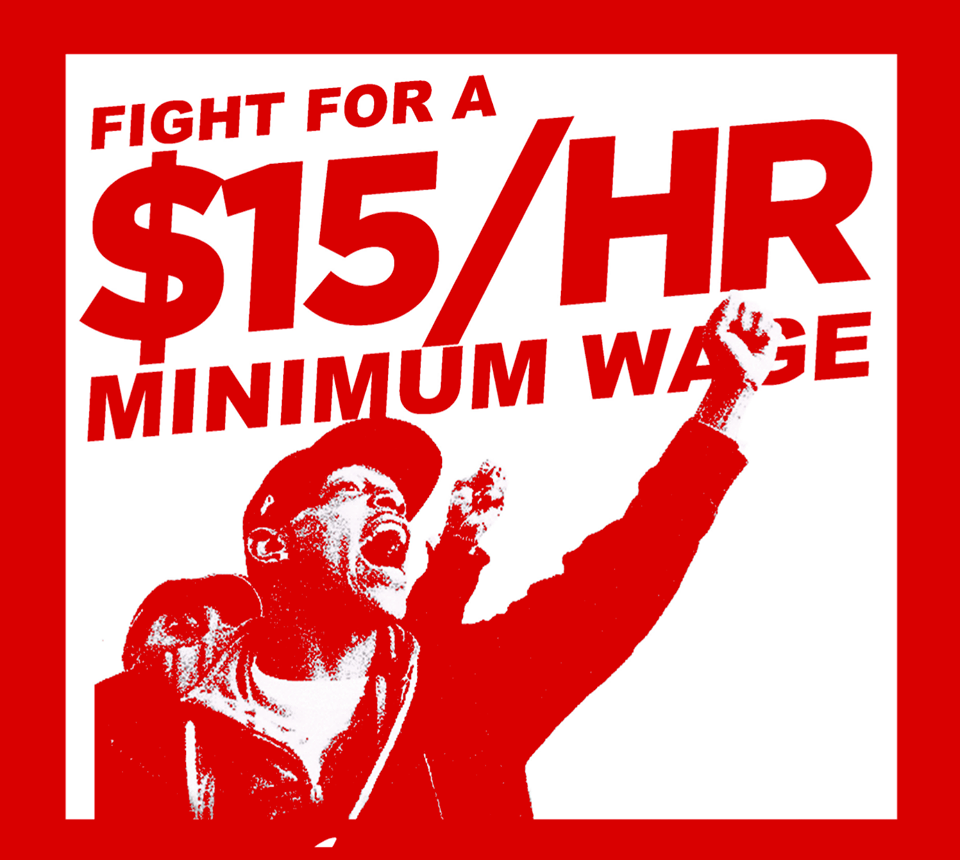
Los Angeles $15/Hr. Minimum Wage Huge Win


Leadership of mainstream political parties, zombies of a bankrupt and corrupt neoliberal consensus, got a jolt yesterday as the megalopolis of Los Angeles adopted a $15/hr. minimum wage. Jennifer Medina and Noam Scheiber have the story, "Los Angeles Lifts Its Minimum Wage to $15 Per Hour":
LOS ANGELES — The nation’s second-largest city voted Tuesday to increase its minimum wage from $9 an hour to $15 an hour by 2020, in what is perhaps the most significant victory so far for labor groups and their allies who are engaged in a national push to raise the minimum wage.
The increase, which the City Council passed in a 14-to-1 vote, comes as workers across the country are rallying for higher wages and several large companies, including Facebook and Walmart, have moved to raise their lowest wages. Several other cities, including San Francisco, Chicago, Seattle and Oakland, Calif., have already approved increases, and dozens more are considering doing the same. In 2014, a number of Republican-leaning states like Alaska and South Dakota also raised their state-level minimum wages by ballot initiative.
The effect is likely to be particularly strong in Los Angeles, where, according to some estimates, almost 50 percent of the city’s work force earns less than $15 an hour. Under the plan approved Tuesday, the minimum wage will rise over five years.
“The effects here will be the biggest by far,” said Michael Reich, an economist at the University of California, Berkeley, who was commissioned by city leaders to conduct several studies on the potential effects of a minimum-wage increase. “The proposal will bring wages up in a way we haven’t seen since the 1960s. There’s a sense spreading that this is the new norm, especially in areas that have high costs of housing.” 
The groups pressing for higher minimum wages said that the Los Angeles vote could set off a wave of increases across Southern California, and that higher pay scales would improve the way of life for the region’s vast low-wage work force. 
Supporters of higher wages say they hope the move will reverberate nationally. Gov. Andrew M. Cuomo of New York announced this month that he was convening a state board to consider a wage increase in the local fast-food industry, which could be enacted without a vote in the State Legislature. Immediately after the Los Angeles vote, pressure began to build on Mr. Cuomo to reject an increase that falls short of $15 an hour.
Opponents of the $15/hr. minimum wage hide behind small business owners, arguing that it will force them to close their doors. This is a red herring akin to trotting out the family farm when it comes time to call for a repeal of the estate tax or similar to USG claims that Shiite militias have to be sidelined in order to prevent the spread of sectarianism as Islamic State rampages.

If you have been to any urban core lately, you will have noticed, as I did recently on a trip to the Bay Area, that there are very few independent, small business retailers left standing. The overwhelming number of the storefronts I saw were corporate chains. The Bay Area I grew up in always had a large number of vibrant, independent small businesses, part of the legacy of being a Hippie Mecca. No longer.

As the Medina and Scheiber story makes plain, neoliberal Democrats like Andrew Cuomo are now on the hot seat. It is "shit or get off the pot" time for captive politicians. This minimum-wage wave is robust in red states too, as victories in Alaska and South Dakota during the GOP landslide of the 2014 midterms prove.

Over the weekend I finished Tariq Ali's The Extreme Centre: A Warning (2015). Ali takes us on a tour of Western democracies, focusing principally on the UK, since the collapse of communism in the late 1980s/early 1990s. The mainstream parties have morphed into de facto permanent neoliberal government cannibalizing the remnants of the post-WWII social order.

I mentioned in a post last month that Ali thinks that there is plenty of juice left in U.S. global hegemony. All talk of a "decline of the U.S.-led West" is wishful thinking. The one wild card Ali does hold out is popular reaction. As the mainstreams parties have cohered into an extreme center, they have become almost totally divorced from the 99% they nominally represent. This creates an opportunity for new parties to form, at least in parliamentary systems where party formation isn't impossible. So you have Syriza, which has been locked in a death struggle with enforcers of neoliberal austerity, the troika, since it came out on top in Greece's January elections. And you have Podemos in Spain, which will get a chance this Sunday in municipal and regional elections.

In the U.S., the only game in town is $15 Now. Well, that's not true. There's the #Black Lives Matter movement, which has, in less than a year, re-framed centuries of policing and racial stereotypes. Whites are moving toward minority status in the U.S. Obama, in Camden, NJ on Monday, announced that he was curtailing the Pentagon pipeline of surplus hardware to local police.

The LA $15 minimum wage and the shift underway in racial perceptions are huge gains and bode ill for business-as-usual neoliberalism. A mainstream party will win the election next year, but the ground is shifting. Change is coming.

Wednesday, May 6, 2015

Two Good Signs: The Rise of the Scottish National Party and the Diminution of Police Exceptionalism in the U.S.

Two rays of sunshine greet today's reader of the Gray Lady: Noam Scheiber's frontpage "Police Struggle With Loss of Privileged Position" and Katrin Bennhold must-read "Nicola Sturgeon, Not Running in British Election, May Yet Prevail."

Scheiber's story is a useful recap of police missteps over the last year. No longer can police automatically rely on "thin blue line" fear-mongering and racial hatred to guarantee a privileged status. Scheiber anchors his piece with a description of St. Louis's decade-plus effort to finally pass civilian review legislation:
Early this year, Megan E. Green, a St. Louis alderwoman, met with officials of a local police union to discuss a proposal for a civilian oversight board that would look into accusations of police misconduct. After Ms. Green refused to soften her support for the proposal, the union backed an aggressive mailing campaign against her. 
But Ms. Green won her primary with over 70 percent of the vote, and the Board of Aldermen approved the oversight board by a large margin. “All that stuff backfired,” Ms. Green said. “The more they attacked me for it, the more people seemed to rally around me.” 
During the urban crime epidemic of the 1970s and ’80s and the sharp decline in crime that began in the 1990s, the unions representing police officers in many cities enjoyed a nearly unassailable political position. Their opposition could cripple political candidates and kill police-reform proposals in gestation.

But amid a rash of high-profile encounters involving allegations of police overreach in New York, Baltimore, Cleveland, Ferguson, Mo., and North Charleston, S.C., the political context in which the police unions have enjoyed a privileged position is rapidly changing. And the unions are struggling to adapt. 
“There was a time in this country when elected officials — legislators, chief executives — were willing to contextualize what police do,” said Eugene O’Donnell, a former New York City police officer and prosecutor who now teaches at John Jay College of Criminal Justice. “And that time is mostly gone.”
***
St. Louis offers a particularly vivid example of the inability of police unions to update their tactics amid widespread frustration with policing. The St. Louis Board of Aldermen first passed a measure creating a civilian oversight board back in 2006. Mayor Francis G. Slay, a Democrat, vetoed the bill at the time, citing its “inflammatory antipolice” language and questioning whether it would survive a legal challenge given that the State of Missouri still formally controlled the local Police Department. 
But, in December, after months of outrage following the shooting death of Michael Brown by a police officer in nearby Ferguson, Mr. Slay agreed to support a bill similar to the one he vetoed a decade ago. A spokeswoman for the mayor said that local control of the Police Department now made the bill legally defensible. 
The St. Louis Fraternal Order of Police, one of two prominent local unions, was not persuaded. Although the alderman involved in drafting the legislation met with union officials around the same time and asked them for input, the union offered suggestions in writing only on April 13, two days before the board was set to vote on the bill, and far too late to incorporate any of its changes.
“When we met with them in December, I was honestly interested in their thoughts,” said Alderman Terry Kennedy, who sponsored the legislation. “I would have tried to incorporate as much as I could have.” But, Mr. Kennedy said, the union’s objections proved to be a “constantly moving target.” 
Jeff Roorda, a spokesman for the union, said that once it became clear that the Board of Aldermen was determined to give the oversight board investigative authority, rather than simply review powers, the union felt it was better to save its reservations for a future legal challenge.
Civilian police review boards, even those with subpoena powers, are no panacea. Members are usually appointed by politicians, and politicians are loath to mess with the police. Once misconduct or lawbreaking is exposed, the civilian review board must then rely on police department officials and/or prosecutors to enforce penalties. Civilian review boards in one form or another exist in cities throughout the country, in New York City, for instance, and they have not proven able to check the fundamental excesses -- the racism, lethal force, and gangster-like impunity -- of the police status quo. They are better than nothing. That's about it.

Nonetheless, the fact that city legislatures are beginning to get some traction on long-stalled civilian review laws is a positive sign.

But a truly positive sign is the rise of the Scottish National Party (SNP) out of the ashes of last September's independence referendum defeat. The SNP is positioned to win 45 seats in British parliamentary elections tomorrow, basically scouring Labour leadership out of Scotland, and giving party leader Nicola Sturgeon a great deal of say in any coalition government Ed Miliband expects to form.

Take note of the adulatory opening to Katrin Bennhold's story:
ST. ANDREWS, Scotland — Nicola Sturgeon was late getting to her burgundy helicopter. It had taken her 45 minutes to traverse the 50 yards between the medieval church and the high street — and not just because of her perilous-looking designer heels.
Ms. Sturgeon, the leader of Scotland’s semiautonomous government, was campaigning for her Scottish National Party before the general election on Thursday, and the reception, by the standards of British politics, was rapturous. 
Teenagers screamed. Supporters wearing “I’m with Nicola” badges shouted her name. A half-dozen schoolgirls who skipped class for the occasion lined up to take selfies. A grandfather wanted her autograph on his new party membership card. (“My whole family has joined, three generations,” he said proudly.) 
Then, a man with a distinctly English accent approached. “I’m a fan from London,” he told her. “I wish I could vote for you.”
The affluent university town of St. Andrews, where Prince William and Kate Middleton studied, has never elected a parliamentary candidate from the left-leaning, separatist Scottish National Party in a general election. But it appears likely to do so this week, along with most of Scotland.
Ms. Sturgeon, a 44-year-old feminist from Ayrshire, a working-class county in southwest Scotland, wants to lock the Conservatives out of power, rid Britain of its nuclear weapons and end austerity measures. She has attracted the spotlight in the election campaign — and she is not even running for Parliament herself. 
Judging by opinion polls, she is all but certain to emerge as a national political force, commanding the third-largest bloc of seats in Parliament and ending the Labour Party’s long dominance in Scotland. 
Barely known in England before she took over her party last year, she has gained prominence in a series of televised debates in recent weeks. In one exchange, she challenged the head of the populist U.K. Independence Party, Nigel Farage, after he blamed immigrants for a housing crisis. 
Immigrants “make a net contribution to our country,” she told Mr. Farage. “So if we can maybe just put the boogeyman to one side, we can actually debate these issues for real and in substance,” she continued, to thunderous applause.
“It’s astonishing — —” a shocked Mr. Farage began. 
“You are, yes,” Ms. Sturgeon retorted, to more cheers. 
After she explained to a national audience why she wanted a higher minimum wage, more spending on health and child care and an end to steep budget cuts, people outside Scotland suddenly wanted to know if they could vote for her party. 
They cannot. Her party is fielding candidates only in Scotland. But with neither the Conservatives nor Labour expected to win a majority, Ms. Sturgeon could well determine the shape of the next British government — or whether one can be formed at all.

What is remarkable in Bennhold's story is the rocket-like rise of the SNP following its defeat at the polls for Scottish independence, after which Sturgeon took over party leadership from Alex Salmond:
So far, Ed Miliband, the Labour leader, has ruled out setting up a formal coalition, suggesting that he expects the Scottish Nationalists to support his agenda in any case. The two parties have similar economic platforms, though they differ sharply on some other issues, like nuclear disarmament and Scottish independence. 
But Ms. Sturgeon says that Labour cannot be trusted to make Britain a fairer country on its own. “We can bring an influence to bear on Ed Miliband and a Labour government to make them more progressive,” she said in an interview.
“There is as much of an appetite for political change in England as there is in Scotland,” she continued. “The fact that neither Labour nor the Tories are ahead in the polls reflects the fact that people think they haven’t got much of a choice.”
The right-leaning tabloid The Daily Mail has called her “the most dangerous woman in British politics.” Prime Minister David Cameron has described a possible coalition with her as “a match made in hell.” The Conservative mayor of London, Boris Johnson, likened her to a scorpion and said that allowing her party into a coalition government would be like putting King Herod in charge of a baby farm.
One Conservative campaign poster shows Mr. Miliband peeking out of Ms. Sturgeon’s pocket. Another has her as his puppet master.
Ms. Sturgeon shrugs off the vitriol. “People only try and shoot at you if you’re worth shooting at,” she said. Noting that her party has been in government in Scotland since 2007 and won a majority there in 2011, she said, “If the S.N.P. wasn’t doing well, nobody would be bothering about us.”
In the meantime, each English insult seems to strengthen her in Scotland. 
“Every time David Cameron or Ed Miliband says something stupid, there is a surge in party membership,” said Heather McLean, 59, a former Labour voter from Dundee who joined the Scottish Nationalists during the independence referendum campaign last year. “And they do that quite a lot, you know, say something stupid.” 
The referendum galvanized voters on both sides of the independence debate, drawing nearly 85 percent of Scottish voters to the polls, the highest turnout in any British election in a century. Membership in the Scottish National Party has quadrupled. [!]
Even The Sun, Rupert Murdoch’s tabloid, which is backing the Conservatives elsewhere, has jumped on the nationalist bandwagon in Scotland. Its Scottish edition depicted Ms. Sturgeon as a light-saber-wielding Princess Leia from “Star Wars” and told readers it was “time to vote S.N.P.” 
Ms. Sturgeon was delighted. “If I cast my mind back a decade, the idea of any tabloid newspaper endorsing the S.N.P. would have seemed a bit fanciful,” she said. 
When she joined the party as a teenager, it was a fringe group with three seats in the national Parliament (Scotland would not have its own legislature for another decade). It took two decades and numerous defeats before she finally won election to the Scottish Parliament. When she took her seat, she refused to take an oath of allegiance to the queen, instead swearing loyalty “to the sovereignty of the people of Scotland.”
Oh, what a beautiful thing it is. I know adoration of politicians leads nowhere but to heartbreak, but maybe there is enough intelligence and courage left in the electorate that some sort of counter-hegemonic democratic shift can come about. One thing is for sure. The United States needs the equivalent of the Scottish National Party.