Showing posts with label SEIU. Show all posts

Wednesday, April 27, 2016

Point of No Return: President Hillary and the Demise of the European Union

I feel decent this morning for the first time in more than a week. Stress and strain on the job has led me to abandon this page. I feel like I am back at an SEIU local where I worked ten years ago, which was the closest I have ever come to being a member of a cult. Everyone was fucking each other, lying to each other, drinking and drugging, calling in sick, etc. My current situation is not anywhere near as bad. But I am ten years older, and working a 12-hour day doesn't get any easier.

So I am entertaining the idea of mothballing Burdens. My horizon looks bleak: overtime, staff retreats, six-day work week after six-day work week. We'll see. I think I can manage one post a week.

Enough about me. What about the world in which we live? Yesterday's primary results solidified last week's consensus coming out of New York. It is going to be a Trump vs. Hillary race to the bottom. Trump swept five Eastern states -- Connecticut, Delaware, Pennsylvania, Rhode Island and Maryland -- in commanding fashion, and Hillary almost equaled his performance, losing only Roger Williams' colony.

The big takeaway from yesterday is a post this morning by Nate Silver, an avowed Trump denier: "It’s Trump’s Nomination To Lose. (Well, at least if he wins Indiana.)" With the Kasich-Cruz pact to derail Trump quickly disintegrating, even FiveThirtyEight thinks Trump's path to 1,237 is all but assured. For a moment I was swayed by a Van Jones interview I saw at the beginning of this month where he argued that the GOP was headed straight for a brokered convention because Trump had proven unable to win consistently more than 50% of the vote. Well, he has proven it repeatedly in April. And I think he will do very well in California. I was hoping for a battle royale at the Republican National Convention, maybe even an event where Trump would march his delegates out.

For the Democrats, I was hoping that Bernie could win New York and California and a few other states along the way and bring his children's crusade to the City of Brotherly love where another convention fight would be staged. Remember, it was the meltdown in Chicago in 1968 that brought about the McGovern reforms that led to McGovern's nomination in 1972 and Carter's nomination in 1976, and which superdelegates were created in 1984 to counteract. So convention meltdowns have a big historical impact.

Unfortunately it doesn't look like there will be any convention meltdowns. If anything happens, it will be the big unions backing Hillary (SEIU, for one) attempting to lure disaffected youth back into the corrupt Democratic Party by staging direct action type mobilizations against Trump, possibly even at the GOP convention in Cleveland. I hope youth are too shrewd to be appropriated by Hillary, but in this regard I am not too confident; after all, there was a push in March by MoveOn to mobilize against Trump.

What does a race to the bottom between Hillary and The Donald look like? It is hard to know how the deep the depths, but deep indeed I imagine they will be. A guy who works on the same floor of the building where I work came into the office last week and handed me a sheet he had printed out. It was from The New York Times, based on the "NYT 4/19/16" he scrawled on the bottom of the page. There is no byline. I will retype the key sentences:
Meanwhile, her [Hillary's] negative ratings have been rising and now outweigh her positives by 24 points. That makes her seen no more favorably than Cruz is. Her only salvation is Trump's net negative is minus 41.
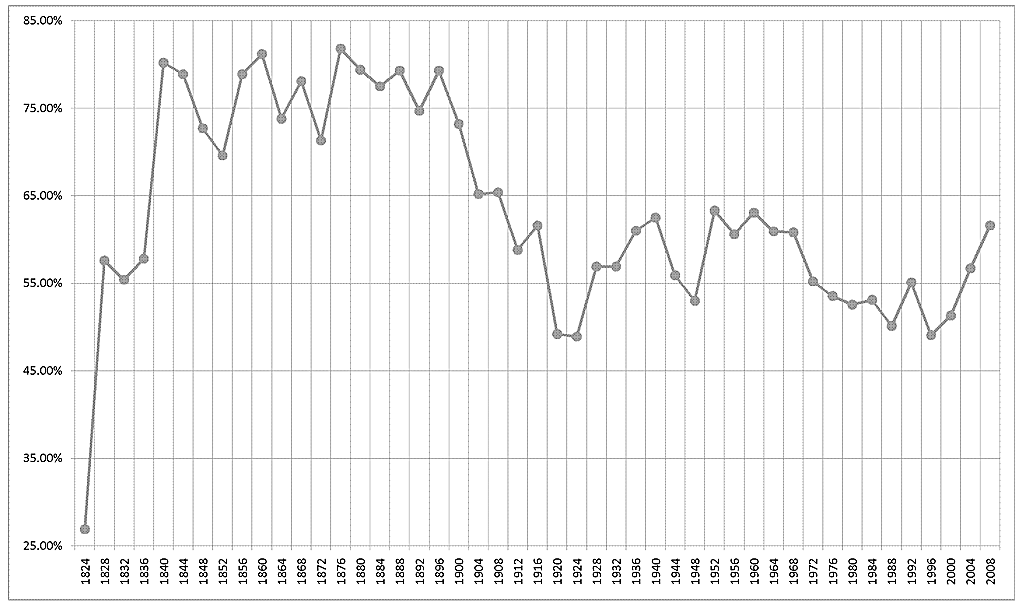
Combine these high marks of disapproval for both front runners with the low voter turnout numbers from the 2014 midterm elections, which were so low you had to go all the way back to the total war mobilization of World War Two to find comparable figures, and we could see participation levels as poor as the 1920s. And while this is proof of a broad distrust of our political system, it does not represent the kind of revolution that is called for.

At this point it looks like Clinton will muddle through. Fear usually trumps hope. By the time November arrives, Trump will be so thoroughly demonized the Rubio-voting soccer mom crossover will more than make up for any hardhat crossover in the opposite direction, leaving the election to be decided by black and Latino turnout. All hail Hillary.

We will have to look for regime change elsewhere.

Though "four more years" yawns at us, I am convinced now more than ever (and not just because I am reading Elizabeth Kolbert's excellent The Sixth Extinction: An Unnatural History) that we are headed for some sort of collapse.

This page since its inception has been preoccupied with the fracturing of the current Pax Americana neoliberal paradigm. From the fiscal cliff, Cyprus, the coup in Kiev, sarin in Ghouta, ISIS in Anbar, Syriza's Greece, Afghanistan, the refugee crisis in Europe to World War Four in Syria the paradigm is quaking.

Europe is critical. The unipolar world of Pax Americana is dependent on a supine, fraudulently monolithic Europe. That party has ended. Obama's meek and exhausted goodbye junket to the continent drove the message of defeat home.

The ceasefire in Syria is over. In the new phase of fighting the U.S. alliance with Al Qaeda affiliate Al Nusra is more manifest than ever. The only thing keeping it from popular consciousness is a polite, conspiratorial elision by the mainstream media.

Renewed fighting in Syria and Iraq means a surge in refugees to Europe. Yemen is cued up to be even worse. All in time for the June 23 Brexit referendum. (Interestingly, in 1975, Year 1 of neoliberalism, the Brits voted by a supermajority to remain part of the European Community. It will be much closer this time.)

Even if the UK votes to stay in the EU, the continent will continue to fray because war in the Middle East is going to accelerate. The sheikhs of the Gulf are engaged in an arms buying bonanza, while the Saudis are in full tilt PR smokescreen mode. The panic is palpable. The captive USG is doing its part by sabotaging Obama's remaining legacy achievement, the nuclear deal with Iran. This can't end well. Hillary, more beholden to the neocons and the Saudis, will only make things worse.

And we haven't even mentioned the militarized Asia pivot or NATO's New Cold War with Russia, both of which were initiated absent public support. This is a "no future" horizon.

Thursday, April 16, 2015

$15 Now Last Gasp for Organized Labor

Yesterday was another nationwide mobilization to demand a $15-an-hour minimum wage for low-wage workers. The fast-food industry has been the principal target. Service Employees International Union (SEIU) is the key labor organization spearheading the push. For instance, SEIU ran the successful 2013 initiative campaign for a $15/hr. minimum wage in SeaTac, the city that is home to Seattle's airport, at the same time it provided valuable support in socialist Kshama Sawant's victory over an entrenched corporate liberal Seattle City Council incumbent. Sawant's win paved the way for Seattle's breakthrough $15/hr. minimum wage, which was copied, in one form or another (usually a lower rate of pay), in other cities and states.

"In Test for Unions and Politicians, a Nationwide Protest on Pay," by Noam Scheiber, provides background and an overview to yesterday's 200-city-plus protest. It is a good story.
“America, period, is unequal,” said Chasten Florence, 26, a construction worker from Jamaica, Queens. “Once we accept that, we can change that." 
McDonald’s said in a statement: “We respect people’s right to peacefully protest, and our restaurants remain open every day with the focus on providing an exceptional experience for our customers.” 
The campaign, staffed in part by organizers from the Service Employees International Union, orchestrated the country’s first-ever fast-food industry strike in November 2012, when 200 New York City workers walked off their jobs. The periodic protests expanded to six other cities in the spring of 2013, 60 cities in August of that year, 150 cities in May 2014, and 190 last December. 
The protests have coincided with an extraordinary shift in the political consensus on the minimum wage. In the last two years, Seattle has moved to gradually increase its minimum wage to $15 an hour, from $9.32. Oakland, Calif., established a new minimum wage of $12.25, while Chicago approved an increase to $13, from $8.25, over the next four years. Alaska and Arkansas passed minimum wage increases by referendum in 2014. 
In 2013, President Obama endorsed raising the federal minimum wage to $9, from $7.25 an hour, then increased that to $10.10 by the fall of that year. Democrats in the Senate are now working on a proposal to raise the national minimum wage to $12 by 2020.
But there was not a peep about the event yesterday in my place of employment, and I work for a union. And that is the problem. There is a yearning on the part of the broad public for a change in working conditions, which Scheiber makes clear, but, besides SEIU, the other big international unions have shown no ability to capitalize on the unrest.
“The labor movement has been stuck,” said Janice R. Fine, an associate professor of Labor Studies at Rutgers University. “They deserve a lot of credit in deciding that, in a situation this bleak, you needed ‘climate change’ ”— that is, a change in how the public views low-wage work — “before you’d actually get an opportunity to organize again.”
Partly in response to the political shift as well as competitive pressure from tighter labor markets, several major employers of low-wage workers have moved to raised their base pay in recent months. Walmart, Target and McDonald’s have all announced plans to increase their minimum wage to or near $10, though for McDonald’s it would apply only to the roughly 10 percent of its workers employed directly by the company, not by its franchisees.
But business groups argue that a substantially higher increase would force employers to reduce hiring, accelerate automation and even threaten the basic economic model of some industries.
For Mary Kay Henry, the president of S.E.I.U., the investment in the Fight for $15 campaign was initially controversial among her colleagues, many of whom wondered why the union should spend millions of dollars on a campaign that did not immediately net it dues-paying members. 
But it was the result of a calculation that the 20th-century model of organizing workers was rapidly becoming obsolete for those in a growing sector where employers considered it essentially costless to replace them. “We can no longer change our lives, and our kids’ lives, without the support of a broader movement of workers,” Ms. Henry said.
The origins of the Fight for $15 campaign date back to early 2012, when organizers from New York Communities for Change, which had built support for Occupy Wall Street activists among more established progressive activists and labor organizers, began canvassing low-income New Yorkers, many of them employed in the fast-food industry.
At the same time, public opinion was shifting. According to the General Social Survey, regarded by researchers as the gold standard in public opinion data, the share of Americans who agreed that “inequality continues to exist because it benefits the rich and powerful” spiked by more than 10 points from 2010 to 2012, to over 60 percent.
“People know Walmart and McDonald’s are doing pretty well, people at top,” said Leslie McCall, a professor of sociology at Northwestern University, who has closely analyzed the opinion data on inequality. “It was like: ‘Wait a minute. We’re into the recovery, the unemployment rate is going down. But most people aren’t doing well.’”
Even politically moderate voters appear to believe that it is the responsibility of corporations to mitigate the problem. In her own preliminary surveys, Professor McCall found that, when asked to choose who should be most responsible for reducing inequality — the poor, the rich, the government, major companies, or that it did not need to be reduced — a plurality of Republican respondents, about 37 percent, chose “major companies.”
The Fight for $15 campaign hopes to harness these sentiments in ways that Occupy Wall Street never quite succeeded in doing. In Seattle, Steve Gelb, who makes above minimum wage at a work force training outfit, said he supported the protests because “the disparity of wealth has reached alarming proportions and the salaries of business owners and executives are way out of proportion.”
There is some evidence that the big internationals headquartered in D.C. are beginning to get the message. But it is not about income inequality and economic justice and the need for a broad mobilization of low-wage workers. What the big, wealthy internationals are afraid of is the rapid spread of right-to-work laws, some of which are being passed at the local and county level. The right senses weakness and fear and it is lunging for the jugular. Right to work has become a new litmus test for Republican governors. Wisconsin's Scott Walker is the matinee idol of the movement. His chances of winning the GOP presidential nomination are as good as anyone's.

The math on right to work is unforgiving. Once passed it quickly leads to a loss of 20 percent in union dues-paying membership. So the message that is coming from on high is not "We need to mobilize our membership and develop a radical consciousness," it is, "We need to get our budgets in line with a possible 20-percent loss in operating revenue. We need to think about a dues increase."

Unions are gray at the top and completely captive to business-as-usual, conventional thinking. There is zero ability to transform into a radical organization capable of spearheading progressive social change. The guys at the top are all about dollars and cents and the size of their pension funds and the amount of bonus miles they have on their credit cards. They have their eyes on retirement. They'll willingly file aboard the Titanic of Hillary's presidential campaign and argue that it is a vessel for working people.

Even SEIU, a local of which I have worked for, is a conventional, top-down, tyrannical hierarchy that produces a culture of mendacity. Our problem is that it is the only game in town. There needs to be a new leftist political formation. At least SEIU has shown a willingness to work with a socialist like Kshama Sawant.

Tuesday, January 14, 2014

How Employers are Subverting the SeaTac $15/hr Minimum Wage Law

The latest on the SeaTac Prop 1 $15/hr minimum wage initiative that was passed last November (the campaign for which was run out of the top floor of the building where I work) appeared in a story, "Seattle Port commissioners listen to SeaTac wage activists," written last week for the Puget Sound Business Journal by Ana Sofia Knauf. Here are the first two paragraphs:
SeaTac wage activists attended a Port of Seattle Commission meeting on Tuesday [January 7] to appeal to commissioners to get a $15-per-hour minimum wage reinstated at Seattle-Tacoma International Airport. 
On Dec. 27, King County Superior Court Judge Andrea Darvas struck down part of a city of SeaTac ordinance that would have increased the minimum wage from $9.32 per hour to $15 per hour for some employees at the airport, which is run by the port, as well as others outside the airport. Her decision limited the minimum-wage increase to some hospitality workers in the city of SeaTac. Wage activists have appealed her decision to the state Supreme Court.
Service Employees International Union distributed video of a KING 5 TV story on the port commission meeting.

But last week I also got the worker perspective on the implementation of Prop 1 from a young Latina acquaintance who rides the bus I take from the light rail stop in SeaTac. She works at one of the hotels located next to the building where I work.

According to my friend, her employer, in order to get out of paying the $15/hr minimum wage passed by initiative, is laying off staff to get below 30 employees, the trigger for the $15/hr wage. My friend will earn $15/hr this month, but next month she will go back to $9.32/hr, except that the number of rooms she cleans will go up to 19 from 17.

"Very bad," she said.

Her English isn't very good, and my Spanish is unspeakable. So I had difficulty understanding what she was trying to say, but I think that was what she was getting at. I had her repeat it twice.

Now she has more work for less pay. Isn't capitalism beautiful?