U.S. Special Envoy for Syria James Jeffrey met with senior Turkish officials this week to hash out the details on the creation of "safe zones" in northern Syria. The talks did not go to Ankara's liking. According to Reuters,
After U.S. special envoy for Syria James Jeffrey held talks with Turkish officials, Turkey said on Wednesday it had run “out of patience” with Washington and warned that it would carry out a military operation in the region if an agreement on the safe zone was not reached.
Turkish Foreign Minister Mevlut Cavusoglu said the United States was stalling progress on the safe zone, just as it did with a joint roadmap agreed to clear the northern Syrian town of Manbij of the YPG last year.
At a briefing in Ankara on Thursday, Turkish military officials said talks on the planned safe zone with the United States would continue, but reiterated that Turkey’s expectations on the Manbij roadmap had not been met.
“Work is planned to continue in the coming period. We cannot share details as efforts are under way. Our aims are clear. The Turkish army is the only force capable of doing this,” one of the officials said regarding the safe zone.
These safe zones were agreed to by Trump last December. Trump promised at the same time to withdraw all U.S. forces in northeast Syria, which prompted the resignation of U.S. Defense Secretary James Mattis and ISIS czar Brett McGurk. Trump eventually walked back the troop withdrawal. Today thousands of U.S. troops remain in Syria.
How such a buffer zone would be created by Turkey is unclear. A 20-mile zone would encompass the majority-Kurdish towns including Qamishli and Kobane as well as strategic cities controlled by groups affiliated to the Syrian Democratic Forces, such as Tal Abyad and Manbij. It would also include Ayn Issa, the new administrative center for north and east Syria.
The Turkish government has long been threatening to launch a military incursion to clear the border area of the predominantly Kurdish YPG, which forms the core of the U.S.-led Coalition-backed SDF in ground operations against Islamic State.
Washington’s support for the group has infuriated the Turkish government, which views the YPG as a branch of the Kurdistan Workers’ Party, or PKK, designated a terrorist organization by Turkey and its Western allies.
In Manbij, Turkey expected the U.S. to get rid of all heavy weapons, eliminate the YPG, and hand the city over to a Turkish-approved governing council.
Turkey does not appear to be willing to settle for anything less than military control of this 20-mile buffer along the border, an area heavily populated by the Kurds and vital to any future Rojava.
Turkey appears willing to fight. The Defense Post story ends with the following:
Turkish media reported a significant buildup of Turkish military forces along the Syrian border in the days following the [S-400] missile system’s initial delivery.
American patrols were reported in the border area near Serê Kaniyê (Ras al-Ayn) earlier this week after the Turkish military said it retaliated against rocket fire from the Syrian side that landed in the Turkish town of Ceylanpinar.
Both the SDF and YPG also said a shell was fired from Syrian territory but denied responsibility and said an investigation was underway.
The YPG called the incident a “provocative act” and a “clear attempt to disrupt stability in NE Syria.”
The United States is vulnerable in northeast Syria. It would have to use air power to defend its troops on the ground. Erdogan's purchase of the S-400 is proof that Turkey is serious about attacking Rojava.
UPDATE: The latest from Hodeidah is that the Saudi-UAE coalition has successfully wrested portions of the airport from the Houthis. This is denied by the Houthis, a spokesman for which said the coalition forces are in retreat. The airport is destroyed and civilian casualties are growing. The seaport is still operating. UN special envoy for Yemen, Martin Griffiths, left Sanaa without any agreement. The battle for Hodeidah grinds on with no end in sight.
****
If looked at through the prism of the Kurdish failure in March to hold Afrin City against the Turks, it's hard to imagine a more hopeful outcome for the Houthis in Hodeidah. The stakes are different as is the terrain. Afrin is a river city in Syria near the Turkish border that is the production center for olive growing. Hodeidah is the principal port -- both air and sea -- on the Red Sea; it is Yemen's fourth largest city with a population of 400,000. Hodeidah falls to the UAE-Saudi coalition and Sanaa the capital starves.
It took the Turks and their Free Syrian Army proxies less than a week to conquer Afrin City, sending the Kurds of the YPG and YPJ retreating into the surrounding hills. The siege of Hodeidah is already into its sixth day.
At first there were breathless reports that the UAE-Saudi coalition was proceeding methodically and with little trouble to control both air and sea ports. The story this morning is not so sanguine. Houthi fighters are stubbornly resisting; the coalition has responded with shelling, which is impacting neighborhoods surrounding the airport. There are civilian casualties.
My assessment back in March was that the if YPG/YPJ failed to hold Afrin City, they would prove themselves merely a U.S. proxy, unable to achieve their objective of an independent Rojava. With the news that Turkish forces are entering the outskirts of Manbij, this assessment has proven accurate.
We'll soon find out if the Houthis are nothing more than Iranian proxies -- which has been the prevailing mainstream wisdom, with an occasional caveat, since the Yemeni Civil War began three years ago.
The Houthis are not Iranian proxies. My guess is that they will put up more of a fight than the Kurds. Moon of Alabama notes reports that French special forces are part of the coalition attacking Hodeidah. What we're looking at is another inconclusive Western-backed military campaign. Plenty of death and destruction, but not much of anything else.
Rudaw reported yesterday, "Turkish forces advance, closing in on Afrin city," that the battle for Afrin has reached the point of a siege of the city. The Kurdish-led SDF responded by announcing a move of 1,700 fighters from the eastern Syrian province of Deir al-Zour. The SDF in Deir al-Zour are there primarily to guard the oil fields war booty coveted by the U.S.
The Kurds of the YPG/YPJ have to hold Afrin because if they don't then they will have proven to be incapable of acting independently of the protection provided by U.S. air power and logistics. If Turkey and the CIA-trained Free Syrian Army triumph, then the Kurds will be seen as merely another mercenary proxy force that the U.S. exploits willy-nilly to achieve its objectives.
At this point the Turks appear to have all the advantage. They can lay siege to Afrin city indefinitely. Don't expect the same outrage over Afrin in the Western media as there is for East Ghouta.
The Turkish assault on the Kurdish-controlled northwest Syrian region of Afrin continues. The United States foothold in Syria is predicated on a fiction. That fiction is the Syrian Democratic Forces (SDF), a U.S. re-branding of the Kurdish People's Protection Units (YPG). The YPG is a Syrian PKK militia.
Y.P.G. leaders say theirs is a homegrown movement that sprang up to defend civilians in the early days of Syria’s war and against offensives by the Islamic State.
That role, and the backing of the United States, has transformed the group into the most prominent political and military force in northeastern Syria.
Formerly an impoverished and marginalized minority, Syria’s Kurds now administer substantial territory, where they are teaching Kurdish in schools and setting up local administrations. Critics have accused them of displacing Arabs.
American officials have long sought to minimize the Y.P.G.’s ties to the P.K.K., but Turkey is enraged that the United States is giving military support to a group that idealizes Mr. Ocalan, the sole inmate of an island prison in the Sea of Marmara.
Many Y.P.G. leaders speak openly of their history with the P.K.K., and Kurds from Iraq, Iran and Turkey have joined the movement in Syria.
Mr. Bonsey said there had been hope among the Americans that they could pull the Y.P.G. away from the P.K.K.
But such a prospect appears unlikely — especially with the Kurds now uncertain that they have solid support from the United States, which has sent mixed messages about how strongly it would back them against a Turkish onslaught.
The American ambivalence was clear on Wednesday in comments by Thomas P. Bossert, Mr. Trump’s homeland security and counterterrorism adviser, at the World Economic Forum in Davos, Switzerland.
“I’m not in any way critical of the Turkish decision, but I’m just praying for their longer-term strategic patience,” Mr. Bossert told reporters.
Asked if the Turks should withdraw, Mr. Bossert said, “I would prefer it if for now they would remove themselves from the capital of Afrin.”
The United States effectively gave a green light to the current Turkish offensive against Afrin, urging restraint but emphasizing that it does not work with the Y.P.G. there.
The enclave is in northwest Syria, not connected to a larger territory held by the Syrian Democratic Forces in the country’s northeast, where several small American military bases and several thousand American advisers are.
But Mr. Erdogan has threatened to attack that larger area, beginning with the town of Manbij. The Turks say the Americans promised that the Syrian Democratic Forces would withdraw from such majority-Arab areas after taking them from the Islamic State, but it has not.
The ingredients for this clash have been brewing since Syrians rose up against the authoritarian rule of President Bashar al-Assad in 2011. Within a few years, the northeastern province of Hasaka, with a large Kurdish population as well as Arabs and Assyrians, was effectively ruling itself.
As it became the area’s dominant force, the Y.P.G. tried to implement its vision of a utopian society, inspired by Mr. Ocalan. Influenced by Murray Bookchin, an American anarchist, Mr. Ocalan has called for autonomous rule by local committees unbound by national borders. Proponents say they do not seek to break up Syria but are leading a long-term social revolution that will ensure gender and minority rights.
Reuters is reporting that in a speech today Erdogan reiterated that the goal of Turkish military campaign is to take Manbij. Problem there is that is where the U.S. Special Forces have a base:
ANKARA/BEIRUT (Reuters) - President Tayyip Erdogan said on Friday Turkish forces would sweep Kurdish fighters from the Syrian border and could push all the way east to the frontier with Iraq -- a move which risks a possible confrontation with U.S. forces allied to the Kurds.
The Turkish offensive in northwest Syria's Afrin region against the Kurdish YPG militia has opened a new front in the multi-sided Syrian civil war but has strained ties with NATO ally Washington.
Turkey considers the YPG a terrorist group but the militia has played a prominent role in U.S.-led efforts to combat the hardline Islamic State in Syria.
Since the start of the incursion, dubbed "Operation Olive Branch" by Ankara, Erdogan has said Turkish forces would push east towards the town of Manbij, potentially putting them in confrontation with U.S. troops deployed there.
"Operation Olive Branch will continue until it reaches its goals. We will rid Manbij of terrorists, as it was promised to us, and our battles will continue until no terrorist is left until our border with Iraq," Erdogan said in a speech in Ankara.
Any drive by Turkish forces toward Manbij, part of Kurdish-held territory some 100 km (60 miles) east of Afrin, could threaten U.S. efforts in northern Syria.
The United States has about 2,000 troops in Syria, officially as part of the international, U.S.-led coalition against Islamic State.
U.S. forces were deployed in and around Manbij to deter Turkish and U.S.-backed rebels from attacking each other and have also carried out training missions in the area.
Washington has angered Ankara by providing arms, training and air support to the Syrian Kurdish forces. Turkey sees the YPG as an extension of the outlawed Kurdistan Workers Party (PKK), which has waged a deadly insurgency in Turkey's largely Kurdish southeast for three decades.
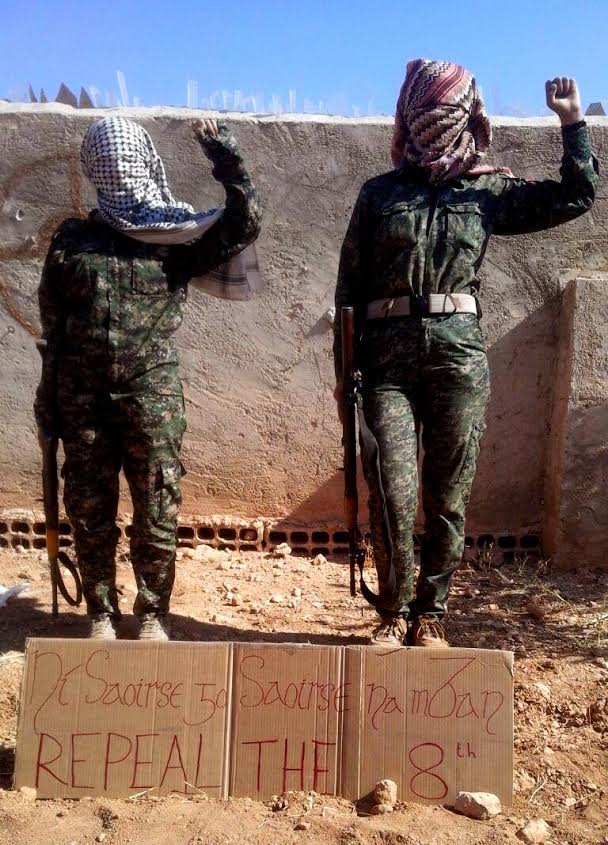
Perhaps more importantly, brigade members have established political connections between Kurdish and European activists. On September 7, 2016, they tweeted an image of two armed guerrillas wearing balaclavas and raising their left fists. Beneath them, a scrap of cardboard read: “Ni Saoirse go Saoirse na mBan [there is no freedom without the liberation of women]: repeal the Eighth.”
“The Eighth” refers to the Irish constitution’s eighth amendment, which outlaws abortion in Ireland and restricts access to information about having an abortion in England (similar restrictions also exist in Northern Ireland). The tweet must be put in the context of the international mobilization against Ireland’s anti-abortion laws, culminating in simultaneous demonstrations on September 24 in various European cities.
Karker Bakur explains the story behind the tweet:
Our women comrades in the IFB [International Freedom Battalion] asked us about the women’s movement in our countries, and we said the most heroic thing right now was the women in Ireland buying abortion pills and then turning themselves in. They were really interested in this.
After the Kurds entered the war with the Mount Sinjar Rescue, the YPJ [Women’s Protection Units] spoke to thousands of Yezidi women from ISIS who had been raped as sex slaves or as “wives” awarded to the jihadis from abroad. From that point on it became clear that ISIS’s systematic rapes were partly to leave behind future ISIS recruits, children who would be potential outcasts.
The Rojava women’s movement launched a campaign for European supporters to send abortion pills to help rescued women, and, furthermore, abortion is a completely legal process in Rojava since the revolution. So when our female comrades heard this wasn’t the case in Ireland, they asked how to show support.
Outlining the Raqqa puzzle Obama leaves unfinished as he exits the Oval Office, Gordon and Smith illuminate the contradictions of the administration's war in Syria.
The U.S. can't conquer Raqqa, capital of the Islamic State, without the radical, anarcho-feminist Syrian Kurd fighters of the YPG. The YPG must be armed for urban combat and then backed up by U.S. Apache helicopters equipped with Hellfire missiles. But to arm the Syrian Kurds risks almost certain reprisal from Turkey, including the possibility of a Turkish invasion of Rojava.
The CIA favors sidelining the YPG (see the Barzani quote below) by fabricating a larger force comprised of Turkish troops and Iraqi Pesh Merga. But the Pentagon knows that these CIA-engineered militias are more PR than actual fighting units. So it is insisting on the YPG. Obama will likely dither and punt it to Trump. And Trump, no anarcho-feminist, will probably want to curry favor with Erdogan. Then again Trump's administration is heavy with Pentagon brass, and Trump is none too keen on the CIA these days. So maybe Rojava has a shot.
But arming the Kurds would also aggravate Mr. Obama’s tense relations with Turkey’s president, Recep Tayyip Erdogan, who has contended that the Y.P.G. is linked to the Kurdistan Workers’ Party, which Turkey and the United States regard as a terrorist group.
The administration has been considering ways to ease Turkey’s anxiety, such as making arrangements to monitor the weapons given to the Syrian Kurds for the Raqqa offensive and thus prevent the weapons from being used elsewhere by the Kurds. In addition, Arab forces would occupy Raqqa after the city is taken, and Kurdish fighters would be withdrawn.
The United States also recently began carrying out airstrikes near Al Bab, a town in northern Syria that Turkey has been struggling to take from the Islamic State.
But American diplomats in Ankara, the Turkish capital, have warned that providing weapons to the Y.P.G. could provoke a Turkish backlash, officials say. Not only might it cause a deep breach in the United States’ relations with Mr. Erdogan, but the Turks might take actions against the Y.P.G. in northern Syria that could ultimately undermine the offensive to retake Raqqa.
Anticipating Mr. Obama’s decision, the Turks have been quietly increasing the pressure by delaying approval for American air missions that are flown from the Turkish air base at Incirlik and supplies going in and out of the base. Incirlik has been a major hub for carrying out airstrikes against the Islamic State in Syria and Iraq.
Turkey’s sensitivity on the issue was clear last week when the United States Central Command, which oversees military operations in the Middle East, posted a statement on Twitter by the Syrian Democratic Forces, the umbrella group that includes Syrian Kurds as well as Syrian Arab fighters, affirming that it is not part of the Kurdistan Workers’ Party as “some regional governments” have claimed.
“Is this a joke or @CENTCOM has lost its senses,” Ibrahim Kalin, Mr. Erdogan’s spokesman, responded on Twitter.
Faced with the dilemma, some administration officials have suggested that American officials go back to the drawing board and try to cobble together a more diverse force to take Raqqa that would include Turkish Special Forces as well as Turkish-supported Syrian opposition groups. American commanders say about 20,000 troops will be needed to seize the city. By contrast, Turkey has been able to muster only about 2,000 Arab fighters in its battle to reclaim Al Bab, and that campaign has been bogged down by fierce resistance.
During a visit to Washington last month, Masrour Barzani, a top security official in the Kurdish autonomous region in Iraq, pressed American officials to work with Syrian Kurds who are separate from the Y.P.G. and are operating in Iraq, a group known as Pesh Merga of Rojava, or Roj Pesh. Aides to Mr. Barzani assert that the Roj Pesh are trained by the pesh merga, would be politically acceptable to the Turks and number about 3,300.
“Roj Pesh are the most efficient and politically diverse force,” Mr. Barzani said. “They can be the bridge to lessen regional tensions and a force multiplier in the campaign.”
But Pentagon officials say that the Y.P.G. has the most effective fighters, is already closing in on Raqqa, and that trying to assemble, train and equip an alternative force could be difficult and at best would take many months.
The routing of Islamic State jihadists from Palmyra by the Syrian Arab Army (SAA) is another game-changer in a series of recent game-changers in the global proxy war taking place in Syria. First, there was the military victory by the combined forces of Russia, Syria, Iran and Hezbollah in Aleppo Province; next, a ceasefire, excluding Jabhat al-Nusra and Islamic State; then, Russia's announcement of a "mission accomplished" withdrawal of forces, followed, this past weekend, by the military victory in and recapture of Palmyra, a UNESCO world heritage site filled with ancient ruins where the Roman and Persian worlds intersected.
U.S. involvement in Syria is defined by contradiction papered over by crass propaganda. The overarching theme of the propaganda is that Syria is ruled by a bloodthirsty dictator who feeds on the broken bodies of a peaceful citizenry. The U.S. supports the peaceful citizens, the "moderates,' in a war against Islamic jihadists and regime goons.
When Russia intervened militarily last fall, the United States wailed constantly -- a cry amplified in the Western press -- that Russia was attacking the "good guys," the U.S.-backed "moderates," and not the ISIS jihadists. The press asserted that Russia and Syria were actually working with Islamic State to keep Assad in power.
Russia explained that there were no "moderate" jihadists in the war theater; and if indeed there were, why didn't the U.S. provide coordinates of their location so that Russian bombers might spare them?
With the victory in Palmyra, Russia, as Moon of Alabama persuasively outlines, is vindicated. The campaign against U.S.-backed Islamic militias working in concert with Nusra led to a ceasefire which freed up troops to retake Palmyra from ISIS. Obama's false narrative is debunked. Even the Los Angeles Times is taking note in "Syrian army's blow to Islamic State presents a paradox for Obama" by Patrick McDonnell, and "In Syria, militias armed by the Pentagon fight those armed by the CIA" by Nabih Bulos, W.J. Hennigan and Brian Bennett.
Where the discredited U.S. position on Syria goes from here is anybody's guess. If a major daily newspaper is reporting that the Pentagon and CIA are actively engaged on opposite sides of a proxy war in Northern Syria -- the Pentagon backing the Syrian Kurdish People's Protection Units; the CIA, from its operations center inside Turkey, Fursan al Haq, or Knights of Righteousness -- one wonders if this might be the future: U.S. wars overseas where one branch of government battles another.
Somini Sengupta reports from the United Nations, "Dispute Over Opposition’s Seat at Table Threatens to Push Back Syria Peace Talks," that peace talks on the war in Syria scheduled to begin next week in Geneva will likely be delayed. The reason? The Saudis are demanding the exclusive right to name the opposition, meaning they will determine who will negotiate with the Syrian government. Currently the Saudis are barring participation by the Kurdish People's Protection Units, fighters who have proven time and again to be superior to the Salafi jihadists. But they are Marxist in orientation. So the sheikhs of monarchical al-Saud will not countenance them at "their" table. The Russians have responded that if al-Saud gets a veto over composition of the negotiating teams, so too will Russia.
Unless the Saudis relent this doesn't seem like it is going to be resolved. And there is very little in the last several years to lead one to believe that the Saudis are going to relent. If they are made to toe the line because of U.S. pressure, they'll find some other way to scuttle the peace talks. Already the promised ceasefire that was trumpeted when these talks were agreed to last month is being walked back.
The war will of course continue. Hence the importance of another story by Somini Sengupta, one that appeared in yesterday's paper, "U.N.-Appointed Panel Calls for a Tax to Pay for Crises." Acknowledging that global megacrises are not going away -- in fact, they are expected to increase -- the United Nations is considering a small transaction tax on high-volume goods and services, like that morning Starbucks:
UNITED NATIONS — What if the next time you buy World Cup tickets or summon an Uber ride, you found yourself paying a few cents extra to pay for winter blankets for Syrian refugees or clean water for those displaced in Darfur, Sudan?
That idea — a small tax on high-volume goods and services — is among those proposed by an independent panel appointed by the United Nations to figure out how to pay for the staggering humanitarian crises facing the world today. The report, released Sunday, plainly acknowledges the limits of traditional charity on the part of the world’s rich and calls for a sea change in thinking about how to pay for lifesaving aid in what the Secretary General, Ban Ki-moon, called “the age of the megacrises.”
The nine-member panel’s report comes as new conflicts erupt in places like Yemen, old ones persist in places like Darfur and climate change intensifies floods and droughts in already fragile countries. Aid for the millions of people affected has sharply risen, but it has not kept pace with demands.
The world needs $40 billion each year to meet the needs of those affected by wars and natural disasters and already faces a shortfall of $15 billion for this year.Those needs are expected to grow; as the report stated bluntly, “Never before has generosity been so insufficient.” Already, food aid has been repeatedly slashed for refugees fleeing conflict in places like Somalia and Syria.
The panel — which includes representatives of donor governments, corporations and civil society — takes pains to point out that despite the growing needs, what the world needs to pony up for emergency relief is a fraction of the $78 trillion global economy. It also argues that in the end, while “helping people in distress is morally right,” providing aid is also in the interest of donor countries.
A new UN tax is not going to be popular with the "black helicopter" Tea Party crowd; it will confirm in their minds that there is a vast global conspiracy to enslave them. And there is. But the ring leader is not Ban Ki-moon. All the UN report does is confirm that its member states are committed to warfare and not so committed to addressing climate change; hence, the need for a dedicated revenue stream to deal with all the refugees created by war and flooding.
Participating in a peaceful march on Martin Luther King, Jr. Day I chatted with a fellow union member and we agreed that a return of slavery is the end game of the 1%. It might not look the plantation system of the Old South in the United States, though there might be similarities. I think first we'll see some sort of de jure form of indenture or peonage rather than the de facto second-class citizenship or "sub-citizenship" so common in today's low-growth, low-wage dominant neoliberal paradigm.
For an interesting discussion of the contradictions inherent in today's U.S. economy -- slow growth vs. healthy hiring -- read Nelson Schwartz's "U.S. Growth and Employment Data Tell Different Stories." This prediction caught my eye:
To be sure, some experts are not convinced that healthy payroll increases necessarily portend faster growth, arguing that the economy is on very shaky ground.
“People commonly use employment as a leading indicator,” said David A. Levy, a veteran independent economist in Mount Kisco, N.Y., “but it’s a lagging indicator.”
Mr. Levy said the optimists were underestimating just how big the impact from weakness overseas will be.
“The U.S. economy is going to be pulled into a recession for the first time since World War II by overseas events,” he said. “Emerging markets, including China, are this cycle’s housing bubble.”
Previously I have been of the mind that the Chinese had a steady hand on the controls of their economy. Now I'm moving with the herd. I think China is overextended, and they are in a box with global deflation.
The first story to catch my eye this morning was a short one by Liam Stack, "Scholastic Halts Distribution of ‘A Birthday Cake for George Washington’." Apparently Scholastic, a publisher for children (and my first post-college workplace), killed a book because of outrage over the depiction of joyful slaves toiling happily for General Washington. At first, Scholastic stood by the book:
The plot of the book focuses on Hercules, an enslaved cook in the home of George Washington, and his daughter Delia as they bake the president a birthday cake.
Earlier this month, Andrea Davis Pinkney, the executive editor of Scholastic Trade Publishing, defended the book in a blog post as a complex portrayal of American slavery that approached the topic with “the utmost care.”
She wrote that Mr. Washington “admired” Hercules and that the cook lived a life of “near-freedom” because of the president’s fondness for him. Hercules and the other kitchen slaves reciprocated those warm feelings, she said, and “took great pride in their ability to cook for a man of such stature.”
That pride in their position in the president’s kitchen is why the book’s illustrator, Vanessa Brantley-Newton, chose to depict the slaves “as happy people,” Ms. Pinkney wrote.
“They were not happy about being enslaved, but there was joy in what they created through their intelligence and culinary talent,” she said, adding that some historians consider Hercules to have been “the first celebrity chef in America.”
Critics were unimpressed by those explanations, however, and the backlash against the book led to an avalanche of one-star reviews on Amazon and a Change.org petition calling for its removal from stores.
This I fear is what is coming down the pike: We must learn to love our lives of "near-freedom" and relish and take "great pride" in being in proximity to people of stature. If this is what we are teaching our children, slavery is not far off.
Russia has played the most prominent public role so far in the new diplomacy. Some analysts say that the discussion reflects a softening of the Obama administration’s long-held position that “Assad must go,” and a fear, shared with Russia, that the Islamic State could be the primary beneficiary if Mr. Assad’s government continues to weaken, as they expect, or even to collapse entirely, which they view as less likely but increasingly possible.
The Syrian government has been jarred by a series of defeats on the battlefield and difficulty recruiting for its forces, even among members of Mr. Assad’s minority Alawite sect. Having lost large sections of the country to the Islamic State and various rebel forces, it is concentrating its remaining military strength in the capital, Damascus, and other crucial cities in western Syria.
Mr. Assad’s opponents, too, have reason to reassess strategy; American efforts to build a proxy force in Syria have largely failed, insurgent groups have their own attrition problems, and Saudi Arabia and Turkey face political and security blowback at home.
As the military situation continues to deteriorate, the major powers are growing increasingly nervous. Emile Hokayem, a Middle East analyst with the International Institute for Strategic Studies and a vociferous critic of Mr. Assad, said the United States was letting Russia take the lead because “they don’t want to own this.” If anything, Mr. Hokayem added, “it’s the United States that has moved closer to Russia’s position” that Mr. Assad could be part of the transitional government that is the stated goal of any negotiations.
Regional news outlets have attributed the outburst of diplomatic activity to the aftermath of the tentative nuclear deal with Iran, which has “has thrown a great stone into the region’s waters,” as the Jordanian newspaper Al Ghad put it. The pan-Arab daily Rai al-Youm went so far as to declare that “a political resolution is taking shape with notable speed.”
But analysts in the region, across the political spectrum, strongly caution that no breakthroughs can be expected soon. Fundamental disconnects remain, and in the diplomatic dance, each side claims that its adversaries are coming around to its point of view.
I put in bold the last paragraph because these diplomatic flurries on Syria are periodic, and they follow the same general pattern. The U.S. is said to realize that only ISIS will benefit from a collapse of the Baathist Syrian state, while Russia is said to accept that Assad might have to vacate the seat of government. Then the war continues.
What seems to be different now is that Turkey, in blowback from the war in Syria, has shredded its ceasefire with the Kurdistan Workers Party (PKK) and is now engaged in a civil war of its own.
An excellent article by Rukmini Callimachi ("Inside Syria: Kurds Roll Back ISIS, but Alliances Are Strained") that appeared on Monday clearly shows that the Marxist Kurds working in concert with U.S. air power have figured out how to beat the Salafist jihadis. Fearing that the Syrian Kurd People's Protection Units (YPG) would completely roll back ISIS and control the territory along the Turkish border from Aleppo to the border with Iraq, Turkey cut a deal with the U.S. to enter the war against ISIS. What this really was was a declaration of war against the PKK.
What also appears to be different this go-round is the realization that any additional setbacks for the Syrian government will translate into more refugees fleeing to Europe. Barnard acknowledges this when she says, "What is nonetheless taking place internationally is a shift in tone, a sense of movement below the surface. That alone is notable in a context of divides that can seem unbridgeable, after four and a half years of fighting that has killed at least a quarter-million people and driven the worst refugee crisis in a generation."
Based on a reading of the Saudi press, Barnard provides the contours of what a deal on Syria might look like:
The pro-government newspaper Al Watan noted that at last week’s three-way meeting in Qatar, Secretary of State John Kerry did not repeat the American demand that Mr. Assad step aside. He declared only that the Syrian leader had “lost his legitimacy.”
And even the Saudi newspaper Al Watan — no connection to the Syrian one — used a notable phrase, saying that while Mr. Assad’s government was to blame for Syria’s troubles, a solution could come “ either by reforming it, or by removing it immediately, or in stages.”
Such shifts have driven an emerging theory about the outlines of an eventual compromise — albeit one that could take years to achieve.
The gist is that a new government would be formed including elements of the current government — perhaps including Mr. Assad for a finite period — and moderate Syrian opposition figures. The army would absorb some insurgents from relatively moderate groups. Alawites and majority Sunnis would both be represented.
Then, as the Syrian analyst Ibrahim Hamidi put it in the Saudi-owned pan-Arab newspaper Al Hayat, “the government and army will have the necessary political legitimacy and sectarian representation to ‘unite against terrorism.’ ”
That scenario fits in with a plan that Iran put forward amid last week’s flurry of meetings, calling for an immediate cease-fire, the formation of a national unity government, a constitutional amendment guaranteeing the rights of all Syria’s ethnic and religious groups, and internationally supervised elections.
Does this stop the fighting? Highly doubtful. As we see in the case of Afghanistan where the Taliban leadership is cosseted in Quetta by the Pakistani state, fighting will rage on year in and year out. But what such a deal would likely accomplish is the prevention of Damascus' fall and the resulting massive increase in an already massive influx of refugees to Europe. Something worth bargaining over.
A good argument can be made that the Ghouta sarin gas attack of two years ago was a false-flag job launched by Turkey with the goal of establishing a no-fly zone over Syria which would then lead to the collapse of Bashar al-Assad's government. Sy Hersh made such an argument last year in "The Red Line and the Rat Line."
Now, with this morning's announcement, "Turkey and U.S. Agree on Plan to Clear ISIS From Strip of Syria’s North," despite official U.S. denials, it looks like Turkey is finally getting its wish. The story is written by trusted USG mouthpieces Anne Barnard, Michael Gordon and Eric Schmitt:
BAGHDAD — Turkey and the United States have agreed in general terms on a plan that envisions American warplanes, Syrian insurgents and Turkish forces working together to sweep Islamic State militants from a 60-mile-long strip of northern Syria along the Turkish border, American and Turkish officials say.
The plan would create what officials from both countries are calling an Islamic State-free zone controlled by relatively moderate Syrian insurgents, which the Turks say could also be a “safe zone” for displaced Syrians.
***
In another complication, gains for such insurgents would come at the expense of Syrian Kurdish militias that are already fighting the Islamic State farther east with American air support and that have been eyeing the same territory.
Turkish officials and Syrian opposition leaders are describing the agreement as something just short of a prize they have long sought as a tool against Mr. Assad: a no-fly zone in Syria near the Turkish border. They want such a zone in order to curb devastating Syrian government airstrikes on opposition areas, to allow refugees in Turkey to go home and to insulate Turkey from the war, and they call the new plan a “safe zone” that could achieve some of those goals.
But American officials say that this plan is not directed against Mr. Assad. They also say that while a de facto safe zone could indeed be a byproduct of the plan, a formal no-fly zone is not part of the deal. They said it was not included in the surprise agreement reached last week to let American warplanes take off from Turkish air bases to attack Islamic State fighters in Syria, even though Turkey had long said it would give that permission only in exchange for a no-fly zone.
Instead, United States officials said Turks and Americans were working toward an agreement on the details of an operation to clear Islamic State militants from a heavily contested area roughly between the eastern outskirts of the city of Aleppo and the Euphrates River.
That is an ambitious military goal, because it appears to include areas of great strategic and symbolic importance to the Islamic State, and it could encompass areas that Syrian helicopters regularly bomb. If the zone goes 25 miles deep into Syria, as Turkish news outlets have reported, it could encompass the town of Dabiq, a significant place in the group’s apocalyptic theology, and Manbij, another stronghold. It could also include the Islamic State-held town of Al Bab, where barrel bombs dropped by Syrian aircraft have killed scores, including civilians, in recent weeks.
American officials emphasized that the depth of the buffer zone to be established was one of the important operational details that had yet to be decided. But one senior official said, “You can be assured many of the principal population centers will be covered.”
The plan does not envision Turkish ground troops entering Syria, although long-range artillery could be used across the border. Turkish ground forces would work on their side of the border to stem the Islamic State’s ability to infiltrate foreign fighters and supplies into Syria.
Inside Syria, the plan calls for relatively moderate Syrian insurgents to take the territory, with the help of American and possibly Turkish air support.
That would entail a far higher degree of coordination with Syrian insurgents than the United States has yet undertaken. American officials said they would need to arrange the same kind of system for calling in airstrikes that American Special Operations forces have worked out successfully with Kurdish fighters to the east in Syria.
Insurgents, as well as their supporters in the Syrian opposition and the Turkish government, are already envisioning the plan as a step toward establishing an area where alternative governance could be set up without fear of attack by Islamic State or government forces.
Once the plan is put in place, “safe zones will be formed naturally,” Foreign Minister Mevlut Cavusoglu said at a recent news conference, adding that displaced Syrians could return there.
American officials in recent months have argued to Turkish counterparts that a formal no-fly zone is not necessary, noting that during hundreds of American-led strike missions against Islamic State in Syria, forces loyal to Mr. Assad have steered clear of areas under concerted allied attack.
But until now, those missions been mostly farther east, in areas that are not seen as priorities for Mr. Assad, and where there are few non-Islamic State insurgents to benefit, except for Kurdish militias that the government views as less of a threat.
By contrast, the new plan directly benefits Syrian Arab insurgents. Islamic State attacks on them east of Aleppo have complicated their efforts to take the half of that city, Syria’s largest, that remains in government hands.
“Any weakening of ISIS will be a privilege for us on the battlefield,” Ahmad Qara Ali, a spokesman for Ahrar al-Sham, an insurgent group that often allies with the Nusra Front, Al Qaeda’s Syria affiliate. “As for our role, we are already in an open battle against I.S.”
Such Syrian Arab insurgents would gain at the expense of the People’s Protection Units, a Kurdish militia known by the initials Y.P.G. that is seeking to take the same territory from the east. While the United States views the group as one of its best partners on the ground, Turkey sees it as a threat; it is affiliated with the Kurdistan Workers’ Party, a militant group whose longstanding conflict with Turkey has flared anew in recent days.
The area has become more crucial to the Islamic State since the Kurds recently drove the group from a border crossing farther east at Tal Abyad, denying it supply routes and revenues. The operation seeks to stop the Islamic State from establishing new routes anywhere between the Kilis border crossing and Jarabulus on the Euphrates.
Make no mistake, this new agreement is all about Turkey keeping the Kurdistan Workers' Party (PKK) at bay; in particular, the militia of the Syrian affiliate of the PKK, the Kurdish People's Protection Units (YPG), which as Barnard et al. note above was making gains against ISIS from the east. Moon of Alabama reported in a post yesterday, "Turkey's War On Kurds Realigns Syrian Kurds With Their Government," that Syrian Kurds were ready to cut a deal with Assad and join the Syrian Arab Army:
The Kurds in Syria and their leader Salih Muslim are under attack from the Islamic State and now also from Turkey. They have now offered to reconcile with their only reliable partner, the Syrian government. Salih Muslim said that the Kurds would join the Syrian army if that army would show a "new mentality". He spoke favorably of the father of Bashar al Assad and his relations with the Kurds and discussed various forms of federalism.
THIS IS HUGE!
Should the Syrian government take up this offer for talks (likely!) and guarantee some kind of Kurdish autonomy within some federal Syrian structure the Syrian army would regain the manpower to again go on the offense. Supported by Iran and Russia and united with the Kurds the Syrian army would again be dominant power in the country and likely be able to retake the insurgency and islamist occupied areas.
Clearly, the U.S.-Turkey buffer zone announcement is designed to prevent this from happening.
An excellent story by Ceylan Yeginsu, "Strikes on Kurd Militias Elevate Tensions in Turkey," lends credence to the notion that the lightning rapprochement between Turkey and the United States over joint operations targeting Islamic State, a rapprochement that was spurred by a suicide bombing targeting pro-Kurdish activists in the Turkish town of Suruc which was then used by Erdogan's government to attack PKK camps, was likely a false-flag operation:
Although Turkish officials said that large-scale counterterrorism operations had been planned for some time, the measures put into place last week were prompted by a suicide bombing at a cultural center in the border town of Suruc last Monday that killed 32 people and wounded more than 100.
The attack, which targeted a group of pro-Kurdish activists and was carried out by a Turkish citizen with suspected ties to the Islamic State, laid bare a sociopolitical fault line in Turkey, as Kurds accused the government of allowing the Islamic State to operate in the country.
“The conflict in Syria has spilled across the border into Turkey, and the Turkish state has a big part to play in that reality,” said Fatma Edemen, a journalism student at Ankara University who survived the attack. “The government has let ISIS roam freely in Turkey for years.”
Ms. Edemen, 22, is a member of a pro-Kurdish socialist youth group that had gathered at the Amara Culture Center on Monday to discuss rebuilding the war-ravaged Syrian border town of Kobani, which was besieged by Islamic State militants last year in a battle that drew crucial support from the American-led coalition.
The Turkish government’s reluctance to take part in the Kobani campaign inspired violent protests across Turkey, with Kurdish nationalists accusing Ankara of aiding the Islamic State. At least 30 people died in the demonstrations.
Turkey’s lack of response over Kobani also bolstered the Kurdish election campaign in June, after conservative nationalist Kurds, who had previously voted for Mr. Erdogan’s Islamist Justice and Development Party, defected to the pro-Kurdish People’s Democratic Party, or H.D.P., which won representation in Parliament for the first time by passing a 10 percent threshold in the June 7 election.
Earlier this month, Mr. Erdogan gave Prime Minister Ahmet Davutoglu amandate to form a government. If the prime minister fails to establish a coalition within 45 days, Mr. Erdogan is likely to call for another election in November.
Selahattin Demirtas, the co-chairman of the H.D.P., has accused the government of supporting the attack in Suruc as part of a larger strategy to drag the country into a war — and improve the Justice and Development Party’s election prospects.
Analysts say that Turkey’s campaign to bundle the crackdown on the Islamic State with the P.K.K. could help Mr. Erdogan and Mr. Davutoglu regain the disaffected nationalist voters that they lost in the last election (though probably not the conservative Kurdish voters).
“Erdogan’s strongman image is being restored with the strikes,” said Soner Cagaptay, director of the Turkish Research Program at the Washington Institute.
“His persona of someone that gets things done at home and abroad has been shattered by Turkey’s failure in Syria and against the rise of the P.K.K.,” he added. “These strikes have revived that image.”
The greatest risk of Turkey’s new counterterrorism policy, according to analysts, is that it could reignite unrest in the Kurdish southeast.
Time and again we see this neocon logic at work with large state powers, principally the United States: "If first you don't succeed, if things aren't going your way, try again -- by making things worse." That is why there are so many failed states and war is on the rise.
There seems to be a great deal of mystery about the military situation in Kobani, the Syrian Kurdish city on the Turkish border that has been under assault by Islamic State since mid-September.
Last week, following news that the U.S. was supplying antitank weapons and other munitions by airdrop and that Turkey had cleared the way for the pesh merga to join the battle, I thought it was all over but the shouting. ISIS was being cleared from the city, resorting to car bombs in a desperate attempt to maintain a tactical advantage.
Well, today a defeat of Islamic State is far from clear.
Conniptions in the Western media monopoly began in earnest on Monday when Islamic State released a video of Brit hostage John Cantlie reporting in level tones from a serene-seeming Kobani that all stories in the Western press to the contrary "the mujahideen" were in complete control of the city and nary a Western reporter or PKK or YPG Kurdish fighter was anywhere to be seen.
The video production quality is impressive and Cantlie has some gravitas. So all in all one would have to conclude that it is a significant propaganda triumph for the caliphate.
The following is a transcript of Cantlie's comments as provided by the SITE web site:
0:00
In the Name of Allah, the Most Gracious, the Most Merciful
Inside 'Ayn al-Islam
0:20
[Aerial footage from "drone of the Islamic State Army"]
0:40
[John Cantlie]
Hello, I'm John Cantlie, and today we're in the city of Kobani on the Syrian-Turkish border. That is in fact Turkey right behind me, and we are here in the heart of the so-called PKK safe zone, which is now controlled entirely by the Islamic State. For a month now, the soldiers of the Islamic State have been besieging this key Kurdish city and, despite continual American airstrikes, which have so far cost nearly half a billion dollars in total, the mujahideen have pushed deep in the heart of the city. They now control the eastern and southern sectors.
Now, the Western media, and I can't see any of their journalists here in the city of Kobani, have been saying recently that the Islamic State are on the retreat. In the last 48 hours, hundreds of Islamic State militants have been reportedly killed in airstrikes, said the IB Times, on the 16th of October. We now we've killed several hundred of them, said John Kirby, the Pentagon official. The Islamic State is retreating from the Syrian city of Kobani, said the BBC on October the 17th, while Patrick Coburn said in The Independent that despite suffering serious losses, the Islamic State was continuing its assault on the city.
Now this is all quite a turn-around from earlier in the month, when U.S. officials were saying, and I quote: "The strategically unimportant city of Kobani was going to fall into mujahideen hands in just a matter of time. It's going to be difficult with just airpower to prevent the Islamic State from taking the town, said U.S. National Security Advisor Tony Blinken on the 10th of October.
Now, good ole John Kerry doesn't seem to think the mujahideen are retreating. He called Kobani a "horrible example of the unwillingness of people to help those who are fighting the Islamic State". Now that's a dig at Kurd-hating Turkish President Erdogan.
But the point is, from where I'm standing right now, I can see large swathes of the city, and I can even see the Turkish flag behind me, and all I've seen here in the city of Kobani is mujahideen. There are no YPG, PKK, or Peshmerga in sight. Just a large number of Islamic State mujahideen, and they are definitely not on the run. Without any safe access, there are no journalists here in the city. So the media are getting their information from Kurdish commanders and White House press secretaries, neither of whom have the slightest intention of telling the truth of what is happening here on the ground. Now, airstrikes did prevent some groups of mujahideen from using their tanks and heavy armor as they would have liked, so they are entering the city and using light weapons instead, going house to house.
Now America is very keen for Kobani to become a symbol - a symbol of victory of the coalition that is working together to defeat the Islamic State. But they now and the mujahideen also know that even with all their airpower and all their proxy troops on the ground, even this is not enough to defeat the Islamic State here in Kobani and elsewhere.
Kobani is now being reinforced by Iraqi Kurds who are coming in through Turkey, while the mujahideen are being resupplied by the hopeless United States Air Forces, who parachuted two crates of weapons and ammunition straight into the outstretched arms of the mujahideen. Now the battle for Kobani is coming to an end. The mujahideen are just mopping up now, street to street, and building to building. You can occasionally hear erratic gunfire in the background as a result of those operations. But contrary to what the Western media would have you believe, it is not an all-out battle here now. It is nearly over. As you can hear, it is very quiet, just the occasional gunfire.
Two-hundred thousand inhabitants of the city have been displaced because of the fighting that came here. You can see the refugee camps over my right shoulder over there in Turkey, where the inhabitants now are. But contrary to media reports, the fighting in Kobani is nearly over.
Urban warfare is as about as nasty and tough as it gets, and it’s something of a specialty of the mujahideen.
On cue, running to play catch-up in the propaganda game, are stories this morning by both the Gray Lady and the Associated Press announcing the entry of modest numbers of fighters -- 150 pesh merga and 50 Free Syrian Army militia -- into Kobani to provide support for the beleaguered YPG fighters there.
MURSITPINAR, Turkey (AP) — A small group of Syrian rebels entered the embattled border town of Kobani from Turkey on Wednesday on a mission to help Kurdish fighters battling Islamic State extremists in Syria, activists and Kurdish officials said.
The group of around 50 armed men is from the Free Syrian Army, and it's separate from Iraqi Kurdish peshmerga fighters who were also en route Wednesday to Kobani, along the Syrian-Turkish border.
Idriss Nassan, a Kurdish official from Kobani, said the FSA group crossed to Kobani through the Mursitpinar border crossing in Turkey. Nassan, who spoke in Mursitpinar, said they travelled in cars but did not have more details.
The FSA is an umbrella group of mainstream rebels fighting to topple Syrian President Bashar Assad. The political leadership of the Western-backed FSA is based in Turkey, where fighters often seek respite from the fighting.
The 150 Iraqi peshmerga troops arrived in Turkey from Iraq early on Wednesday and were expected to cross into Syria later in the day. Their deployment came after Ankara agreed to allow the peshmerga troops to cross into Syria via Turkey.
The United States has conducted more than a hundred airstrikes on the militants around Kobani, and has provided weapons and ammunition to the Kurdish fighters with airdrops. Even so, Kurdish officials in Kobani said Tuesday that the Islamic State had recovered from losses it sustained earlier this month as the airstrikes intensified, and now controlled up to half the city.
The Gray Lady's Robert Mackey posts a story, "Echoes of Patty Hearst in Kobani," that explores the authenticity of the Cantlie video. What is interesting about the Mackey piece is that the version of the Cantlie video he posts is edited down to exclude much of the content of Cantlie's critique of Western journalists, namely, that because Western reporters are not on the ground in the city they are relying solely on the Pentagon and the YPG for their information. In other words, they are being played.
It is a legitimate point. The reporting on Kobani has been poor.
To be fair to the Gray Lady, her reporters have quoted civilians who have fled the city. But these quotes don't provide much illumination other than to confirm, "Yes, things are bad; so bad we had to leave our home and cross the border."
Mackey, sort of a Williamsburgesque laptop whiz meant no doubt to rope millennials into the newspaper, hews closely to the State Department line.
I don't think Islamic State will capture Kobani. The Kurdish fighters of the YPG have proven too formidable for that. Coupled with U.S. air power and newly arriving pesh merga artillery, Kobani will remain -- to the chagrin of Erdogan -- under the control of the Kurdish People's Protection Forces.
There is more to the headline "Turkey to Let Iraqi Kurds Cross to Syria to Fight ISIS" than meets the eye. Less a change of heart or the result of concessions won from the United States, it is Turkey acknowledging that the Kurdish People's Protection Units, the YPG, have won the critical battle for Kobani.
The Turks are not allowing PKK-affiliated fighters transit to the battle zone; rather, it is the Kurdish pesh merga, with whom Ankara has cordial relations. As Kareem Fahim and Karam Shoumali report,
The decision to permit fighters aligned with different Iraqi Kurdish factions — groups that are aligned with Turkey — to join the battle in Kobani allows Mr. Erdogan to maintain his stance against the P.K.K. while addressing some of the criticism of his policy.
“Opening a passage for the pesh merga creates the impression that Turkey has changed its stance, and is on board with the coalition against ISIS,” said Halil M. Karaveli, an expert on Turkey and a senior fellow at the Central Asia-Caucasus Institute in Stockholm. “But this move is actually in Turkey’s own interests.” Mr. Karaveli said the pesh merga would counterbalance the Kurdish groups in Kobani that Turkey opposes.
The U.S. decision to resupply the YPG with arms (supplied by Iraqi Kurdistan), including antitank weapons, and ammunition by means of airdrop seems to have forced Erdogan's hand. Islamic State fighters have been pushed back and, in a sign of losing tactical advantage, have resorted to car bombings and torching homes.
This is a significant defeat for ISIS. Jihadis were massed along with APCs and tanks to take the town, which, contrary to initial Obama administration claims that the area was of little strategic value, was of utmost importance to the caliphate (for the reasons why, see Carl Drott's "What is at Stake in Kobani"). Now, the People's Protection Units, bolstered by the pesh merga, can go on the offensive, pushing east against the jihadis.
A senior Pentagon official said on Monday, speaking on the condition of anonymity, that “it will be a significant change to be able to have a free flow of fighters going into Kobani.”
A Kurdish defense official in Kobani, Ismet Sheikh Hassan said he had not been given any information about when the pesh merga would arrive. He welcomed the influx, while asserting that the Kurdish fighters already in the city — members of the People’s Protection Forces, the Y.P.G. — were not desperate for more fighters.
“We are short on ammunition and weapons,” he said “not on human power.”
But Mohamed Arif Ali, a doctor working in Kobani, said that the arrival of even a few pesh merga fighters was symbolically important, and would bolster Kurdish unity. “It means a lot to the civilians and fighters,” he said. “They are not left alone facing ISIS.”
Picking my through a morning paper choked with stories on Ebola -- now that the virus has arrived in the wealthy West, the column inches devoted to the outbreak have ballooned -- there is not much that jumps out. Azam Ahmed has a useful recapitulation, "Ambush by the Taliban Kills 14 in Afghan Forces," of the Taliban's increased military activity over the last year in the context of a recent spate of terror bombings and attacks on Afghan forces:
The Taliban have waged heavy offensives this year, deeply cutting into Afghan security forces who for the first time have full responsibility for the country’s security. Many areas that had once been considered safe have been roiled, especially in the north. And in traditional areas of insurgent strength, mostly in the south and east, the Taliban have made many gains.
Driving the insecurity in many areas is the lack of international forces, who have completely handed over security to their Afghan counterparts. For the first time in years, there are widespread reports of insurgents massing in large groups to attack, banking on the international coalition’s limited ability to conduct airstrikes.
In response, American forces have stepped up airstrikes, conducting more in August than they had over the past two years in total, according to the United States Central Command.
For example, officials in the southeastern province of Paktia claimed that such strikes had killed seven civilians, including a child, who were collecting firewood on a mountaintop near the provincial capital, Gardez.
The International Security Assistance Force rejected that account, however, saying in a statement that the airstrike “resulted in the death of eight armed enemy combatants.”
President Ashraf Ghani’s office released a separate statement saying, “The president is looking at every civilian casualty incident with much importance, and has asked for a full investigation of this unfortunate incident.”
Taliban violence has been especially heavy around the country in recent days.
In the highly secure city of Mazar-i-Sharif, the financial capital of northern Afghanistan, attackers dressed as policemen detonated suicide vests at the provincial police headquarters on Sunday, killing at least two officers and wounding nine others. And a mix of bombs, rockets and ambushes in the provinces of Wardak, Nangarhar, Kunduz, Kunar and Laghman, as well as in the capital city, Kabul, resulted in the deaths of at least 18 others in the last two days.
I've been trying to keep up with the news coming out of Afghanistan because like the Iranian Revolution, the civil war in Afghanistan, stoked for decades by foreign powers, is ontologically connected to our currently exhausted globally dominant neoliberal paradigm. Neoliberalism spreads its tentacles at the same time -- the late-1970s -- that Afghanistan is destabilized, becoming a Petri dish for the use of jihadi proxies against communism.
Paying attention to which way Afghanistan is trending, I believe, offers insight into the dialectical path of an enervated neoliberalism. For instance, if the Taliban is successful, routs the Ashraf Ghani government in Kabul, which right now certainly seems a possible outcome, then I think this presages an attempt to maintain neoliberalism by means of a brutal, medieval religious fundamentalism.
In a way, I think we are already there. This is what Islamic State is. Whipped up by the U.S., Turkey and oil-rich Gulf emirates, ISIS seeks to remake boundaries of the Middle East at the expense of the Kurds and the Shia without in anyway questioning the legitimacy of the global neoliberal order.
As Samir Amin notes in a recent article, "The Return of Fascism in Contemporary Capitalism," the "Islamization" of politics in the contemporary South is an acknowledgement by leaders within the U.S. that neoliberalism can only be maintained through chaos:
Can there be a possible return to the national popular model of the Bandung era, maybe with a hint of democracy? Or a more pronounced crystallization of a democratic, popular, and national front? Or a plunge into a backward-looking illusion that, in this context, takes on the form of an “Islamization” of politics and society?
In the conflict over—in much confusion—these three possible responses to the challenge, the Western powers (the United States and its subaltern European allies) have made their choice: they have given preferential support to the Muslim Brotherhood and/or other “Salafist” organizations of political Islam.The reason for that is simple and obvious: these reactionary political forces accept exercising their power within globalized neoliberalism (and thus abandoning any prospect for social justice and national independence). That is the sole objective pursued by the imperialist powers.
Consequently, political Islam’s program belongs to the type of fascism found in dependent societies. In fact, it shares with all forms of fascism two fundamental characteristics: (1) the absence of a challenge to the essential aspects of the capitalist order (and in this context this amounts to not challenging the model of lumpen development connected to the spread of globalized neoliberal capitalism); and (2) the choice of anti-democratic, police-state forms of political management (such as the prohibition of parties and organizations, and forced Islamization of morals).
The anti-democratic option of the imperialist powers (which gives the lie to the pro-democratic rhetoric found in the flood of propaganda to which we are subjected), then, accepts the possible “excesses” of the Islamic regimes in question. Like other types of fascism and for the same reasons, these excesses are inscribed in the “genes” of their modes of thought: unquestioned submission to leaders, fanatic valorization of adherence to the state religion, and the formation of shock forces used to impose submission.In fact, and this can be seen already, the “Islamist” program makes progress only in the context of a civil war (between, among others, Sunnis and Shias) and results in nothing other than permanent chaos. This type of Islamist power is, then, the guarantee that the societies in question will remain absolutely incapable of asserting themselves on the world scene. It is clear that a declining United States has given up on getting something better—a stable and submissive local government—in favor of this “second best.”
But there is also the possibility that the medievalism being forced upon us will fail. Possibly Ashraf Ghani is as great a man as Ralph Nader says he is, and he will clear a new path for Afghanistan. Maybe the Marxist-inspired YPG will triumph over the Islamic State in Kobani, showing us that populist humanism is not dead yet.
The Gray Lady had surprisingly little to offer over the weekend about the fate of Kobani, the Kurdish-majority town near the Turkish border under siege by Islamic State. Last week news about the important battle for Kobani pivoted between impending doom for the YPG fighters -- the Syrian Kurdish self-defense force aligned with the Turkish Kurdistan Workers Party (PKK) -- and hosannas for deadly U.S. airstrikes on ISIS mechanized armor.
When you get such large contradictory swings in reporting it usually means that something significant is underway. This was the state of affairs in the Donbass prior to the "ceasefire." The Gray Lady was reporting that any day Donetsk and Luhansk would fall; then came the rebel counter-assault that sent the junta fleeing.
The scoop the story offers is an interview with PKK founder Cemil Bayik who promises a resumption of PKK's guerrilla war against Turkey if president Erdogan allows Kobani to be massacred by ISIS fighters:
P.K.K. commanders say their halting, nine-year-old peace process with the Turkish government and, indeed, the future of the region, will turn on the battle for Kobani and on Turkey’s response. If Turkey does not help the embattled Kurdish forces in Kobani, the commanders say, they will break off peace talks and resume their guerrilla war within Turkey, plunging yet another country in the region into armed conflict.
“Negotiations cannot go on in an environment where they want to create a massacre in Kobani,” Cemil Bayik, a founder and leader of the P.K.K., said in a recent interview in a secret location in this area of the Qandil range. “We cannot bargain for settlement on the blood of Kobani.”
“We will mobilize the guerrillas,” he vowed.
Despite increased pressure from the United States and pleas from outgunned Kurdish fighters in Kobani, Turkey has refused to deploy its military against the Islamic State, also known as ISIS or ISIL, or to open the border to allow reinforcements, weapons and supplies to reach the town.
Retired U.S. General John Allen, the official Obama put in charge of coordinating the multi-nation response to Islamic State, after two days of meetings in Ankara (one wonders what bargains were actually made) managed to secure basing rights from Turkey. U.S. fighter-bombers will once again fly from Incirlik.
Turkey's public opposition to attacking ISIS and preventing Kurdish efforts to reinforce Kobani has had the effect of unifying Kurds:
Kobani became one battle for everybody,” said Hiwa Osman, a Kurdish political analyst who was an adviser to Jalal Talabani, the former Iraqi president. “This is a matter between good versus evil. For Turkey to be on the other side, by omission, positions all the Kurds in one camp. And this camp will not be friendly to Turkey.”
In addition to unifying the Kurds, the battle for Kobani has been a public relations windfall for the Kurdistan Workers Party. Unlike the pesh merga, constantly celebrated in the Western press for their prowess as fighters, the YPG has actually proved to be a fierce opponent of ISIS:
While Mr. Erdogan’s standing has plunged among Kurds, the Kurdish fighters’ reputation has soared. In the Kurdistan region, the P.K.K. has enjoyed remarkably broad public support in recent months in light of its battlefield successes against the Islamic State militants.
In the initial months of the Islamic State assault on northern Iraq, the P.K.K.’s performance stood in contrast to that of the Iraqi military, which wilted in the face of the Islamic State sweep, and of the pesh merga, Iraqi Kurdistan’s army, which suffered demoralizing setbacks before regaining its footing with the support of American airstrikes.
P.K.K. units are widely credited with engineering the rescue of thousands of Yazidis who were trapped on Mount Sinjar and facing annihilation. P.K.K. fighters established an evacuation corridor from the summit of the mountain, where the Yazidis had languished for days. The P.K.K. also rushed to the aid of the pesh merga after Islamic State fighters threatened the Kurdish capital, Erbil, by overrunning Makhmur, a nearby Kurdish town.
“Had we not intervened, there would’ve been a great massacre,” Mr. Bayik said. The Kurdish government, he said, “would’ve lost face.”
Many Kurds have called on the United States and the European Union to reassess their classification of the P.K.K. as a terrorist organization — a rebuke of Mr. Erdogan and Turkey.
“Officially they are on the terrorist list,” Brig. Gen. Helgurd Hikmet Mela Ali, a spokesman for the pesh merga, said in a recent interview. “But if you want my personal opinion, not official: It’s clear now and it’s very obvious who the terrorists are. ISIS or P.K.K.?”
After the counterattack that recaptured Makhmur, Massoud Barzani, the president of the Kurdistan regional government, whose political party has had a bitter relationship with the P.K.K., rewarded its fighters with a visit.
“We have the same destiny,” Mr. Barzani told the guerrillas.
The limitation to the U.S.-Turkey-KSA strategy of using jihadis as proxies is that eventually the conflict expands and the jihadis have to be beaten down. Support for ISIS can no longer be easily maintained. Popular indigenous responses, like the YPG, rise up. The Turks and Saudis cannot just snuff out such resistance because, as riots in Turkey last week showed, the public will resist.
Turkey, a NATO ally, is insistent that Syria under Assad is a greater threat than Islamic State; hence, the Turkish demand for a buffer zone along its border as a quid pro quo for the country's participation in the U.S.-led coalition to degrade and destroy ISIS. As Tim Arango and Ceylan Yeginsu report today in "Turkey Seeks Buffer Zone on the Border With Syria":
While Turkey has largely described the plan in humanitarian terms — to protect refugees and also Turkey’s border — the argument made privately is that a buffer zone would quickly evolve into a place where moderate rebels would be trained to fight Mr. Assad’s government; in other words, a fledgling rebel state.
“It would mainly be a place where an alternate government structure would take root and for the training of rebels,” said Frederic C. Hof, a senior fellow at the Atlantic Council and a former American envoy to the Syrian opposition.
It should be noted that Fred Hof has been an advocate for regime change in Syria from the outset, and he remains the go-to guy in the prestige press for an easy warpig quote.
Make no mistake, the buffer zone is not about toppling Assad; it is about beating down the Kurds. Erdogan prefers a caliphate on his southeastern flank to a "fledging" Marxist-inspired Kurdish state:
Some analysts say that Turkey’s call for a buffer zone would allow it to forestall any bid for Kurdish autonomy within northern Syria, and the Kurds have opposed the idea.
“Turkey is ultimately using the no-fly zone and talk of taking part in the coalition against ISIS as a cover for seeking international legitimacy for what they actually want to do, which is to crush the Kurds,” said Halil M. Karaveli, an expert on Turkey and a senior fellow at the Central Asia-Caucasus Institute in Stockholm.
For a brief presentation of the enormous importance of the ISIS vs. YPG battle over Kobani, check out yesterday's Syria Comment post by Carl Drott, "What is at Stake in Kobani: Islamic State and Kobani Calculations." Drott sees the current struggle for the Kurdish enclave as basically determining whether the caliphate will survive or a Kurdish homeland in northern Syria will:
To conclude: If IS forces capture Kobani, their victory will be definite and irrevocable. If YPG manages to hold IS at bay, its forces will eventually have to take back enough territory to create sustainable living conditions. The scale of their ambitions will depend on what is feasible.In their very different ways, IS and YPG both have the capacity to govern these areas over time.
U.S. dithering makes more sense in light of Kobani's importance. After all, the U.S. has an ownership stake in ISIS; it does not want Islamic State to collapse before Sykes-Picot can be remade according to plan, whatever exactly that plan is (though it definitely includes a non-Baathist Syria and a tripartite, federalized Iraq). If the Leftist Kurds, the Syrian branch of the PKK, were to successfully beat back the jihadis, it would represent a great strategic victory, as Drott explains:
Before the attack started, YPG controlled some territory between Shiukh bridge and Qara Quzak bridge along the eastern shore of the Euphrates. Even more importantly, YPG controlled a stretch of the main motorway east of Qara Quzak bridge. This territory has now been captured, which means significantly improved communications within the northern parts of the “caliphate.” Kobani town itself is relatively insignificant, but the survival of a YPG-controlled enclave would tie up military resources and constitute a security problem for IS in the longer term.
If the tables are turned at some point in the future, YPG will certainly look east towards Tel Abyad. The capture of this town would enable the isolated Kobani enclave to be connected with the much larger Jazira area that also borders the Kurdistan Region in Iraq (a successful attack would most likely come from this side). For IS, on the other hand, getting expelled from this area would mean losing all access to Turkey east of Jarabulus.
Erdogan has apparently risked all -- scrapping the peace process with the PKK, butting heads with the Obama administration, outing Turkish support of ISIS -- because the future of the caliphate is at risk in Ayn al-Arab. We can expect the Turks to do everything in their power to make sure the YPG does not triumph. The Obama administration, given its split between State Department neocons and Pentagon reluctant warriors, will continue to dither.