Showing posts with label capitalism. Show all posts

Sunday, February 21, 2016

Hippies vs. Punks: Earth, Wind & Fire's That's the Way of the World (1975)


Earth, Wind & Fire founder Maurice White died at the beginning of the month, adding his name to the list of influential artists -- David Bowie, Glenn Frey and Paul Kantner -- who have passed so far in this young year and who also dominated the radio in the important Hippies vs. Punks year of 1975.

Nineteen-seventy-five is important because it is the year that the present global neoliberal paradigm takes root and begins its rigorous extirpation of post-WWII social democracy. Most if not all important indices -- union density, inflation-adjusted hourly wages, workforce share in productivity gains -- mark the middle 1970s as the beginning of U.S. working-class decline. It is no coincidence that the mid-70s are the time that the Punks arrive on the scene to begin their extermination of what remains of the Hippies (think Patti Smith's Horses, released at the same time, the end of 1975, as Earth, Wind & Fire's live album, Gratitude).

In the latest issue of Jacobin there is an interview with UCLA historian Robert Brenner, "The Dynamics of Retreat," that adds some context to why it is that 1975 is such a critical year:
This surge of working-class resistance did slow the employers’ offensive and the revival of profitability. But the deep recession of 1974–75 brought a major reversal, specifically a major increase in unemployment that sapped worker energy and reduced combativeness. The way was thus opened to round after round of wage restraint and spending cuts that, sooner or later, received the backing of the official social-democratic and labor leaderships in every country. 
Did it all have to collapse? Was there a reformist path out of the contradictions that you’re talking about? Or can we say that, unless there had been some kind of anticapitalist break sometime in the 1970s, we were unlikely to prevent the situation we’re suffering through today?
I do think it’s clear today that, short of the overthrow of the capitalist order, there were powerful economic and political pressures that make it unsurprising that we’ve ended up where we are.
On the one hand, the economic responses of capital itself to its profitability problem have only made things worse. The reduced rate of return has decreased the incentives for capitalists to invest and employ. It has, at the same time, motivated capital and the state to cut back on the growth of compensation and social spending so as to jack up profits by reducing the cost of production. The outcome has been ever-slower growth in demand for investment goods, consumer goods, and state services, and this has put further downward pressures on the rate of return.
There it is. Hippies vs. Punks in a nutshell. In 1975 we needed the Hippies to be bold and power an anti-capitalist revolution. But the Hippies were far past the point of offering even the tiniest resistance; they were too busy wallowing in the corporate trough. In 1975 the Hippies cloaked their abject capitulation to the predatory capitalist order with appeals to mysticism, libertinism or esoteric Eastern religiosity. Enter the Punks. Hallelujah.

The big breakthrough #1 album for Maurice White and Earth, Wind & Fire is That's the Way of the World. Released at the end of winter in 1975, the album was also a soundtrack to a Sid Shore film of the same name, written by Robert Lipsyte and starring the great Harvey Keitel.


You couldn't go anywhere in a car with the radio on in 1975 without hearing "Shining Star" or "That's the Way of the World," the two big singles off the album. As a kid I liked both. As for Earth, Wind & Fire, the group struck me as magnificent black Hippies. The size of band was intimidating, as was Maurice White's incorporation of the exotic sounds of the Frankiphone, an electronically amplified kalimba (African thumb piano), backed up by a horn section, spiced with the immaculate R&B guitar of Al McKay. To a white Hippie kid 6th grader living in the Santa Cruz mountains, being driven by his parents with the car radio always on a half hour each way to and from town, Earth, Wind & Fire was a revolution unto itself.

Listening to That's the Way of the World all week -- and a truly stressful week it was -- I was surprised what a masterpiece the record is. Yes, there are the hit singles, which are flawless. But there is also an amazing -- no lie -- breadth of material. Songs like "All About Love," "Reasons" and "See the Light" showcase jazz fusion, disco, prog rock, Billy Paul Philly Soul and traditional African music. No better encapsulation of Hippie sensibility in the mid-70s can be found than Maurice White's rap about radiating the inner-beauty of the self in "All About Love":
Now, I want you to stop whatever you're doing.
You're doing. Just stop.
You know, they say there' s beauty
in the eyes which I say is not the fact.
'Cause you are as beautiful as your
thoughts, right on.

You know, for instance, we study all
kinds of sciences, astrology, mysticism,
religion, so forth you dig.
And like coming from hip place, all these things help
because they give you insight into  your inner self
Have mercy!

Now. there's an outer self we got to deal with
the one that likes to go to parties,
one that likes to dress up and be cool
and look pretty, all ego-trips and all this.


Hear you all, I'm trying to tell you,
you gotta love you. And learn all the beautiful things around you,
trees and birds. And if there ain't no beauty,
you got to make some beauty. Have mercy!
Listen to me, Yeah!
There it is in a nutshell once again. By the mid-70s Hippies -- both black and white -- had given up the hope of building a better world on top of the wreckage of the technocratic war machine in favor of accommodation fueled by a mass narcotic self-love.

Don't get me wrong. This is an incredibly fertile period for the Hippies, this dying time bardo state of the middle 1970s. Classic rock bursts forth, like Minerva from the brow of Zeus, during these few years as a powerful opiate which maintains a grip on the masses under Reagan, Thatcher, Bush, Clinton and Blair.

We'll wind down this contemplation of 1975 next week with a look at the classic rockers par excellence, The Eagles.

Sunday, July 26, 2015

Low-Growth/Low-Wage Horizon of Nasty, Brutish "New Imperialism of Globalized Monopoly-Finance Capital"

Binyamin Appelbaum had a story in yesterday's paper, "Leaked Fed Staff Forecast Reflects Gloomier Expectations for U.S. Economy," about a dour assessment of the U.S. economy by Federal Reserve analysts that was inadvertently posted online. This is a newsworthy item since the Fed is signalling a rate increase in the near future; yet the Fed's own economists are telling Fed leadership that growth will remain low as will inflation:
The Fed published the minutes of its June meeting on July 8, in keeping with its normal procedures, including a summary of the staff forecast. 
The minutes said the staff moved its forecast for 2015 growth “a little lower.” The detailed data showed the staff predicted the economy would expand by 1.55 percent in 2015. 
The minutes also described the staff forecast as predicting that inflation will return to a 2 percent annual pace by 2018. The staff actually forecast that inflation would average 1.92 percent in 2018, and that it would not reach the Fed’s 2 percent target in the next five years, rising to 1.97 in 2020. 
Fed officials serving on the policy-making Federal Open Market Committee have said that they plan to raise interest rates later this year, and investors are eager for information about the exact timing. Analysts cautioned that the new disclosures reflected the views of staff members, and that the forecasts of Fed officials, published in June, were more optimistic.
The super-rich are doing smashingly well in this low-growth/low-inflation economy. To get a feel for how it all works, consult John Bellamy Foster's "The New Imperialism of Globalized Monopoly-Finance Capital" in the current July-August issue of the Monthly Review.

It is a depressing picture of global labor arbitrage where cost savings are vacuumed up by corporate monopolies in the capitalist industrial core creating "dynastic" wealth for a fraction of the 1%. This imperial system is precariously enforced by five monopolies enumerated by Samir Amin (see below): technology, financialized markets, resource extraction, media, and weapons of mass destruction:
Economically, the outward movement of generalized-monopoly capitalism is propelled primarily by the competitive struggle for low cost position via global sourcing of labor and increasingly scarce raw materials, and the monopoly rents that all of this generates. The result, as we have seen, is enormous cost savings in production for individual monopolistic enterprises, generating widening profit margins, which, coupled with more traditional forms of tribute, leads to a continual inflow of imperial rent to the center of the system. The full extent of extracted surplus is disguised by the enormous complexity of global value chains, exchange ratios, hidden accounts, and above all by the nature of capitalist GDP accounting itself.46 A part of the imperialist rent remains in the peripheral country and is not transferred to the center, but constitutes rather a payment to local ruling classes for their roles in the globalization game. About $21 trillion of this global tribute, meanwhile, is currently parked abroad in tax-haven islands, “the fortified refuge of Big Finance.”47
At the center of the capitalist economy the tendency to economic stagnation has been increasingly asserting itself since the mid-1970s. This induced repeated attempts to stimulate the system through military spending, with the United States as the engine.48 This strategy proved to be limited, however, since a big enough boost to the capitalist economy by these means in today’s environment would need to assume the dimension of a world war. 
Under these circumstances, as corporations in the 1970s and ’80s sought to hold onto and expand their growing economic surplus in the face of diminishing investment opportunities, they poured their massive surpluses into the financial structure, seeking and obtaining rapid returns from the securitization of all conceivably ascertainable future income streams. Increased concentration (“mergers and acquisitions”) and its attendant new debt, securitizations representing the income stream of already-existing mortgages and consumer debt that piled new debt on old, and new issues of debt and equity that capitalized the potential future monopoly income of patent, copyright, and other intellectual property rights, all followed one another. The financial sector provided every sort of financial instrument that could arguably be serviced by a putative income stream, including from the trading in financial instruments themselves. The result, as Magdoff and Sweezy already documented in the early stages of the process from the late 1970s to the ’90s, was a vast increase in the financial superstructure of the capitalist economy. 
This financialization of the economy had three major effects. First, it served to further uncouple in space and time—though a complete uncoupling is impossible—the amassing of financial claims of wealth or “asset accumulation” from actual investment, i.e., capital accumulation. This meant that the leading capitalist economies became characterized by a long-term amassing of financial wealth that exceeded the growth of the underlying economy (a phenomenon recently emphasized in a neoclassical vein by Thomas Piketty)—creating a more destabilized capitalist order in the center, manifested in the dramatic rise of debt as a share of GDP. Second, the financialization process became the major basis (together with the revolution in communications and digitalized technology) for a deepening and broadening of commodification throughout the globe, with the center economies no longer constituting to the same extent as before the global centers of industrial production and capital accumulation, but rather relying more and more on their role as the centers of financial control and asset accumulation. This was dependent on the capture of streams of commodity income throughout the world economy, including the increased commodification of other sectors—primarily services that were only partially commodified previously, such as communications, education, and health services. Third, “the financialization of the capital accumulation process,” as Sweezy called it, led to an enormous increase in the fragility of the entire capitalist world economy, which became dependent on the growth of the financial superstructure relative to its productive base, with the result that the system was increasingly prone to asset bubbles that periodically burst, threatening the stability of global capitalism as a whole—most recently in the Great Financial Crisis of 2007–2009. Given its financial ascendancy, the United States is uniquely able to externalize its economic crises on other economies, particularly those of the global South. As Yanis Varoufakis notes in The Global Minotaur, “To this day, whenever a crisis looms, capital flees to the greenback. This is exactly why the Crash of 2008 led to a mass inflow of foreign capital to the dollar, even though the crisis had begun on Wall Street.”49 
The phase of global monopoly-finance capital, tied to the globalization of production and the systematization of imperial rent, has generated a financial oligarchy and a return to dynastic wealth, mostly in the core nations, confronting an increasingly generalized (but also highly segmented) working class worldwide. The leading section of the capitalist class in the core countries now consists of what could be called global rentiers, dependent on the growth of global monopoly-finance capital, and its increasing concentration and centralization.50 The reproduction of this new imperialist system, as Amin explains in Capitalism in the Age of Globalization, rests on the perpetuation of five monopolies: (1) technological monopoly; (2) financial control of worldwide markets; (3) monopolistic access to the planet’s natural resources; (4) media and communication monopolies; and (5) monopolies over weapons of mass destruction.51 Behind all of this lie the giant monopolistic firms themselves, with the revenue of the top 500 global private firms currently equal to about 30 percent of world revenue, funneled primarily through the centers of the capitalist system and the core financial markets.52 As Boron points out with respect to the world’s 200 largest multinational corporations, “96 percenthave their headquarters in only eight countries, are legally registered as incorporated companies of eight countries; and their boards of directors sit in eight countries of metropolitan capital. Less than 2 percent of their boards of directors’ members are non-nationals. Their reach is global, but their property and their owners have a clear national base.”53
The internationalization of production under the regime of giant, multinational corporations thus follows a pattern first explained by Stephen Hymer, and recently underscored by Ernesto Screpatini, who writes that “the great multinational companies” are characterized by “decentralized production but centralized control. As a consequence the process of expansion of foreign direct investments involves a constant flow of profits from the South to the North, that is, from the Periphery to the Center of the imperial power of multinational capital.”54
Today the threatened implosion of this system is everywhere apparent. U.S. hegemony in the military sphere—in which it retains the power to unleash untold destruction but has a diminishing power to control geopolitical events—is receding along with its economic hegemony. This is so well understood today within U.S. foreign policy circles that some of the sharpest establishment thinkers emphasize that U.S. global preeminence is giving way to an imperium based on the combined force (military, economic, and political) of the triad of the United States/Canada, Western Europe, and Japan. The United States, although still retaining global preeminence, is increasingly able to exercise its power as a “sheriff” only when backed up by the “posse” (represented by Western Europe and Japan)—as famously articulated by Haass in The Reluctant Sheriff and subsequent works.55 It is thus the U.S.-led triad, and not Washington itself directly, which increasingly seeks to establish itself as the new governing power, through such institutions as the G7 and NATO. The goal is to promote the interests of the old imperial powers of the capitalist core through political, economic, and military means, while containing threats to its rule by a rising China, a recovering Russia, emerging economies generally, and the global anti-neoliberal revolt based in Latin America’s movement toward socialism.
Haass describes the current world situation as “The Unraveling.” As evidence he points to the U.S. role in destabilizing the Middle East and North Africa, the rise of the Islamic State of Iraq and al-Sham (ISIS), the growing conflicts of the United States with China over the South China Sea and Africa, the return of Russia as a world power (manifested in the dispute over the Crimea and the Ukraine), the misdirection (in his terms) of states such as “Brazil, Chile, Cuba, and Venezuela,” as well as a whole failed set of regime changes initiated by Washington. He concludes: “The question is not whether the world will continue to unravel but how fast and how far.”56
All of this highlights, as István Mészáros tells us, “the potentially deadliest phase of imperialism.”57 It is perhaps a reminder of the seriousness of the world situation today that Soviet and U.S. climatologists alerted the world in the 1980s to the fact that a full-scale nuclear war would generate a nuclear winter, reducing the temperatures of whole continents by several degrees and possibly several tens of degrees, destroying much of the biosphere itself and with it humanity. It was this type of scenario that E.P. Thompson had in mind in his “Notes on Exterminism, the Last Stage of Civilization.”58 A war between the great powers does not appear to be an imminent danger at present. However, the instability generated by the hyper-exploitative and expansionist imperialist world system of today, led by the United States, which is now engaged in simultaneous military interventions and drone warfare in a half dozen countries (and which is planning to spend $200 billion dollars in the next decade modernizing its massive nuclear arsenal), suggests any number of ways in which a deadly confrontation could emerge. Climate change itself, with the continuation of business as usual, is expected to destabilize civilization, heightening the threat of a world war, which would quickly lead to a planetary level of destruction.59
The responsibility of the left under these circumstances is to confront, in Lenin’s terms, the “contradictions, conflicts, and convulsions—not only economical, but also political, national, etc.”—that increasingly characterize our era. This means fostering a more “audacious” global movement from below in which the key challenge will be the dismantling of imperialism, understood as the entire basis of capitalism in our time—with the object of creating a more horizontal, egalitarian, peaceful, and sustainable social-metabolic order controlled by the associated producers.60 
Our future is not bright. Electoral politics -- democracy -- has not been able to right the ship. Syriza's Alexis Tsipras proved to be another Barack Obama: in the end, one more glib salesman of the status quo.

We could very well hit the Hobbesian trifecta of "nasty, brutish and short." We've already realized the first two; whether our present savagery is going to be a drawn out or brief is still up in the air.

Sunday, April 5, 2015

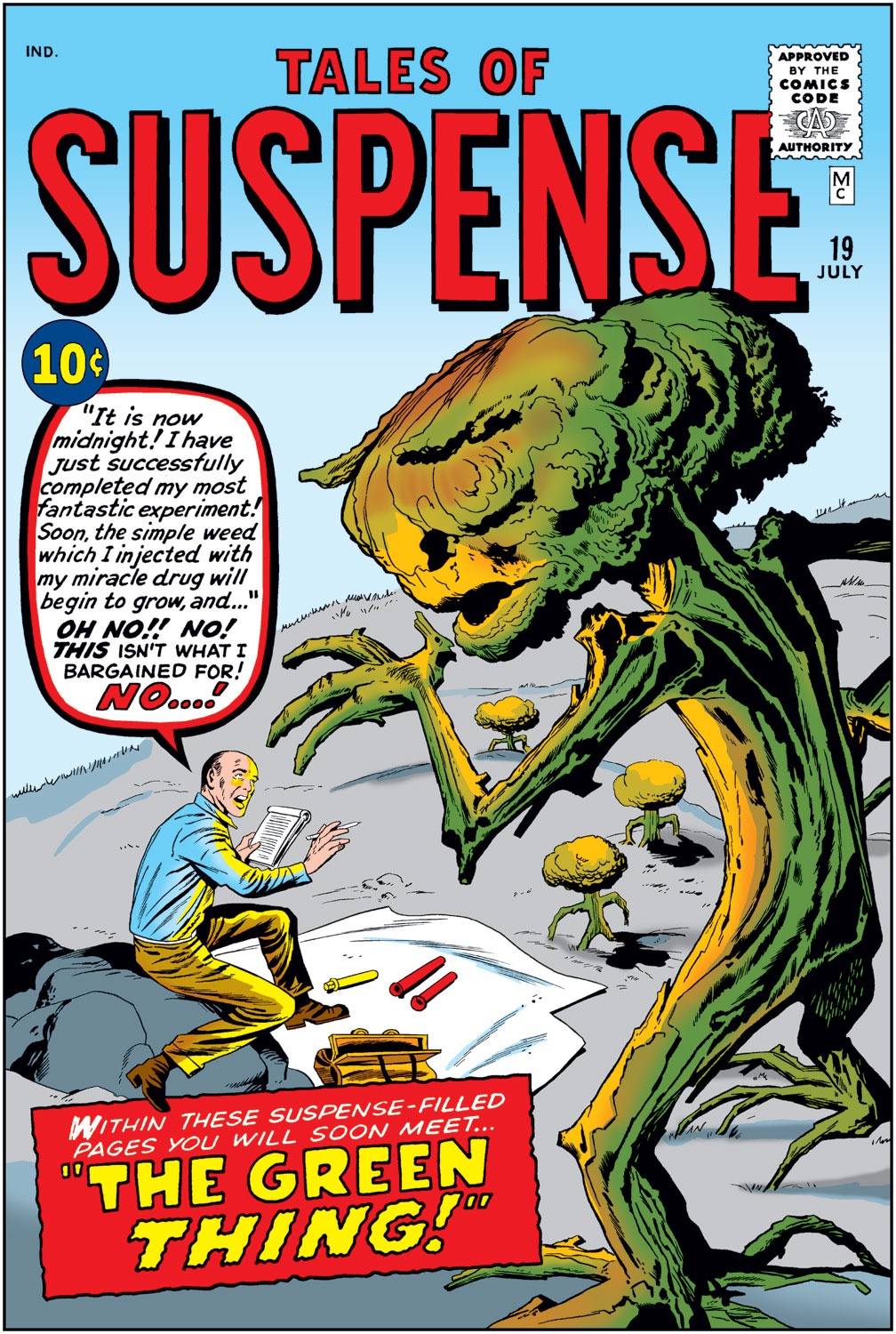
Where Monsters Dwell #14: The Green Thing!


"The Green Thing!," the Lee-Kirby SciFi monster story that John Severin provided the gorgeous cover for Where Monsters Dwell #14 (March 1972), first appeared in Tales of Suspense #19 (July 1961).

Given how publication dates run several months ahead of when the comic book actually appears on the rack, "The Green Thing!" arrived for public consumption approximately the same time as the Bay of Pigs fiasco.

Though Severin's Where Monsters Dwell cover is beautiful, accentuating as it does classic horror elements like a full moon rising, the Kirby original I believe is superior. It makes you feel the curve of the Earth or maybe even a lunar landscape and the monstrosity of science gone wrong with the Green Thing! towering over its hapless creator.


"The Green Thing!" is a Lee-Kirby reworking of Frankenstein, a proto-anti-GMO fable that is very timely for us today.

The story opens with a botanist at a swank dinner party who is startled when a house plant stirs in the breeze. Guests ask the scientist what is bothering him, and he spins his yarn:
"I believed that every living thing has intelligence! We all know that humans have it, and to a lesser degree animals have intelligence too! So, I theorized that plants also have intelligence although to a much lesser degree . . ."
If I could only develop serum that would increase a plant's intelligence . . .
. . . Increase it to the point where humans could recognize it, then I will have proved my theory!
The botanist develops his intelligence-boosting serum and sets out for a small island off Australia in search of "Ignatius rex! The highest known specimen of plant life!"

When the scientist is unable to locate I. rex he settles for injecting his serum into a normal weed. The weed grows exponentially, assuming an anthropomorphic form. Along with its human attributes -- sentience, speech, bipedal mobility, aggressiveness -- the roided out weed promptly hatches a plan for global domination. (It is, after all, the Cold War.)

What ensues are several pages of the beleaguered botanist fighting for his life. This allows Kirby to showcase his muscular draftsmanship, what would soon become the industry superhero standard in the 1960s. The reader even gets an underwater fight scene, a Lee-Kirby specialty.

When all appears lost the scientist stumbles on his last legs into a cave where lo and behold! he finds the smartest plant on the planet, Ignatius rex. He injects I. rex with the smart serum. Then Ignatius rex and the Green Thing! face off in a battle royal death match.

I. rex triumphs over the Green Thing!, sending the bumbling botanist on his way with these cautionary words:
Hear my words, human!! End you experiments! Never again inject us with your serum! We plants are far happier living in our own world, with the amount of intelligence we already have! It is nature's plan and it is for the best!
The botanist replies, "Yes, you are right! I shall never again tamper with the natural scheme of things!"
I also shall keep this a secret . . . for most civilization would not believe me anyway! And of those who did believe me, some might try to duplicate my serum and use it as I did! That would be too dangerous!"
Indeed.

Today, more than 50 years after "The Green Thing!" first appeared, the mad science of the story dominates global agriculture. Last month the World Health Organization classified glyphosate, the active ingredient in Monsanto's RoundUp herbicide, a probable human carcinogen. This is the first time such an august body like the WHO has come out against glyphosate. Glyphosate works in tandem with patented genetically modified seeds marketed by Monsanto. The seeds are herbicide resistant, allowing farmers to baste their fields in glyphosate to kill weeds.

We've visited this issue of cancers caused by glyphosate before when we looked at Where Monsters Dwell #28.

People are waking up to the fact that their food system is compromised and dangerous. While most have largely given up on the political system, completely corrupted as it is by big money, consumers feel some hope that by altering their diets they can improve their lot. I rode the train home the other evening with an overweight woman, a Metro bus driver, who had recently discovered that by buying organic and not eating fast food at lunch she felt much better. She told me that she recently had lost 11 pounds. The lady bus driver said something to the effect that "If people would just eat better they wouldn't have to be going to the doctor all the time."

Amen.

The most radical contributing writer the New York Times features on its opinion page is Mark Bittman (see "Stop Making Us Guinea Pigs"), the guy who writes about food politics and public health.

What Lee-Kirby knew back in 1961 -- not to tamper with the "natural scheme of things" -- an opinion that was undoubtedly noncontroversial and widely shared by their audience is upside down in today's "capitalism triumphant" world. In today's world the botanist would have rowed back to the mainland and immediately started efforts to sell his serum to the highest corporate bidder.

As Michael Friedman wrote recently in "GMOs: Capitalism’s Distortion of Biological Processes" (which can be found in this March's Monthly Review):
The development and deployment of GMOs is a response to production challenges facing capitalists. They are meant to address problems of unit cost, marketability, and production cycle velocity by engineering transgenic organisms that have rapid growth rates, physical attractiveness, novel nutrient combinations, and are pest or herbicide or drought or cold resistant. But, echoing our earlier allusion to the unintended consequences of genetic modification, ecologist David Ervin and colleagues caution us with regard to GM plants that:
The analogy of a plant as a production machine that can be ‘brute-force’ reengineered for more efficiency is suspect.Unanticipated and unintended results—both positive and negative—can emerge from such engineering because the plants are complex systems embedded in poorly understood, complex, and interacting ecosystems. 51
Biodiversity runs counter to the very nature of homogenized capitalist production. The dynamics of complex ecosystems are anathema for capitalist producers, who seek absolute control over the production process with the aim of eliminating complicating variables that increase costs of production and decrease marketability. For producers, GMOs would appear to introduce a new and much greater degree of control over such variables as pests or climatic variation, particularly given a static and deterministic view of nature. Yet, as we have seen, they entail a far greater degree of uncertainty in terms of consequences. Of course, the costs of those consequences can then be externalized.


Saturday, June 28, 2014

Some Thoughts on Pride Weekend


A few thoughts here on Pride weekend. My neighborhood is the historic center of the gay and lesbian community in the Emerald City. The parade used to go down Broadway but has been moved downtown in the last five years. We still host a block party the Saturday before the Sunday parade; that means thumping dance music all-day long.

The current wave of celebration for gay marriage is what the Democratic Party is choosing to hang its hat on: Not the economy, not the recent $15-hour minimum-wage victories in SeaTac and Seattle, but the dramatic, sweeping acceptance of gay rights. For example, here are the first lines of a fundraising appeal I received the other day from the state party:
“GOP Front-Runner Compares Gay Marriage to Polygamy.” It’s sad but it’s true. 
Pedro Celis, the GOP candidate running against Suzan DelBene for Congress in the 1st district, is rushing to the right to appeal to the Tea Party. And he’s not alone.
Democrats are hiding behind the skirt of gay marriage because they are adrift. Gay marriage is all well and good. As Nietzsche said, "The more tolerant a society, the greater it is." Or something like that. But for a party to trumpet its tepid leadership on gay rights in a fundraising letter is a mark of desperation. (Unless I'm wrong, the great breakthroughs on same-sex marriage came in the courts and from ballot initiatives in 2012.)

People want jobs and public spending on transportation, housing and health. And the Democrats have delivered little. But the Nobel Peace Prize president is promising to deliver spending on war.

Ben Hubbard has a small piece today, "Syria: Dispute Unsettles Rebel Coalition," about the putative recipients, the Free Syrian Army, of Obama's latest folly, his $500 million lethal-aid request to arm and train a "moderate" Syrian force to compete with the Saudi-sponsored Salafis in the ouster of the Baathist government in Syria:
As President Obama asks Congress for $500 million to help Syria’s rebels, the dysfunction and infighting that have long undermined their fight against the Syrian government spilled into the open again on Friday. The leader of the interim government established by the exile opposition, the Syrian National Coalition, said in a statement that he was firing the head of the Supreme Military Council of the Free Syrian Army and referring its members to a commission to investigate accusations of corruption. The military council responded that the interim government had made a “grave legal error” and did not have any power over it — a position that was supported by the leader of the Syrian National Coalition, Ahmad Assi al-Jarba. Despite being endorsed by the West as the leaders of the struggle against President Bashar al-Assad of Syria, none of the bodies involved in the dispute are currently playing a significant role in the civil war. The coalition is widely seen as ineffective, its interim government is little more than a list of names, and the military council has been overshadowed on the ground by rebel formations and extremist groups that have been more active.
The lightweight Saudi stooge Ahmad Assi al-Jarba had a photo op yesterday at the airport in Jidda with the Hogarthian John Kerry. Al-Jarba is being presented as an answer to ISIS in Iraq and Syria. Yes, I know. It is hard to believe.

A legitimate question to ask is, "Which body is more corrupt, the Syrian National Coalition or the U.S. Congress?" The answer will be the latter if Obama is granted his half a billion.

David Brooks had an interesting column yesterday, "The Spiritual Recession: Is America Losing Faith in Universal Democracy?"

Brooks riffs on a recent article by Mark Lilla, "The Truth About Our Libertarian Age: Why the dogma of democracy doesn't always make the world better," in the New Republic and asks why people no longer aspire to large social projects like global democracy or socialism.
. . . Lilla argues that we have slid into a debauched libertarianism. Nobody envisions the large sweep of events; we just go our own separate ways making individual choices.
He’s a bit right about that. When the U.S. was a weak nation, Americans dedicated themselves to proving to the world that democracy could last. When the U.S. became a superpower, Americans felt responsible for creating a global order that would nurture the spread of democracy. But now the nation is tired, distrustful, divided and withdrawing. Democratic vistas give way to laissez-faire fatalism: History has no shape. The dream of universal democracy seems naïve. National interest matters most. 
Lilla’s piece both describes and unfortunately exemplifies the current mood. He argues that the notion of history as a march toward universal democracy is a pipe dream. Arab nations are not going to be democratic anytime soon. The world is an aviary of different systems — autocracy, mercantile despotism — and always will be. Instead of worrying about spreading democracy, we’d be better off trying to make theocracies less beastly.

Such is life in a spiritual recession. Americans have lost faith in their own gospel. This loss of faith is ruinous from any practical standpoint. The faith bound diverse Americans, reducing polarization. The faith gave elites a sense of historic responsibility and helped them resist the money and corruption that always licked at the political system. 
Without the vibrant faith, there is no spiritual counterweight to rampant materialism. Without the faith, the left has grown strangely callous and withdrawing in the face of genocide around the world. The right adopts a zero-sum mentality about immigration and a pinched attitude about foreign affairs.
Brooks is a genius of keeping the obvious unstated. The unchallenged domination of predatory capitalism is the taproot of "rampant materialism." A Muslim says “There is no god but God and Muhammad is the Messenger of God.” What do we say here in the belly of the beast on Pride weekend? I'll tell you what we say: It is The Teaches of Peaches (2000).

"Fuck the Pain Away" is all we have to say. That is the rainbow-colored standard that we fly so high.

Sunday, May 4, 2014

“Capitalists Will Always Be Capitalists" + Neoliberalism and the Incarceration Bonanza + Gregg Shotwell

There was an interesting story yesterday, "Plying Social Media, Chinese Workers Grow Bolder in Exerting Clout," about a partially successful strike in a Taiwanese factory, Yue Yuen, in the Chinese city of Dongguan. Partially successful because:
While Yue Yuen agreed to reimburse pension contributions and increase a monthly living subsidy by $37, the outcome is something of a Pyrrhic victory for its workers. In order to claim the past benefits, employees must pay matching funds, which for many amounts to years of savings they do not have.
“Worker wages are barely enough to feed their families now,” said Wang Kongxia, 38, who has worked at Yue Yuen for 19 years. “A lot of people feel quite helpless.” 
Despite those misgivings, workers say, Chinese authorities and Yue Yuen used subterfuge to force employees back to the assembly lines. According to Ms. Wang, factory management removed the time clocks for four days this week, requiring employees to sign in every two hours or be fired. Supervisors were also asked to photograph each employee. “We didn’t do it,” she said. 
Yue Yuen did not respond to repeated phone calls requesting comment. 
Zhen Fanfei, 35, has gone back to making Adidas midsoles, but he doubts the company will be more respectful of workers’ demands without a major change in the government’s attitude. 
“Capitalists will always be capitalists,” he said.
Eduardo Porter had another good Business Page column this past Wednesday, "In the U.S., Punishment Comes Before the Crimes." The dawn of neoliberal age in the middle 1970s was also the beginning of the incarceration bonanza  in the United States. Prior to this, the U.S. and other industrialized nations had similar rates of incarceration:
Scholars don’t have a great handle on why crime fighting in the United States veered so decidedly toward mass incarceration. But the pivotal moment seems to have occurred four decades ago. 
In 1974, the criminologist Robert Martinson published “What Works? Questions and Answers About Prison Reform.” Efforts at rehabilitation, it concluded, were a waste of time. 
“With few and isolated exceptions, the rehabilitative efforts that have been reported so far have had no appreciable effect on recidivism,” he wrote. Standard rehabilitation strategies, he suggested, “cannot overcome, or even appreciably reduce, the powerful tendency for offenders to continue in criminal behavior.” 
Crime was rising in the 1960s and 1970s, alarming the public and increasing the risk to politicians of appearing “soft” on crime. 
The decline in manufacturing employment, once the backbone of many urban economies, wasn’t helping. Later, in the 1980s and ’90s, crack cocaine became a scourge of the nation’s inner cities. 
But as Steven Raphael of the University of California, Berkeley, and Michael A. Stoll of the University of California, Los Angeles, note in their book “Why Are So Many Americans in Prison?,” what drove up imprisonment rates was not crime but policy. 
If rehabilitation was out of reach, the thinking went, all that was left was to remove criminals from society and, through harsh sentencing, deter future crime. From 1975 through 2002, all 50 states adopted mandatory sentencing laws, specifying minimum sentences. Many also adopted “three strikes” laws to punish recidivists. Judges lost the power to offer shorter sentences. 
And the prison population surged. Four decades ago, the correctional population in the United States was not that dissimilar from the rest of the developed world. Less than 0.2 percent of the American population was in a correctional institution. By 2012, however, the share of Americans behind bars of one sort or another had more than tripled to 0.7 percent. 
Bruce Western of Harvard suggests a specific American motivation, which sprang to some degree from the victories of the civil rights movement. 
“The crime debate was racialized to an important degree,” Professor Western told me. “The anxieties white voters felt were not just about crime but about fundamental social changes going on in American society.”
Today, a little under half the state and federal prison population is black. The Bureau of Justice Statistics estimates that a black boy born in 2001 had a 32.2 percent chance of doing time behind bars. 
Growing inequality, too, appears to have played a role. As Devah Pager of Harvard told me: “There is something to the idea that the more distant the rich become to the poor, the easier it is to impose policies that are more punitive than others.” 
Professor Raphael is wary of linking incarceration with income dynamics. Still, he agrees the trends are suspiciously similar. “In the 1970s, something changes,” he told me. “The increasing concentration of income at the top follows the incarceration rate almost perfectly.”
And a final reference for your Sunday, be sure to check out Gregg Shotwell's absolutely essential "A Practical Solution to an Urgent Need," which appeared in last month's Monthly Review. American organized labor started buckling at the same time as the mass incarceration boom.

Chomsky has that line, "excess of democracy," from one of his books about a Trilateral Commission report on the social upheaval of the 1960s. The report's conclusion was that the world was suffering from an "excess of democracy."

Wednesday, February 27, 2013

The Austerity War

We're in the middle of a war. The war is between capital and labor. But what's strange about this war is that capital has lost faith in capitalism, at least the kind of modern capitalism of Keynesian economics as practiced in the twentieth century. How else to explain this lust for austerity, for steep cuts in government spending, while there is still high unemployment and low and slow growth? The only thing that makes sense is that the 1%, the plutocrats who control the Republican Party, no longer believe that capitalism can deliver high and persistent growth; so they're engaged in a smash and grab. The idea is to destroy the post-war Keynesian capitalist system as soon as possible and suck up all the resources; then hope that twenty-first-century technology can lock everything down in a way that was not possible for the robber barons of the nineteenth century.

Let's recall the last two years. First, we had the debt-ceiling crisis in the summer of 2011. Markets crashed, Standard and Poor's downgraded U.S. debt, and Obama signed off on huge government spending reductions while kicking the can of additional cuts down the road. Then in the fall of 2011 you had a big push back in the form of Occupy Wall Street which spread around the globe before sputtering out in the winter, giving way to the 2012 presidential campaign. Obama ran as a stalwart defender of post-war social democracy, and he won a historic election. He took that win into negotiations with the GOP on the fiscal cliff  and came away with a win; not a resounding victory, but a win. The 10% across-the-board reductions in federal spending that are a hold over from the summer 2011 debt-ceiling standoff got delayed until now. And that's where we are.

Binyamin Applebaum does a nice job in a frontpage story today of explaining how significant our current embrace of austerity is:
The federal government, the nation’s largest consumer and investor, is cutting back at a pace exceeded in the last half-century only by the military demobilizations after the Vietnam War and the cold war. 
And the turn toward austerity is set to accelerate on Friday if the mandatory federal spending cuts known as sequestration start to take effect as scheduled. Those cuts would join an earlier round of deficit reduction measures passed in 2011 and the wind-down of wars in Iraq and Afghanistan that already have reduced the federal government’s contribution to the nation’s gross domestic product by almost 7 percent in the last two years. 
The cuts may be felt more deeply because state and local governments — which expanded rapidly during earlier rounds of federal reductions in the 1970s and the 1990s, offsetting much of the impact — have also been cutting back. 
Federal, state and local governments now employ 500,000 fewer workers than they did on the eve of the recession in 2007, the longest and deepest decline in total government employment since the aftermath of World War II.
Yesterday in Senate hearings Bernanke had to defend the Federal Reserve's policy of quantitative easing against sniping from some Fed officials and Republicans. This from a story by Binyamin Applebaum that appears on the business page today:
Ian Shepherdson, chief economist at Pantheon Macroeconomic Advisors, wrote that the testimony amounted to a “robust defense” of the aggressive efforts by the Federal Open Market Committee that “gives no ground to those within and without the F.O.M.C. who think asset purchases will soon need to be curtailed.” 
The reception on Capitol Hill was frostier, as several Republican senators challenged Mr. Bernanke’s assertion that the purchases were producing clear economic benefits, and questioned the potential costs. Senator Bob Corker, a Tennessee Republican, drew Mr. Bernanke into an unusually sharp exchange. 
Mr. Corker, asserting that low interest rates were “throwing seniors under the bus,” by reducing returns on some kinds of investments, asked Mr. Bernanke, “Do you all ever talk about the longer-term degrading effect of these policies?” 
“One thing we talk about is unemployment,” Mr. Bernanke responded. He added that the best way to increase interest rates was to increase growth. 
Mr. Corker then accused Mr. Bernanke of insufficient concern about potential inflation, saying, “I don’t think there’s any question that you would be the biggest dove since World War II,” using the term “dove” to denote a Fed official who is more concerned about unemployment than higher inflation. 
Mr. Bernanke, clearly piqued, responded, “You call me a dove, but my inflation record is the best of any chairman in the postwar period.”
And for a flavor of the direction that we are headed in check out the postmortem on Italy's election by Liz Alderman and Jack Ewing:
Few experts anticipated the depth of anger displayed by Italian voters over the austerity that Mr. Monti, the technocrat beloved by other European leaders but resented at home for pushing tax increases and spending cuts, represented. The electorate chose two men convicted of crimes — Mr. Berlusconi and Mr. Grillo — over the one Italian leader in whom the rest of Europe had put great faith. 
Mr. Monti initially resisted Ms. Merkel’s harsh austerity prescription, warning that it would stifle growth. But he nonetheless pushed a number of measures that reflected the Merkelian view that prudent finances were the fastest way to reduce Italy’s staggering debt and restore its reputation with international investors. In the end, Ms. Merkel’s embrace played a big part in Mr. Monti’s undoing. 
“The fact that Merkel was so involved and interested in our elections — her support was very negative for Monti’s fate,” said Tito Boeri, an economist at Bocconi University. “There is no doubt that in the Italian campaigns and vote there was a clear message against Europe.” 
Since the euro zone crisis began in 2010, European voters have generally shown remarkable forbearance in the face of recession, soaring unemployment, tax increases and cutbacks in government services. Ireland, Spain, the Netherlands, Greece and, last week, Cyprus chose centrist governments that offered the best chance of staying in the euro zone. 
Italy may just be being Italy. But this latest vote may be a sign that Europeans are reaching the limit of their patience. Experts said the developments here served as a warning that a new round of economically driven political turmoil could confront the Spanish prime minister, Mariano Rajoy, and France’s president, François Hollande. Both have grudgingly adopted austerity to keep the euro crisis at bay, despite recessions and rising unemployment. 
Italy, for its part, is mired in a recession that so far has lasted a year and a half. The economy is expected to contract further before improving — largely, many Italians say, because of a host of tax increases and spending cuts that Mr. Monti put in place. 
And like other countries, Italy is finding that austerity is making it harder, rather than easier, to stoke the growth needed to reduce the mountain of debt that set off the euro zone’s crisis in the first place. Its gross debt is expected to peak above 128 percent of gross domestic product this year — the highest level in the euro zone after Greece, and up from 126 percent last year.
Either austerity goes or the euro zone starts to disintegrate. There is more electoral freedom in Europe's multi-party parliamentary system than we have here. Syriza is likely to win the next election in Greece. In the United States, Obama has to step up. If he does not, if he becomes Clintonian in his second term, we'll see a big push for a third party that will equal or surpass the Nader-LaDuke challenge of 2000.

Tuesday, February 26, 2013

Richard Wolff's Appearance on Public Broadcast

Naked capitalism has a post this morning about Richard Wolff's appearance on Bill Moyer's show last Friday. After watching the Moyers interview of Wolff online this past Saturday I too thought that we've crossed some sort of line. We are now talking openly -- because the facts at this point are overwhelming and irrefutable -- that capitalism is failing. We are naming the system, and along with it, its endemic corruption; its redistribution of wealth upwards to the 1%; its immiseration of working people. Capitalism used to get by on the argument that it did the best job of creating growth; that, yes, the wealthy do very well but so do working people. This argument can no longer be made, as the latest numbers from Berkeley economist Emmanuel Saez show. A rising tide now only lifts the boats of the 1%. The rest of us are paddling furiously to stay afloat.

Wednesday, January 23, 2013

Non-Capitalist Society Needed

Here's a good quote from Fred Magdoff's latest Monthly Review article, "Global Resource Depletion: Is Population the Problem?":
The comprehensive 2012 report, People and the Planet by the Royal Society of London, included as one of its main conclusions that there is a need “to develop socio-economic systems and institutions that are not dependent on continued material consumption growth” (bold in original). In other words, a non-capitalist society is needed.

Saturday, December 8, 2012

The Planetary Emergency

Reading "The Planetary Emergency" by John Bellamy Foster and Brett Clark in the current Monthly Review the consensus is that irreversible climate change sets in with a rise in temperature of 2 degrees C (3.6 degrees F), which corresponds to one trillion cumulative metric tons of carbon emissions.  We're going to hit the one trillion metric ton mark in 2043.  Three decades.

The answer?  We've got to stop growing.  But capitalism is based on growth, on constantly increasing consumption, on the American ideal of every Chinese family owning a car or two and eating meat three times a day.  So get ready to rumble.  Conflict is coming our way, either in the form of dealing with the catastrophic effects of climate change (imagine being a character in Cormac McCarthy's The Road) or in the many politically necessary battles required to radically change the status quo.  It's more than likely that we'll be dealing with both at the same time.

Thursday, November 29, 2012

Post-Familialism

A couple Thursdays back David Brooks had a column devoted to a significant demographic shift underway in developed countries. 

More people are living alone.  "The number of Americans who are living alone has shot up from 9 percent in 1950 to 28 percent today."  Brooks says "This is not a phenomenon particular to the United States.  In Scandinavia, 40 percent to 45 percent of people live alone."

The bachelor and the bachelorette are a burgeoning demographic, what Brooks calls post-familialism, after a research report -- "The Rise of Post-Familialism: Humanity's Future?" -- prepared by Joel Kotkin.

Brooks asks "Why is this happening?  The report offers many explanations.  People are less religious.  People in many parts of the world are more pessimistic and feeling greater economic stress.  Global capitalism also seems to be playing a role, especially, it seems, in Asia."

So there you have it.  The system has been named, capitalism, although with two "seems" in the same sentence.

But for the rest of the column Brooks does what a crafty, formidable rhetorician toiling in defense of concentrated wealth does -- he turns the discussion away from the political economy to a manichean morality tale.

According to Brooks it is the self-indulgent, petulant urban single, the one who voted for Obama, who is spurring this collapse of the two-parent family.  If she would just buck up and take on a little responsibility and get married and make a baby then all would be well and good and the nation would be stronger.

As a bachelor with a string of wrecked relationships behind me I see the rise of post-familialism as a rational response to the increasing stresses accompanying whatever stage capitalism (finance monopoly) we are now living under.

For what it is worth, Brooks' columns of the last couple of years have been interesting.  Since the Republican Party has become overtly Birchite he has had to rely more on indirection, sleight of hand, to support his conservative worldview, and he has done this by writing about recent social science research.