Showing posts with label Stan Lee. Show all posts
Sunday, November 1, 2015
Captain America: White #2
Captain American: White, like Hulk: Gray, Spider-Man: Blue and Daredevil: Yellow, is a limited-run series by the dynamic duo of writer Jeph Loeb and artist Tim Sale that attempts to define the mythological essence of the character.
In the case of Captain America, Loeb defines the superhero mythos as loss, the loss of his World War Two sidekick Bucky in a fatal encounter with a drone. Bucky's death is also the event that leads to Cap's two decades of suspended animation. The drone explodes, killing Bucky and blowing Captain America into the icy waters of the North Atlantic and eventually into a block of ice worshiped by the Inuit.
All of this is from the Stan Lee/Jack Kirby Avengers #4 reintroduction of the character in the 1960s. None of it was actually from the WWII era when then Marvel precursor Timely Comics mothballed Captain America in 1949 due to a shift in popular appetites to true-crime and horror fare.
It is interesting that Lee and Kirby brought Cap back soon after the Kennedy assassination and just prior to a massive U.S. ramp up in its commitment to war in Vietnam; and that the reborn Captain America should be so heavily freighted with loss and alienation -- the loss of his boy partner and his own era. Captain America is "a walking anachronism," a man out of time in an age of protest and lost credibility.
What really shines through in the Loeb-Sale retelling of Captain America is the psychological dimension of lost childhood. It is downright Jungian. Captain America is constantly flagellating himself for not living up to his inner child, Bucky, who repeatedly put his life on the line for Cap during their WWII exploits.
This made me realize that what superhero comic books are all about is juveniles letting go of their childhood and acclimating to the ways of the adult world, which, as Freud says, is all about accepting loss.
But what makes Captain America particularly potent as a myth is the idea that man creates himself (autogenesis) and therefore man can heal himself. It has something to do with his relationship to his inner child. Most men end up going to women to maintain the inner child, and to my mind that is a Faustian bargain (Nietzsche's line about, "When you go to woman be sure to bring a whip"). But man need not go to woman to maintain the child. The child is there for the man, and the man the child. The relationship oscillates. That is the beauty of it, and its potent dynamism. You just have to think about it and not run to the nearest woman for coddling.
All of this is on wondrous display in Captain America: White #2. Below are ten scans. Captain America, Bucky and the Howling Commandos are headed for Nazi-occupied France on a secret mission when their transport plane is shot down and crashes into the sea. Bucky saves Cap but is unable to retrieve his iconic shield. The last page has Cap consoling Bucky in loving embrace, what every man must learn to do for himself if he is truly to stand alone and be a "tough guy" and independent.
Saturday, October 17, 2015
Fury: S.H.I.E.L.D. 50th Anniversary #1
A very troubling sign greets us with the roll out of the many issues commemorating the 50th anniversary of S.H.I.E.L.D., Marvel's fictional representation of the overarching, suffocating U.S. national security state military industrial complex.
First off, as mentioned in a recent post devoted to Fantastic Four #600, I find it bizarre how little fuss Marvel made of the golden anniversaries of its seminal, industry-defining characters -- Spider-Man, Thor, Fantastic Four. I made sense of this bizarreness by explaining it as a marketing decision. Marvel's characters now principally toil for the profit of Walt Disney Studios. Seating movie-going youth in front of the big cinema screen is not achieved by accentuating the rich heritage of your fictional property.
But the opulent celebration of S.H.I.E.L.D.'s fiftieth cuts against this grain. Why? S.H.I.E.L.D. back in the day -- meaning, back in the Silver and Bronze Age of comic books when Marvel replaced D.C. as king of the hill -- was never more than background noise, set dressing, Stan Lee's fictive recasting of the Cold War, CIA vs. KGB, as S.H.I.E.L.D. vs. Hydra; it provided a platform on which the superheroes could perform their derring-do. But S.H.I.E.L.D. and its agent Nick Fury, outside of an influential -- influential among industry aficionados -- 20-issue run by graphic pioneer Jim Steranko in the 1960s, was never front and center. So why now?
My suspicion is base commercialism. Disney wants to emphasize characters that can be easily and lucratively translated into television and film. S.H.I.E.L.D. is the anchor.
This bodes ill for the creative potential of Marvel going forward. I think the recent iteration of Secret Wars, Marvel's latest crossover reboot, was a confusing dud. And having recently watched Avengers: Age of Ultron (2015), I can say the same thing about it. It was horrible. I had to struggle to sit through it.
But the heavy promotion of S.H.I.E.L.D.'s fiftieth also has a political component as the presidential election years approaches. The message is don't fret about our old buddy the intrusive national security state; see, he has been with us for a half century, and that whole time he has been keeping us safe from hatred and Hydra.
An example of this noxious message is on full display in Fury: S.H.I.E.L.D. 50th Anniversary #1, written by David Walker with art by Scott Hepburn. Here the black son of Fury, the present Nick Fury, travels back in time to Watts during the rebellion of the summer of 1965 where he encounters his father, the original Nick Fury, who, hagiographically, is actively sympathizing with blacks and trying to keep the Los Angeles Police from overindulging in a murderous rampage.
For the sake of verisimilitude, representatives of the national security state would be actively engaged in the "turkey shoot" alongside L.A.'s Finest, not trying to tamp it down. Proof of this is the political tsunami that Watts, along with Berkeley's Free Speech Movement, brought about -- white backlash. It elected Reagan in a landslide over Pat Brown, probably the greatest liberal governor in the history of the United States.
Absurdly the story concludes with Nick Fury rescuing the tot Obama from assassination by a time-displaced Hate-Monger. But Obama has transformed nothing about our system of predatory capitalism, war-mongery and institutional racism. So the contemplation of his possible death at an early age really represents nothing in terms of a meaning counterfactual.
Below you will find eight scans from Fury: S.H.I.E.L.D. 50th Anniversary #1.
Sunday, April 5, 2015
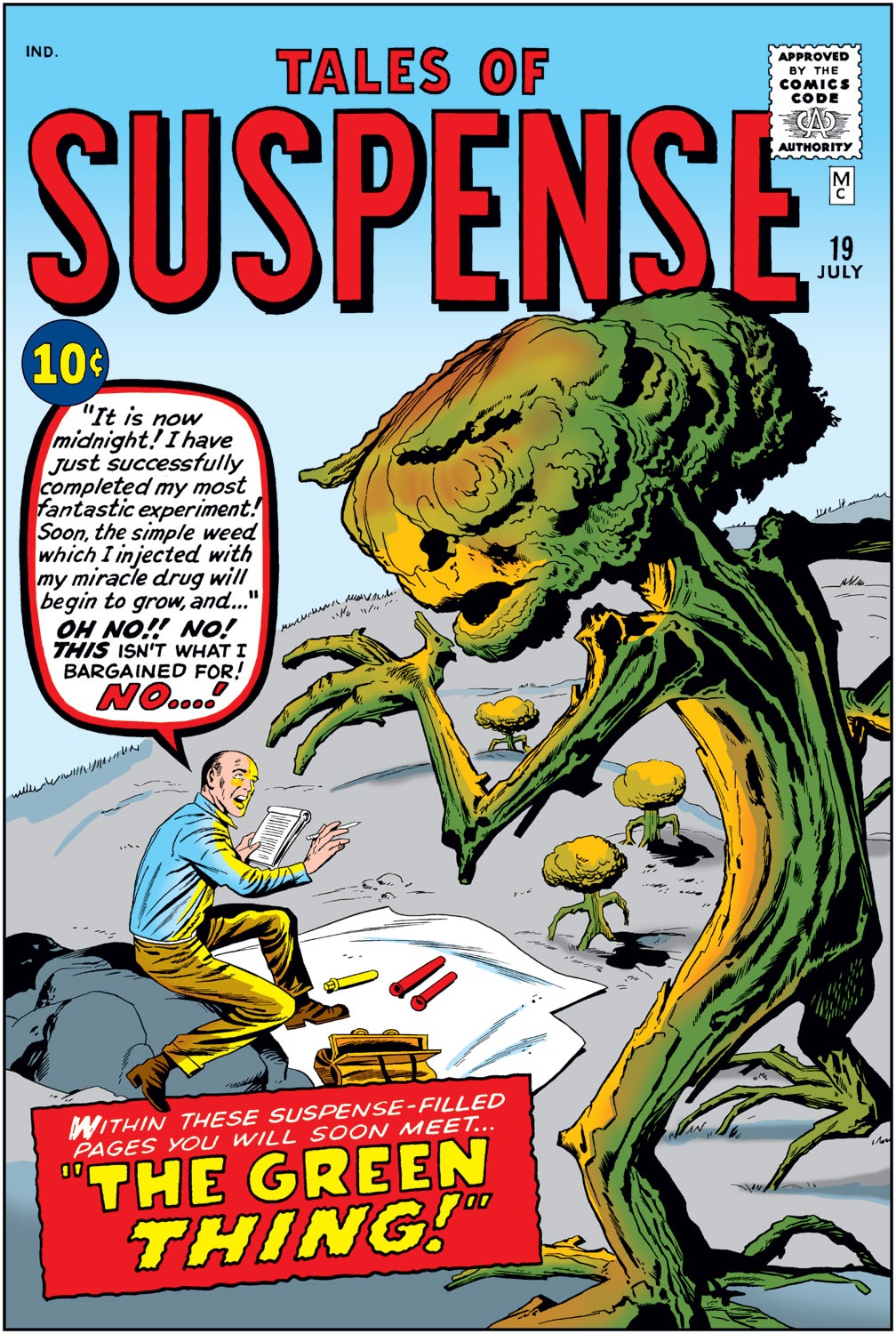
Where Monsters Dwell #14: The Green Thing!
"The Green Thing!," the Lee-Kirby SciFi monster story that John Severin provided the gorgeous cover for Where Monsters Dwell #14 (March 1972), first appeared in Tales of Suspense #19 (July 1961).
Given how publication dates run several months ahead of when the comic book actually appears on the rack, "The Green Thing!" arrived for public consumption approximately the same time as the Bay of Pigs fiasco.
Though Severin's Where Monsters Dwell cover is beautiful, accentuating as it does classic horror elements like a full moon rising, the Kirby original I believe is superior. It makes you feel the curve of the Earth or maybe even a lunar landscape and the monstrosity of science gone wrong with the Green Thing! towering over its hapless creator.
"The Green Thing!" is a Lee-Kirby reworking of Frankenstein, a proto-anti-GMO fable that is very timely for us today.
The story opens with a botanist at a swank dinner party who is startled when a house plant stirs in the breeze. Guests ask the scientist what is bothering him, and he spins his yarn:
"I believed that every living thing has intelligence! We all know that humans have it, and to a lesser degree animals have intelligence too! So, I theorized that plants also have intelligence although to a much lesser degree . . ."
If I could only develop serum that would increase a plant's intelligence . . .
. . . Increase it to the point where humans could recognize it, then I will have proved my theory!The botanist develops his intelligence-boosting serum and sets out for a small island off Australia in search of "Ignatius rex! The highest known specimen of plant life!"
When the scientist is unable to locate I. rex he settles for injecting his serum into a normal weed. The weed grows exponentially, assuming an anthropomorphic form. Along with its human attributes -- sentience, speech, bipedal mobility, aggressiveness -- the roided out weed promptly hatches a plan for global domination. (It is, after all, the Cold War.)
What ensues are several pages of the beleaguered botanist fighting for his life. This allows Kirby to showcase his muscular draftsmanship, what would soon become the industry superhero standard in the 1960s. The reader even gets an underwater fight scene, a Lee-Kirby specialty.
When all appears lost the scientist stumbles on his last legs into a cave where lo and behold! he finds the smartest plant on the planet, Ignatius rex. He injects I. rex with the smart serum. Then Ignatius rex and the Green Thing! face off in a battle royal death match.
I. rex triumphs over the Green Thing!, sending the bumbling botanist on his way with these cautionary words:
Hear my words, human!! End you experiments! Never again inject us with your serum! We plants are far happier living in our own world, with the amount of intelligence we already have! It is nature's plan and it is for the best!The botanist replies, "Yes, you are right! I shall never again tamper with the natural scheme of things!"
I also shall keep this a secret . . . for most civilization would not believe me anyway! And of those who did believe me, some might try to duplicate my serum and use it as I did! That would be too dangerous!"Indeed.
Today, more than 50 years after "The Green Thing!" first appeared, the mad science of the story dominates global agriculture. Last month the World Health Organization classified glyphosate, the active ingredient in Monsanto's RoundUp herbicide, a probable human carcinogen. This is the first time such an august body like the WHO has come out against glyphosate. Glyphosate works in tandem with patented genetically modified seeds marketed by Monsanto. The seeds are herbicide resistant, allowing farmers to baste their fields in glyphosate to kill weeds.
We've visited this issue of cancers caused by glyphosate before when we looked at Where Monsters Dwell #28.
People are waking up to the fact that their food system is compromised and dangerous. While most have largely given up on the political system, completely corrupted as it is by big money, consumers feel some hope that by altering their diets they can improve their lot. I rode the train home the other evening with an overweight woman, a Metro bus driver, who had recently discovered that by buying organic and not eating fast food at lunch she felt much better. She told me that she recently had lost 11 pounds. The lady bus driver said something to the effect that "If people would just eat better they wouldn't have to be going to the doctor all the time."
Amen.
The most radical contributing writer the New York Times features on its opinion page is Mark Bittman (see "Stop Making Us Guinea Pigs"), the guy who writes about food politics and public health.
What Lee-Kirby knew back in 1961 -- not to tamper with the "natural scheme of things" -- an opinion that was undoubtedly noncontroversial and widely shared by their audience is upside down in today's "capitalism triumphant" world. In today's world the botanist would have rowed back to the mainland and immediately started efforts to sell his serum to the highest corporate bidder.
As Michael Friedman wrote recently in "GMOs: Capitalism’s Distortion of Biological Processes" (which can be found in this March's Monthly Review):
The development and deployment of GMOs is a response to production challenges facing capitalists. They are meant to address problems of unit cost, marketability, and production cycle velocity by engineering transgenic organisms that have rapid growth rates, physical attractiveness, novel nutrient combinations, and are pest or herbicide or drought or cold resistant. But, echoing our earlier allusion to the unintended consequences of genetic modification, ecologist David Ervin and colleagues caution us with regard to GM plants that:
The analogy of a plant as a production machine that can be ‘brute-force’ reengineered for more efficiency is suspect….Unanticipated and unintended results—both positive and negative—can emerge from such engineering because the plants are complex systems embedded in poorly understood, complex, and interacting ecosystems. 51
Biodiversity runs counter to the very nature of homogenized capitalist production. The dynamics of complex ecosystems are anathema for capitalist producers, who seek absolute control over the production process with the aim of eliminating complicating variables that increase costs of production and decrease marketability. For producers, GMOs would appear to introduce a new and much greater degree of control over such variables as pests or climatic variation, particularly given a static and deterministic view of nature. Yet, as we have seen, they entail a far greater degree of uncertainty in terms of consequences. Of course, the costs of those consequences can then be externalized.
Labels:
Bay of Pigs,
capitalism,
glyphosate,
GMO,
Jack Kirby,
John Severin,
Marvel Comics,
Michael Friedman,
Monsanto,
Monthly Review,
RoundUp,
Stan Lee,
Tales of Suspense #19,
Where Monsters Dwell #14,
WHO
Saturday, March 7, 2015
Where Monsters Dwell #15: Kraa -- the Unhuman!
Where Monsters Dwell #15, with a publication date of May 1972 and original cover art by John Severin, features a reprint of the Tales of Suspense #18 (June 1961) cover story, "Kraa the Unhuman!"
A Lee-Kirby monster tale in the classic Silver Age mode -- meaning, the Cold War is either overtly or covertly a central part of the narrative, as it is in "Fin Fang Foom!" and Fin Fang Foom prototype Grogg! -- "Kraa the Unhuman!" is another example of Lee-Kirby doing a walk-through in a monster story of a blockbuster superhero title soon to come; in this case, The Incredible Hulk #1 of May 1962.
"Kraa the Unhuman!" is a poor African guy who falls into a hunter's pit trap right before an invading army from the East (a.k.a., the Soviet Union) sets off a nuclear test explosion; he is transformed into a suffering behemoth who the benighted natives worship as a god.
The other protagonist in "Kraa the Unhuman" is a meek teacher who is held in low esteem by his students. One day he decides to transform his life and travel to Africa to learn the meaning behind the Wabuzi tribe's worship of a strange idol. The teacher lectures his class that
Much of Africa is strange and mysterious! Even in this, the twentieth century, we understand little of its tribal customs and superstitions!
For instance, one of the most primitive tribes -- the Wabuzi -- has started fashioning many statues like this one! We don't know what this strange, grotesque figure represents, but I personally feel it is something sinister! Something evil!
Once in the jungle, the teacher makes contact with Kraa. Kraa says he will kill him. The teacher asks Kraa to tell him his story before Kraa takes his life. This is when we learn about the secret nuclear tests of the Red Army and Kraa's transformation into a brute.
The teacher realizes that Kraa is suffering from radiation sickness and is in great pain. He offers to apply some soothing ointment to Kraa's burning skin, and in performing this act of kindness he wins Kraa's trust.
Kraa ends up sacrificing his life to protect the teacher from a giant luridly colored python. The Wabuzis hail the teacher as a conquering god, replacing Kraa's image with the teacher's as their new idol.
Teacher returns home a new man; his dismissive students, dumbfounded:
So ends my tale! Since that time, my pupils have had new respect for me . . . and, what is more, I have had new respect for myself! But I owe it all to a strange, lifeless figure who shall remain unknown until the world is ready to understand! The figure of . . . Kraa, the Unhuman!Stan Lee has managed a tidy little fantasy of white supremacy here.
At the time Tales of Suspense #18 originally appeared, the Freedom Rides of 1961 were just getting underway. The view of Africans as superstitious, ignorant -- un-human, really -- that is expressed in "Kraa the Unhuman!" was no doubt a broadly held belief in the United States, one that extended to include African-American citizens. Stan Lee always framed his narratives firmly in the language of conventional wisdom.
The fact that Kraa is a sympathetic character though -- not evil, not sinister (that role is played by the Commies and their nuclear test); in fact, Kraa sacrifices his life for the white man -- points the way to the political victories of the civil rights movement that were fast approaching.
The last four scans are from a story -- "Dead Ringer!" -- that concludes Where Monsters Dwell #15. The art is by Rich Buckler, channeling Jim Steranko, in one of his first assignments for Marvel.
Subscribe to:
Posts (Atom)