
"The Green Thing!," the Lee-Kirby SciFi monster story that John Severin provided the gorgeous cover for Where Monsters Dwell #14 (March 1972), first appeared in Tales of Suspense #19 (July 1961).
Given how publication dates run several months ahead of when the comic book actually appears on the rack, "The Green Thing!" arrived for public consumption approximately the same time as the Bay of Pigs fiasco.
Though Severin's Where Monsters Dwell cover is beautiful, accentuating as it does classic horror elements like a full moon rising, the Kirby original I believe is superior. It makes you feel the curve of the Earth or maybe even a lunar landscape and the monstrosity of science gone wrong with the Green Thing! towering over its hapless creator.
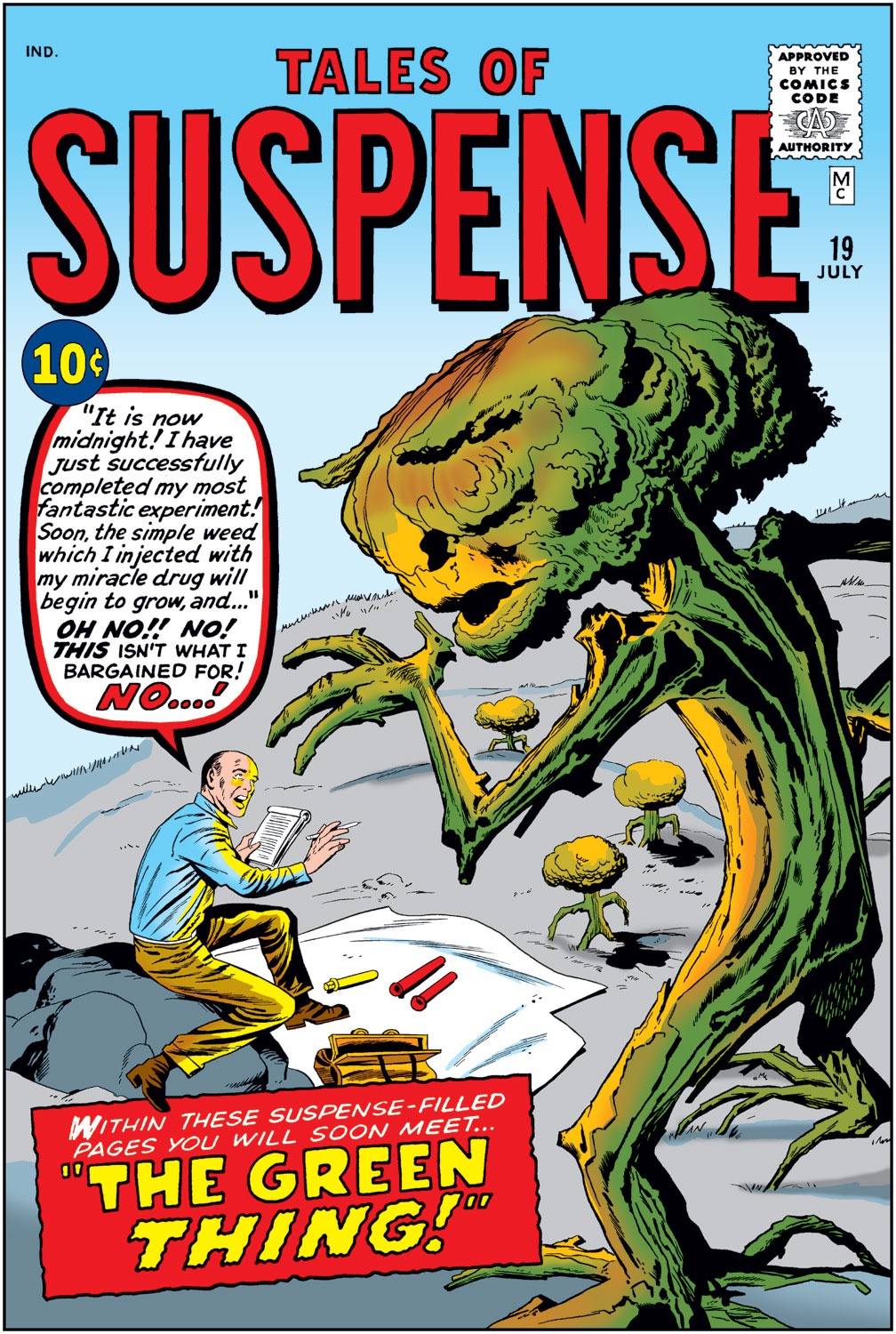
"The Green Thing!" is a Lee-Kirby reworking of Frankenstein, a proto-anti-GMO fable that is very timely for us today.
The story opens with a botanist at a swank dinner party who is startled when a house plant stirs in the breeze. Guests ask the scientist what is bothering him, and he spins his yarn:
"I believed that every living thing has intelligence! We all know that humans have it, and to a lesser degree animals have intelligence too! So, I theorized that plants also have intelligence although to a much lesser degree . . ."
If I could only develop serum that would increase a plant's intelligence . . .
. . . Increase it to the point where humans could recognize it, then I will have proved my theory!The botanist develops his intelligence-boosting serum and sets out for a small island off Australia in search of "Ignatius rex! The highest known specimen of plant life!"
When the scientist is unable to locate I. rex he settles for injecting his serum into a normal weed. The weed grows exponentially, assuming an anthropomorphic form. Along with its human attributes -- sentience, speech, bipedal mobility, aggressiveness -- the roided out weed promptly hatches a plan for global domination. (It is, after all, the Cold War.)
What ensues are several pages of the beleaguered botanist fighting for his life. This allows Kirby to showcase his muscular draftsmanship, what would soon become the industry superhero standard in the 1960s. The reader even gets an underwater fight scene, a Lee-Kirby specialty.
When all appears lost the scientist stumbles on his last legs into a cave where lo and behold! he finds the smartest plant on the planet, Ignatius rex. He injects I. rex with the smart serum. Then Ignatius rex and the Green Thing! face off in a battle royal death match.
I. rex triumphs over the Green Thing!, sending the bumbling botanist on his way with these cautionary words:
Hear my words, human!! End you experiments! Never again inject us with your serum! We plants are far happier living in our own world, with the amount of intelligence we already have! It is nature's plan and it is for the best!The botanist replies, "Yes, you are right! I shall never again tamper with the natural scheme of things!"
I also shall keep this a secret . . . for most civilization would not believe me anyway! And of those who did believe me, some might try to duplicate my serum and use it as I did! That would be too dangerous!"Indeed.
Today, more than 50 years after "The Green Thing!" first appeared, the mad science of the story dominates global agriculture. Last month the World Health Organization classified glyphosate, the active ingredient in Monsanto's RoundUp herbicide, a probable human carcinogen. This is the first time such an august body like the WHO has come out against glyphosate. Glyphosate works in tandem with patented genetically modified seeds marketed by Monsanto. The seeds are herbicide resistant, allowing farmers to baste their fields in glyphosate to kill weeds.
We've visited this issue of cancers caused by glyphosate before when we looked at Where Monsters Dwell #28.
People are waking up to the fact that their food system is compromised and dangerous. While most have largely given up on the political system, completely corrupted as it is by big money, consumers feel some hope that by altering their diets they can improve their lot. I rode the train home the other evening with an overweight woman, a Metro bus driver, who had recently discovered that by buying organic and not eating fast food at lunch she felt much better. She told me that she recently had lost 11 pounds. The lady bus driver said something to the effect that "If people would just eat better they wouldn't have to be going to the doctor all the time."
Amen.
The most radical contributing writer the New York Times features on its opinion page is Mark Bittman (see "Stop Making Us Guinea Pigs"), the guy who writes about food politics and public health.
What Lee-Kirby knew back in 1961 -- not to tamper with the "natural scheme of things" -- an opinion that was undoubtedly noncontroversial and widely shared by their audience is upside down in today's "capitalism triumphant" world. In today's world the botanist would have rowed back to the mainland and immediately started efforts to sell his serum to the highest corporate bidder.
As Michael Friedman wrote recently in "GMOs: Capitalism’s Distortion of Biological Processes" (which can be found in this March's Monthly Review):
The development and deployment of GMOs is a response to production challenges facing capitalists. They are meant to address problems of unit cost, marketability, and production cycle velocity by engineering transgenic organisms that have rapid growth rates, physical attractiveness, novel nutrient combinations, and are pest or herbicide or drought or cold resistant. But, echoing our earlier allusion to the unintended consequences of genetic modification, ecologist David Ervin and colleagues caution us with regard to GM plants that:
The analogy of a plant as a production machine that can be ‘brute-force’ reengineered for more efficiency is suspect….Unanticipated and unintended results—both positive and negative—can emerge from such engineering because the plants are complex systems embedded in poorly understood, complex, and interacting ecosystems. 51
Biodiversity runs counter to the very nature of homogenized capitalist production. The dynamics of complex ecosystems are anathema for capitalist producers, who seek absolute control over the production process with the aim of eliminating complicating variables that increase costs of production and decrease marketability. For producers, GMOs would appear to introduce a new and much greater degree of control over such variables as pests or climatic variation, particularly given a static and deterministic view of nature. Yet, as we have seen, they entail a far greater degree of uncertainty in terms of consequences. Of course, the costs of those consequences can then be externalized.


