Showing posts with label Daredevil. Show all posts

Saturday, November 22, 2014

Captain America #24 + Captain America #25

Wednesday evening is a big night out for me. I go to a taqueria off Pine Street and get a takeout bean burrito. I visit for a bit with the young Mexican guy who runs the taco shop; he is friendly without being obsequious and extremely efficient; a solid citizen who enriches the community where I live. Another warm acquaintance of mine is also an immigrant from Mexico. My Latina friend with whom I ride the bus in SeaTac and who cleans rooms at the airport motel next to the building where I work is a paragon of decency; she works six days a week and never fails to be warm and polite.

I consider these two people -- immigrants, I'm not sure of their legal status -- the finest individuals I come in contact with in public. To make political hay by stirring up hard-shell nativism and bigotry is not only suicidal, given the obvious demographic trends, but it is morally wrong as well. Mexicans are just as American as Captain America if you ask me.

From the taqueria I walk north on Broadway past the community college. A few blocks after the college I arrive at the neighborhood comic shop where I pick up the week's new releases.

As I enter, the proprietor greets me by name. This week he suggests that I read the latest Daredevil issue.

A big, bearded, barrel-chested guy with a earring and a puka-shell necklace wearing a yellow t-shirt (I'm wrapped in several layers; it's cold) standing in front of the wall where the new releases are displayed chirps, "I can't stand Mark Waid."

Mark Waid writes Daredevil.

"It's always the same precious, 'Oh, look at me! Aren't I witty?' crap," says Big Yellow.

Big Yellow then proceeds to recapitulate the history of the Daredevil title the last five years. I engage in dialogue with him; tell him I wasn't a big fan of Shadowland. Then I shift gears, pointing to the cover of the comic book he holds in his hands. "There's the guy I like."

The name on the cover I was pointing to was Remender. The comic Big Yellow was holding? All-New Captain America #1.

"I'm excited that Sam Wilson is finally getting his due," says Big Yellow.

"What I could never figure out is how Sam Wilson could go from being an island kid to a Harlem badass," I say, proceeding to confuse Big Yellow by imparting to him my own confusion.

I remember reading the Stan Lee-Gene Colan Falcon origin, Captain America #117, as a kid. Falcon is Sam Wilson's superhero alter ego. Sam Wilson is a fresh-faced youth with a trained hawk, Red Wing, on a tropical island (I thought it was Trinidad and Tobago; turns out it was an island off Haiti) who comes to the assistance of Red Skull. The Red Skull is getting shit-kicked by a bunch of Nazis. Turns out the Red Skull is actually Steve Rogers, a.k.a., Captain America. The real Red Skull, using the Cosmic Cube, has traded identities with Captain America. So while the Red Skull is parading around Manhattan sucking up adulation as the star-spangled Avenger, Captain America is fighting for his life against a group of war criminals that the Red Skull double-crossed one time too many.

Confusing.

Anyway, it turns out I was confused. Sam Wilson is not an islander but a Harlem native who answered a newspaper ad soliciting workers to come to the tropics. Steve Rogers/Red Skull trains Sam up to superhero status, gets him a costume and an alter ego, the Falcon -- and away they go.

In Captain American and the Falcon #144, Sam Wilson loses his pretty green outfit and gets the red-and-white costume (not unlike the Atlanta Falcons white jersey) and the gold nose-guard that we have come to associate with the character. A year or two later, during the Watergate era, is when I became a regular reader of Captain America and the Falcon. By this time Sal Buscema had taken over the penciling duties and Steve Englehart was the writer. Sam Wilson was no longer the ingenue sidekick; he was one tough brother, pure Black Power muscle. These comic books are a treasure trove of early '70s Americana.

Anyway, Big Yellow just stared back at me as if I were unhinged, babbling as I was about Sam Wilson's origins.

The scans you will find below are from the final two issues of the Captain America devoted to the Dimension Z storyline. The Iron Nail, the loser in a fight to the death with Captain America, managed to strip the Super-Soldier serum from Cap's DNA, leaving Steve Rogers a frail old man.

As the Avengers battle Arnim Zola's Dimension Z hoards in downtown Manhattan, the Falcon flies a ticking super-bomb to the stratosphere, sacrificing his life so the inhabitants of the megalopolis might live.

Remender is not afraid to embrace the hoariest, clunkiest conventions of the genre.

Fear not though, Sam Wilson is not dead. In the end, his Stark-designed vibranium wings shield him from the lethal blast. Only the Falcon character shuffles off, while Sam Wilson is reborn as the "All-New" Captain America.

Remender, whose writing is always to be read with an eye to the present political age, is making a statement here, I believe, about the failure of our first black president. Sam Wilson, the son of community organizers, Marvel's first African-American superhero, is taking his shot as leader of the Free World. Will he fail like Obama? Or will Remender, a true radical, render this black Captain America, albeit if only as a counterfactual, a triumph?


Saturday, October 25, 2014

Elektra #4

To pick up where we left off in yesterday's post, which was October 1982, I was walking home down Telegraph Avenue one sunny afternoon (it might have even been the same day that I sat near Ron Rivera and heard him sing "Should I Stay or Should I Go") when I stopped at 7/11 and perused the comic-book rack. The title I picked up was Daredevil by Frank Miller.

It sort of blew me away. I had stopped reading comic books in high school, a period of time which coincided with the controversial ascent of Jim Shooter as Editor-in-Chief at Marvel. To me Marvel comic books had become flat, shiny, corporate, reflecting the swing to the Right that was underway in the country as Reaganism locked in. (Briefly, during the summer between my junior and senior year in high school I collected Moon Knight. I was not drawn to the title because of its creative potency; rather, as a onetime avid reader of Werewolf By Night, I was intrigued that a villain from its pages would get his own comic book.)

What was stunning about the Daredevil that I held in my hands that sunny afternoon in a 7/11 on Telegraph was how alive and edgy and real it seemed to me, the complete opposite of the cereal box splashiness that had taken hold since the Bicentennial.

Finally, the woman manning the register ran me off by saying, "Excuse me. This is not a library."

One of the hallmarks of Frank Miller's historic run on Daredevil (#158, May 1979 to #191, February 1983) is the introduction of the character Elektra, a female ninja. Her death, hoisted on her own sai, at the hand's of Daredevil villain Bullseye is one of those key Marvel moments in the collective consciousness of its readership.

Since Elektra appeared after I had stopped reading comic books, I am not fully briefed on her backstory. She strikes me as a female version of The Punisher: a baleful, slightly unhinged assassin; or, a darker Black Widow, one without the security clearance or national security state credentials.

Last Saturday I finished the first five issues of the All-New Marvel NOW! Elektra. It was a real treat. The story by W. Haden Blackman of Elektra on the trail of super-assassin Cape Crow who happens to be hunted by a bevy of other super-assassins, one of whom is the psychopath serial killer cannibal Bloody Lips, is economical and compelling, like a classic Doc Savage pulp serial.

The art of Michael Del Mundo is a revelation, a comic book Gustav Klimt. To see what I mean, check out the scans below from Elektra #4. Elektra and Bloody Lips battle underwater while tripping out because unbeknownst to them a precog empath is fiddling with their minds:


Saturday, October 4, 2014

Black Widow #4

I hit a sweet spot last Saturday. There is one 5K that is my favorite. It takes place in a residential neighborhood at the the city's northern edge at the end of September. A guy who has some sort of association with the Catholic Church there organizes the foot race. I enjoy it so much because there aren't too many runners; there are enough so that there is plenty of good competition; everyone has enough room to maneuver and there is just the right amount of spacing that makes for optimal pacing.

I ended running a decent race. And while my time was not a personal best, or even what I would call a normal performance based on what I've done over the last several years, it was the first race I have run since I injured my foot in May where I felt like I was on my way back, that the finish line for my long convalesce is just around the bend.

The early fall weather was gorgeous and the light was perfect. I took my runner's high back to my studio apartment where I dug into Black Widow, part of All-New Marvel NOW! series of titles.

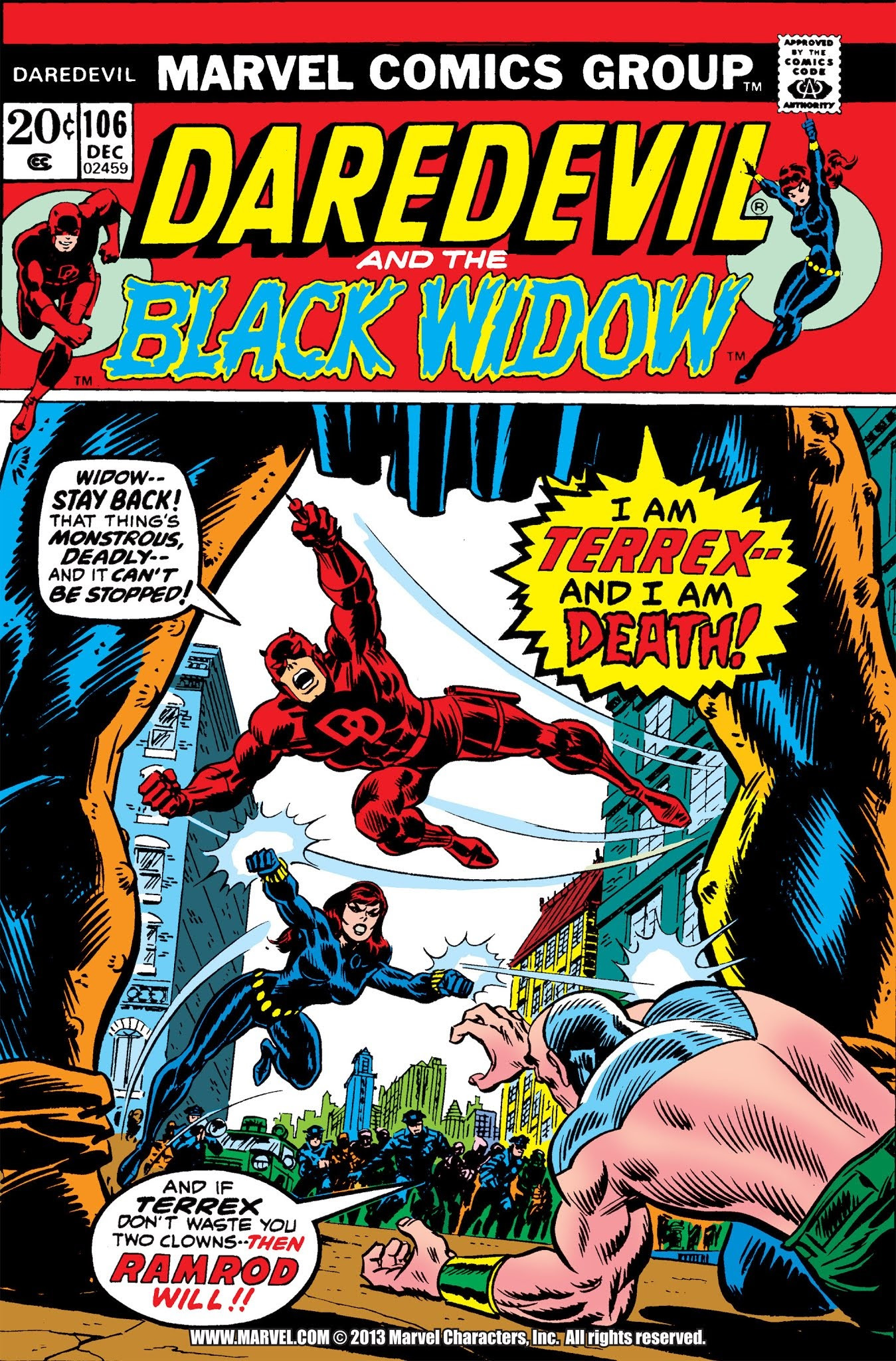
When I started reading comic books as an elementary-school kid, one of the first titles I followed was Daredevil. This was at a time, 1971 to 1975, when the blind costumed crime fighter was teamed with Natasha Romanova, the Black Widow. They lived together unmarried (though sleeping on separate floors of their apartment in order to satisfy the moral strictures of the weakened but still functioning Comics Code Authority) in the Hippie Mecca of swinging San Francisco.


The backstory is that Daredevil was going to being rolled into a comic book with another flagging Marvel superhero title, Iron Man, but Gerry Conway, who would also co-create The Punisher during the Watergate era of cultural ferment, had the idea instead to hook Matt Murdock up with Natasha Romanova and move them out of New York City to the West Coast capital of the counterculture. The idea worked and the title proved to be popular.

The Black Widow originally was a beautiful Russian spy, a run-of-the-mill mid-'60s "Bond Girl," when she appeared in the Iron Man title Tales of Suspense. 


Eventually she was clad in a costume (a fishnet leotard with a Cinderella ball mask) and teamed with former circus act Hawkeye to take on the Golden Avenger.


Then Black Widow defected, joined Nick Fury's S.H.I.E.L.D., and becomes part of the American war machine. In 1970 she assumes the look we have come to identify with the character, and the one she wears in her present title -- the long red hair and the black, form-fitting scuba-suit-like full-body unitard with a pan flute shooting out rappelling line wrapped around each wrist.


After the Inhumans proved to be more of a draw, Marvel drops Black Widow from Amazing Adventures; that is when the character begins her run in Daredevil.

As a kid I remember thinking that the Daredevil-Black Widow relationship seemed like the man-woman ideal, that which would be awaiting me when I reached adulthood: a romantic pairing of co-equals, each powerful and self-assured, assisting one another in doing good and making the world a better place.

Of course as each of us comes to find out in his or her own way, the exact opposite is usually the case. Adult couplings between the sexes are for the most part a toxic neurotic stew of co-dependency, a combat of the vicious and needy to see who can drag the other one down to the pit the quickest. Yet the duel turns out to be none too quick; it goes on for years, in some cases a lifetime. Really the war goes on forever, waged unconsciously, passed down from generation to generation in a plodding somnambulant trail of tears. The world is not made a better place. Anyhow, that's one bachelor's perspective.

What makes this latest run of Black Widow so enjoyable is that Nathan Edmondson tells a story of a woman who is singularly alone -- not paired up with Buck Barnes assuming the role of Captain American, or Daredevil, or Hawkeye. This Black Widow is a worker working jobs (assassinations, etc.) to earn money so that she might pay the families of the victims left in the wake of her prolifically violent career. Natasha Romanova keeps her distance from people as best she can. There are those she has to deal with to do the job. But her private life is kept as clear as possible of all human entanglements.

Edmondson describes the warrior's way, but I found, reclining on my mattress on the floor on a Saturday afternoon, that he was describing my life as well. Not that I leap from rooftop to rooftop to trade punches with super-powered madmen; but that I am a solitary individual who outside of work is keenly aware of the distance I keep from others; I am also like the comic-book Romanova woman in that I am constantly carrying on a conversation with myself as to the wisdom of this practice.

Below you will find seven scans, including cover page, from Black Widow #4. The art is by Phil Noto who I think does incredible work accentuating the sense of Black Widow's solitariness and isolation. There is a gauzy, spacious quality to the panels. It is like looking at a comic-book version of Antonioni's The Passenger (1975):


Saturday, August 3, 2013

Daredevil: Dark Nights #1

If you want to enjoy a fine example of the power of the comic-book medium check out Lee Weeks' Daredevil: Dark Nights #1. Good art creates a space where you're participating in whatever you're witnessing -- whether watching a play or looking at a painting -- but you're also someplace else, almost like another planet with light gravity, where your mind is able to roam free, moving light as a feather here and there wherever it wants to go. It's totally refreshing. And while you can access this space by reading a book, I think it's more difficult. Following the written line, finding what Jack London called the White Logic, requires a type of concentration that moves in the opposite direction of that "someplace else" space.

Below are five scans from the opening pages of Lee Weeks' Daredevil: Dark Nights #1, colors done beautifully by Lee Loughridge. There's something about Daredevil and Manhattan rooftop water tanks (scan #2) that captures an essential part of New York City that I haven't found accurately represented elsewhere:


Saturday, June 29, 2013

Daredevil: Reborn #3

Last Sunday I enjoyed the four-issue Daredevil: Reborn, which acts as a bridge between the Shadowland blowout and the current Daredevil (3rd Series). Andy Diggle is the writer. The story of Reborn is a Western. Matt Murdock is the honest but conflicted drifter who finds himself in a small New Mexico town ruled by corrupt, murdering, gun-running, dope-peddling law officers. The battle commences.

Below you'll find three scans from Daredevil: Reborn #3. The art of Davide Gianfelice is dynamite. The truck-versus-car chase sequence is better than any movie:


Saturday, June 1, 2013

Daredevil: End of Days #1

Below is a scan of the first page after the credits from Daredevil: End of Days #1. The great Klaus Janson provides the pencils; Bill Sinkiewicz, the inks. The story, which is a mystery featuring intrepid Daily Bugle reporter Ben Urich trying to make sense of Bullseye's broad daylight slaughter of the Man Without Fear, is written by Brian Michael Bendis and David W. Mack.


It's been an excellent series so far. I'm looking forward to the final issue, which is due out next week. The last Daredevil title I read was Shadowland, and it was a disappointment. I enjoyed Black Panther: The Man Without Fear. And I've been accumulating issues of Daredevil (3rd Series) but have yet to dive in.