Showing posts with label Michelangelo Antonioni. Show all posts

Saturday, October 4, 2014

Black Widow #4

I hit a sweet spot last Saturday. There is one 5K that is my favorite. It takes place in a residential neighborhood at the the city's northern edge at the end of September. A guy who has some sort of association with the Catholic Church there organizes the foot race. I enjoy it so much because there aren't too many runners; there are enough so that there is plenty of good competition; everyone has enough room to maneuver and there is just the right amount of spacing that makes for optimal pacing.

I ended running a decent race. And while my time was not a personal best, or even what I would call a normal performance based on what I've done over the last several years, it was the first race I have run since I injured my foot in May where I felt like I was on my way back, that the finish line for my long convalesce is just around the bend.

The early fall weather was gorgeous and the light was perfect. I took my runner's high back to my studio apartment where I dug into Black Widow, part of All-New Marvel NOW! series of titles.

When I started reading comic books as an elementary-school kid, one of the first titles I followed was Daredevil. This was at a time, 1971 to 1975, when the blind costumed crime fighter was teamed with Natasha Romanova, the Black Widow. They lived together unmarried (though sleeping on separate floors of their apartment in order to satisfy the moral strictures of the weakened but still functioning Comics Code Authority) in the Hippie Mecca of swinging San Francisco.
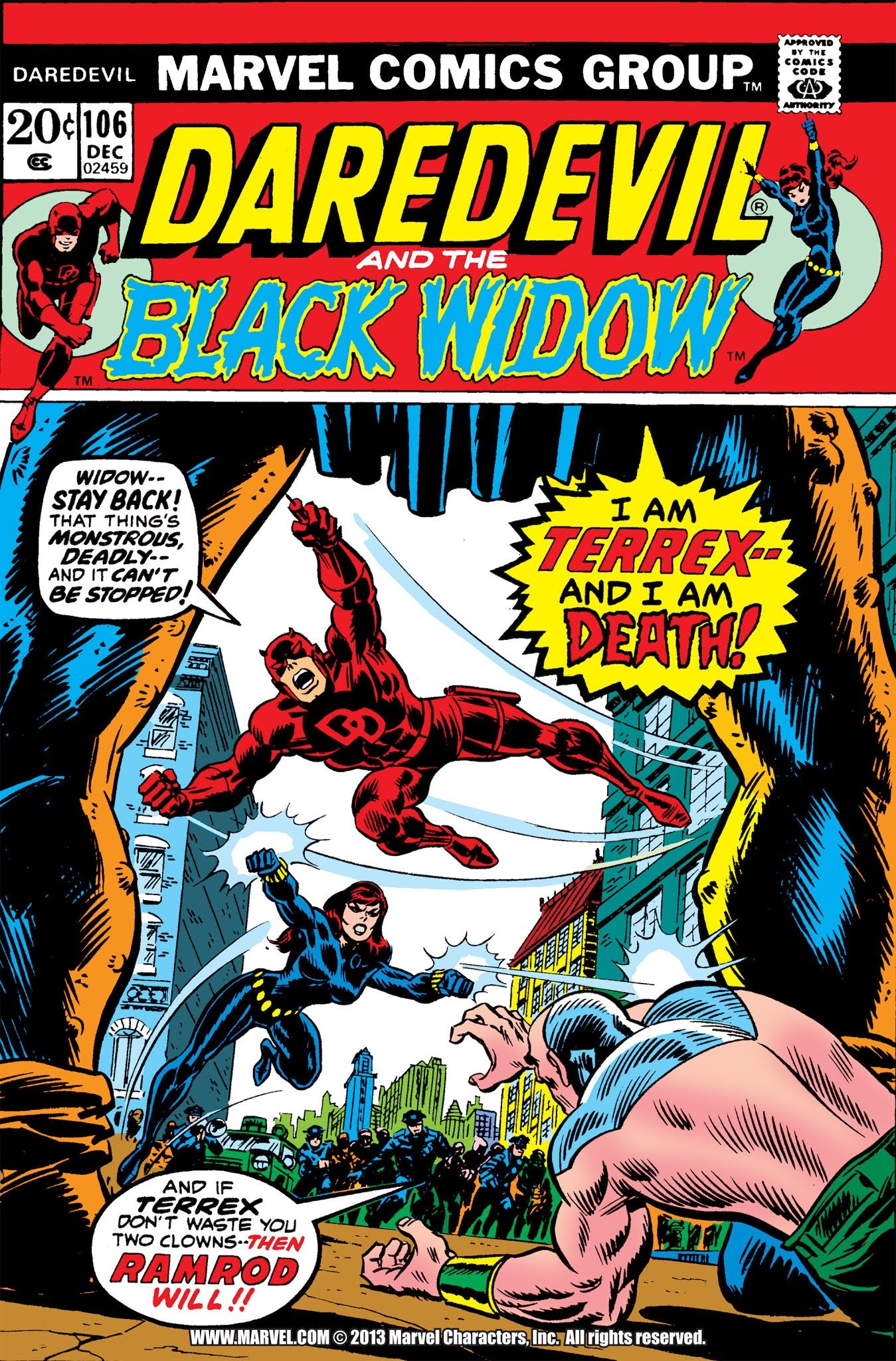

The backstory is that Daredevil was going to being rolled into a comic book with another flagging Marvel superhero title, Iron Man, but Gerry Conway, who would also co-create The Punisher during the Watergate era of cultural ferment, had the idea instead to hook Matt Murdock up with Natasha Romanova and move them out of New York City to the West Coast capital of the counterculture. The idea worked and the title proved to be popular.

The Black Widow originally was a beautiful Russian spy, a run-of-the-mill mid-'60s "Bond Girl," when she appeared in the Iron Man title Tales of Suspense. 


Eventually she was clad in a costume (a fishnet leotard with a Cinderella ball mask) and teamed with former circus act Hawkeye to take on the Golden Avenger.


Then Black Widow defected, joined Nick Fury's S.H.I.E.L.D., and becomes part of the American war machine. In 1970 she assumes the look we have come to identify with the character, and the one she wears in her present title -- the long red hair and the black, form-fitting scuba-suit-like full-body unitard with a pan flute shooting out rappelling line wrapped around each wrist.


After the Inhumans proved to be more of a draw, Marvel drops Black Widow from Amazing Adventures; that is when the character begins her run in Daredevil.

As a kid I remember thinking that the Daredevil-Black Widow relationship seemed like the man-woman ideal, that which would be awaiting me when I reached adulthood: a romantic pairing of co-equals, each powerful and self-assured, assisting one another in doing good and making the world a better place.

Of course as each of us comes to find out in his or her own way, the exact opposite is usually the case. Adult couplings between the sexes are for the most part a toxic neurotic stew of co-dependency, a combat of the vicious and needy to see who can drag the other one down to the pit the quickest. Yet the duel turns out to be none too quick; it goes on for years, in some cases a lifetime. Really the war goes on forever, waged unconsciously, passed down from generation to generation in a plodding somnambulant trail of tears. The world is not made a better place. Anyhow, that's one bachelor's perspective.

What makes this latest run of Black Widow so enjoyable is that Nathan Edmondson tells a story of a woman who is singularly alone -- not paired up with Buck Barnes assuming the role of Captain American, or Daredevil, or Hawkeye. This Black Widow is a worker working jobs (assassinations, etc.) to earn money so that she might pay the families of the victims left in the wake of her prolifically violent career. Natasha Romanova keeps her distance from people as best she can. There are those she has to deal with to do the job. But her private life is kept as clear as possible of all human entanglements.

Edmondson describes the warrior's way, but I found, reclining on my mattress on the floor on a Saturday afternoon, that he was describing my life as well. Not that I leap from rooftop to rooftop to trade punches with super-powered madmen; but that I am a solitary individual who outside of work is keenly aware of the distance I keep from others; I am also like the comic-book Romanova woman in that I am constantly carrying on a conversation with myself as to the wisdom of this practice.

Below you will find seven scans, including cover page, from Black Widow #4. The art is by Phil Noto who I think does incredible work accentuating the sense of Black Widow's solitariness and isolation. There is a gauzy, spacious quality to the panels. It is like looking at a comic-book version of Antonioni's The Passenger (1975):


Friday, April 4, 2014

Hippies vs. Punks: The Yardbirds

In order for a society to move forward it has to be able to generate a popular vision of the future -- A WAY OUT. What makes our present age so perilous is we have lost our ability to produce a collective perception of a way out. Our current neoliberal neoconservative cultural dead end predominantly manufactures dystopian fantasies (The Walking Dead, Breaking Bad) or historical paeans (Vikings, Mad Men).

The Hippie was the new man the Western World produced at the zenith of its 1960s post-war prosperity. The Punk was the new man spawned in reaction to the Hippie's failure. The Hip Hop artist has been our new man here in the West for decades -- really since Grunge quickly collapsed under the weight of its commercial excesses twenty years ago.


I don't think there is a finer, more sensitive, honest, hopeful vision of the future -- a discourse on possibility itself -- than Michelangelo Antonioni's Blowup (1966). This is what the Western World looked like when there was still hope and the future was open. Starring a Dylanesque David Hemmings as a fashion photographer in "Swinging London," The Yardbirds appear in the middle of the film performing "Stroll On." Antonioni wanted The Who because he was entranced by Pete Townshend's guitar-smashing routine. The Who declined. Antonioni then tried to get The Velvet Underground but was unable to either because of the band's inability to secure a work permit in the UK or the prohibitive cost of transatlantic travel. So he settled on The Yardbirds; Jeff Beck did the guitar smashing.

When I last saw this film, my unemployment spring of 2011, I was struck by how fresh and new the band looked, as if they truly were pioneering new territory with no attachments to binding constraints of the past.

The Yardbirds, along with The Who, were the new men of the middle 1960s. They as much as anyone else created the Hippies and the Hippie era. This is Lester Bangs' take. The Yardbirds changed music. They brought fraying, shattering guitar distortion to the fore, and they perfected a heavy-bottom backbeat. This inspired countless imitators and knockoffs ("Punks," such as Count Five of Bangs' title essay in Psychotic Reactions and Carburetor Dung) across the broad expanse of Great Society suburban American. Out of the suburban garage emerges the Hippie.


Bangs' spontaneous-prose-style analysis is basically in line with an academic study by Michael Hicks titled Sixties Rock: Garage, Psychedelic and Other Satisfactions (1999) I read last summer.


We all know that out of the ashes of The Yardbirds Jimmy Page forms the Hippie supergroup Led Zeppelin, an endless source of Bangs' ire (so too for the Punks) because of the band's artistic pretensions and superstar status demanding hero worship and mindless fan obeisance.

****
Last night I attended a union meeting. We voted on a tentative agreement (TA) that will more than likely result in the loss of our current health plan in favor of a cheaper one. This means that for those of us who seek medical attention regularly there will be a significant increase in out-of-pocket expenses.

I voted against the TA. Our bargaining team only met with the employer group twice, and then basically rolled over and presented us with a TA that is nothing but givebacks.

I understand that the costs to our current health have shot through the roof -- a 29% jump this year alone -- and that it cannot be maintained and in the long run we will have to move to another plan. But year after year the only thing that we focused on in our bargaining was maintaining the health plan. Now in less than two full bargaining sessions we are caving in. Unacceptable.

Nonetheless, the tentative agreement passed, and it passed by a healthy margin. People are scared and beat down and have no fight left in them. Our union representative, who is also the head of the union local and our chief negotiator with the employer as well as a trustee of our foundering health plan, took the employer's side. The message, simply put, was that we all are a bunch of monkeys easily replaced, and we are lucky to have whatever the employer gives us. So we should shut our fucking traps and take was is being offered pronto.

Needless to say, it was an unpleasant experience. One interesting sidebar was our union representative's opinion that the Affordable Care Act (ACA), a.k.a., Obamacare is proving to be very damaging to union Taft-Hartley regulated health plans. There is a firewall between Taft-Hartley plans and the ACA insurance exchange; they cannot buy insurance on the exchange. Yet the ACA brought a whole host of additional costs, such as covering adult children up to the age of 26.

The crowning achievement of the Obama administration, elected with fulsome union support, is Obamacare. Obamacare will be the undoing of a basic foundation of union membership, blue-chip medical coverage. Defined-benefit pensions are almost all gone (see the recent Boeing Machinists' capitulation where they voted to go to a 401(k) plan); now, fully-paid, employer-provided health insurance. Soon belonging to a union will not mean much.

As this reckoning sinks in, the only way Democrats will be able to win elections is solely by tapping plutocrats and playing the big money game. They do this now of course. But they have managed to keep healthy numbers of working people aligned with the party because it is the lesser of two evils. After Obamacare and the death of the unions, this alignment becomes increasingly problematic.

We need new men! We must be inspired by a vision of the future as fecund as Blowup and The Yardbirds of the middle-60s. Right now there is nothing.