A tremendous comic book, Red Wolf, just finished a six-issue run. That Marvel cancelled the series speaks poorly of its corporate leadership. This comic book had everything -- excellent writing, superb art, a riveting narrative of a noble hero who, from the 1872 title (part of the recent Secret Wars crossover event), suddenly finds himself transported to present-day small-city New Mexico on the verge of a big-business drug-trade takeover.
Red Wolf is a Luddite manifesto. Scribe Nathan Edmondson champions a "whole earth" noble savage gestalt. Red Wolf fights gun-totting criminals barehanded, with the exception of an occasional mighty toss of a stone or an empty beer bottle, relying on pure athleticism and an understanding of the natural world, both flora and fauna, to best his foes.
Red Wolf is a true hero, no easy achievement these days, and for this Edmondson and penciler Dalibor Talajic deserve praise. Red Wolf offers a primer on how to be a good man. Do what you know. Be honest. Don't be afraid. It brought me to tears (a weakness of mine, this tendency to start weeping while reading comics books) in the 14 scans below:
Now is a good time to get caught up on all the back issues of the current The Punisher title. With nationwide protests targeting homicidal police violence, two police gunned down in Brooklyn while sitting in their patrol car, and the recent release of the forward to Senate Select Committee on Intelligence report on the CIA's use of torture post-9/11, we are definitely in a Frank Castle world.
The world of Frank Castle, a.k.a, The Punisher, is a world of jihad. But there is no "Allahu Akbar" in Frank Castle's world. The Punisher is a nihilist, a vigilante. He sees only evil, death and destruction. He believes in law and order, but he finds only deceit, brutality and corruption.
The Punisher's mindset provides an interesting insight into the police power structure. Crime is rampant, a demon out of control, and an overwhelming force is required to keep it in check. It is a Hobbesian mindset -- man is a wolf to man and a monopoly of force is required to keep the wolves at bay.
But what if crime isn't out of control? What if man isn't an errant wolf? What if the state of nature is more collaborative than Hobbes imagined?
Then we find that the violence, the death and destruction that Hobbes believed brought people together to form a state and grant great powers to a sovereign are actually the product of the state.
This is the key realization of Rousseau: War, corruption, hierarchy are products of the state.
In order for citizens to continue to accept brutalization and subjugation by the state, the state must convince those who it rules that it is protecting them from wickedness and horror. That is why in the case of Occupy Wall Street and Black Lives Matter, two protest movements that have recently arisen to challenge state power, both have been criticized for attracting society's scary underclass. In the case of Occupy movement, the many encampments dotting the nation's cities attracted homeless, some who were mentally ill and abused drugs. This became an excuse used by the Fourth Estate to reject the movement.
In the case of the Black Lives Matter movement, the murder of NYPD officers Wenjian Liu and Rafael Ramos by deranged shooter Ismaaiyl Brinsley was promptly used as an excuse to call a halt to the ongoing protests against police violence. The Fourth Estate has provided story after story making false, scary comparisons between today's New York City and the white flight, fear and loathing, "French Connection" New York City of the early 1970s.
Given the portrayal of Occupy Wall Street and Black Lives Matter by the mainstream media, one would expect The Punisher to gun down the protesters for attracting society's detritus. It would be a nice change to see a story arc where Frank Castle goes after the real bad guys -- the beltway politicians, Wall Street bankers, casino magnates, the PAC bundlers, the transnational oil corporation CEOs, and Saudi and Qatari princes -- rather than the usual street-level gang bangers, sundry hoodlums and crime families. I'll be waiting for that one.
The current Punisher title has Frank relocated to Los Angeles where he does battle with the Dos Soles gang. The Dos Soles are attempting to unify all gangs in Los Angeles in order to control the city. Towards that end, the Dos Soles gang has implemented a reign of terror.
I have cherry-picked pages from two issues, The Punisher #10 and The Punisher #11, that depict Frank's pal from the diner where he eats breakfast, a LAPD officer by the name of Stone, shooting a fleeing thief in the back and then embracing vigilantism when the owner of the diner is attacked by hooligans.
The writer is Nathan Edmondson. The artist, whose work I think is some of the best in comic books today, is Mitch Gerads. Check out the scans below to see what I mean. Amazing stuff.
Remember. It is the fear of violent disorder and mayhem that justifies police brutality. Be skeptical of the manufacture of fear, and we can begin to get some traction in our demands for a just state.
Friday is a special day of the week. A few days away from the rat race beckon. Whether because a lot of people work a four-ten-hour-day schedule or the recurring happenstance of workers taking Friday off, the commute is always lighter on a Friday.
So there is a sense of relief. But there is also a feeling of exhaustion and regret: exhaustion from going to work Monday through Friday, week in and week out, year in and year and out, and all the stress and hostility that entails; and regret from the realization that one's life boils down to this.
And what is work? Let's not gussy it up here. Work is exploitation, and sometimes it is crass. I work for a labor union. So I have a collective bargaining agreement with a wage scale and benefits. But the indignities and injustices of society at large are not absent from my office. We recapitulate all the errors of hierarchy and the impediments of the ego. Some get the company car, the gas card, expense account, private office and flexible schedule, while others punch the clock and do the work in a constant state of anxiety over punishment and new demands.
Yesterday after I disembarked from the train and was waiting for the bus on International Boulevard, I watched a pot-bellied man with a black handle-bar mustache and a fat wallet attached to a chain hooked to his belt labor his way through oncoming traffic until he arrived at the safety of the median. He waited there for a while until traffic cleared and then he crossed the three lanes to the bus stop where I stood.
Once the bus arrived and we boarded, we sat in the back with a couple of young guys -- one white, the other black -- wearing the obligatory gear of professional sports franchises. There were also two young black women, one wearing a headscarf.
The back of the bus is an urban drain grate, the place where society's detritus accumulates. It is not an accident that I am there. This week I lumbered through the days with a badly pulled hamstring and a burst eardrum.
Music from one of the young men's phone filled the back of the bus -- tinny, whiny, simple synthesized sounds like those that accompany early-generation video games such as Donkey Kong, Asteroids or Space Invaders. Neil Young is right. Music is dying. I have noticed more young people, shunning earbuds, walking around holding their phones, listening to this flat screeching noise.
The pot-bellied man with the black handle-bar mustache talked on his phone to whom I assume was his lover: "I want you to be happy. Can you do that? I just want you to be happy."
He kept saying, "I want you to be happy. I want you to be happy. I want you to be happy. I want you to be happy," as if it were an incantation.
The young men ignored him.
When Deathlok first appeared in Astonishing Tales (cover date, August 1974) I, a grade-school kid, read it. It was different from other super-hero titles of the time. Darker, dystopian, a The Six Million Dollar Man meets Frankenstein; or, The Modern Prometheusin a near future where multinational corporations and the military rule over a post-apocalyptic wasteland.
As a boy I knew right then, situated as I was in the sunshine of Watergate America, that Deathlok announced a new era. As Nixon helicoptered away from the White House that August, we were on the cusp of something radically different. Artist Rich Buckler and writer Doug Moench successfully captured what that was to be: Cyborgs toiling in service of a corporate-military nexus reigning over a planet of failed states. One might argue that this is the default landscape depicted in today's comic books.
What I a particularly enjoyed as a kid was the dialogue that Deathlok carried on with himself; or, I should say, the conservation that Colonel Luther Manning, the body and mind of Deathlok, carried on with the sentient computer implanted in his head. It was at once futuristic, like an internalized HAL 9000 from 2001: A Space Odyssey, and primitive, capturing the basic everyday self-consciousness of our species.
Deathlok has been through many iterations and character cycles since I stopped collecting comic books. The latest incarnation features a black man named Henry Hayes who works for an NGO like Doctors Without Borders. He is an ex-soldier with a prosthetic leg, a single father raising a wayward teenage daughter. That is his cover. But secretly -- unknown even to himself -- he is a super-agent, like a Jason Bourne, who conducts assassinations and grand theft for a shadowy organization; an attractive female keyboard jockey dispatches and coordinates Deathlok's operations from a darkened computer room.
Nathan Edmonson, who does excellent work on The Punisher and Black Widow, is the author. Mike Perkins, provides the art, which I particularly enjoy; it is as grand as Mike Deodato's. Take a look at the scans below. Deathlok deals with a drone attack at sea while trying to extract an asset from a downed aircraft. Note Perkins' study of the ocean horizon. Very evocative.
I hit a sweet spot last Saturday. There is one 5K that is my favorite. It takes place in a residential neighborhood at the the city's northern edge at the end of September. A guy who has some sort of association with the Catholic Church there organizes the foot race. I enjoy it so much because there aren't too many runners; there are enough so that there is plenty of good competition; everyone has enough room to maneuver and there is just the right amount of spacing that makes for optimal pacing.
I ended running a decent race. And while my time was not a personal best, or even what I would call a normal performance based on what I've done over the last several years, it was the first race I have run since I injured my foot in May where I felt like I was on my way back, that the finish line for my long convalesce is just around the bend.
The early fall weather was gorgeous and the light was perfect. I took my runner's high back to my studio apartment where I dug into Black Widow, part of All-New Marvel NOW! series of titles.
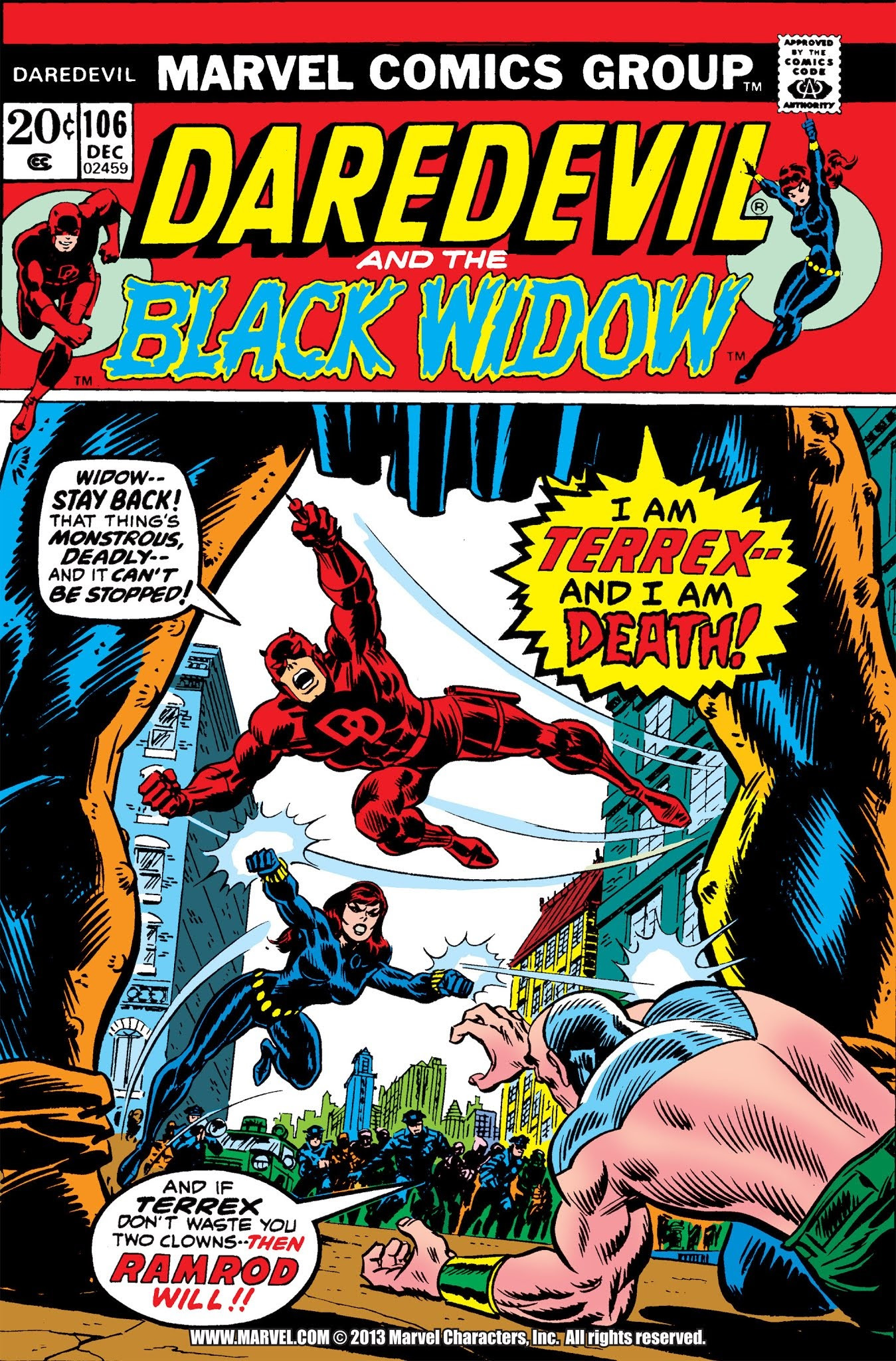
When I started reading comic books as an elementary-school kid, one of the first titles I followed was Daredevil. This was at a time, 1971 to 1975, when the blind costumed crime fighter was teamed with Natasha Romanova, the Black Widow. They lived together unmarried (though sleeping on separate floors of their apartment in order to satisfy the moral strictures of the weakened but still functioning Comics Code Authority) in the Hippie Mecca of swinging San Francisco.
The backstory is that Daredevil was going to being rolled into a comic book with another flagging Marvel superhero title, Iron Man, but Gerry Conway, who would also co-create The Punisher during the Watergate era of cultural ferment, had the idea instead to hook Matt Murdock up with Natasha Romanova and move them out of New York City to the West Coast capital of the counterculture. The idea worked and the title proved to be popular.
The Black Widow originally was a beautiful Russian spy, a run-of-the-mill mid-'60s "Bond Girl," when she appeared in the Iron Man title Tales of Suspense.
Eventually she was clad in a costume (a fishnet leotard with a Cinderella ball mask) and teamed with former circus act Hawkeye to take on the Golden Avenger.
Then Black Widow defected, joined Nick Fury's S.H.I.E.L.D., and becomes part of the American war machine. In 1970 she assumes the look we have come to identify with the character, and the one she wears in her present title -- the long red hair and the black, form-fitting scuba-suit-like full-body unitard with a pan flute shooting out rappelling line wrapped around each wrist.
After the Inhumans proved to be more of a draw, Marvel drops Black Widow from Amazing Adventures; that is when the character begins her run in Daredevil.
As a kid I remember thinking that the Daredevil-Black Widow relationship seemed like the man-woman ideal, that which would be awaiting me when I reached adulthood: a romantic pairing of co-equals, each powerful and self-assured, assisting one another in doing good and making the world a better place.
Of course as each of us comes to find out in his or her own way, the exact opposite is usually the case. Adult couplings between the sexes are for the most part a toxic neurotic stew of co-dependency, a combat of the vicious and needy to see who can drag the other one down to the pit the quickest. Yet the duel turns out to be none too quick; it goes on for years, in some cases a lifetime. Really the war goes on forever, waged unconsciously, passed down from generation to generation in a plodding somnambulant trail of tears. The world is not made a better place. Anyhow, that's one bachelor's perspective.
What makes this latest run of Black Widow so enjoyable is that Nathan Edmondson tells a story of a woman who is singularly alone -- not paired up with Buck Barnes assuming the role of Captain American, or Daredevil, or Hawkeye. This Black Widow is a worker working jobs (assassinations, etc.) to earn money so that she might pay the families of the victims left in the wake of her prolifically violent career. Natasha Romanova keeps her distance from people as best she can. There are those she has to deal with to do the job. But her private life is kept as clear as possible of all human entanglements.
Edmondson describes the warrior's way, but I found, reclining on my mattress on the floor on a Saturday afternoon, that he was describing my life as well. Not that I leap from rooftop to rooftop to trade punches with super-powered madmen; but that I am a solitary individual who outside of work is keenly aware of the distance I keep from others; I am also like the comic-book Romanova woman in that I am constantly carrying on a conversation with myself as to the wisdom of this practice.
Below you will find seven scans, including cover page, from Black Widow #4. The art is by Phil Noto who I think does incredible work accentuating the sense of Black Widow's solitariness and isolation. There is a gauzy, spacious quality to the panels. It is like looking at a comic-book version of Antonioni's The Passenger (1975):