Showing posts with label Richard and Linda Thompson. Show all posts

Friday, January 3, 2014

Hippies vs. Punks: Richard & Linda Thompson's "Light(s)" Albums, Pt. 3, Shoot Out the Lights


There is one run I have been doing for over 15 years now. I call it the "Big Man's Run" because it involves running for over an hour. When I was in my thirties I could complete it in one hour. Now, it takes me an hour and a quarter. The Big Man's Run (BMR) is a little under eight miles and takes me north out of my Capitol Hill neighborhood over the University Bridge and then onto the Burke-Gilman Trail until I get to Fremont; at which point I exit the trail, cross the Fremont Bridge and then head east down the hill to hook up with Westlake Avenue, more exactly, the miles of parking lot that rim Lake Union. I head south until I get to the South Lake Union Cascade neighborhood, which used to be a funky, bohemian low-rent district but is now dominated by new concrete architecture that anchors the Amazon commercial empire. Then I head east climbing hills and a freeway overpass until I am back in my Capitol Hill neighborhood.

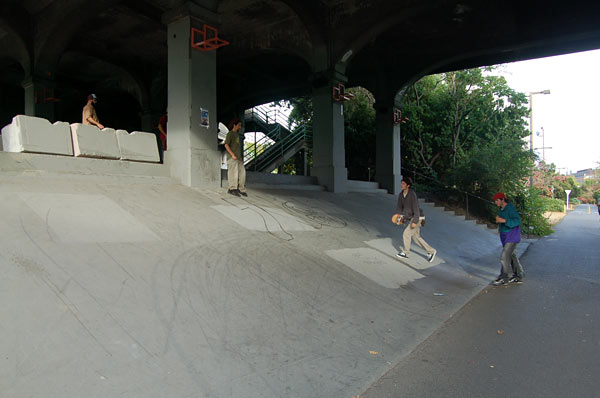
On the BMR, right when I cross the University Bridge and am connecting with the Burke-Gilman Trail, there is a sculpture that incorporates the words "The Wall of Death." It is located, incongruously, beneath the north end of University Bridge where the Burke-Gilman Trail passes underneath. The Wall of Death was a once-popular carnival sideshow where stunt-riding motorcyclists ride around a circular wall climbing higher and higher as their centripetal force grows. (A variation of The Wall of Death opens the 2013 Derek Cianfrance film The Place Beyond the Pines.) The Wall of Death sculpture beneath the University Bridge might be so named because it is a popular spot for skateboarders attracted by the forty-five-degree angle concrete walls.


Whenever I run past the sculpture, which, as I said, I've been doing regularly for a long time, I can't help but think of the final track on Richard & Linda Thompson's break-up album, Shoot Out the Lights (1982).

Shoot Out the Lights is widely acknowledged as Richard & Linda Thompson's masterpiece. For instance, it comes in at number 332 on Rolling Stone's 500 Greatest Albums of All Time, significantly outpolling I Want to See the Bright Lights Tonight (1974) which comes in at 471.

I prefer Bright Lights and First Light (1978) of the three great "Light(s)" albums of Richard & Linda Thompson. But thanks to the success of Shoot Out the Lights -- it was a critics choice album back in 1982 boosted by Robert Christgau's 'A' grade in The Village Voice -- it established Richard Thompson on a long, productive solo career that is still going strong, and it sparked a much-deserved reappraisal of the couple's previous recordings.


Recorded quickly in the summer of 1981 while Linda was pregnant, Shoot Out the Lights was produced by Joe Boyd (the guy responsible for discovering and recording Fairport Convention back in the 1960s) for his small Hannibal Records label. Richard & Linda Thompson had been dropped by Chrysalis because of the poor sales of Sunnyvista (1979). By the time Shoot Out the Lights is released in March 1982, the Thompson's marriage had collapsed.

An earlier version of the album exists in bootleg form. Recorded by Gerry Rafferty (lead guitarist of Stealers Wheel and co-writer of "Stuck in the Middle with You," the pop tune memorialized in Reservoir Dogs) in September and October of 1980 and unsuccessfully shopped to record labels, it is a slicker studio album; some of its tracks can be found online under the heading "Rafferty's Folly," like this version of "Don't Renege on Our Love":


For me, my memories of Shoot Out the Lights always begin with the first side of the album, particularly the first three cuts: "Don't Renege on Our Love," "Walking on a Wire," and "Man in Need." These songs are a point-counterpoint of an aggrieved wife and husband. I would listen to this album before heading off to work a second-shift job on the 99th floor of the World Trade Center. My own marriage was collapsing that sunny spring. I believe, looking back now, that Shoot Out the Lights provided excellent counsel:

Friday, December 27, 2013

Hippies vs. Punks: Richard & Linda Thompson's "Light(s)" Albums, Pt. 2, First Light


Hippie music, Hippie bliss. But not from a source one would expect. There's no Pacific Coast Highway Malibu to San Francisco coked-out, boozed-out self-indulgence to be found here (for that, see the Hippies vs. Punks post devoted to Rick Danko's solo debut). This is solid sonic strength from the young Sufi husband-&-wife team of Richard & Linda Thompson.

Produced at a time, 1978, when most Hippies had already given up fighting the Man and started to settle down and when the Punks, post-Pistols, were creating Post-Punk, First Light is an amazing record of the small but vibrant late 1970s Hippie vanguard.


To get a sense of what that anomaly looked like -- a Hippie vanguard as late as 1978-1979 -- consult Werner Herzog's films from this period, particularly Woyzeck (1979), but also Nosferatu the Vampyre (1979):


Those of you who have seen the DVD of Grizzly Man (2005) or enjoyed its soundtrack know that the Herzog-Thompson connection is not me merely being fanciful:


But back to First Light. It was the first album for Richard & Linda Thompson after a three-year recording hiatus. They had left behind Sufi-commune living but not Sufism. First Light is suffused with a spirituality of the type I was familiar with growing up as a Hippie kid.

I truly love this album. The back cover photo of the couple radiates power and beauty:


All ten album tracks soar, like "Strange Affair":


I even enjoy "Pavanne" now, which I didn't for a long time:


It reminds me of living in Ashland, Oregon in the late 1970s. My mother was a professional astrologer. I was just starting high school. My oldest sister, a teenage Hippie, lived nearby in the Applegate doing organic gardening. I didn't listen to the album at the time. I was listening to Mozart and Brahms and Bach. It took me another ten years to get to First Light. Then I was dealing with work and marriage and life in the Big Apple. Whenever I hear "Don't Let a Thief Steal Into Your Heart" I think about high-rise living/high-rise working and skyscraper sunshine, and of course my wife who was becoming a stranger.

But I'm pretty sure my sister listened to Richard & Linda Thompson back in the day. My Hippie sister who smelled always of garlic and patchouli oil, who wore rings on her toes and bells on her ankles, who went everywhere barefoot dressed in baggy sheer cotton pants and a brassiere-less blouse. I got to talk to her on Christmas Day. I asked her if she had enrolled in Obamacare. She runs a daycare out of her home now. She explained that she had not enrolled yet but will. Due to some tax payments owed to the state, she has to hold off until the new year. It was good to hear her voice. It has been a while.

Another film that captures the look and feel of the Hippie at the end of the 1970s is John Boorman's Excalibur (1981). In high school my best friend and I drove to Medford on a school night to see a late show thinking that it would be the best chance we had of making it into the 'R'-rated movie without being carded. We made it in.


I saw Excalibur again not too long ago. It had probably been 25 years since I saw it last. I found myself crying throughout the film, particularly the scene where Arthur goes to the convent to see Guenevere one last time and from beneath her tiny bed Guenevere pulls Excalibur -- the sword that the young Arthur had yanked out of the stone -- hands it to Arthur and says, "I've been keeping this for you."

I don't why this movie and that scene in particular reduces me to tears. I get weepy just thinking about it. But I suspect it has something to do with the disappearance of the Hippies. Very soon after the release of Excalibur the remnants of the Hippies vanish into New Ageism, and Richard & Linda Thompson record their last album together as a duo, Shoot Out the Lights (1982). Next week we will conclude with Shoot Out the Lights.

But in the meantime do yourself a favor. Find a copy of First Light and listen to it. What you will be hearing is the sound of the last Hippie vanguard.

Friday, December 20, 2013

Hippies vs. Punks: Richard & Linda Thompson's "Light(s)" Albums, Pt. 1, I Want to See the Bright Lights Tonight

"The way up and the way down is one and the same."
Heraclitus, Fragment 60, Diels: Die Fragmente der Vorsokratiker


Each week on Friday I have a Hippies vs. Punks post. The idea is to take a band, usually an album from that band, immerse myself in it during the work week, and then report back at week's end. I have chosen the period from 1975 to 1979, the time the Hippies, the main motor of the '60s cultural revolution in the West, give up the ghost and slink off the center stage and the Punks take over. ("The king is gone but he's not forgotten/This is the story of Johnny Rotten.") Nineteen-seventy-five to 1979 is the main focus -- particularly the years 1977 and 1978 -- but I allow myself to roam free both before and after. For instance, a number of posts have dealt with 1970 -- bombing of Cambodia, Kent State nationwide campus riots, the Cincinnati Pop Festival.

In any Present Age there is more than one avant-garde, perhaps a counter avant-garde or contra-garde. As the Punks assumed the cultural vanguard in the middle 1970s and the Hippies split into miscellaneous camps -- hard rock, glam, prog rock, etc. -- some Hippies kept fighting the good fight. Richard Thompson, a co-founding member and lead guitarist for folk rock giants Fairport Convention, and his wife Linda were two of those Hippies.


No truer statement of the facts of life can be found than Richard & Linda Thompson's debut album, I Want to See the Bright Lights Tonight. It is a rich sonic narcotic, easily one of the greatest albums of all time (though it only squeaks in at number 471 on Rollings Stone's "500 Greatest Albums of All Time" list).


Recorded quickly and on the cheap in the spring of 1973, I Want to See the Bright Lights Tonight went unreleased until the following spring owing partly to Island Records executives' discomfort with the Thompsons' bleak existentialism and aversion to celebrity, but also due to a vinyl shortage resulting from the Arab oil embargo.

Thompson had become reacquainted with Linda Peters, a session singer, while the two worked on his solo debut, the fantastic and underappreciated Henry the Human Fly (1972). That album took a brutal and undeserved hazing from the music press which no doubt instilled some bitterness and self-doubt in Thompson, a guy who was already shy. After Thompson marries Linda (October of 1972) and the two become a duo, she becomes the frontman. Her beauty is electric.


While I Want to See the Bright Lights Tonight received some decent reviews, mostly it was ignored when finally released by Island in 1974. By then Richard and Linda had become Sufis, the esoteric branch of Islam that is the polar opposite of the Salafi movement that is having such a violent, transformative effect on the Middle East today. Their next two albums, Hokey Pokey (1975) and Pour Down Like Silver (1975), are both recorded while the Thompsons are living in a Sufi commune in East Anglia; following Hokey Pokey and Pour Down Like Silver, they retire from the music industry for several years; they return with First Light (1978), which will be the subject of next week's Hippies vs. Punks post.

So I Want to See the Bright Lights Tonight really stands by itself. Even though Hokey Pokey shares some similarities and is a great album, it doesn't hang together, it doesn't resonate as an organic unity like Bright Lights. Bright Lights is a masterpiece, plain and simple. It is a profound Hippie assessment of the world after the last rays of light from the Summer of Love have disappeared. It is a winter's album. Cold, dark, harrowing. It is a tribute to secularism and existentialism. The stories are of work and suffering. No greater tandem of songs to end an album can be found than "The End of the Rainbow," which Thompson wrote for his newborn daughter! and "The Great Valerio":


I embraced this album when I left the university and moved to New York City with my wife so she could attend medical school (a period I regularly explore with the "The Colt 45 Chronicle" posts). We played Bright Lights a lot, introduced it to friends who went out and got copies for themselves. It spoke to all of us because we were about the same age as the Thompsons -- early to mid-twenties -- when they recorded it, and we were confronting the same bleak themes. The reality of what life looks like in your middle twenties when you're just starting to travel the long road of work, marriage, survival is crushing. It says something that a beautiful young Hippie couple could create an aural document more devastating and stark than anything the Punks ever came up with.

Do yourself a favor. Get the album. "The Calvary Cross" is one of the greatest rock 'n' roll songs of all time. And if you get a chance, check out the compact documentary the BBC did on Richard Thompson, Solitary Life:


Yesterday morning at work sitting at my desk I came across this video of Thompson performing "The Calvary Cross" with a young band, Dawes, about whom I know little. Looking up from where I sit, through one of the windows, I can see the Comfort Inn next door. In the window of the Comfort Inn I saw, barely, the form of a cleaning lady making a bed, and I wondered if it was the pretty young Latina who I ride the bus with in the morning and who works at the Comfort Inn and who I suspect is undocumented since she will never cross against the light even if there is no traffic for as far as the eye can see. Then I thought about the time when I worked in the north tower of the World Trade Center, a time when I survived on a steady diet of Richard and Linda Thompson, a time when I broke up with my wife. I thought about the brilliant blue sky and looking up at the towers of the World Trade Center from the courtyard below and how I entered the building and began my shift.

Friday, December 6, 2013

Hippies vs. Punks: Penelope Houston's Birdboys


The Friday before last Hippies vs. Punks dealt with the Avengers, the first wave San Francisco Punk band famous for preceding the Sex Pistols at the January 14, 1978 Winterland show that signaled the demise of the Pistols only a few months after the masterpiece Never Mind the Bollocks, Here's the Sex Pistols (1977) was released.

Ten-years later -- nine years after the Avengers broke up and five years after the release of their sole full-length album, Avengers (1983) -- lead singer and feminine Punk avatar Penelope Houston released her debut solo album, Birdboys (1988).


It was my final year at the university. By 1988 I was, at 23 years of age, somewhat of a salty dog: a drinker, a confused philanderer and occasional street fighter, a reader of weighty texts and a teaching assistant. I was headed back East to live in the Big Apple where my girlfriend, who I would marry en route, had been admitted to medical school.

Nineteen-eighty-eight was a tumultuous year. The Pixies' Surfer Rosa (1988) would appear and put a little pep back into a music scene that was listing from underground indie toward the corporate mainstream. My friends and I were listening to a lot of The Pogues. We played constantly Rum Sodomy & the Lash (1985) and If I Should Fall from Grace with God (1988).

It was into this milieu that Penelope Houston made her debut with Birdboys (which was also the name she gave her acoustic backing band). I never owned or even heard the record. Put out by Bay Area Punk label Subterranean Records, I remember reading a review of it in the East Bay Express and seeing a picture of PH in what I took to be some sort of Hippie dress. It confused me. She still had her Punk insouciance, but she was wearing a Hippie dress. My buddy and musical mentor Oliver made a sarcastic comment about the former Avenger's metamorphosis from Punk to Hippie.


I don't think I was alone in avoiding Birdboys. The album didn't find an audience. Most of us were still fully wedded to the "Hey Hey, My My" rock 'n' roll fantasy. It took five more years for Penelope Houston to find her niche, and it turned out to be in Germany, where she was dubbed the "Queen of neo-folk" and would end up signing with major label WEA Germany. (For a helpful synopsis of Penelope Houston's career, see her interview with Richie Unterberger.)

When I was working on the Avengers post a couple weeks back I decided to download Birdboys and listen to what I missed out on 25 years ago. The album garners favorable reviews online.


I wasn't much impressed my first few listens. The songs have a "Michael Row the Boat Ashore" / "He's Got the Whole World in His Hands" elementary-school-growing-up-in-California-in-the-'60s-sing-along daintiness and preciousness that is off-putting when listened to on iPod ear buds, prompting me to say to myself, "No wonder she never cashed in like Suzanne Vega."

It wasn't until I heard Birdboys on good speakers at home on a Saturday evening cooking dinner that I found myself enjoying the record. I proceeded to play it repeatedly. I understood what Penelope Houston was up to -- the aural capture of empty space -- and how the "Kumbaya" folkiness of Birdboys is of a piece with the first wave Punk of the Avengers. Here is how Houston explains it in the interview with rock 'n' roll historian Unterberger:
I remember I used to tell people that we were a folk band when I was in the Avengers. What I meant was that we were just playing music that we made up for friends, the way the original of folk is just music of the people. It's the folk music of Mexico, or the folk music of whatever. It's music that's played by regular people. It's not played by the court entertainers for the king. It's just the music that people go out on their porch and start strumming, and the neighbors come around. When I said the Avengers were a folk band, I just meant that we were making it up ourselves, that we'd taken it out of the realm of arena rock and the gigantic showplaces, and taken it back to the garage. 
I never really thought, oh, I want to do a cover version of "Wild Mountain Thyme." But there wasn't any...the loudness of the Avengers was so much of the expression. There wasn't really a chance to actually sing. I don't remember ever having monitors. I know we must've had monitors, but I don't remember looking at them and thinking, "I'm not getting enough of myself on the monitor." Everything was really loud and you just screamed at the top of your voice to be heard in live shows. I didn't think our live shows were anything...they were so different than our recorded output. 
I guess it was 1984 that I did my first show that was acoustic. The idea of having these big holes in the music, where there was no sound and then my voice would come out, was the most terrifying thing to me. I thought it was much more frightening than getting up in front of a Marshall stack three-piece band and screaming your lungs out. It was like stepping on a tightrope over this huge hole that was left in the music. 
And I was never a big fan of rock. I was never a rock'n'roller before I was a punk rocker. I was just a punk. I was just doing it because it was the most exciting thing that was happening. It was different, it was new, and we were creating it ourselves, and I felt the same way when I started doing this music with different instruments that had big holes in it. I didn't think, I'm going to start playing folk music. I just thought, we're doing something new and it's exciting and it's scary. The whole thing became more musical after that. But the way we started it was more like the Violent Femmes. It was more like kind of a punk attitude towards really quiet music. Since then, I think I've become a lot more musical. I guess in that way, I've changed.
Going forward in future Hippies vs. Punks posts, several topics suggest themselves from Penelope Houston's biography; the aforementioned influence of the Violent Femmes, for starters. Also, Houston, during the period she lived in England in the early '80s, performed on Howard Devoto's only solo album, Jerky Versions of the Dream (1983). I intended to post on Jerky Versions of the Dream before. It was ubiquitous at the time of its release, and it typified a kind of sound that spelled doom for the Punks, much like the California pop rock of the Eagles and Fleetwood Mac spelled doom for the Hippies.

Finally, PH mentions in the interview that at some point in her solo career she realized how much she had been influenced by English folk rockers Fairport Covention and Pentangle:
When I was younger, before the Avengers, listened to a lot of Pentangle and Fairport Convention and Incredible String Band. I loved them. I didn't really realize this until maybe six years ago, after I'd recorded Birdboys. I got a copy of the double Pentangle album, Sweet Child. I listened to it and I knew ever song on it. I was like, "Whoa! This is weird." It was before my punk life, I'd heard a lot of English folk-rock. So I think that was a big influence that I'd forgotten about somehow.
These are bands that were vital for the Hippies but were also held dear by the Punks. Why is that? Which brings up the issue of Richard and Linda Thompson, who, as I will argue in a future post, provide an example of a Hippie counter-avant-garde during a time when the Punks were wiping out the last vestiges of the longhair Flower Power Freak scene.

Wednesday, May 29, 2013

"The Dark End of the Street"

All problems are easily remedied if one has plenty of energy. Energy is the key. When one is feeling ill, exhausted, compromised, low, angry problems are not so readily solved. Routines conserve energy. A variation -- a radical variation -- the introduction of an unknown -- produces stress. Stress is a sudden energy purge; it is the "fight or flight" response. If one could merely rest after undergoing a "fight or flight" response all would be fine. But the rat race, such as it is, does not allow rest; hence, the importance of a steady routine.

Waiting for the train this morning I saw my companion from last week's commute fiasco. I'm pretty sure he saw me as well. But while just recently we might have been good buddies talking and speed-walking past crime scene tape, we were dead to each other now. We said not a word and cast not another glance each other's way. We were back to the routine the rat race demands; it conserves energy. And energy solves problems.

Tonight upon arriving home I headed into the kitchen and turned on Greg Vandy's The Roadhouse, which appears on KEXP every Wednesday at 6 PM. He's doing a tribute to the "Muscle Shoals Sound." I heard a snippet of Dan Penn saying that the finest version of "The Dark End of the Street" is James Carr's, which reached #10 on the R&B charts in 1967. Vandy played it. I listened. Yes, it is good. But I'm partial to the Sufi Hippie version by Richard and Linda Thompson from 1975. You be the judge.