Showing posts with label Shoot Out the Lights. Show all posts

Friday, January 3, 2014

Hippies vs. Punks: Richard & Linda Thompson's "Light(s)" Albums, Pt. 3, Shoot Out the Lights


There is one run I have been doing for over 15 years now. I call it the "Big Man's Run" because it involves running for over an hour. When I was in my thirties I could complete it in one hour. Now, it takes me an hour and a quarter. The Big Man's Run (BMR) is a little under eight miles and takes me north out of my Capitol Hill neighborhood over the University Bridge and then onto the Burke-Gilman Trail until I get to Fremont; at which point I exit the trail, cross the Fremont Bridge and then head east down the hill to hook up with Westlake Avenue, more exactly, the miles of parking lot that rim Lake Union. I head south until I get to the South Lake Union Cascade neighborhood, which used to be a funky, bohemian low-rent district but is now dominated by new concrete architecture that anchors the Amazon commercial empire. Then I head east climbing hills and a freeway overpass until I am back in my Capitol Hill neighborhood.

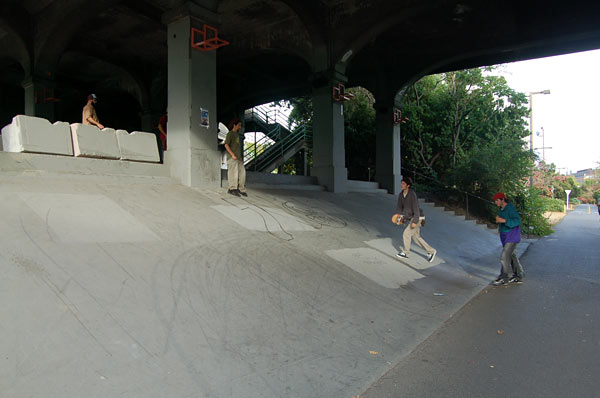
On the BMR, right when I cross the University Bridge and am connecting with the Burke-Gilman Trail, there is a sculpture that incorporates the words "The Wall of Death." It is located, incongruously, beneath the north end of University Bridge where the Burke-Gilman Trail passes underneath. The Wall of Death was a once-popular carnival sideshow where stunt-riding motorcyclists ride around a circular wall climbing higher and higher as their centripetal force grows. (A variation of The Wall of Death opens the 2013 Derek Cianfrance film The Place Beyond the Pines.) The Wall of Death sculpture beneath the University Bridge might be so named because it is a popular spot for skateboarders attracted by the forty-five-degree angle concrete walls.


Whenever I run past the sculpture, which, as I said, I've been doing regularly for a long time, I can't help but think of the final track on Richard & Linda Thompson's break-up album, Shoot Out the Lights (1982).

Shoot Out the Lights is widely acknowledged as Richard & Linda Thompson's masterpiece. For instance, it comes in at number 332 on Rolling Stone's 500 Greatest Albums of All Time, significantly outpolling I Want to See the Bright Lights Tonight (1974) which comes in at 471.

I prefer Bright Lights and First Light (1978) of the three great "Light(s)" albums of Richard & Linda Thompson. But thanks to the success of Shoot Out the Lights -- it was a critics choice album back in 1982 boosted by Robert Christgau's 'A' grade in The Village Voice -- it established Richard Thompson on a long, productive solo career that is still going strong, and it sparked a much-deserved reappraisal of the couple's previous recordings.


Recorded quickly in the summer of 1981 while Linda was pregnant, Shoot Out the Lights was produced by Joe Boyd (the guy responsible for discovering and recording Fairport Convention back in the 1960s) for his small Hannibal Records label. Richard & Linda Thompson had been dropped by Chrysalis because of the poor sales of Sunnyvista (1979). By the time Shoot Out the Lights is released in March 1982, the Thompson's marriage had collapsed.

An earlier version of the album exists in bootleg form. Recorded by Gerry Rafferty (lead guitarist of Stealers Wheel and co-writer of "Stuck in the Middle with You," the pop tune memorialized in Reservoir Dogs) in September and October of 1980 and unsuccessfully shopped to record labels, it is a slicker studio album; some of its tracks can be found online under the heading "Rafferty's Folly," like this version of "Don't Renege on Our Love":


For me, my memories of Shoot Out the Lights always begin with the first side of the album, particularly the first three cuts: "Don't Renege on Our Love," "Walking on a Wire," and "Man in Need." These songs are a point-counterpoint of an aggrieved wife and husband. I would listen to this album before heading off to work a second-shift job on the 99th floor of the World Trade Center. My own marriage was collapsing that sunny spring. I believe, looking back now, that Shoot Out the Lights provided excellent counsel:

Saturday, December 28, 2013

NFL Week 17: "Who is Going to Cure the Heart of a Man in Need?"


Another regular season draws to a close tomorrow. Once again we have traveled from September summer sunshine to the dark mornings of late December, and once again I am left wondering about the wisdom of planting myself hour after Sunday hour in front of the idiot box indulging in all the stress and bliss and passivity of being a fan of the National Football League.

I go through this every year, and every year I end up coming back -- to the TV, to my mattress on the floor, to my Hugg-a-Mars pillow propped beneath my head. I am a vision of the bachelor alone. But I keep coming back not because of the elixir of solitude that the NFL on television offers. I keep coming back because of community. Everyone watches the National Football League; or, if not everybody, a lot of people. There are even a number of women at work who watch the Seahawks. It is a way to attach oneself to his community -- to analyze the games on Monday morning with coworkers; to chat with a fellow competitor during a 5K race about an upcoming game; to compliment a young man on his beautiful knit dark-blue Seahawks cap (as I did on a run this morning). This is why every year I renew my commitment to watching all the games.

Right now on the NFL's web site, Seattle is shown as the top seed in the NFC. This of course is assuming a lot; it's prioritizing the numbers over the trend lines. The trend is that Seattle is faltering. Last week the Seahawks lost their first game at home with Russell Wilson starting at quarterback, and they have lost two out their last three. We could also mention that the Rams have won their last two, and that last year they came very close to beating a Seahawks team (that was much more potent offensively) in their home park. As for the 49ers, they are on a roll, peaking at just the right time. I don't see them losing to the Cardinals even if Arizona has the home-field advantage. I think Carson Palmer will toss some interceptions, and, unlike the Seahawks last week, Kaepernick will capitalize. Take the 49ers.

But back to the Rams-Seahawks game. I spoke with my uncle on Christmas Day. He was a high school quarterback in the San Jose area in the 1960s. He played at the same time and in the same league as Jim Plunkett and Dan Pastorini. He lives in Santa Cruz now and is of course a San Francisco fan. And while he thinks that Seattle has a dirty defense that relies on the black magic of the 12th Man (he also hypothesizes that the fan noise at CenturyLink Field is augmented electronically), he nonetheless feels that Russell Wilson is an incredible quarterback and a winner and that the Seahawks can win if they just leave Wilson enough time on the clock at the end of the game, something the defense was unable to do against both San Francisco and Arizona. Pete Carroll needs to keep his time-outs for the two-minute warning in the fourth quarter.

This made me feel encouraged; that, and my uncle's assessment that Kellen Clemens is not a threat. The line on the Rams-Seahawks game is Seattle by ten. I don't know if the Seahawks cover, but I think they win the game, hopefully in a blowout. Take the Seahawks. They have a lot to prove after their performance against the Cardinals. I think they rise to the occasion.

Friday, December 27, 2013

Hippies vs. Punks: Richard & Linda Thompson's "Light(s)" Albums, Pt. 2, First Light


Hippie music, Hippie bliss. But not from a source one would expect. There's no Pacific Coast Highway Malibu to San Francisco coked-out, boozed-out self-indulgence to be found here (for that, see the Hippies vs. Punks post devoted to Rick Danko's solo debut). This is solid sonic strength from the young Sufi husband-&-wife team of Richard & Linda Thompson.

Produced at a time, 1978, when most Hippies had already given up fighting the Man and started to settle down and when the Punks, post-Pistols, were creating Post-Punk, First Light is an amazing record of the small but vibrant late 1970s Hippie vanguard.


To get a sense of what that anomaly looked like -- a Hippie vanguard as late as 1978-1979 -- consult Werner Herzog's films from this period, particularly Woyzeck (1979), but also Nosferatu the Vampyre (1979):


Those of you who have seen the DVD of Grizzly Man (2005) or enjoyed its soundtrack know that the Herzog-Thompson connection is not me merely being fanciful:


But back to First Light. It was the first album for Richard & Linda Thompson after a three-year recording hiatus. They had left behind Sufi-commune living but not Sufism. First Light is suffused with a spirituality of the type I was familiar with growing up as a Hippie kid.

I truly love this album. The back cover photo of the couple radiates power and beauty:


All ten album tracks soar, like "Strange Affair":


I even enjoy "Pavanne" now, which I didn't for a long time:


It reminds me of living in Ashland, Oregon in the late 1970s. My mother was a professional astrologer. I was just starting high school. My oldest sister, a teenage Hippie, lived nearby in the Applegate doing organic gardening. I didn't listen to the album at the time. I was listening to Mozart and Brahms and Bach. It took me another ten years to get to First Light. Then I was dealing with work and marriage and life in the Big Apple. Whenever I hear "Don't Let a Thief Steal Into Your Heart" I think about high-rise living/high-rise working and skyscraper sunshine, and of course my wife who was becoming a stranger.

But I'm pretty sure my sister listened to Richard & Linda Thompson back in the day. My Hippie sister who smelled always of garlic and patchouli oil, who wore rings on her toes and bells on her ankles, who went everywhere barefoot dressed in baggy sheer cotton pants and a brassiere-less blouse. I got to talk to her on Christmas Day. I asked her if she had enrolled in Obamacare. She runs a daycare out of her home now. She explained that she had not enrolled yet but will. Due to some tax payments owed to the state, she has to hold off until the new year. It was good to hear her voice. It has been a while.

Another film that captures the look and feel of the Hippie at the end of the 1970s is John Boorman's Excalibur (1981). In high school my best friend and I drove to Medford on a school night to see a late show thinking that it would be the best chance we had of making it into the 'R'-rated movie without being carded. We made it in.


I saw Excalibur again not too long ago. It had probably been 25 years since I saw it last. I found myself crying throughout the film, particularly the scene where Arthur goes to the convent to see Guenevere one last time and from beneath her tiny bed Guenevere pulls Excalibur -- the sword that the young Arthur had yanked out of the stone -- hands it to Arthur and says, "I've been keeping this for you."

I don't why this movie and that scene in particular reduces me to tears. I get weepy just thinking about it. But I suspect it has something to do with the disappearance of the Hippies. Very soon after the release of Excalibur the remnants of the Hippies vanish into New Ageism, and Richard & Linda Thompson record their last album together as a duo, Shoot Out the Lights (1982). Next week we will conclude with Shoot Out the Lights.

But in the meantime do yourself a favor. Find a copy of First Light and listen to it. What you will be hearing is the sound of the last Hippie vanguard.