Thursday, February 2, 2017

"Become Ungovernable"

The image below comes from the U.C. Berkeley protest of a speech by Milo Yiannopoulos. I think it perfectly accompanies the re-post of Ilargi's "Unrest Is The Only Growth Industry Left" by Yves Smith.

What Ilargi says I think is unassailable and worth reading: Our outrage at Trump should be contextualized within a broad-based acquiescence of the last decade's centrist peak neoliberalism.

The planet and its human systems are in crisis. That crisis is here to stay. Get used to it.


Ilargi: Unrest Is The Only Growth Industry Left
Posted on February 2, 2017 by 
Yves here. This otherwise fine post is marred by an outbreak of debt fear-mongering at the end. A fiat currency issuer like the US can never go bankrupt. It can create too much inflation but we are nowhere near that happening. General inflation leads to more brisk demand, as people stockpile goods or accelerate the purchase of services because if they buy them later, they will cost more in real terms. That in turn increases demand, which leads to higher employment and more labor bargaining power…which can increase prices more (demand-pull inflation).
Call me when we have tight labor conditions. Until then, the inflationistas are still fighting the last war.

And even though we are seeing some ugly price increases in certain sectors, like healthcare and higher education, neither is due to too many Treasury/central bank created dollars bidding up prices. As regular readers know well, health care cost increases are due to it not being a market good. You get driven to an emergency room and you have no control over what they will do to you, let alone what it will cost. The pricing of operations is totally opaque. Even if you go for an office visit, the doctor may add procedures, making the visit more costly than expected. And how many patients say “no” to unnecessary tests, like EKGs for people at low risk of a heart attack?
Similarly, the explosion in college costs is due to the perceived necessity of getting a degree, combined with colleges who are hardly neutral parties effectively selling loans to students who are ill-equipped to evaluate them and too often misrepresenting the earning potential of graduates.
And as more and more economists are finally acknowledging, decades of weak to non-existant anti-trust enforcement means more and more industries have become oligopolies, which means companies can set their prices artificially high.
By Ilargi, editor at Automatic Earth. Originally published at Automatic Earth
Benoît Hamon won the run-off for the presidential nomination of the Socialist party in France last weekend. The party that still, lest we forget, runs the country; current president François Hollande is a Socialist, even if only in name, but he did win the previous election. Hamon ran on a platform of shortening the workweek from 35 to 32 hours, legalizing cannabis and ‘easing’ the country into a universal basic income of €750/month per capita. He’s way left of Hollande, who has a hilariously low approval rating of 4%.
Hamon doesn’t appear to have much chance of winning the presidency in the two voting rounds taking place on April 23 and May 7, but we all know how reliable election predictions are these days, and in that regard France is as volatile as the next country. With conservative runaway favorite François Fillon accused of having paid his wife $1 million for doing nothing and Marine Le Pen, already desperately short on funds, targeted by the EU over money, who knows what and who will decide the election? Hamon may simply be the only one left standing on the day after the vote.
I bring up Hamon, about whom I know very little, not least because he was more or less a late minute addition to the field that was supposed to have been an easy win for his former boss Manuel Valls, I bring up Hamon because he confirms something I’ve been talking about for a while. That is, the fact that ‘leftist France’ chooses to go even more left than expected, goes a way towards proving my ‘theory’ that voters in many if not most western countries will move away from their respective political centers, and towards extremes.
This is an inevitable consequence of traditional, less extreme, politicians and parties having all become clustered together in shapeless and colorless blobs in the center, both in the US and in most European countries, combined with the fact that all of their policies -especially economic ones- have spectacularly failed vast amounts of people (or voters, if you will).
The failure of their policies has been hidden from sight by interest rates squashed like bugs, ballooning central bank balance sheets, real estate bubbles, fabricated economic data, and fantasy stories in their media that seem(ed) to affirm the ‘recovery’ tales, but they all ‘forgot’ to -eventually- line up reality with the fantasies. They never made 99% of people actually more comfortable. The entire politics-economics-media deus ex machina has failed because it was/is based on lies and fake news, meant to hide economic reality (i.e. negative growth), and this will have grave consequences.
People have started noticing this despite the official and media-promoted data. And they’re not going to “un-notice”. Not only don’t people -once they find out- like having been lied to for years, they dislike worsening living conditions even more. And that’s all they get; the only people who get it better are the rich, because without that the machinery can’t continue pumping up the ‘official’ numbers.

And what do you get? People complain about Trump. And they focus on one of his -seemingly- crazy ideas: temporarily closing US borders to refugees from nations with large Muslim populations. Which is a fine thing to resist, because yes, it’s a pretty silly idea, but why haven’t they paid similar attention to how they’ve been lied to for years on both the economy and on Syria, on how Obama became the Drone King and how many innocent people lost their lives because of that?!
To how favorite all-American gal Hillary screwed up Northern Africa when she declared We Came We Saw He Died and the death of Libya’s Gaddafi, who gave his country the highest living standards in the region, free education and free health care, but was murdered by Hillary’s US troops, co-created the chaos that led to so many people wanting to flee their homelands in the first place?
Why is that? Why are there protests when people are halted at an American border crossing but not when American and British and French and Australian forces blow the very same people’s homes to smithereens? Could that have something to do with where the protesters get their information? With how much they know about what’s happening in the world before it reaches their doorsteps?
Yes, people are suffering, and it’s very unfair what’s happening to many caught in the Trump Ban, but does anyone really believe that that’s where it started, that this is the first time (or even a unique time) that protest is warranted, or more so? And if not, why is it happening? Because people only notice stuff when it hits them in the face, I would presume, but who among the protesters would volunteer to agree they live their lives with blinders on? Not many, I would venture. So why do we see what we do? Where were you when Obama ordered yet another child, a family, which hadn’t yet made it to a US airport but might as well have, to be collateral damage?
I get why you’re protesting the Trump ban, but I don’t get why that’s your prime focus. I am guessing that most of the protesters would not have voted Trump in the first place, and would have been much happier -to put it mildly- for Hillary to be president right now. But if you would have paid attention in history class, you would know that it was Hillary who brought the refugees to your welcome mats to begin with.
Take it a step further, like to the January 21 women’s march, and you would realize that the vast majority of the refugees would have much preferred to stay where they grew up, where the women in their families, their sisters and aunts and daughters used to live. Most of whom are gone now, they’re either dead or diaspora-ed to Jordan, Turkey, Alberta, Sweden, Greece. All on account of Obama and his crew. Who of course blamed it on Assad and Putin. “I killed 1000 children, but I had to because those guys are so dangerous….”
This generation of refugees, of the huddled masses that the Statue of Liberty is supposed to teach you about, didn’t come to America because it’s the promised land; they came because America turned their homeland into a giant pile of rubble surrounded by garbage heaps and minefields. I don’t know if you’ve ever seen pictures of Aleppo before it was destroyed, but I dare you to tell me there is even one existing American city today that’s more beautiful than Aleppo was before Americans and their allies reduced it to dust. Here you go. This is Aleppo before America got involved in Syria:

There’s very little left of that beautiful city, with its highly educated people and their lovely happy children. And none of that has anything at all to do with Donald Trump! I don’t want to give you pics of what Aleppo looks like now. I want you to remember how lovely it was before ‘we’ moved in, years go. Sure, what you hear and see in the west is that Assad and Putin are the bad guys in this story. But now that the US/EU supported ‘rebels’ are gone, dozens of schools are reopening, and medical centers, hospitals. Who are the bad guys now?
And yeah, Trump is an elephant, and elephants are always awkward and they’re messy and they tend to kick things over and when they make mistakes those tend to be huge, but how much valuable china does the US really have left anyway? Isn’t it all perhaps just a sliver off target, the demos, the outrage and indignation? Is the idea that your army can destroy people’s living environments with impunity without you protesting in anything approaching a serious way, and that then you get to demand, through protest, that those same people are allowed entry into your country? That’s way too late to do the right thing.

I started out making the point that as our politico-economic systems are failing, voters will move away from the center that devised and promoted those systems, and that this will happen in many countries. The US could have had Bernie Sanders as president, but the remaining powers in the center made that impossible. Likewise, many European countries will see a move towards either further left or further right.
Since the former is mostly dormant at best, while the latter has long been preparing for just such a moment, many nations will follow the American example and elect a right wing figurehead. This will cause a lot of chaos, but that’s not necessarily a bad thing. People need to wake up and become active. The recent US demonstrations may be a first sign of that, even though they look largely out of focus. More than anything else, people need a mirror, they need to acknowledge that because they’ve been in a state of mindless self-centered slumber for so long, they have work to do now.
And that work needs to consist of more than yelling at the top of your lungs that Trump and Le Pen and Wilders are such terribly bad people. For one thing because that will only help them, for another because they were not the people who put you to sleep or were supporting mindless slaughter in faraway nations or were making up ‘official’ numbers as your economies were dumped into handbaskets on their way to hell. So ask yourselves, why did you believe what Obama was saying, or Merkel, or Cameron, Sarkozy, Rutte, you name them, while you could have known they were just making it all up, if only you had paid attention?
Why? What happened? Why did the term ‘fake news’ only recently become a hot potato, even though you’ve been bombarded with fake and false news for years? Is it because you were/are so eager to believe that your economy is recovering that any evidence to the contrary didn’t stand a chance? If so, do realize that for many people that was not true; it’s why they voted for the people you now so despise. Is it perhaps also because you’re so eager to believe your ‘leaders’ do the right thing that you completely miss out on the fact that they’re not? And whose fault is that?

In yet another angle, people claim that the planet’s in great peril because Trump doesn’t ‘believe’ in climate change. But it’s not Trump’s who’s the danger when it comes to climate change, you are, because you’re foolish enough to believe that things like last year’s infinitely bally-hood Paris Agreement (CON21) will actually ‘save’ something. That belief is more dangerous than a flat-out denial, because it lulls people into sleep, while denial keeps them awake.
It’s the idea that there’s still time to rescue the planet that’s dangerous, because it’s the perfect excuse to keep on doing what you were doing without having to feel too much guilt or remorse. You’re not going to save a single species with your electric car or whatever next green fad there is, the only way to do that is through drastic changes to your society and your own behavior.
That’s not only true with respect to the climate, it’s just as valid with respect to the refugees on your doorstep. If you want to rescue them, and those who will come after them, the only thing that makes any difference is making sure the bombing stops, that the US and European war machines are silenced. If you don’t do that, none of these protests are of any use. So sure, yeah, by all means, protest, but make sure you protest the real issues, not just a symptom.
That doesn’t mean you should shut the door in the face of these frail forms fainting at the door, that’s just insane, but it does mean that after welcoming your guests, you will also have to make sure what brought them there must stop. If you stop killing and maiming these people, and help rebuild Aleppo and a thousand other places, they won’t need to come to your door anymore.

As for the political field, unrest will continue and grow because the end of economic growth means the end of centralization, and our entire world, politically, economically, what have you, is based on these two things. Today, unrest is the only growth industry left. And it’s not going away anytime soon. It’s a new day, a new dawn, it’s just that unfortunately this is not going to be a pretty one.
Still, none of it is unexpected. The Automatic Earth has been saying for years, and with us quite a few others, that this was and is inevitable. Of course there are those who say that we cried wolf, but we’ll take that risk any day. Saw a nice very short video of Mike Maloney saying in 2011 that Obama would have to double US debt between 2008 and 2016 just to keep the entire system from starting to collapse, running to stand still, Alice, Red Queen and all. And guess what?
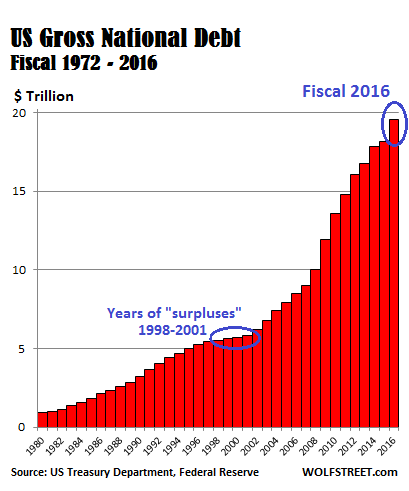
There’s the recovery as it’s been sold to you. It’s all been borrowed, to the last penny. Will Donald Trump double US debt once again? Will the EU countries do the same? How about Japan and China? And to think that federal debt isn’t even the worst threat, personal debt is, and so many of us carry so much of that, and try to pass off our mortgaged homes as assets, not debt. An increasingly desperate game on all fronts.

Tuesday, January 31, 2017

Trump's "Safe Zones"

It looks like a Trump administration is melting down even sooner than anticipated.

Iran test fired a missile. Such missile launches, the Israelis insist, are banned under the 2015 nuclear agreement. Trump talked tough on the campaign trail about how he would crack down on Iran. Things are heating up in Yemen as well. So Trump is at a point where he can't freely tack back and forth on foreign policy. He is going to have to commit to a course of action.

There is no course more momentous than Trump's apparent commitment to "safe zones," a sloppy repackaging of Hillary's long-sought-after "no-fly zones."

According to Nahal Toosi's story in Politico, "Trump chats with Saudi, Abu Dhabi leaders about 'safe zones'":
In his call with Saudi King Salman, the president “requested, and the king agreed to support, safe zones in Syria and Yemen, as well as supporting other ideas to help the many refugees who are displaced by the ongoing conflicts,” the White House said.
It was not immediately clear what Trump meant by “requested” safe zones in those two war-struck countries or what the Saudis are willing to do. Past talk of creating such havens has run into the reality that U.S. lawmakers are cool to any move that could lead to the deployment of American troops in the Middle East.
Trump and Salman also “agreed on the importance of rigorously enforcing the [nuclear deal] with Iran and of addressing Iran’s destabilizing regional activities.”
Trump garnered quite a bit of intellectual support from the left because of his reluctance to embrace the neocon jihadi war to oust the Baathists in Syria. Now that reluctance appears to have been a campaign ploy.

Obama's reboot of the Cold War likely cost the Democrats the White House in 2016. When Trump dons the mantle of the perpetual warrior, whether saber-rattling against Tehran or fiddling about with the sheikhs golden ticket of a Syrian no-fly zone, most of his popular intellectual support will evaporate. He'll be left with the know-nothings out there in opioid-induced-constipation TVland.

Monday, January 30, 2017

Trump Needs Le Pen and Vice Versa

Benoît Hamon won the Socialist Party primary yesterday in France. He won 58% of the vote, clobbering the neoliberal Manuel Valls. Alissa Rubin reports in "Benoît Hamon Wins French Socialist Party’s Presidential Nomination":
Mr. Hamon strongly endorses a stimulus approach to improving the economy and has promised to phase in a universal income, which would especially help young people looking for work, but would also supplement the livelihood of low-paid French workers. The end goal would be to have everyone receive 750 euros per month (about $840).
With the Republican's François Fillon on the ropes over allegations that his wife received a lucrative no-show job, and Jean-Luc Mélenchon of the Left Party gaining momentum, the first round of France's general election on April 23 is shaping up to be anybody's guess.

Fillon stands for greater austerity, and Emmanuel Macron, who abandoned the Socialist Party and the Hollande government last year to create a new political party En Marche!, is a peak neoliberal who is currently standing at number three in the opinion polls.

I suppose a scenario is possible where Fillon continues to bleed out and Macron qualifies for the second round. But what I am interested in is whether it is at all possible to imagine a leftist, whether Hamon or Mélenchon, moving on to round two. And I don't think it is. Hollande has done lasting damage to the Socialists, and in the West, there is no broad base of support for legitimate leftist political formations.

So it appears that it will be Fillon or Macron squaring off against Marine Le Pen of the National Front. I think she beats either one for the same reason Trump beat Hillary -- because s/he is the person who said s/he is going to protect voters' jobs and lifestyles.

Trump needs Le Pen at this point, and Le Pen needs Trump to avoid total self-destruction before the end of April. Announcing his immigration order without working first with the Department of Homeland Security created chaos. If Trump makes more decisions like this in the next three months, a Le Pen presidency might not seem worth the risk to a majority of French voters.

Friday, January 27, 2017

Bogus Study Foundation of Voter Fraud Claims

Nate Cohn debunks Trump's epic voter fraud claim in "Illegal Voting Claims, and Why They Don’t Hold Up":
There isn’t any evidence to support President Trump’s assertion that three to five million illegal votes were cast in the 2016 presidential election. 
But there is one study that has been interpreted to suggest it is at least possible. It found that between 32,000 and 2.8 million noncitizen voters might have fraudulently cast ballots in the 2008 presidential election. The study, based on a survey of 38,000 people after that election, has been under fire since it was published in 2014.
Cohn proceeds to burn the survey, the Cooperative Congressional Election Study, to the ground. All its noncitizen voters can be explained, and have been explained, as response error. Respondents completing the survey filled it out incorrectly. Not one noncitizen voter has been proved.

This says a lot about the Bizarro world in which we live. The media monopoly is so tainted its critique of Trump's assertion that Hillary's margin of victory in the popular vote can be explained entirely by illegal voters seems merely like more noise.

Thursday, January 26, 2017

Trump Will Go the Way of Nixon

I've been telling people since before the inaugural that it can't be sustained, that Trump will flame out. My epiphany yesterday was that what we are are dealing with here is a convoluted backward reanimation of Nixon.

Nixon came to power after winning a squeaker in 1968 because the Democratic Party had imploded. A shrewd campaigner and a dirty tricks magician, Nixon colluded with the South Vietnamese to upend LBJ's peace initiative, dooming Humphrey's chances of victory; then, in 1972, thanks to Kevin Phillips' Southern Strategy and the assassination attempt and crippling of George Wallace, Nixon reaped the whirlwind and smoked McGovern, remaking the GOP as the party of the cracker working man.

After that '72 landslide there was Watergate, and it was the GOP's turn to wander in the wilderness. Until the Reagan messiah appeared to cleanse the body politic six years later.

But Trump, who fancies himself a Reagan, is no Reagan. Trump is a Nixon, a deluded, brooding, grudge junkie without any of Nixon's Deep State sophistication, on foreign policy, on the labyrinthine federal bureaucracy, etc. Rather than recording himself on mountains of magnetic audio tape, Trump mainlines himself into the global noosphere via Twitter.

Nixon's election was a river flowing backward against the zeitgeist. The country continued to get freakier as Nixon welcomed Billy Graham to the White House. The same thing is going to happen now. Western society is now solidly feminist and multicultural and pantheistic. The old time dysfunctional cracker monotheistic patriarchal order is broken beyond repair. It can appear from the corner of the eye, like a ghost encountered on the staircase of the Winchester Mystery House, as majority sentiment, but it is not. Trump's 45% approval rating is probably his maximum level of support. We'll see tomorrow when a Right-to-Life march stacks up against last week's women's march.

Trump is headed full speed for the cliff. If I had to bet I would say that his goading of the Dragon is an almost certain path to destruction. To understand why read "Trump Injects High Risk Into Relations With China" by Jane Perlez and Chris Buckley. Trump's scrapping of the TPP convinced the Chinese that he might do the same thing with Nixon's One China policy. The Chinese are now preparing for a trade war; they will target Boeing aircraft and U.S. agricultural bounty. The Trump administration has also been hinting at a blockade of the islands China has recently constructed in the South China Sea. According to Perlez and Buckley,
Mr. Trump has also threatened China on control of territory it claims in the South China Sea. The comments by Mr. Trump’s press secretary, Sean Spicer, on Monday echoed those made by his nominee for secretary of state, Rex W. Tillerson, at his Senate confirmation hearing.
While Mr. Trump has not explained how he will keep China off islands where it has built airstrips and installed weapons, the comments by his appointees suggest the possibility of an American blockade. While Mr. Obama tried unsuccessfully to leverage American allies in the region to compel China to back down, Mr. Trump seems willing to abandon them and face China on his own.
That go-it-alone attitude has raised alarms at the Pentagon and among American Navy experts, who said such a blockade would be tantamount to war. The idea has also alarmed America’s allies.
Australia, Washington’s staunchest ally in the Asia Pacific region, would not participate in such a venture, its defense officials said, adding that a blockade could not be successful and could serve to persuade disenchanted American friends in the Asia Pacific to pivot toward China.
A scenario where the Pentagon refuses orders of the commander in chief and then works with allies in Congress to remove him is not far-fetched.

One thing is certain, the Masters of the Universe, the 0.1%, are nervous. "Elites Eying the Exits Signals America's Crisis," by Robert Johnson, was posted yesterday on Naked Capitalism:
Yves here. A former private equity partner mentioned the New Yorker story on 0.1% bunkering. He noticed how they focused on the private jet pilot as a point of vulnerability, that he might fly his family out and leave them stranded. So the approach is to assure him that his relatives get seats on the plane too.
Originally published at the Institute for New Economic Thinking website
Interviewed as part of an extraordinary New Yorker investigation into growing anxiety among America’s corporate elite over the potential for anarchic social collapse, Institute President Robert Johnson saw his peers’ talk of bolt-holes in New Zealand as reflecting a deeper crisis.
Johnson told writer Evan Osnos of the mounting anxiety he had encountered among hedge-fund managers and other wealthy Americans he knew. “More and more were saying, ‘You’ve got to have a private plane,” Johnson said. “You have to assure that the pilot’s family will be taken care of, too. They have to be on the plane.’ ”
Osnos writes: “By January, 2015, Johnson was sounding the alarm: the tensions produced by acute income inequality were becoming so pronounced that some of the world’s wealthiest people were taking steps to protect themselves. At the World Economic Forum in Davos, Switzerland, Johnson told the audience, ‘I know hedge-fund managers all over the world who are buying airstrips and farms in places like New Zealand because they think they need a getaway.’ ”
Johnson bemoaned the lack of a “spirit of stewardship” and openness to more aggressively redistributive tax policy among the wealthy.
“Twenty-five hedge-fund managers make more money than all of the kindergarten teachers in America combined,” he told the New Yorker. “Being one of those twenty-five doesn’t feel good. I think they’ve developed a heightened sensitivity.”
If anything, Osnos wrote, inequality is widening, noting recent statistics from the National Bureau of Economic Research that showed that while incomes for the top 1 percent of Americans have nearly tripled, half of the population was earning at the same level they did in 1980, comparing America’s wealth gap to that seen in the Democratic Republic of Congo.
“If we had a more equal distribution of income, and much more money and energy going into public school systems, parks and recreation, the arts, and health care, it could take an awful lot of sting out of society,” Johnson said. “We’ve largely dismantled those things.”
He saw elite anxiety as an indicator America’s social crisis.
“Why do people who are envied for being so powerful appear to be so afraid?” Johnson said. “What does that really tell us about our system? It’s a very odd thing. You’re basically seeing that the people who’ve been the best at reading the tea leaves—the ones with the most resources, because that’s how they made their money—are now the ones most preparing to pull the rip cord and jump out of the plane.”
Trump is a manifestation of end times. When it becomes apparent that he is a lens magnifying end times, hastening their arrival, rather than punting them downfield for another decade or two, the GOP in Congress will abandon him. But by that time it will be too late.

Wednesday, January 25, 2017

Trump Now Controls the Clock

You have to struggle to find news this morning about Trump's pipeline signings. My local paper leads with a story about a rally I attended last night, which was impressive in that it was called in the afternoon and managed to fill the downtown park where these events usually take place.

After about five-minutes worth of searching the online corpus of The New York Times I found "Trump Revives Keystone Pipeline Rejected by Obama," by Peter Baker and Coral Davenport, which had briefly topped Google News yesterday.

The big takeaway from the article is that Trump's pipeline signings -- inviting TransCanada to resubmit its Keystone XL application and then instructing the Army Corps of Engineers to hurry up in permitting DAPL -- were pure theater. He has bigger fish to fry, like green-lighting mountain-top removal and rolling back CAFE standards:
Mr. Trump’s biggest target may be emission rules that would force the closing of hundreds of coal-fired power plants meant to be replaced by wind and solar power. But they are caught up in court battles that could run for months or years.
By contrast, he could more quickly soften Mr. Obama’s rules requiring tougher vehicle emission standards. Mr. Trump met on Tuesday with executives of major American automakers, who complained that before leaving office, Mr. Obama finalized an ambitious E.P.A. rule requiring that vehicles average 54.5 miles per gallon by 2026. Mr. Trump said he would help with burdensome regulations, but offered no specifics.
Mr. Trump could lift a moratorium instituted last year by Mr. Obama on new coal mining leases on public lands. As soon as next month, the Republican-led Congress may pass legislation undoing Mr. Obama’s regulations on the practice of mountaintop-removal coal mining and on leaks of planet-warming methane emissions from oil and gas drilling rigs.
In the meantime, the Keystone and Dakota pipelines provided Mr. Trump with visible ways to demonstrate action. As proposed by TransCanada, an Alberta firm, Keystone would carry 800,000 barrels a day from the Canadian oil sands to the Gulf Coast. Republicans and some Democrats said that it would create jobs and expand energy resources, while environmentalists said it would encourage a form of oil extraction that produces more gases that warm the planet than normal petroleum.
Studies showed that the pipeline would not have a momentous effect on jobs or the environment, but both sides made it into a symbolic test case. The State Department estimated that Keystone would support 42,000 temporary jobs for two years — about 3,900 of them in construction and the rest through indirect support, like food service — but only 35 permanent jobs. Similarly, the government concluded that Keystone’s carbon emissions would equal less than 1 percent of the total greenhouse gas emissions in the United States.
“Keystone has never been a significant issue from an environmental point of view in substance, only in symbol,” said David L. Goldwyn, an energy market analyst and a former head of the State Department’s energy bureau in the Obama administration.
But it was a symbol Mr. Trump found important enough to seize on early in his presidency. He signed an executive memorandum inviting TransCanada “to promptly resubmit its application to the Department of State for a presidential permit” for the pipeline, although the document did not guarantee approval.
The president told reporters he would “renegotiate some of the terms” — including possibly an insistence that the pipeline be built with American steel — but left little doubt that he wanted it approved. “We’ll see if we can get that pipeline built,” he said. “A lot of jobs.”
In a statement, TransCanada accepted his invitation to seek permission again. “We are currently preparing the application and intend to do so,” the company said, vowing that it would create jobs and still protect waterways and other sensitive resources.
The Dakota Access pipeline in North Dakota became the focus of protests when the Standing Rock Sioux Tribe objected to its construction less than a mile from its reservation. The tribe and its allies won victory last month when the Army Corps of Engineers announced that it would look for alternative routes for the $3.7 billion pipeline instead of allowing it to be drilled under a dammed section of the Missouri River.
Mr. Trump signed an executive memorandum directing the Army “to review and approve in an expedited manner” the pipeline, “to the extent permitted by law and as warranted.” In his session with reporters, he added, “Again, subject to terms and conditions to be negotiated by us.”
Mr. Trump owned stock in Energy Transfer Partners, the company that is building the Dakota Access pipeline, according to his most recent filing with the Federal Election Commission. Last month, a spokesman for Mr. Trump said he sold all of his stock in June, but there is no way of verifying that sale, and Mr. Trump has not provided documentation of it.
Critics vowed to keep resisting the projects. Jan Hasselman, a lawyer for Earthjustice, an environmental law group representing the tribe, said Mr. Trump was discarding the findings of a review. “They’re just ignoring the problems that the government has already found,” he said, “and that is the kind of thing that courts need to review very closely.”
The signings coincided with the Standing Rock Sioux Tribe asking the water protectors to pack up and go home. Poor timing.

Timing is the meta-narrative of Trump's first week in office. Trump controls the clock. He is controlling the flow of news. It is coming too fast. The media is playing hurry-up. This morning the headlines are dominated by Trump's executive order to build a border wall, as well as his promise of a federal investigation of voter fraud. Tomorrow it will be something else.

The #ResistTrumpTuesdays protests were a whisper following the adulation over "a revolutionary movement in the making" of the women's march.

If Trump continues to wrong-foot his opponents, Robert Miller's comments from yesterday will no doubt be proven true: "Maybe Donald's purpose in life is to teach liberals that the CIA is really swell, and that coups by intelligence agencies are really the cat's meow."

Tuesday, January 24, 2017

Pink Revolution Demographics + Trump on Trade + Goading the Dragon + Brexit in Play

Nate Silver has a definitive breakdown of Saturday's women's marches ("The Long March Ahead For Democrats"):
Saturday’s Women’s Marches, which rebuked President Trump on the day after his inauguration, probably drew more than 3 million participants between hundreds of locations across the United States, making them among the largest mass protests in American history. The marches recalled the tea party protests of April 15, 2009, an event that helped to mark the beginnings of a backlash to former President Obama — but overall attendance at the Women’s Marches was about 10 times higher than at the tea party rallies, according to our estimates.
But the geographic distribution of the marches also echoed November’s election results, in which Hillary Clinton lost the Electoral College despite receiving almost 3 million more votes than Trump nationwide. About 80 percent of march attendees were in states that Clinton won, and a disproportionate number were in major cities. So if the marches were a reminder of the depth of opposition to Trump — unprecedented for a president so early in his term — they also reflected Democrats’ need to expand the breadth of their coalition if they are to make a comeback in 2018 and 2020.
Silver then proceeds to analyze the marches in terms of geography. The marches overwhelming took place in big cities, in states Clinton won, and reflect an urban versus rural divide that defined the election. Silver has very faint praise for the overall import of the Pink Revolution:
Like the early tea partiers, some of the people who turned out on Saturday will turn into organizers, fundraisers and influential voices in their communities, and some of them will even become candidates for office. The Democratic Party needs broader geographic appeal than what it has right now. But turning out 3 million people one day after the new president is inaugurated is a pretty good start.
My gut sense is that the women's march is a classic one-off like the People's Climate March of 2014 organized by 350.org -- huge but hard to replicate and of uncertain merit in creating meaningful change.

Yves Smith assesses what is in store for us with a Trump presidency. In "Consternation as Trump Starts Delivering on Campaign Promises While Making More Crazy Attacks on Critics" Smith argues that Trump is a narcissist with a difference -- he's a narcissist who is willing to regularly destroy his own image:
With Trump, we have, far more visibly. the same question that dogged the Obama Administration: what does he really stand for? With Obama, we learned that he was conservative and cautious, but also very much liked the appearance of getting things done. His press office repeatedly cited how much legislation was passed on his watch, as if volume was more important than quality. Trump is likely to have the same orientation. It’s easy to assume, as critics do, that Trump wants to become even wealthier. But Trump more than anything wants to be visible: his splashy/trashy buildings, his TV show, his relentless self-promotion, his reckless tweets. While Trump in oh so many ways looks like a classic narcissist, one departure is his need to mix things up. Most narcissists are working above all to have their environment reflect back a good image of them. Trump’s regular undermining of his own image is at odds with that.
There are far too many moving parts to have any firm view as to how the Trump Administration will pan out. But even though there was good reason to suspect that given the record of both celebrity politicians and DC outsiders, that Trump would wind up as Jimmy Carter squared, a President that didn’t get much done, the flip side is that underestimating Trump has proven to be a losing bet. Stay tuned.
Much a Trump's popular support is going to depend on how he handles trade. The Democrats doomed themselves by Obama pushing the TPP throughout 2016. Trump is off to a good start by scrapping the TPP. But as Smith points out much remains to be seen:
Both Bernie Sanders and the Teamsters praised Trump for ending the TPP. It is surprisingly under-reported that Trump met today with labor leaders, almost all of whom had supported Clinton. It is a not-well-kept secret that many union members bucked the leadership and voted for Trump. But the bosses engaging in a session with Trump that they described as “excellent” may be the start of the formal and long-overdue exit of unions from a party that has treated them as disposable for over 30 years. 
But how far will Trump go? The problems with TPP were much better publicized than many might assume; when Lambert saw Trump speak in Bangor, Trump referred to the TPP only by its initials, didn’t explain it, and the crowd seemed familiar with it. By contrast, other dangerous “trade” deals, like the TTIP and TISA, are still as of now, moving forward.
Trump appears committed to goading the Dragon. According to this morning's Foreign Policy Situation Report:
Warning shot aimed at Beijing. Sean Spicer also told reporters Monday that Washington is prepared to take action to prevent China from building more islands in the South China Sea and claiming the territory as its own. "It’s a question of if those islands are in fact in international waters,” he said, “and not part of China proper, then yeah, we’re going to make sure that we defend international territories from being taken over by one country."
Chinese Foreign Ministry spokeswoman Hua Chunying shot back on Tuesday that China's sovereignty over the Spratly Islands in the South China Sea was "irrefutable," adding, “we urge the United States to respect the facts, speak and act cautiously to avoid harming the peace and stability of the South China Sea," Hua said. "China's resolve to protect its sovereignty and maritime rights in the South China Sea will not change.” 
If Trump continues down this path it can't end well. Trump acts as if he thinks that the Chinese are lightweights. He is going to have to switch up his game or risk catastrophic failure.

When it comes to catastrophic failure the UK political class' management of Brexit comes to mind. The Supreme Court ruled today that Article 50 negotiations can't begin until Parliament votes. Here is an 11th-hour opportunity for the discredited neoliberal orthodoxy. Parliament could block Article 50 and in effect repeal Brexit. This outcome is usually dismissed in most stories. But why? A majority of Labour and Conservative MPs opposed Brexit. I suppose they are worried about the repercussions to their political careers if they were to block Brexit. But a plausible scenario is to amend and talk any Parliamentary vote to death, May's government would fall and new elections would be held which would be a replay of the Brexit referendum. The outcome could very well be different this time.