Showing posts with label Summer of Love. Show all posts

Friday, July 24, 2015

Hippies vs. Punks: Ravi Shankar


It has been a strange week. The sizable crew of painters who have been working on the exterior of the apartment building for weeks finally arrived to the north side where my studio is located. They use diesel telescopic booms. From Monday on my windows have been masked with milky polyethylene plastic sheeting and brown paper. So when I arrive home after work it has been like stepping into a spider's cocoon, dark and stuffy.

At the same time I have been preparing for a job interview, actually interviewing, and then waiting to hear if I would receive a job offer. I did, which then created another cycle of adrenaline as I submitted two-week's notice to the office manager at the local.

Waking up every morning in the midst of this I needed something sonically different, something calming but nutritious. By happenstance I lighted on my collection of Ravi Shankar records.

Listening to Hindustani classical Indian music turned out to be just the thing I needed.

Of course Ravi Shankar played an enormous role in the definition of Hippie culture. He was present at the creation when the Summer of Love kicked off at the Monterey Pop Festival in June of 1967.


And he and George Harrison pioneered the superstar blow-out benefit rock concert with The Concert for Bangladesh the summer of 1971.


But critical for Hippies vs. Punks is his role in the Dark Horse Tour with Harrison in November and December of 1974. The concerts were savaged in the music press. Shankar suffered a heart attack and Harrison lost his voice. To me it is a critical moment in the expiration of the Hippie. If the Manson Family and Altamont hadn't killed off the Hippie at the end of 1969, since the massification of bohemia along Hippie lines proceeded apace all during the early 1970s, by the beginning of 1975, given the stillbirth of the first tour of the U.S. by a Beatle since 1966, it was clear the Hippie had run out of juice.


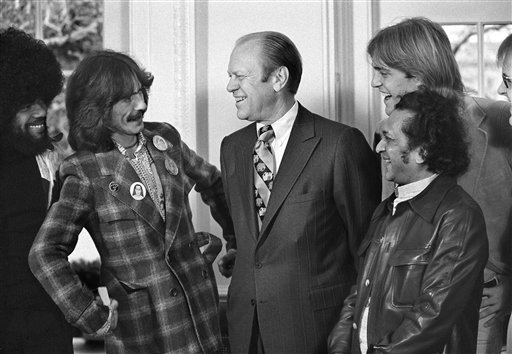
This photo from the Dark Horse Tour of Harrison and Shankar in the White House with Gerald Ford (Billy Preston to the left of Harrison) sums it all up. The president who pardoned Nixon (thereby preventing a necessary airing of a dangerously corrupt system) and who presided over the fall of Saigon yuks it up with the coked out peddler of "Krishna Consciousness." Is there a more fitting bon voyage to the Hippie?

Nonetheless Ravi Shankar's recordings are a goldmine. The ragas are particularly rejuvenating:

Friday, September 13, 2013

Hippies vs. Punks: Quicksilver Messenger Service and Happy Trails


One band that seemed to be a participant at every seminal event in the formative Hippie years of 1966-1967 is Quicksilver Messenger Service. For instance, QMS performed at the Human Be-In at Golden Gate Park in January 1967, where the Hippie was named, and the Monterey Pop Festival in June 1967, where the Hippie burst into the national consciousness during the "Summer of Love."

I've had a copy of Happy Trails (1969) loaded on my iTunes for a while, but I didn't really get around to studying it until this year. Word is that it is one of the all time great rock albums. Listen to it and you very well might agree. Its extended contemplation of Bo Diddley's foundational "Who Do You Love?" is otherwordly; it has been called the definitive recording of the psychedelic San Francisco ballroom sound. Listen to it and you conjure up a world whose conception of time -- the Hippie trip -- has long since gone the way of the dinosaurs.

That pregnant, full, meandering, languorous sense of time is on display in the first album as well, the eponymous Quicksilver Messenger Service (1968), though here it is less beautiful and seems shot through with Technicolor 1960s cowboy Western rhythms and imagery.


It is ironic that the band that so perfectly captured the Hippie sensibility of a deep, flowing type of time, as opposed to a standard manic rat-race reaffirmation of time found on the three-minute AM radio pop tune, would choose the speedy, elusive messenger god Mercury as its namesake. Speed as the primary force shaping our time is the hallmark of the Punk. (See Paul Virilio's Speed and Politics: An Essay on Dromology, published in the Punk year of 1977, for a discussion of speed as the essence of technological society.) And in the end this is an argument for the Hippie being a much more radical, revolutionary figure than the Punk. The Hippie sought an entirely different temporal order than the technological one ruling Industrial/Post-industrial society. The Punk pursued the opposite strategy. Rather than eschewing the temporal order of the dominant society, the Punk attempted to pluck out its heart -- speed.

After Happy Trails lead singer and rhythm guitarist Gary Duncan took a year-long hiatus, and QMS, like any good band, moved on in a different direction. But for those who want to experience what time felt like in the 1960s -- really, what the '60s were all about -- we have the first two Quicksilver Messenger Service records.