Showing posts with label Seattle. Show all posts

Tuesday, June 12, 2018

Great Satan Reigns in the Emerald City

To sample abject capitulation in the face of money power the two stories to read this morning are by Heidi Groover and Steven Hsieh, "Seattle City Council Will Vote on a Head Tax Repeal" and "5 Takeaways From the City Council's Impending Head Tax Repeal."

Before seeing if the paid signature-gatherers hired with money from Amazon and Starbucks had accumulated enough valid signatures to place on the ballot in November a repeal of a head tax on large employers to fund homeless services and housing, which the city council passed last month, the council is scheduled to repeal its own handiwork today. Groover and Hsieh set the mood:
Less than a month after passing a head tax to fund housing and homelessness services, the Seattle City Council looks poised to repeal it tomorrow.
"It is clear that the ordinance will lead to a prolonged, expensive political fight over the next five months that will do nothing to tackle our urgent housing and homelessness crisis,” wrote seven city council members and Mayor Jenny Durkan in a statement.
The announcement caps off what has become one of the ugliest political debates in recent Seattle history, handing a victory to big businesses who opposed the head tax every step of the way.
If the council axes the head tax tomorrow—and it seems almost certain that they will—we’ll be feeling the ripple effects of the move for a long time.
While this might seem of merely local importance, it's actually a significant "canary in the coal mine" moment in the global Zeitgeist. If one of the most progressive cities in the nation, a city with the one of the worst homelessness problems in the U.S. (Seattle is behind New York and Los Angeles, significantly larger cities), a city that recently led the way with a $15-an-hour minimum wage, cannot address a state of emergency then we must accept the fact that government can do only that which the wealthy allow.

It's a bitter realization, one we intellectually understand, but hard to swallow. The election of Obamaite Durkan last year as a mayor was a clear indication that the moneybags would no longer allow Seattle's progressive proclivities to go unchecked. Too much money was coming into the city. The city had to be governed like every other large polity. Ruthlessly and with eye only toward mammon.

In the big picture, if U.S. leadership decides to wage war on Iran there will be barely a peep of protest from voters. That was my takeaway last month when I spied nary a single Democrat at a rally and march for the head tax.

Liberals don't care. They only care to have a reputation for caring. It's a society absent soul, and one in need of a radical makeover post-haste.

Tuesday, May 15, 2018

Don't Expect Any Liberal Resistance When the War Against Iran Starts: My Impression of a Saturday Rally and March for Affordable Housing

There is resolution to Seattle's effort to build affordable and fund homeless services by taxing large corporate employers. Yesterday a reduced proposal was passed 9-0 by the city council. As The Stranger reports, "Seattle City Council Passes $45 Million Head Tax Compromise":
The tax, which passed unanimously, is nearly half the size that four city council members originally proposed in April. Under the plan, Seattle would collect $275 per employee from businesses grossing more than $20 million in annual revenue, or about three percent of the businesses in the city.
The tax is projected to bring the city about $45 million of new annual revenue in its first year, according to a spending plan prepared by council staff. Under the legislation, council members would have the option of renewing the tax after five years.
Now the bill heads to Mayor Jenny Durkan’s desk. In a statement, she says she plans to sign the legislation. "This legislation will help us address our homelessness crisis without jeopardizing critical jobs," Durkan said.
The tax proposal represents a compromise between city council members who aimed much higher—$500 per employee to raise $75 million—and their colleagues who believed the initially proposed rate would be too costly for businesses. Mayor Durkan fell in the latter camp. Late last week, she put her support behind a $250 per employee tax.
The Seattle Times reports, "Seattle City Council votes 9-0 for scaled-down head tax on large employers," that Amazon, though unhappy with the reduced tax, will resume construction planning on the large downtown location, Block 18, that was paused:
The city declared a homelessness state of emergency in late 2015. A point-in-time count last year tallied more than 11,600 homeless people in King County and one in 16 Seattle Public Schools students is homeless.

“We have community members who are dying,” Councilmember Teresa Mosqueda said before the 9-0 vote. “They are dying on our streets today because there is not enough shelter” and affordable housing.
In a statement after the vote and weeks of fierce debate, demonstrations and denunciations, she said the tax “will have a meaningful impact on addressing our homelessness crisis by building housing and providing health services.”
Having paused construction planning on an office tower over the larger proposal, Amazon now will move ahead with it, a spokesman said after the vote. But the company’s plans to occupy a skyscraper under construction are still up the air, he said.
“We are disappointed by today’s City Council decision to introduce a tax on jobs,” spokesman Drew Herdener said in a statement.
“While we have resumed construction planning for Block 18, we remain very apprehensive about the future created by the council’s hostile approach and rhetoric toward larger businesses, which forces us to question our growth here.”
I attended a rally and march Saturday for the full $500 per employee head tax. Despite the homeless crisis in the city, despite the national attention and Amazon's high-stakes extortion, despite the golden opportunity to build some affordable housing, which the Chamber of Commerce's own study says is desperately needed, the people who showed up were mostly socialists -- Freedom Socialists, Socialist Alternative, Democratic Socialists of America, Workers World Party, and probably some other socialist splinters that I'm leaving out.

Nowhere did I see any Democrats, whether politicians or precinct-level people. Nor did I see any organized labor presence other than rank'n'file AFSCME members who were socialists.

It was a good group. Probably 100 strong. We made a lot of noise as we marched through downtown to Amazon's new headquarters. It's just that there were no liberals among us.

So here you have a slam dunk: Tax Amazon, a global behemoth, to build some units of affordable housing and put some more resources into dealing with the homeless state of emergency. But the liberals are missing.

My immediate takeaway is that liberals have lost all connection to decency. The Democratic Party, including its rank'n'file, is neoliberal. False consciousness is its only consciousness. Don't expect any protest when the war with Iran starts.

Thursday, May 10, 2018

Ape-Shit in the Emerald City

Over the last week or two I've noticed that the usual homeless encampments I come across on my morning walk to work have been swept up. I got to see a sweep take place today. A guy was sleeping peacefully wrapped in one of those blankets made out of recycled material when two strapping young white officers of the Seattle Police Department pulled up in their trendy hatchback cruiser and rousted him.

Rather than address the problem -- which Charles Mudede correctly identifies in a post yesterday "Why Seattle's Proposed Head Tax Is Making So Many People Go Ape-Shit" -- of skyrocketing housing costs brought on by Amazon's commercial construction orgy, the idea is just to scatter it to the winds so it's not as visible, not such an eyesore.

This change, I surmise, is pegged to the high-stakes city politics underway. There is a committee vote tomorrow morning on a "head tax" to fund low-income housing and homeless services in Seattle. From this morning' s Slog:
Under the current proposal, the city would impose a tax of about $500 per employee on for-profit businesses grossing more than $20 million annually. In 2021, the city would switch to a .7 percent tax on payroll for the same businesses. City staff estimate both taxes will generate about $75 million of revenue for housing and homelessness services.
The mayor has come out in opposition. She will likely veto the legislation, and the council majority does not have the votes to override her veto.

Mayor Durkan was elected for this very reason. The wealthy have been troubled by the progressive drift of the city since Occupy Wall Street and the ascension of Kshama Sawant and the $15 minimum wage. The message is clear. The market rules even in a progressive metropolitan gem like the Emerald City.

With the head tax stymied, the present boom will maintain its course. More homeless sweeps, more sterile gentrification of an already gentrified city. Eventually -- I thought of this last week -- a prison ship will be anchored in Elliott Bay to keep the homeless and their refuse off the streets.

Mudede sums it all up:
All of this hysteria, however, obscures one obvious fact about Seattle's boom: It's not benefiting the poor. They can't afford to live in the city because rising rents, which are tied to rising house prices, are claiming more and more of their hard-earned, but still low, wages. Indeed, a recent article by Puget Sound Business Journal's Marc Stiles reports that though there is more supply in the local housing market, prices are still going up and up. He also reports that, according to Northwest Multiple Listing Service, the "median sales price of houses in King County hit $725,000, up 16 percent over a year ago."
This is all that the boom has meant for most people in Seattle who, even if they find employment, are unlikely to earn enough to meet the ever-rising costs of living in this city. For them, the boom has been a crisis that's only getting worse. Officially, we haven't been in a recession for most of this decade, and in an economic boom for half a decade, and yet, IRS data from 2015 (a full two years into the boom) shows half of the people who live in Seattle earn less than $50,000. The five-year boom has, for many in this city, done more harm than good; this we do actually know. But what the anti-tax op-eds and stories in this city's leading papers are saying is that the head tax will be even worse than the continuation of a boom whose benefits have yet to be shared in any meaningful way. So, even if you do not agree with raising taxes, you have to admit that what all of the anti-tax people are offering as a solution to a brutal housing crisis is more of what has, for the most part, caused the crisis.
And it is exactly here that the noise about the taxes is revealed to be atavistic rather than edifying. Those who authorized the current hysteria are from a class that, since the birth of the market-centered society, has hated taxes (the rich). And with good reason. Taxes hit them the hardest. And with good reason—they have most of the money. So, it's not a matter of the head tax being right or wrong, good or bad, fact or fiction, science or religion. What the chimps must do is bang and jump when any talk about raising taxes emerges from the foliage.

Thursday, May 3, 2018

Amazon Shows Its Inner Trump

I meant to stop in at a bagel shop yesterday morning on my way to work. There was an all-staff meeting at the office. I couldn't stop and get a dozen bagels because the bagel shop is no longer there.

The main thoroughfare of my neighborhood has been bleached of personality largely due to the massive year-after-year expansion of Amazon's corporate presence downtown. Any old Hippie or Punker ghetto chic has been blasted away. Now there is nothing on Broadway but expensive restaurants, drop-in for-profit health centers, and chain stores fronted by sidewalks filled with the homeless. The Alley, an arcade of greasy spoon eateries, is still hanging on. But for how much longer?

Bear all this mind if you care to read two stories -- "Amazon pauses plans for Seattle office towers while City Council considers business tax," published by the remaining daily in town, the plutocratic Seattle Times, and "Amazon Halts Downtown Construction Pending City Council Vote on Head Tax," by the blog of one of the weekly papers, The Stranger.

Seattle City Council is considering a modest tax on large employers in the city. As The Stranger explains:
The council proposal would tax businesses grossing more than $20 million a year $0.26 cents per hour per employee. Beginning in 2021, the employee hours tax would be phased out and replaced with a 0.7 percent payroll tax. 
It would affect roughly three percent of businesses and bring an estimated $75 million to housing and homelessness services.
There is a serious homelessness problem in the city. As the Times story reports, "Seattle’s homeless crisis is among the worst in the country, with an official state of emergency more than two years old and a record 169 deaths recorded last year."

I could write about it every day. When I walk to work in the morning it is a tour of destitution. And what makes it so bizarre is that the sidewalk shanties and refuse-strewn nooks of abandoned storefronts are cheek by jowl with the high rises shooting up and tower cranes seemingly on ever block.

Walking home from work at the end of the day I walk through the heart of Amazonia. It reminds me when I used to go visit my high-school buddy. He was at Stanford and I was at Berkeley. We would trade off weekend visits a couple times a year. He lived on campus. For me, Stanford was like a country club. That's what the Amazon-heavy parts of the city are becoming, privileged enclaves of elite workers.

What made the news yesterday is that Amazon lifted up its shirt and showed the butt of a big handgun shoved under its belt. Executives in a meeting with councilman Mike O'Brien threatened to halt construction on a huge, long-stalled development in the heart of downtown if the large-employer tax moves forward.

Amazon's threat puts the city council, which right now is 5-4 for approving the tax, in a tight spot, and not in a way that Amazon would want. For any of the five to change his/her vote now would be very damaging; at the very least, it would invite a challenge the next election.

In the end, the whole thing -- the homelessness crisis in tech-giant boom town; the hostile, extortionist response to a modest tax from a corporate behemoth that posted $1.6 billion in profit last quarter -- stinks to high heaven. It is yet more proof of how completely bankrupt peak neoliberalism is.

My sense is that the Seattle City Council will hold the line. It will be an interesting study to see if big money can bribe and threaten its way out of this. I suppose one of the five could switch sides and then not run for reelection, or run for a different seat. Lorena González is the weak link.

Friday, March 9, 2018

The Emerald City is Going to Shit

From yesterday's Significant Digits:
5,400 people
That’s the number of people in Seattle who live on the street, according to one 2017 survey, about half of whom live in their vehicle. A judge ruled in favor of a Seattle man whose vehicle, where he also lived, was impounded to pay for parking debts, saying that the vehicle was covered under the 123-year old Homestead Act. That law says the government cannot force people to sell their homes to pay for a debt. [KIRO 7 News]
And this from Wednesday's Charles Mudede post, "Seattle Housing Prices Continue to Soar, as Congress Prepares to Deregulate Banks":
Two important pieces of news to consider this afternoon. The first, reported by the Seattle Times, is that the median for single-family-home prices in Seattle has reached an astounding $777,000. That is an increase of $20,000 from the last peak, which was reached in January. As for the Eastside, the median cost is almost $1 million. As expected, the explanation provided for these ever-rising prices is not speculation, but a hot jobs market.

From Seattle Times:
The hyper job market in the Pacific Northwest continues to outpace almost every metro area in the nation, and thus our housing market is booming; for now, there is no end in sight,” Mike Grady, president and COO at Coldwell Banker Bain, said in a statement.

The reporter, Mike Rosenberg, felt that the opinion of this Bain banker settled the matter. Rosenberg did, however, mention that while incomes are rising in the Seattle area, home prices are "still increasing much faster." 
Meanwhile in Washington, D.C., several Dems in alliance with lots of Republicans are preparing to remove significant rules that were imposed on the banking industry after it destroyed the global economy in 2008. These rules are a part of the Dodd–Frank Wall Street Reform and Consumer Protection Act.
I live near downtown Ground Zero of all this. Homelessness is visible everywhere in spite of an atypically harsh winter (part of the polar vortex thing). The nuts and bolts are this: a small business, like a gym or neighborhood saloon, move into a storefront and then closes after not too many months. The main reason? Can't afford the high rent. So the storefront goes vacant and the homeless move in and squat. There has been one a couple blocks from my apartment building for a year now.

Another aspect of living in the hottest job market/real estate market is the massive amount of dog shit on the sidewalk. Maybe it's human shit. I don't know. I assumed it was from a dog based on the large number of people I see walking their precious pooches. More so than at points in the past. More condos and high-end multi-story apartment buildings have shot up in my neighborhood and they cater to the single professional who usually shares her living quarters with a canine pet.

Rampant homelessness, no doubt far worse than that documented by the quote at the top of the post, and sidewalks slathered in shit that's what you get in this iteration of "as good as it gets" neoliberalism.

And now comes the news that Michael Bennett has been traded to Philadelphia and that Richard Sherman will be cut today  The Emerald City is definitely going to shit.

****

POSTSCRIPT: There is a really good piece by Brian Floyd, "A Seahawks fan’s elegy for the Legion of Boom," on what appears to be a done deal -- Richard Sherman will be cut today. It is definitely the end of an era:
The history of the Legion of Boom is full of trials and errors, huge mistakes and amazing successes. In the 2013 playoffs, the Seahawks defense gave up a last-second field goal to the Falcons in the divisional round, ending their season. The next year, with the 49ers driving in the NFC Championship, Richard Sherman tipped a Colin Kaepernick pass to the end zone to Malcolm Smith to seal a Seahawks win. Failure, a lesson learned, and a success. What happened two weeks later was a foregone conclusion and a victory lap for the Seahawks defense. The Legion of Boom had a ring, and the experiment worked.
The question is always how long will it keep working. Getting the experiment off the ground is half the battle. In the NFL, the window is short and so is the shelf life for players. And it’s a contact sport so injury luck is involved.
It wasn’t hard to spot the seams. The blowups on the sidelines became more frequent, and there was more tension. Age catches up and the margin for error on defense goes down. Injuries happen, including freak ones like a leg whip from Chancellor, which ended Thomas’ season in painful and devastating fashion. The wear and tear later caught up to Chancellor, and he may never play football again. Playing at the speed and level the Legion of Boom did takes its toll.
The realization that it was over came as Sherman laid on the turf during a brutal Thursday night game against the Cardinals. His Achilles was ruptured, and had been just barely hanging on all season anyway. The Legion of Boom was aging and injured, and the Seahawks had to make some decisions. The seams had been showing, and this was the last gasp before they, too, burst.
Sherman will be released, and may or may not be back. Michael Bennett is gone and Cliff Avrilmay never play again. The Seahawks are moving players around left and right, signaling a large-scale roster shakeup. Earl Thomas may be the only remaining member of the Legion of Boom. Seattle’s defense will look different, and sound quieter.
The Seahawks will try to rebuild, and try to recapture what the Legion of Boom created. There are holdovers, and new faces will emerge. But it’s impossible to re-create what the LOB became because it was an experiment all along: careful scouting, some patience, an environment they could flourish in, a scheme that fit their skills to a perfectly, and a whole lot of luck. What you’re left with is the end of an era and attitude, and a whole bunch of fun memories.
Those Seahawks teams from the 2012 season through the Super Bowl loss that capped the 2014 season were some of the greatest of all time. It's a shame that Carroll and Bevell didn't let Marshawn Lynch run the ball into the end zone against the Patriots. Back-to-back Super Bowl wins would have memorialized the team's greatness. Now it's being junked as a matter of routine business.

Friday, March 31, 2017

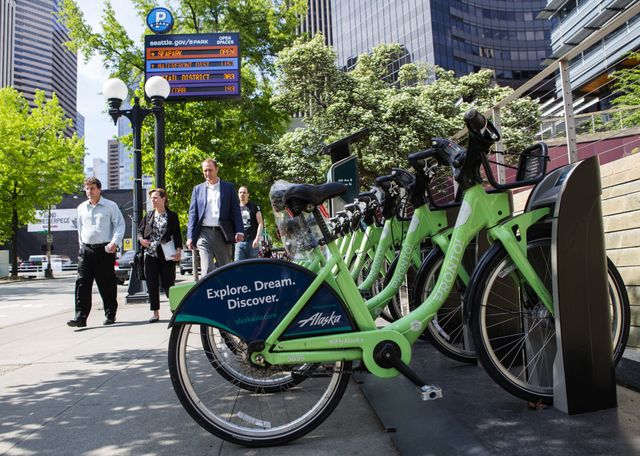
The Premature Death of Pronto: Bike Share Fails in Emerald City


Today is the last day of Seattle's appalling attempt at a bike-sharing program. Dubbed "Pronto," it didn't even survive three years.

Pronto began as a public-private partnership in 2014, but in a little over a year it was declared insolvent. The city was forced to buy it in toto in March of 2016. At the beginning of this year, Mayor Ed Murray said he would kill Pronto. Today is execution day.

The week began with a spate of media coverage of this unseemly embarrassment for a city that fancies itself the capital of Cascadia, the wealthy, urban Eco-sophisticate to its more provincial cousins, Portland and Vancouver, B.C. Both Portland and Vancouver have far larger cycle-share programs in terms of numbers of bikes. To give you an idea the depths of Seattle's failure, Houston is scheduled to expand its cycle-share to 1,000 bikes by the end of the year.

The best synopsis of this Emerald City debacle I read was David Gutman's piece in the Seattle Times:
Bike shares are booming in the United States. In 2010 the nation had only four bike-share systems, which accounted for about 300,000 total rides, according to data from the National Association of City Transportation Officials.
Last year there were 55 bike-share programs and more than 28 million total rides.
Total ridership nationwide has increased nearly 60 percent since Pronto launched in 2014.
But it’s been a different story in Seattle.
Pronto launched in fall 2014 with high hopes, a $2.5 million private sponsorship and $1.75 million in state and federal money. 
But it had to deal with a challenging environment — a hilly, rainy city with a mandatory helmet law and a downtown area clogged with traffic and with few protected bikeways.

Ridership lagged.
Within a year, city officials were pushing to take over the bike-share system, which had been owned by a nonprofit.

Scott Kubly, the city’s transportation director, argued that a city takeover would allow Seattle to build a bigger, broader network that would attract more riders. In January 2016, the city was told that Pronto was insolvent and would shut down if the city didn’t buy it. The city complied in March 2016, buying Pronto for $1.4 million. 
Kubly, in his previous job, had been president of the company that operated Pronto. He later admitted to an ethics violation and agreed to a $10,000 settlement for failing to get an ethics waiver or recuse himself from the city’s launch and purchase of Pronto. 
After the city’s purchase, Pronto never significantly expanded its network. It still had the same number of bikes it did at its launch and had added only four more docking stations. 
Still, as recently as December, the city seemed ready to make significant new investments — by buying a whole new fleet of 1,200 electric bikes and 100 new docking stations — to transform the system. 
In January, Mayor Ed Murray announced that he was changing course. He scrapped Pronto and said the $3 million that had been budgeted to the bike share would be used for pedestrian and bike projects such as improving crosswalks at schools and adding bike lanes.
The brittle, sneering, "hipper-than-thou" weekly, The Stranger, attempted to spin the demise of Pronto as a triumph of pedestrian commuting. But that's just bullshit.

I think 20 years ago it would have been impossible for the city, corruption and all, to have fucked-up a cycle-share program (even if all the bikes were latrine green and plastered with the Alaska Airlines corporate logo). Neighborhoods that surrounded downtown still housed young people of very modest means.

Thinking about this, I went online to see if the local chapter of Critical Mass was still active. Apparently not.

Now the median price of a home in Seattle is over $600,000, and I imagine a home costs much more in one of the neighborhoods, like mine, that is very close to downtown. On the northern perimeter of the downtown retail core Amazon is constructing a corporate Oz. High rises are sprouting like toadstools.

My neighborhood, which for many years was part LBGTQ-Grunge rocker-old-Hippie enclave, part old money surrounding the Olmsted Brothers designed public park, is now the bedroom community for young Amazon digerati.

Leaving my apartment building for work one morning I passed a young man in the latest gear -- nice black running pants, stylish long-sleeve Arcteryx shirt with zippered collar -- coming back from a run. He looked like someone in fashion magazine. He casually greeted a beautiful young blond woman who was just exiting the entrance to the building opposite my own. She was so pretty and tastefully dressed I started thinking of the Kinks song. She said to the young man, "I quit my job yesterday. I'm going to freelance."

Just like that. Like I was in New York City.

But it is not New York. Because if it were we would have a successful bike-share program.

Wednesday, November 4, 2015

2015 Election Results So Far: Right on the Rise; Left Holding Steady in Pockets of Progressivism

The morning after election day in the United States the early results seem to be a status quo election. The U.S. status quo is drifting to the right, with pockets of progressive sentiment in those places where the economy is waxing. For instance, here in Seattle, much to my surprise, a vague, nearly $1 billion transportation levy is headed for victory. My sense, based on a steady diet of negative local press and word-of-mouth hostility, was that the proposition would lose by a super-majority. Also encouraging, though not unexpected, a progressive county-wide initiative on early-childhood education is headed for approval. Plus, there is socialist Sawant's solid showing. She leads her corporate challenger 53% to 47%. The way ballots are tallied in King County, which votes entirely by mail, it takes a week to finalize the count. By that time, Sawant's total, if her last election is any guide, should be closer to 60%. Quite a statement.

One disappointment is West Seattle's District 1. Progressive Lisa Herbold is running six points behind the corporate stooge. It is not impossible, as the late ballots are counted, for Herbold to mount a comeback, but it a real long shot. Maybe if the margin were three points she could pull it off. But six is daunting.

Nationwide, the Gray Lady is trumpeting two elections, both conservative victories. In the Commonwealth of Kentucky, the Republican Tea Party candidate, Matt Bevins, easily bested his Establishment Democrat opponent, Kentucky Attorney General Jack Conway, 52.5% to 43.8%.

Two passages in the frontpage story by Sheryl Gay Stolberg and Alan Blinder, "Matt Bevin, Republican, Wins Governor’s Race in Kentucky," both persuasively argue for a rightward electoral drift.

In the first, the reporters mention that there is only one statehouse in the South that is now under Democrat control -- one! -- and that is looking shaky:
For Democrats, more than the governorship was at stake. Kentucky is the last state in the South where Democrats hold a legislative chamber — the Kentucky House — and without the governor’s mansion, their hold on that chamber is in danger. 
“This changes the dynamics,” State Senator Robert Stivers, a Republican and the Senate president, said. “Instead of having one leg of the stool, we now have two legs of the stool — and the third leg is very weak.” Later, Mr. Stivers and Mr. Bevin appeared together onstage after Mr. Bevin’s victory speech, leading supporters in a chant of “Flip the House! Flip the House!”
Second, Democrat Conway ran to no avail on all the issues that Democrats consider their "Aces High":
The son of a prominent lawyer in Louisville, Mr. Conway hews mostly to traditional Democratic positions. He favors increasing the minimum wage (Mr. Bevin is opposed); is a strong backer of unions (Mr. Bevin favored “right-to-work” laws that would limit union organizing); and made early childhood education a centerpiece of his election campaign. (Mr. Bevin emphasized school vouchers.)
Not a good sign. Also not a good sign is the other election that The New York Times national edition highlights this morning, the defeat of Houston's anti-discrimination ordinance. One positive trend over the last few election cycles has been the increasing social tolerance of the American voter. Willing to countenance non-traditional sexual preferences, gender roles and substance consumption, citizens in some spots of the Western world have shown a progressive, open-mindedness that points in the direction of a more egalitarian society. If one were willing to engage in some "pie-in-the-sky" hopefulness, one might say all we need to do is crack the plutocratic, oligarchic stranglehold on the our politics and we'll be ready to solve some of big, unresolved issues.

But the old, negative divide-and-conquer logic is hard to overcome. In Houston, the opponents of the anti-discrimination ordinance were able to conjure up a lurid, pulpy image of men stalking women into public restrooms, ravishing our fertile daughters, and the law helpless to do anything but stand by and watch.

Tuesday, November 3, 2015

Election Day: Emerging Class Consciousness in West Coast Tech Cities

"All politics is local" is a largely useless statement ascribed to Tip O'Neill, known in American history for being the liberal Democratic Speaker of the House during the Age of Reagan. The idea that the statement is supposed to convey is that politics boils down to basic interactions between a representative and his/her constituents. The "rubber" always meets the road in some sort of idealized speech act where the honest pol knocks on a door in his/her district and gets an earnest earful from a thoughtful, engaged citizen. Since most people have do not have any sort of basic interaction with public officials -- elected, appointed or otherwise -- it begs the question, doesn't it?

Politics in the West are elections where the "Haves" spend money, usually a lot, to elect the representative of their choice, someone who will continue the gravy train running on time, shuttling more and more wealth to the top of the income pyramid; meanwhile, the "Have Nots," assuming they bother to vote, and assuming they have a clue, struggle to find someone or something on the ballot that might steer the gravy train, even just a little bit, in their direction.

Politics is a question of "Which Side Are You On?" Are you with capital or labor? Our -- meaning basically everyone on the planet -- current impasse is based on the fact that politics increasingly forecloses a choice of sides. It is a choice between capital or capital. No labor option is allowed.

It is election day today. It is an off year. The big election year is next year, but there are high stakes on this ballot. Locally, in the Emerald City, socialist firebrand Kshama Sawant, an exceedingly rare politician who is fighting the good fight, is headed for reelection. It would be an enormous, mind-bending upset, completely off the charts, if her faux-multicultural challenger, a corporate shill, were to triumph. It is not going to happen. The Sawant campaign has been disciplined and well-funded (by individual donations as well as some labor union independent expenditures). Labor cannot lose the Sawant race, something it is well aware of. So no stone has been left unturned.

Locally the race to watch is in District 1. If Lisa Herbold can defeat Shannon Braddock, surmounting the largest independent expenditure campaign in the history of Seattle, we can pronounce with some certainty that there is blossoming old-school "Which Side Are You On?" class consciousness in one the West Coast tech hubs.

Two good articles appeared yesterday in the national edition of The New York Times providing insight into the politics of the tech-booming West Coast. "San Francisco Ballots Turn Up Anger Over the Technical Divide" by Conor Dougherty and "Battles in San Francisco, but Not in Mayoral Race" by Adam Nagourney describe a situation similar to the one in Seattle. New commercial construction spurred on by the tech industry is radically altering the cityscape and dislocating longtime residents.

Nagourney opening paragraphs pretty well sum up the situation prevalent in the metropolitan West Coast tech hubs:
SAN FRANCISCO — This city has been racked by battles over development, a homeless population that spills onto its stoops and sidewalks, rocketing housing costs and increases in violent crime. With its gleaming new buildings and influx of Silicon Valley wealth, San Francisco has the fastest-growing income inequality gap in the nation.
And on Tuesday, when voters here go to the polls for municipal elections, they will see a ballot that captures that turmoil and the deep divisions over the city’s future. There is an initiative to impose a moratorium on new construction in the Mission District and another to severely restrict short-term rentals, as well as a $310 million bond to create affordable housing. 
A Board of Supervisors race in the northeast corner of the city, which includes Russian Hill and North Beach, has turned into a war over development between the two factions that rule politics here: moderate Democrats and the far left.
The factions would be more appropriately named the "corporate Democrats" and the "popular left."

We'll see what happens. But one thing is for sure: Those canyons of new commercial construction I walk through every morning on my way to work, the ones Amazon is building to house its new headquarters, those are not going away. They will change the city forever. San Francisco and Seattle are moving in a Manhattan direction. There will be a reaction. The question is how robust and how class conscious it is. District 1 Herbold vs. Braddock should provide us an indication.

Wednesday, September 23, 2015

Xi Jinping Does the Emerald City


Before his powwow with lame duck Obama tomorrow in Washington D.C., Chinese president Xi Jinping is in the Emerald City for a couple of days. Xi arrived at Paine Field in Everett to the welcome of flower-bearing children of a Boeing worker. The big event yesterday, an early dinner at the Westin Hotel in downtown Seattle, was attended by politicos and corporate giants. This is from a story in the Seattle Times by Janet Tu, "In Seattle, Chinese leader vows to join U.S. to fight cybercrime":
The banquet was more than a venue for Xi’s speech: It demonstrated the array of U.S. business and political luminaries with ties to China. 
The head table alone included Bill and Melinda Gates, Gov. Jay Inslee, Seattle Mayor Ed Murray, former U.S. Secretary of State Henry Kissinger, and the chief executives of Microsoft, Boeing and Starbucks — not to mention the CEOs of IBM, DuPont and Ford, three other U.S. governors and U.S. Secretary of Commerce Penny Pritzker.

Jane Perlez, chief diplomatic correspondent in China for the New York Times, describes the logic of Xi's Seattle visit ("Xi Jinping Pledges to Work With U.S. to Stop Cybercrimes") succinctly and accurately:
The Chinese worked hard to front-load Mr. Xi’s trip — his first to the United States as president — with two days of events in Seattle intended to show an upbeat relationship with American business. And in a broad sense it has worked as a show of force to President Obama about the power that China wields, and how much American companies need China even if its policies do not align with Washington’s.
As close as I got to experiencing the Chinese president's visit was the racket made by a helicopter that hovered over downtown in the vicinity of the Westin. When I went out for a post-work four-mile run to absorb the evening sunshine on the last day of summer I felt like Ray Liotta's character at the end of Goodfellas with the helicopter constantly perched over his shoulder.

To get the official position on China one must read today's piece by USG propagandist David Sanger, "Conflict Flavors Obama’s Meeting With Chinese Leader." Writing with Julie Hirschfeld Davis, Sanger pitches the official line like this: The good, decent government officials of the United States thought that when Xi came to power they would have a reasonable interlocutor with whom they could collaborate. Instead they found themselves confronted by a zealous, power-hungry nationalist bent on confrontation wherever he could find it. That's the official line basically. It can be found towards the end of the story:
“This is not the U.S.-China relationship that senior Obama officials expected,” either at the start of Mr. Obama’s tenure in 2009 or the beginning of Mr. Xi’s in 2013, said Michael J. Green, an Asia specialist at the Center for Strategic and International Studies who served at the National Security Council under President George W. Bush. “The assumptions that many people had, that cooperation on transnational threats like climate change would ameliorate problems in geopolitical arenas, was wrong.”
In her speech on Monday, Ms. Rice [National Security Advisor Susan Rice] made it clear the United States and China would showcase their cooperation on climate change, with a deal on carrying out a broad emissions accord they struck last year during a meeting in Beijing. There will also be agreement on a code of conduct to reduce the risk of accidents between American and Chinese aircraft, and steps to expand educational exchanges between the two countries.
But on the areas of sharpest disagreement, such as human rights, the South China Sea and cyberattacks, there is still a wide gulf, and for weeks the White House has been debating how to handle them.
The South China Sea issue erupted last week in the Senate Armed Services Committee when Senator John McCain, Republican of Arizona, pressed David Shear, the top Pentagon official in charge of Asia and the Pacific, to declare when the last time was that the United States sent ships or aircraft closer than 12 nautical miles to the newly reclaimed reefs.

Twelve miles is the usual limit for “territorial waters,” so the operation would show that the United States did not consider this to be Beijing’s sovereign land. Reluctantly, Mr. Shear said the last time was in 2012, before Mr. Xi took office.

“The United States of America will sail, fly and operate anywhere that international law permits,” Ms. Rice said during her speech, repeating the administration’s policy on the matter. But one official said Secretary of State John Kerry and his deputies, along with several intelligence officials, did not see the value in forcing the Chinese to react. Others disagree.
“They’re cultivating strategic ambiguity,” Patrick M. Cronin, the director of the Asia-Pacific Security Program at the Center for a New American Security, said of the Chinese. “What we need, though, is more clarity about our interests. We have to do more to reinforce rules of the road that are against coercion or force, and against this Chinese buildup.” 
Senator Benjamin L. Cardin of Maryland, the senior Democrat on the Foreign Relations Committee, said policy makers never anticipated this degree of trouble from Mr. Xi, either on maritime issues or on human rights, a prime area of concern after the Chinese president moved to crack down on dissidents and lawyers and took aim at civil society groups. 
Representatives of an array of those groups met with Ms. Rice at the White House on Tuesday to discuss concerns about China’s proposed legislation to tighten controls on foreign nongovernmental organizations, and senior officials said the topic would be a focus of the meetings between the two presidents. 
“Originally, there was reason for optimism about the speed of change in China” under Mr. Xi, said Mr. Cardin, one of a group of lawmakers set to meet with the Chinese president on Capitol Hill on Friday. “And now there’s sort of disappointment.”
What goes unmentioned in all of this is anything that the United States has done. Since Xi's ascent to the presidency, Obama has staged a coup in Ukraine, launched a new Cold War against Russia, cracked the Middle East apart with its regime-change operation in Syria, and lectured Hong Kong on how to handle the Umbrella Movement protests, not to mention the militarized "pivot to Asia."

The United States under the Peace Prize POTUS has been a rogue elephant on the world stage, blundering and marauding, destroying societies willy-nilly. Now even the European Union shows signs of cracking under the strain.

Chomsky's recent talk at the New School, where he deconstructs right-wing opposition to the Iranian nuclear deal, is illuminating with regards to the U.S. position towards China. Rogue powers do not allow nations to possess a deterrent:

Friday, August 7, 2015

Hippies vs. Punks: Let's Hear It for The Gourds' "Cracklins"


The intention this week, the week of the city council primaries in Seattle, was to devote the Friday morning "Hippies vs. Punks" to post-Grunge, post-rock band Red Stars Theory whose heyday was the Emerald City of the mid- to late-1990s.

The untold story of Hippies vs. Punks is all the posts that have gone unwritten and unpublished. For instance, I've been ruminating on a post devoted to Big Star's #1 Record (1972) for more than a year. Another example -- I spent an entire work week listening to Carly Simon's 1971 eponymous debut; the record was produced by Jimi Hendrix's sound engineer Eddie Kramer at Hendrix's Electric Lady Studios at the time of Hendrix's death and had a connection to another post, the one on Zephyr's Going Back to Colorado.

But, as is the case with this week, by the time Friday rolls around there is too little fuel in the tank to do anyone or anything justice. This week was a rough one since I had to get into work an hour early to train my replacement. Yesterday was my last day. Goodbyes can be particularly enervating.

So Red Stars Theory will have to wait for another day. The post was going to dwell on the fading mists of Bohemia in the Emerald City of Clintontime 1990s, a time when Hippie houses were still visible in neighborhoods as well as independent Hippie bookstores and Punk coffee shops. After the millennium that all pretty much got wiped out as Seattle assumed its place as a West Coast digital Mecca.

Walking home yesterday after my bon voyage at the local, feeling not much of anything other than tired, The Gourds "Cracklins" shuffled on the iPod. Suddenly I felt better.

Hearing The Gourds is appropriate at my moment of transition since it was The Gourds, youthful and svelte, whom my girlfriend and I, newly relocated to the Emerald City, witnessed hauling instruments and amps into The Crocodile one late summer evening in 1994.

Looking at video of the band now (or within the last five years) it shows what 20 years can do to a person.

Thursday, July 30, 2015

Seattle District Elections: Money Tries to Beat Back Kshama Sawant's Progressive Movement

On the job I will have conversations with the few coworkers who are able to conceive of a big picture. Where are we headed? Who is going to win it all in 2016? Can we imagine a future that isn't bleak and apocalyptic?

My usual contribution to the dialogue is to locate the nexus of our collective ills in the concentration of wealth and power in a tiny elite who are driven by insatiable greed and who feel themselves somehow invulnerable to the onrushing societal and ecological collapse.

Yesterday I was telling a coworker that if you are a Saudi royal who owns opulent estates on more than one continent, the possibility of genocide in Yemen or igniting a war with Iran must not mean what it does to your average person. The super-rich I believe always expect to be able to parachute somewhere to safety.

Another one of my mantras is that we -- "we" meaning the 99% -- can't win the money game; the super-rich have far more of it. If we try to compete by pooling our dollars and cents -- and try we must -- we almost always end up being buried.

The story of our present history -- Citizens United v. FEC -- is a story of a 1% who, freaked out by the success of Obama 2008 in raising millions online in small donations, rushed to equate money with free speech, clearing the way for unlimited independent expenditure campaigns and creating a brave new world of electioneering in the United States.

In the City of Seattle a law was passed in 2013 to create a district system for the city council. Of the nine council seats, seven would represent individual districts and two would be at-large.

The idea is that it takes a lot less money for yard signs and mailings to campaign in a couple of neighborhoods than it does citywide. I don't think that can be denied.

But what we are seeing in the midst of primary voting (election day is August 4) for the first district elections is that money in the form of independent expenditures is saturating the process as never before.

I am at ground zero, District 3, where superstar socialist Kshama Sawant is running for reelection. The Downtown Seattle Association (DSA) has backed a shill, Urban League of Metropolitan Seattle President Pamela Banks, in an attempt to oust Sawant.

Banks' yard signs and hip, colorful, almost Avalon Ballroomesque posters are, if not everywhere, highly visible. It is a cynical effort made possible by developer deep-pockets that repackages the Urban League corporate toady as a multiracial, multicultural Hippie goddess. As Sawant wrote in a recent email, "So far over $70,000 from 160 top corporate executives, bankers, private equity managers, and developers have poured into our race."

Local captains of industry are banking that Banks can hoodwink enough voters, the ones who are obviously not paying attention, to fill in her bubble on the ballot.

The same thing is happening in other districts. In District 1 $74,000 has been dropped by a business PAC to make sure Lisa Herbold, a longtime legislative aide to Nick Licata, will not join Kshama on the council to push for rent control in the city.

What we are witnessing is the Democratic Party, which is terrified of a socialist rebirth at the local level thanks to the celebrity of Sawant, joined at the hip with the downtown power structure of the Seattle Times, developers and sundry capitalists drenching the primary election in gobs of cash in an effort to beat back a truly progressive uprising.

The issues are income inequality and exorbitant rents in a city that is rapidly, chiefly due to Amazon's ascent, becoming a San Francisco on the Sound. Kshama has proven herself time after time a fighter who will not go down, a rare almost unique politician who walks her radical talk and who cannot be bought. She is concatenating allies around her; and the fear of the power elite is that these allies will join her on city council. Hence, the gobs of cash.

We'll see what happens. I don't think Kshama can be beat. And as for the important District 1 race, the large independent expenditures will hopefully go the way of Karl Rove's Crossroads GPS effort in 2012: Lots of money which in the end bought next to nothing.

Monday, January 20, 2014

The Best

Briefly, a few words on the dust-up created by Richard Sherman's post-game interview with Fox Sports Erin Andrews.


Sherman won the game for the Seahawks with less than a minute to play when he batted Kaepernick's pass away from Crabtree in the end zone and into the awaiting arms of Malcolm Smith. It was an amazing, athletic play. (I anticipated that Sherman would have a large role in beating San Francisco.)

For people to be outraged at Sherman, adrenalin rushing after sewing up the NFC Championship Game, calling out Crabtree as a punk and then proclaiming in full throat that he is the best reminds us of something that most of us are already well aware -- shallow, idiotic, race-based snobbery is alive and kicking in "The Greatest Nation on Earth."™

Read Tommy Tomlinson's "22 Thoughts About That Richard Sherman Interview." He's on the money. And then, for a more culturally nuanced critique, check out Dave Zirin's "Richard Sherman, Racial Coding and Bombastic Brainiacs," which appeared on his Edge of Sports blog for The Nation.

One commentator, Javier, on Zirin's blog hit it when he said, 
I’ve never seen the word thug be used to describe Brady’s behavior. In this season, he literally chased down league officials, yelled and cursed calling their decision BS, imagine if at this moment Erin Andrews seeks the interview? Brady is allowed to intimidate the officials, but his character isn’t questioned.
White privilege, baby. The big American bugaboo. That's why I love the Seahawks so much. In this lily white corporate nirvana -- Boeing, Starbucks, Microsoft, Amazon -- that is the Emerald City, Seattle's transcendent professional football team is young and overwhelmingly black.

There is nothing but love for Richard Sherman in this town. We know who is he. We know he is smart, honest, tough -- sensitive, too; a great competitor. He is the personification of what makes the Seahawks new, different.